















By Sophia Richards
Every year around the second week of September, one of my boys announces his costume with total conviction, and every year I have learned to wait about ten days before I buy anything. The announcement is real. The commitment is not. Somewhere between the announcement and the last week of October, he sees what his friends are doing, or a new show comes out, or he decides the thing he loved in September is now, in his words, “kind of a little-kid thing.”
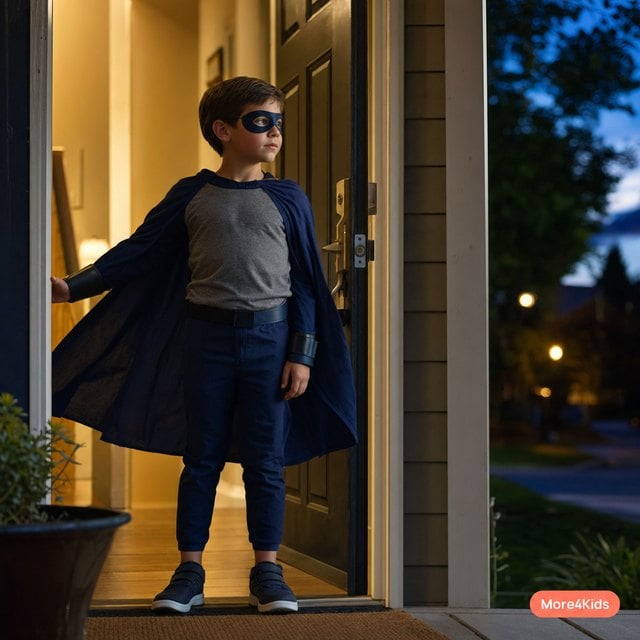
So this piece is not a list of things to buy right now. It’s the two questions I actually work through when I’m picking halloween costumes for boys: what’s genuinely popular this year, so the costume doesn’t feel like a miss at school, and what do I need to check on the physical thing itself before it ends up on a dark sidewalk with my kid inside it.
Those two questions pull in different directions more often than you’d think. The costume everyone wants is frequently the one with the worst visibility, the hottest fabric, or a headpiece that turns a boy into someone who can’t see a curb. That tension is most of what’s worth talking about.
What’s actually trending, and how we know
Table of Contents
Most lists of trending halloween costumes are really lists of what one retailer happens to have in stock. Google’s Frightgeist is a different animal: it ranks costume searches across the whole country, built on what people actually type into a search bar in October rather than on what someone wants to sell them. It’s the closest thing to a real demand signal that exists in this category.
One honest caveat before I list anything: Google refreshes Frightgeist each September, so the ranking available while I’m writing this reflects the last completed Halloween season, not a confirmed read on this one. I’d treat it as a strong directional signal and not a prediction. Costume demand is stubbornly sticky year to year — the classics barely move — but the top few slots swing with whatever show or game landed in the spring.
With that caveat sitting right where you can see it, the pattern in the boy-leaning end of the list looks like this:
- Minecraft — specifically the Chicken Jockey, which spiked hard off the movie and has stayed high
- KPop Demon Hunters characters, which dominated the overall list across genders
- Superheroes, perennially: Spider-Man, Batman, Nightwing, Superman
- Toothless from How to Train Your Dragon
- Skeletons, zombies, vampires, pirates, ninjas — the evergreen tier that never actually leaves
If your son is eight and told you he wants to be a blocky Minecraft mob, he is not being random. He is right in the middle of the curve. The useful thing to know is that the popular pick almost always has three or four versions on the shelf at very different quality levels, and the difference between them is where the actual decision lives.
As an Amazon Associate, More4Kids earns from qualifying purchases. We only recommend products we would use in our own homes, and we check every brand against current CPSC recall data before it appears here. Our recommendations are never paid placements.
Minecraft: the one that keeps showing up
The Minecraft costume is the current king of boys halloween costume ideas, and it comes in roughly two builds. One is a printed jumpsuit — soft, packable, cheap, and honestly fine. The other is the boxy foam-and-fabric build with a cube head, which looks dramatically better in a photo and behaves dramatically worse on a walk.
If you’re going for the cube head, the thing to check before you buy is the eye opening. A lot of these are a single narrow mesh slot across the front, which means your kid has no peripheral vision at all. He will not see the step down off a porch, and he will not see the car backing out of the driveway three houses up. That’s not a hypothetical — reduced visibility is one of the most consistently repeated Halloween warnings from pediatric safety groups, and a boxy costume head is the single most common way it happens.
There’s a simple test that costs nothing: have him put the head on inside the house and walk to you across a room with a chair in the way. If he clips the chair, that costume needs a plan — either the head comes off between houses, or you skip it.
If you’re browsing, kids’ Minecraft costumes on Amazon is a reasonable place to compare the jumpsuit builds against the full boxed-head sets and see how the sizing runs before you commit. Look for a wide or full-mesh front panel rather than a slot, and check whether the head is a separate piece he can carry — the ones that lift off easily get worn a lot longer than the ones that don’t.

Halloween costumes for boys: the fit checks that decide the night
Before I look at anything else, I check three measurements, and I do it with the costume flat on the floor rather than on a wriggling child.
Hem length. The hem should clear the ankle with visible daylight under it. Not “close to the ankle” — clear of it. A robe, cape, or full-body suit that pools even slightly at the foot is a trip hazard on unlit steps, and every Halloween trip-and-fall I’ve personally witnessed came from a hem. If the costume you love runs long, hem it or safety-pin it from the inside; it takes ten minutes.
Room for the layer underneath. Late October in most of the country means a costume worn over a hoodie or long sleeves. A costume that fits perfectly over a t-shirt in September is tight over a fleece in October, and tight costumes come off. Size up when you’re between sizes — a slightly loose costume is a comfortable costume, right up until the hem rule above gets violated.
Nothing long around the neck. Cape ties, hooded drawstrings, and long character scarves are the category I’m most careful about. Look for a cape that attaches with hook-and-loop tape or a plastic breakaway clip rather than a knotted ribbon. If the costume you already bought has a tie, you can cut it short and add a breakaway closure yourself in about five minutes.
And one that isn’t a measurement: check the fabric label. Children’s sleepwear has to meet a mandatory federal flammability standard, and costumes generally don’t — they’re sold as costumes, not sleepwear. In the child-product recalls we’ve tracked since February of this year, eight involved children’s sleepwear or loungewear failing that standard outright, which is a useful reminder of how thin the margin is on cheap synthetic fabric. Keep the costume away from jack-o’-lantern candles, and if you’re carving with real flames, switch to battery tea lights for the night.
Superheroes, and the mask question
Superheroes are the most durable segment of the whole category. Spider-Man in particular has held near the top of boys’ costume demand for as long as anyone has been measuring it, and it has the advantage of being instantly recognizable even in a cheap version.
The thing worth thinking through is the mask. A full-face fabric mask or a molded plastic one creates the same visibility problem as the Minecraft cube head, with the added issue that it traps heat and muffles hearing — which matters more than people expect, because hearing a car is often how a kid knows one is coming.
The alternative most families land on is face paint instead of a mask, which solves visibility completely. If you go that route, use a product actually labeled for use on skin and on the face, do a small patch test on the inside of his wrist the day before, and wash it off before bed rather than in the morning. Craft paint and tempera are not face paint, and “non-toxic” on a craft label means non-toxic if swallowed, not safe on skin.
For the costume itself, Spider-Man and superhero costumes for kids run a wide quality range — the muscle-padded suits are warmer than they look, and the thin printed suits breathe better for a long walking route. If your son is set on the full-face look, look for a two-piece where the mask is separate from the suit, so it can come off between houses without the whole costume coming apart.
If you’ve got a daughter picking a costume the same week, our Halloween costume ideas for girls covers the same decisions from that side, and the fit and visibility checks are identical.
Glow, skeletons, and being seen after dark
Here’s my favorite category, because it’s the one where the costume the kid wants and the costume I want are the same object.
Skeleton costumes are permanently in the top tier of boys’ costume demand, and the glow-in-the-dark versions do something no other popular costume does: the design itself makes the child more visible. A glowing rib cage moving down a dark sidewalk is a genuinely better safety outcome than a black ninja costume, and no negotiation is required to get him into it.
Two honest limits. Glow-in-the-dark pigment needs to be charged under a light before it works, and it fades over a couple of hours — it is a nice supplement, not a substitute for real reflective material or a flashlight. And glow is not reflective: it emits a soft light of its own but doesn’t bounce a car’s headlights back the way a reflective strip does. You want both.
If that’s the direction you’re going, glow-in-the-dark skeleton costumes for kids is the category to compare, and the printed-suit versions tend to hold their glow better than the ones with glow details on a dark base.

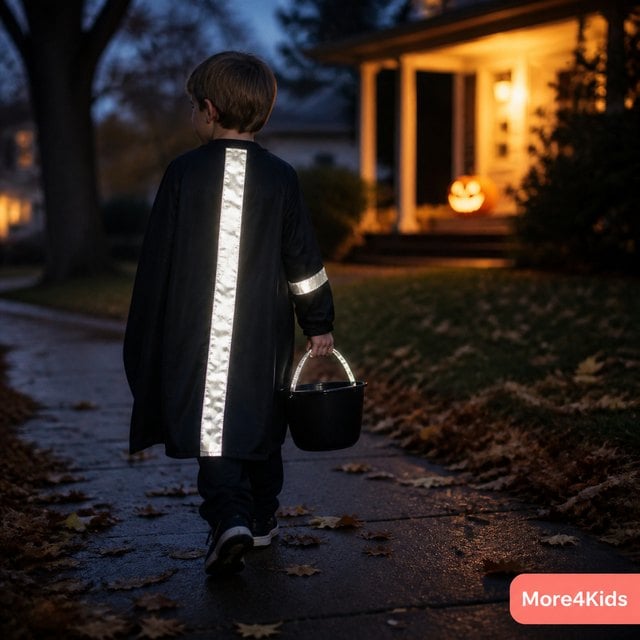
Whatever costume he ends up in, the reliable fix is reflective tape you can add yourself — a strip on the back of the costume, one on each side of the bucket, and one on the back of each shoe. It takes two minutes, costs almost nothing, and works on a black costume you had no other way to make visible.
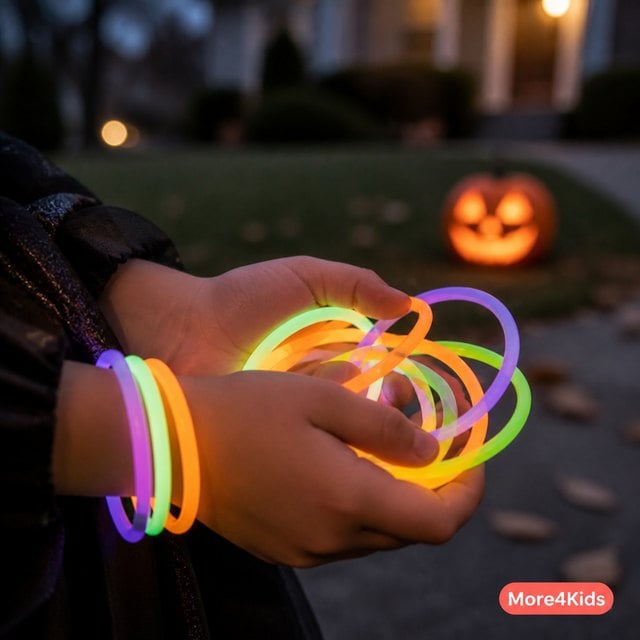
One category I’d be careful with: the light-up accessories that get marketed alongside costumes — glowing rings, finger lights, light-up wands and headbands. They solve visibility, but a large share of them run on button batteries, and a swallowed button battery can cause serious internal injury within a couple of hours. This isn’t an abstract worry. Of the 131 children’s product recalls we’ve logged in our own Recall Center since early February, 23 involved button or coin-cell batteries, and one of them was a set of Halloween light-up rings pulled in April specifically for a battery compartment that didn’t meet the mandatory safety standard. If you use light-up accessories, check that the battery compartment needs a screwdriver to open, and keep them off younger siblings entirely. We went deeper on this in our piece on light-up Halloween accessories and the button battery risk.
Dinosaurs and the inflatable question
The ride-on inflatable dinosaur is one of the highest-volume kids’ costume categories on the market, and it’s genuinely funny — a boy appearing to ride a T-rex down the street gets a reaction on every porch.
I want to be straight about what you’re signing up for, because the reviews rarely say it. The inflatable stays up because a small battery-powered fan runs continuously, which means a battery pack clipped at the waist, a constant low hum, and a costume that goes flat the moment the batteries die. The bulk is real: he will not fit through a normal doorway sideways, he can’t sit down in a car, and on a windy night the whole thing behaves like a sail. They’re also warm, because the fan is circulating air inside a sealed nylon shell around a kid who’s walking.
None of that makes it a bad choice. It makes it a good choice for a trunk-or-treat, a school parade, or a party — a stationary event with a short walk — and a rough choice for a two-hour neighborhood route in the wind. If you’re headed to a lot-based event anyway, our trunk-or-treat guide covers what those evenings actually look like.
If it’s the pick, dinosaur costumes for boys spans both the inflatable ride-ons and the much simpler soft hooded versions, and for a younger boy walking a full route the soft version is the one I’d steer toward. Pack spare batteries either way.
The classics that never actually lose
Every list of trending halloween costumes buries the fact that most kids, most years, pick from a small evergreen set: pirate, zombie, vampire, ghost, ninja, skeleton. These stay popular because they’re adjustable, they’re mostly made of clothes, and a kid can improvise the rest.
They’re also the cheapest of the boys halloween costume ideas to build from what’s already in the house, which matters if your son changes his mind on October 29th — which mine reliably does. A black hoodie and black pants get you most of the way to a ninja. A striped shirt, a sash, and a bandana get you a pirate. Our DIY Halloween costume guide walks through the closet-first versions of these if you want to skip the store entirely.
The evergreen set also tends to be the most comfortable, which is not a small consideration. If your son is particular about seams, tags, or anything tight around his face, our sensory-friendly Halloween costume ideas go through the fabric-first approach in detail, and a lot of it applies to any kid at the end of a long, overstimulating evening.
For younger boys still in the two-to-four range, the decisions shift enough that we handled them separately in our Halloween ideas for toddlers — shorter routes, no masks at all, and a much lower tolerance for anything structured.
What we’d skip
These are the halloween costumes for boys, and the costume add-ons, that I’d leave on the shelf. No links in this section, because this is the part where I’m telling you not to buy things.
- Any costume with a full rigid mask for a boy under about six. The visibility and hearing trade-off isn’t worth it at an age when he’s least likely to tell you he can’t see.
- Long trailing capes, robes, and floor-length anything. The most common Halloween injury is a fall, and the most common cause of that fall is fabric underfoot.
- Toy weapons that are rigid, pointed, or long. A soft foam prop is fine. A hard plastic sword at eye height in a crowd of moving kids is a bad combination, and plenty of schools and trunk-or-treat events ban them outright anyway.
- Small loose accessories on a costume for a young child — clip-on badges, tiny plastic figures, detachable gems. Twenty-four of the 131 recalls in our tracker were choking hazards. Use the toilet-paper-tube test: if a piece fits through the tube, it’s a choking risk for a child under three, and younger siblings will find it on the floor at 9 p.m.
- Light-up novelty items with a battery compartment that pops open by hand. Covered above, and worth repeating.
- Anything bought without checking the hem against his actual height. Costume sizing is not clothing sizing, and it is not consistent between brands.
A parent’s honest take
The costume my son remembers is never the expensive one. Two years running, the thing that made his Halloween was a detail he added himself — a hat, a prop he made out of cardboard, a decision to be the bad version of a character instead of the regular one. The store-bought base was just the foundation.
So my actual advice on halloween costumes for boys is to spend less than you think on the costume and more attention than you think on three things: that he can see, that he can be seen, and that nothing is dragging on the ground. Everything else is a preference, and preferences change on October 29th anyway.
Buy in early October rather than September if you can stand the wait. Check the hem, check the eye opening, add the reflective tape. Then let him tell everyone on the block exactly which mob he is, in detail, at every single door.
Frequently Asked Questions
What are the most popular Halloween costumes for boys?
The boys halloween costume ideas carrying the most search demand are Minecraft costumes — especially the Chicken Jockey — superheroes like Spider-Man, Batman and Nightwing, Toothless from How to Train Your Dragon, and the permanent evergreen tier of skeletons, zombies, vampires, pirates and ninjas. Google’s Frightgeist tool tracks costume search demand nationally and is the most reliable public signal, though its ranking reflects the last completed Halloween season rather than a confirmed forecast for the current one.
What should I check before buying a boys' Halloween costume?
Three things, in order: the hem clears the ankle with visible space beneath it, there’s room to wear a layer underneath for cold weather, and nothing long ties around the neck. After that, check the eye opening on any mask or costume head by having him walk across a room with an obstacle in the way — if he clips it, he can’t see enough to walk a dark street safely.
Are masks safe for kids on Halloween?
Rigid or full-face masks reduce both vision and hearing, which are the two senses a child relies on to notice a car. For younger boys especially, face paint labeled for use on skin is a safer substitute, applied after a patch test on the inside of the wrist the day before. If the costume needs a mask to work, choose a two-piece where the mask lifts off easily between houses.
How do I make a dark Halloween costume visible at night?
Add reflective tape to the back of the costume, both sides of the trick-or-treat bucket, and the back of each shoe, and give him a flashlight or clip-on light. Glow-in-the-dark costumes help but aren’t a replacement — glow emits a fading soft light and needs charging under a lamp first, while reflective material bounces a car’s headlights straight back and doesn’t wear off during the evening.
Are inflatable dinosaur costumes a good choice for trick-or-treating?
They work well for a stationary event like a trunk-or-treat, a school parade or a party, and less well for a long neighborhood route. The costume stays inflated only while a battery-powered fan runs, it’s bulky enough to be awkward in doorways and cars, it gets warm inside, and it catches wind badly. Pack spare batteries, and for a younger boy walking a full route, a soft hooded dinosaur costume is the easier version.
Related Articles
- Girl Halloween Costume Ideas
- Light Up Halloween Accessories Battery Safety
- Trunk Or Treat Ideas
- Diy Halloween Costumes
- Sensory Friendly Halloween Costumes
- Halloween Ideas For Toddlers

Meet Sophia Richards Sophia Richards is an early childhood educator, passionate writer, and the proud mom of three energetic kids. With a degree in Education and over a decade of hands-on classroom experience, Sophia bridges the gap between professional teaching strategies and everyday family life. At More4Kids, she translates complex child development concepts into practical, actionable parenting tips that families can use at home.
Whether she is sharing positive reinforcement techniques, educational crafts, or honest reflections on the chaos of raising three children under one roof, Sophia’s goal is to empower parents to foster resilience and joy in their kids. When she isn't writing or lesson planning, you can find her organizing neighborhood scavenger hunts or trying out new kid-friendly recipes.
Areas of Expertise: Early Childhood Education, Positive Parenting, Sibling Dynamics, Educational Play, Family Wellness.

Add Comment