















My middle kid found a light-up headband in the Halloween clearance bin last year — the kind with a cheap plastic gem that pulses red and blue when you press it. She wore it around the house for two days before the button on the side popped loose and I found the little silver battery sitting on the living room rug, next to a very determined one-year-old who was crawling straight for it. Nothing happened. I got there first. But it rattled me enough that I started paying attention to every light-up thing that comes into this house, and once you start looking, you cannot stop seeing them: finger lights in the party favor bags, blinking rings in the dollar-store aisle, sneakers that flash with every step.
Halloween is peak season for this stuff. Light-up Halloween accessories — glowing wands, blinking pumpkin buckets, LED headbands shaped like cat ears or devil horns, necklaces that pulse through three colors — are everywhere from late September through the trick-or-treat aisle, and they’re genuinely useful for keeping kids visible in the dark. But a lot of them run on a coin-sized lithium battery tucked behind a panel that pops open far too easily, and that single detail is behind one of the fastest-growing categories of children’s product recalls I track. This isn’t a scare piece. It’s the thing I actually check before anything blinking goes in my kids’ trick-or-treat bag, and what I’d want another parent to know before Halloween shopping starts in earnest.
As an Amazon Associate, More4Kids earns from qualifying purchases. We only recommend products we would use in our own homes, and we check every brand against current CPSC recall data before it appears here. Our recommendations are never paid placements.
Why More4Kids tracks this so closely
Table of Contents
We built a Recall Center that pulls directly from the Consumer Product Safety Commission and classifies which recalls actually involve children’s products, rather than making parents dig through a general government feed. As of this week, our database holds 131 classified children’s product recalls, and 22 of them are specifically flagged for button-cell or coin-battery ingestion hazards. Look closer at those 22, and 12 involve light-up products — LED headbands, projecting finger lights, light-up rings, light-up sneakers, light-up racket sets, luminous spinners, even a building set with a single LED piece. That’s the exact category that fills the seasonal aisle every October.
Two of those recalls are Halloween-specific and about as on-the-nose as it gets. The Gavoyeat Halloween Light-Up Rings were recalled in April 2026 because the battery compartment inside the LED ring could be opened by children, exposing the coin battery. The Coluans Christmas Light-Up Rings — sold on Amazon by a seller listed as BUDI Official — were recalled the very same day for the identical defect: a battery door that didn’t actually secure the battery. Different sellers, different listings, same failure. That’s not a coincidence; it’s a manufacturing shortcut that keeps showing up because it’s cheaper to skip a screw than to include one.
I want to be honest about the limits of this data too, because we hold ourselves to that standard. Our recall database starts on February 3, 2026, and it has ingestion gaps we’re still closing — a “no results” search doesn’t mean a product has never been recalled, and a brand not showing up in our system isn’t a clean bill of health. For anything safety-critical, we still point people to CPSC.gov’s recall search directly, and I’d encourage you to do the same before you buy anything with a battery compartment for a child under six.
What actually happens when a battery is swallowed
This is the part I didn’t understand until I started researching it, and it changed how urgently I treat a missing battery. A swallowed button or coin battery is not a choking hazard in the way a marble or a small toy part is. The danger isn’t that it blocks the airway — most of these batteries are small enough to pass through without catching. The danger is chemical and electrical, and it starts almost immediately.
When a battery gets stuck in the esophagus — which happens more easily in young children because their airway is narrower — saliva completes an electrical circuit around the battery. That circuit generates hydroxide, which is caustic. It burns through the tissue of the esophagus from the inside, and according to the safety research and advocacy behind Reese’s Law (the 2022 federal law requiring child-resistant battery compartments and warning labels, named for a toddler who died from this exact injury), that tissue damage can begin in as little as two hours. This is not a “watch and wait” injury. It’s a race against a chemical reaction that’s already underway before a child shows any symptom at all.
That’s the detail that reframes this for me as a parent. A battery is not dangerous the way a grape is dangerous. It’s dangerous the way a chemical spill is dangerous, except it’s happening inside your child’s throat, silently, while they might seem completely fine.
Why “she seems okay” doesn’t mean she’s okay
Here’s the hard part for a parent to sit with: early symptoms of a swallowed button battery are often nothing at all, or something easy to write off — a little drooling, mild coughing, reluctance to eat, something that looks exactly like a cold coming on. Emergency medicine guidance is consistent and blunt on this point: do not wait for symptoms before seeking care, and do not wait to see if the child seems fine. By the time a child is clearly in distress, the chemical burn may already be advanced.
If you know or even strongly suspect your child swallowed a button or coin battery, this is what emergency guidance from poison control and pediatric emergency groups consistently recommends:
- Go to the emergency room immediately — do not wait for symptoms, do not wait to see if it passes.
- Do not let the child eat or drink until you’ve spoken with a medical provider or poison control, unless a provider specifically instructs otherwise.
- Do not try to induce vomiting.
- Call Poison Control at 1-800-222-1222 on the way — they can advise the ER on the specific protocol for battery ingestion, which is different from other swallowed-object care.
- If you still have the toy or the packaging, bring it with you. Knowing the battery size (often stamped on the battery itself, like “CR2032”) helps the medical team assess risk faster.
I keep the Poison Control number saved in my phone under “Poison Control” so I never have to search for it with shaking hands. If you take one thing from this article and do nothing else, do that.
What a genuinely secured battery compartment looks like
Not every light-up toy is a risk — plenty of well-made ones exist. The difference is entirely in the battery door, and it’s something you can check in the store before you ever open the packaging.
A secured compartment requires a tool to open — almost always a small screw that needs an actual screwdriver, not a fingernail or a twist. It should not open with a slide, a snap, a push-and-turn you can do with your thumb, or a friction-fit panel that pops off if the toy is dropped. Every recall in our database that involves a light-up wearable describes the same underlying defect: a compartment “children can easily access” — meaning no tool required, or a screw that doesn’t actually hold once the toy has been handled or dropped a few times.
Here’s the check I actually do standing in the store aisle, in under ten seconds: I pick up the item, find the battery compartment — usually on the underside or inside a seam — and try to open it with just my fingers the way a curious toddler would. If it opens without a tool, I put it back, regardless of how cute it is or how good the price is. If I want to be thorough, I ask if there’s a display sample I can test with an actual small screwdriver (the tiny eyeglass-repair kind works). If the screw doesn’t hold snugly, or if there’s no screw at all — just tabs or a snap closure — that’s a pass on my end.

Since Reese’s Law took effect, toys sold new in the US with accessible coin batteries are supposed to carry a visible warning label and meet a child-resistant standard. But as our own recall data shows, plenty of products — especially from third-party marketplace sellers — still don’t comply, and they end up in a Halloween candy bowl or a party favor bag anyway. The label requirement helps. It is not a substitute for physically checking the compartment yourself.
Where these show up without anyone meaning them to
The products in our recall data rarely arrive in a house because a parent deliberately bought “a light-up toy with a battery.” They arrive sideways — a classroom Halloween party favor bag, a goodie bag from a birthday party, a prize bin at the dentist’s office, a $2 impulse buy at the register while you’re checking out. Finger lights and blinking rings are exactly the kind of thing that gets handed out in bulk because they’re cheap and they feel festive, and nobody in the assembly line checking party favor inventory is testing battery doors.
If your child comes home with a bag of Halloween party favors from school, it’s worth a five-minute sort before it goes in their room — the same instinct most of us already apply to sorting Halloween candy for choking hazards, just applied to the light-up stuff mixed in with it. A quick squeeze-and-check on anything that blinks costs you almost nothing and closes a real gap.
Safer light-up Halloween accessories that skip the risk entirely
The good news is you don’t have to give up the “glowing kid in the dark” look to sidestep this. A few categories are either battery-free or use batteries too large to be a swallowing risk in the first place:

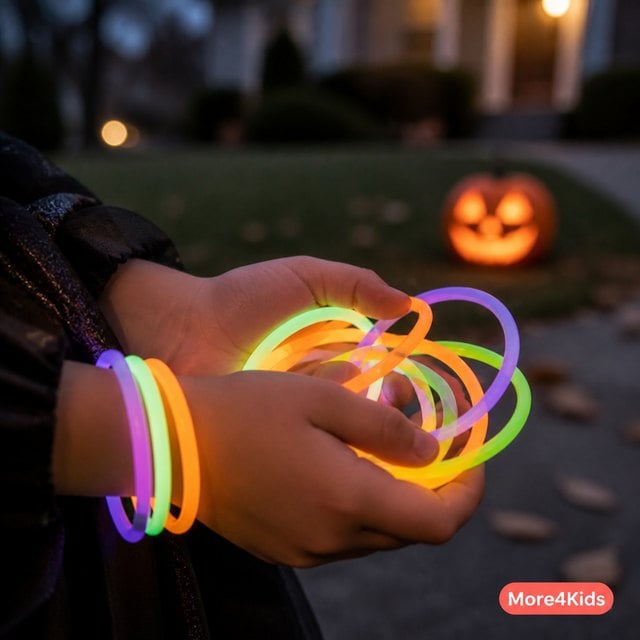
Glow sticks and glow bracelets — the snap-and-shake kind — contain no battery at all. The glow comes from a chemical reaction inside a sealed plastic tube. They’re genuinely disposable (one Halloween night, then done), which some families don’t love environmentally, but from a battery-ingestion standpoint they remove the hazard completely. One caution worth carrying with you: “glow” has become a catch-all marketing word, and battery-powered LED bracelets get sold right alongside the real chemical ones in the same bulk party packs. The tell is the same as everywhere else in this article — if it has a battery door, it isn’t a glow stick. → Browse bulk glow sticks and glow bracelets for trick-or-treating
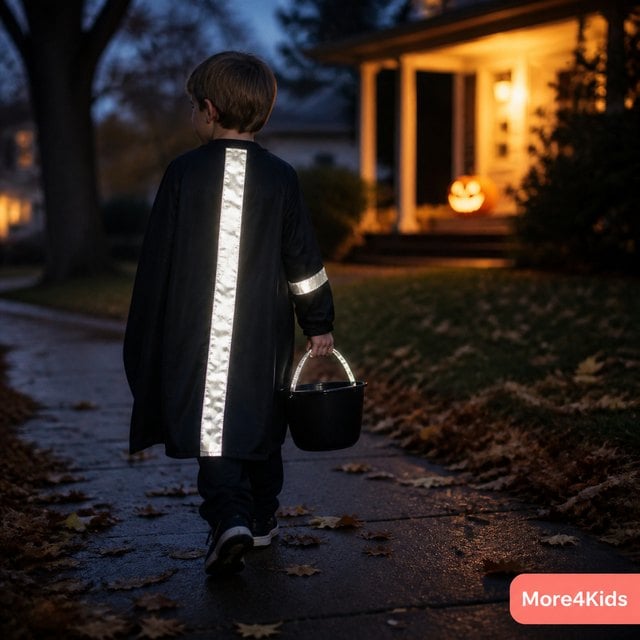
Reflective safety vests and sashes need no battery, no light, and no charging, and they do the actual job — making a kid visible to drivers — better than a blinking gadget does anyway, because the reflective strip works as long as headlights hit it, not just while a battery lasts. Worth layering over a costume regardless of what else you choose. → See reflective safety vests sized for kids
Larger battery-pack items — a proper flashlight, a lantern-style trick-or-treat bucket light, a clip-on bike-style safety light — use AA or AAA batteries in a compartment that’s simply too big to swallow, and the compartments on legitimate outdoor/sporting-goods-grade gear are built to the tool-required standard as a matter of course, not as an afterthought. If your child wants something that genuinely lights up rather than just reflects, this is the safer lane to shop in over the dollar-store novelty aisle.
None of these require giving up the fun. My kids have gone through more glow bracelets than I can count and it’s never once worried me the way the headband did.
What we’d skip entirely
This is the section with no links in it, on purpose. Some categories aren’t worth the risk assessment at all, in my opinion as a parent, regardless of price or how appealing they look on the shelf:
- Unbranded or generic-brand light-up novelty items with no manufacturer name printed anywhere on the packaging — if something goes wrong, there’s no company to trace it back to and no recall notice will ever reach you.
- Any light-up toy where the battery door is a snap-fit plastic tab rather than a screw, even if the packaging says “child safe.”
- Loose light-up rings, finger lights, or spinner-style toys handed out at events where you didn’t see the original packaging or safety labeling — you have no way to check compliance after the fact.
- Anything marketed for very young children (under 3) that lights up and isn’t from a brand you recognize and trust. At that age, everything goes in the mouth first and gets inspected second.
If in doubt, I leave it in the bin. A blinking toy is never worth an ER visit, and there are enough safer ways to get the same glowing-kid-in-the-dark effect that skipping the risky ones costs nothing.
A five-minute Halloween-week checklist
Before Halloween night, and honestly before any party-favor bag comes home this season, here’s the sort I actually run:
- Gather every light-up item — costumes, headbands, rings, buckets, wands, finger lights.
- Check each battery compartment: does it need a tool to open, or can little fingers pop it with a fingernail?
- Look for a visible battery-safety warning label (required under Reese’s Law for compliant products sold new).
- If a compartment fails the check, remove the battery yourself and either tape it shut securely or retire the item.
- Save the Poison Control number (1-800-222-1222) somewhere you’ll actually find it in a panic — a phone contact, not a scrap of paper in a drawer.
- Do a final walk-through the morning of trick-or-treating, since kids handle and drop these items all season and a compartment that was tight in September can loosen by October 31.
The bigger pattern worth knowing
Light-up Halloween accessories are just the seasonal spike of a year-round pattern. Our recall data shows the same battery-compartment defect recurring across finger lights sold on Amazon and Temu, Easter-season LED headbands, badminton and racket toy sets, building-toy sets with light-up pieces, and children’s light-up sneakers — it isn’t unique to October, it’s just concentrated then because so many light-up novelties flood the market for the holiday. The takeaway isn’t “avoid Halloween specifically.” It’s “check the battery door on anything that lights up, every time, regardless of season” — and Halloween is simply the moment most of us are buying the most of that category at once.
If you want to see what else is currently recalled — including toys well outside the light-up category — our Recall Center tracks classified CPSC recalls specific to children’s products, updated as new recalls are issued. It’s the same database behind the numbers in this article, and it’s free to search before you buy anything secondhand or unfamiliar.
For the rest of your costume prep, our guide on what to check before you buy a Halloween costume covers the other hazards worth a second look — hems, masks, and flame resistance — and if you’re dressing a toddler specifically, our low-scare costume ideas for kids under five steers around most of the light-up novelty aisle by design. Our general Halloween safety tips rounds out the rest of trick-or-treat night, from visibility to food allergies.
Frequently Asked Questions
I’m not writing this to scare anyone off Halloween — my kids will absolutely still be carrying blinking buckets and wearing something that glows this year. I just check the battery door first, every time, the same automatic way I check a costume hem for tripping hazards. Ten seconds in the store aisle is nothing. It’s worth it.

Meet Sophia Richards Sophia Richards is an early childhood educator, passionate writer, and the proud mom of three energetic kids. With a degree in Education and over a decade of hands-on classroom experience, Sophia bridges the gap between professional teaching strategies and everyday family life. At More4Kids, she translates complex child development concepts into practical, actionable parenting tips that families can use at home.
Whether she is sharing positive reinforcement techniques, educational crafts, or honest reflections on the chaos of raising three children under one roof, Sophia’s goal is to empower parents to foster resilience and joy in their kids. When she isn't writing or lesson planning, you can find her organizing neighborhood scavenger hunts or trying out new kid-friendly recipes.
Areas of Expertise: Early Childhood Education, Positive Parenting, Sibling Dynamics, Educational Play, Family Wellness.

Add Comment