













By Sophia Richards
If your child has been attached to your leg like a tiny barnacle lately, I want you to know two things before we start. First, you are not doing something wrong. Second, your clingy child is not trying to ruin your shower, your phone call, your preschool drop-off, or your one brave attempt to drink coffee while it is still warm. Clinginess is usually a child’s very loud way of saying, “I need to know you are still my safe place.”

That does not make it easy. I have had seasons with three kids where one needed me to watch every block tower, one needed help finding a missing shoe, and one suddenly could not tolerate me walking into the laundry room without a full emotional farewell. In the classroom, I saw the same pattern at drop-off: the child who sobbed on Monday often marched in proudly by Thursday once the goodbye became predictable. The need was real. The solution was not to shame it, stretch the goodbye forever, or sneak away. It was to give the child enough security to practice being brave.
A clingy child often needs a mix of connection, routine, confidence-building, and time. HealthyChildren.org, from the American Academy of Pediatrics, describes separation anxiety as a normal behavior and a sign of meaningful attachment, especially in infancy, toddlerhood, and preschool. ZERO TO THREE makes the same point for babies and toddlers: once a child understands that you can leave, it can be deeply unsettling until they learn, through experience, that you come back. That is the heart of this whole conversation. We are not trying to make children need us less by pushing them away. We are helping them feel secure enough to take the next small step.
Why a Clingy Child May Need More Security Right Now
Table of Contents
Clinginess is not one single behavior with one single cause. A clingy child might be going through a developmental stage, dealing with a new school routine, recovering from illness, feeling short on sleep, adjusting to a new baby, or simply hitting a season where the world feels bigger than their coping skills. Some children are naturally slow to warm up. Some are highly sensitive to transitions. Some are independent in the living room and completely undone at the preschool door.
That is why the first parenting move is curiosity, not correction. Instead of starting with “How do I stop this?”, start with “What is this clinging trying to tell me?” Is your child tired? Hungry? Overwhelmed by noise? Unsure what happens next? Worried you will leave without warning? Needing more connection after a busy week? I have learned, both at home and in early-childhood classrooms, that behavior makes more sense when we treat it like information. A child hanging on your body is not always defiant. Often, they are dysregulated, uncertain, or trying to borrow your calm.
ZERO TO THREE explains co-regulation as the way caregiving adults help young children manage emotions through attuned, responsive support. In plain parent language: little kids borrow our steadiness before they can find their own. That does not mean we become trapped by every tear. It means we offer comfort first, then gently practice the skill. A clingy child needs both halves: “I am here, and you are safe,” plus “I believe you can do this next little part.”
1. Fill the Connection Cup Before You Ask for Independence
One of the most helpful shifts with a clingy child is to stop treating connection and independence as opposites. They actually work together. Kids who feel full of connection are often more willing to explore. Kids who feel starved for attention often grip harder, because negative attention or desperate attention still feels better than none.
Before a hard transition, give your child a small dose of undivided attention. Ten minutes can be enough when it is truly theirs. Sit on the floor and follow their play. Read one book without checking your phone. Let them help stir the pancake batter. In my house, I have had better luck saying, “First I am all yours for one story, then I am making dinner,” than trying to peel a needy child off me while also chopping onions and answering math homework questions. Connection before separation lowers the emotional volume.
This is not a reward for clinginess. It is prevention. If mornings are rough, build in a short “connection anchor” before the rush starts: a lap cuddle, a silly handshake, one song in the car, or a two-minute porch goodbye before the bus. If bedtime is the clingy zone, start the wind-down earlier so your child does not have to escalate to get your full attention. The same steady connection that helps with emotional regulation for kids also helps a child loosen their grip without feeling pushed away.
The trick is to make the connection predictable and bounded. “I will sit with you for five minutes, then I am going to fold laundry while you build beside me.” The boundary matters because your child is learning that connection is real, and also that you can move in and out of closeness without the relationship disappearing. That is security in practice.
2. Make Goodbyes Short, Warm, and Predictable
If your clingy child melts down when you leave, the goodbye ritual matters more than most of us realize. HealthyChildren.org recommends preparation, brisk transitions, consistency, full attention before leaving, and keeping your promise to return. ZERO TO THREE adds one of my favorite no-nonsense reminders: do not sneak away. Sneaking out may avoid one hard moment for the adult, but it can make a child watch you more anxiously next time because now they know you might disappear.
A good goodbye is loving, clear, and boringly repeatable. That might sound like: “Kiss, hug, high five. I will be back after snack. Grown-ups come back.” Then you leave. Not coldly. Not angrily. Just steadily. The hard part is that the first few times, your child may still cry. That does not mean the ritual failed. It means they are practicing. If you linger, return twice, renegotiate, or let the goodbye become a twenty-minute emotional summit, your child learns that panic keeps the door open. If you leave calmly and return when you said you would, your child slowly learns the deeper truth: goodbyes feel hard, and I can handle them.
Use time words your child understands. “After lunch” means more than “at noon.” “After two sleeps” means more than “on Friday.” For a younger child, a picture schedule can help: breakfast, shoes, school, snack, parent comes back. Some families use a pocket heart, a small bracelet, or a family photo as a reminder. Keep it simple. The object is not magic. The repetition is what teaches trust.
I know this can feel brutal when your child is crying and you are trying not to cry in the parking lot. I have been that parent. The goal is not to become unmoved. The goal is to let your calm body tell your child, “This is safe. Your teacher is safe. I come back.” That message is much stronger than a worried face that says, “Maybe this is too much for you.”

3. Practice Tiny Separations When Nothing Is at Stake
If the only time your child practices separation is at school drop-off, bedtime, or when you are late for work, the skill is always tied to pressure. Practice it in tiny, ordinary ways when the emotional stakes are low. This is where a clingy child can build confidence without feeling abandoned.
Start laughably small. “I am going to put this cup in the sink. You stay here and keep building. I will be right back.” Then come back. “You waited. I came back.” Next time, step into the hallway for ten seconds. Later, let them play in the living room while you fold laundry within earshot. Then try a short visit with a trusted grandparent, neighbor, or babysitter while you run one errand. HealthyChildren.org suggests practicing being apart before child care or preschool so the goodbye ritual is familiar before the big day.
The point is not to trick your child into being independent. It is to give their nervous system a stack of evidence: I can be apart from my parent for a little while and still be safe. I can miss them and keep playing. They come back. For some kids, that stack builds quickly. For others, especially sensitive kids, it takes longer. That is not failure. That is temperament.
One classroom tool I love adapting for home is the “brave job.” Give your child one tiny job to do while you are apart: put three blocks in the basket, pick a book for when you return, feed the dog with another grown-up, draw a picture to show you. A job gives their brain something to do besides scan for you. Then when you return, name the effort: “You missed me and you stayed with Grandma. That was brave practice.” We are not praising them for not needing us. We are praising them for practicing.
4. Name the Feeling Without Letting It Drive the Whole Day
A clingy child needs their feeling named, not debated. “You feel worried that I am going upstairs.” “You want me close.” “Drop-off feels hard today.” Naming the feeling helps your child feel understood, and it gives them language for what is happening inside. ZERO TO THREE’s co-regulation guidance includes using a calm tone, staying close, breathing slowly together, and labeling feelings out loud. Those small moves are not fluff. They are how young children learn to organize big feelings.
After you name the feeling, add the boundary. “You feel worried, and I am still going to the kitchen.” “You want me to stay, and it is time for school.” “You are sad about bedtime, and I will check on you after I brush my teeth.” Both parts matter. If we only validate, the day can become child-led by anxiety. If we only enforce, the child can feel alone with the feeling. Warm limit-setting gives both safety and structure.
Try a two-sentence rhythm:
- “You wish I could stay. I always come back after snack.”
- “You want another hug. One more squeeze, then I am walking to the car.”
- “You feel nervous about the babysitter. She knows your bedtime routine, and I will see you in the morning.”
This same rhythm helps in many parenting moments, from helping kids manage big emotions to guiding a child who is learning how to listen the first time. Feelings are welcome. Feelings are not always in charge.
5. Strengthen Routines Around Sleep, Hunger, and Screens
Clinginess often spikes when a child is low on fuel. HealthyChildren.org notes that separations are harder when children are hungry, tired, or not feeling well, which any parent who has attempted a preschool drop-off after a rough night could have told us through clenched teeth. Before you assume your clingy child is regressing, look at the basics.
Sleep is the big one. A child who can manage a goodbye at 8:30 after a solid night may unravel at 8:30 after two wake-ups and a too-late bedtime. The AAP notes that separation anxiety can also disrupt sleep in young children, and any parent who has stood in a dark hallway at 2 a.m. knows how real that can feel. Keep the bedtime routine steady and connected: bath, pajamas, two books, prayer or quiet gratitude if that fits your family, lights out, one check-in. When the routine is predictable, your child does not have to keep testing what comes next.
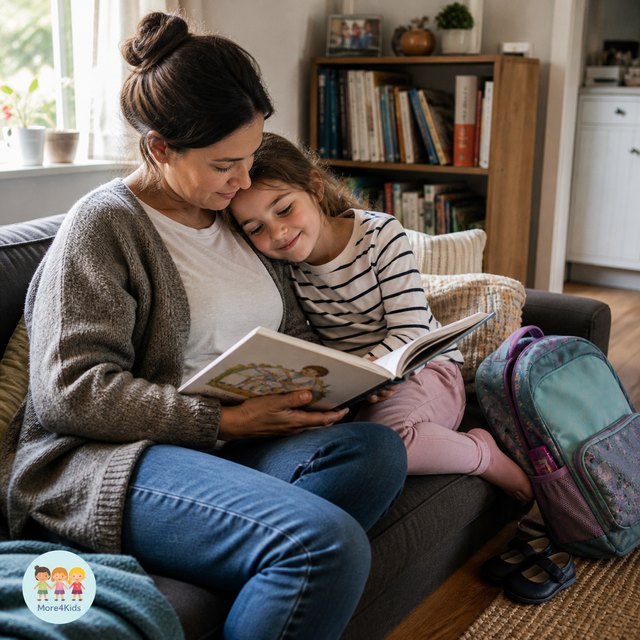
Food matters too. A protein-rich breakfast or a snack before pickup can soften the late-day cling. So can lowering the noise level after school or preschool. Some kids hold themselves together all day and then fall apart the moment they see you because you are their safe landing place. That is not misbehavior; it is release. Build in a decompression ritual before demands: water, snack, quiet music, a short walk, or ten minutes of floor play.
Screens can be tricky in clingy seasons. They may buy quiet in the moment, but fast-paced shows or endless transitions off a tablet can leave some children more dysregulated and less able to separate. If you are sorting out how much screen time is healthy, watch your own child after screens, not just during them. If clinginess reliably spikes after tablet time, tighten the boundary and offer a calmer bridge activity instead.
None of this is glamorous. It is the unshowy work of making your child’s body feel safe enough for their emotions to settle. Often, the clinginess softens when the day becomes more predictable and the child is not running on fumes.
6. Build Independence Beside You First
Sometimes we ask a clingy child to leap straight from “I need you next to me” to “Go play alone in your room,” and then we wonder why they panic. Independence grows better in steps. First beside you, then near you, then within earshot, then out of sight for a short time.
Start with side-by-side independence. Your child colors at the kitchen table while you cook. They put socks in a basket while you fold laundry. They look at books on the rug while you answer two emails. You are present, but you are not the entertainment. That distinction matters. A child can learn, “I can do my own thing while my parent does their own thing, and we are still connected.”
Then widen the circle. “You build here while I switch the laundry. I will call to you from the hallway.” Or, “You pick two stuffed animals for bedtime while I fill your water cup.” If they follow you, gently walk them back and restate the tiny job. Keep your tone ordinary. This is not a test they are failing; it is a muscle they are building.
For toddlers and preschoolers, practical independence routines can be especially powerful because they make a child feel capable. Let them carry their backpack, choose between two shirts, put napkins on the table, or flush and wash during gentle potty training routines. Capability and security feed each other. The child who thinks, “I can do things,” is often less frantic about needing a parent to do every emotional step for them.
Do not mock the clinginess while you build independence. Phrases like “You’re a big kid; stop acting like a baby” may get temporary compliance, but they do not build inner confidence. Try, “This feels hard, and you are practicing. I will help you start.” That is the voice a child can eventually borrow inside their own head.

7. Watch Your Own Anxiety at the Door
This part is tender, because it is about us. A clingy child can pull every protective instinct to the surface. We see the tears, feel the grip on our shirt, and suddenly our own face says, “I am not sure you can handle this.” Kids read that. They may not understand the words, but they read the body language.
Before a hard goodbye or an independence practice, take one slow breath and settle your own nervous system. Keep your shoulders soft. Use a confident voice. Smile at the caregiver. Say the plan once. If you need to cry, do it in the car after you leave, not while your child is trying to borrow your confidence. I say that with full sympathy. I have done parking-lot tears. They count as parenting cardio.
Also watch for the ways adult guilt can stretch clinginess. If you have been working long hours, dealing with a new baby, or navigating a family change, you may feel tempted to remove every hard feeling from your child’s path. That is love, but it can accidentally tell your child, “You are right; this is too scary.” A steadier message is, “I know this is hard. I know you can do hard things with help.”
This is where gentle parenting discipline techniques pair beautifully with clingy seasons. Gentle does not mean boundary-free. It means the boundary comes with respect, warmth, and consistency. You can be compassionate and still leave. You can comfort and still expect the child to sleep in their bed. You can hold the feeling without handing it the steering wheel.
What Not to Do With a Clingy Child
A few common moves tend to make clinginess worse even when they come from good intentions.
- Do not sneak away. It may avoid one meltdown, but it teaches your child to monitor you more closely because you might vanish.
- Do not shame the need. “You’re too old for this” or “Stop being a baby” attacks the child’s dignity and usually increases insecurity.
- Do not make every goodbye a negotiation. Long bargaining tells your child the plan is uncertain.
- Do not promise there will be no tears. Some kids cry and still cope. Tears are not proof of failure.
- Do not turn independence into rejection. “Fine, I am leaving you” may get movement, but it uses abandonment fear as pressure.
The better path is boring and loving: connect, explain, ritual, leave, return, repeat. It is slower than a trick. It also builds trust.
When Clinginess Might Need Extra Support
Most clingy seasons pass with time, routine, and steady practice. But it is wise to pay attention when clinginess becomes intense, persistent, or starts shrinking your child’s life. HealthyChildren.org suggests talking with the pediatrician if a child is not adapting to being without you, especially if separation anxiety persists on a daily basis after the preschool years. You do not need to wait until everything is unbearable to ask for guidance.
Consider checking in with your pediatrician, school counselor, or another trusted professional if your child has severe distress at most separations for weeks on end, refuses school or activities they used to enjoy, has frequent stomachaches or headaches around separation, panics when you leave the room, has sudden regression after a stressful event, or cannot sleep without major distress despite a steady routine. This is not about labeling your child. It is about getting more support and making sure nothing bigger is being missed.
It is also worth asking what has changed recently. New school? New caregiver? Move? Divorce or separation? New sibling? Illness? A scary event? Even positive changes can stir up clinginess because children feel the ground shifting and reach for the person who feels most solid. Extra support during those seasons is not indulgence. It is wise parenting.
Frequently Asked Questions
Why is my child suddenly so clingy?
A child can become clingy for many reasons: developmental separation anxiety, a new school or caregiver, illness, poor sleep, hunger, a family change, a new sibling, or a stretch of stress they do not know how to explain. Some kids are also naturally more sensitive to transitions. Start by looking for patterns. Does it happen most at drop-off, bedtime, after screen time, after busy days, or when your child is tired? The pattern usually points to the support they need.
Is a clingy child spoiled?
No. A clingy child is usually seeking security, not trying to be spoiled or controlling. Children need attachment before they can practice independence. That said, loving a child well does not mean letting clinginess run the whole household. The sweet spot is warm and firm: offer connection, name the feeling, keep the routine, and help your child practice small separations until they build confidence.
Should I leave if my child is crying at drop-off?
If your child is with a safe, trusted caregiver and you have said a clear goodbye, it is usually better to leave calmly than to keep returning and restarting the goodbye. A short, predictable ritual helps more than a long negotiation. You can say, “I love you. I will be back after snack. Grown-ups come back,” then go. It is okay if they cry. Tears mean the goodbye feels hard; they do not automatically mean the goodbye is harmful.
How can I help my clingy child play alone?
Begin with independent play near you. Let your child build, color, or look at books while you do a nearby task. Then slowly widen the space: you step into the hallway for a moment, call back, and return. Give a tiny job while you are away, such as choosing a book or feeding the dog with another adult. Praise the practice: “You missed me and you kept building. That was brave.” Keep the steps small enough that your child can succeed.
When should I worry about clinginess?
It is worth asking for help if clinginess is intense, daily, and not improving with steady routines; if your child refuses school or activities; if separations cause frequent physical complaints; if sleep becomes severely disrupted; or if the clinginess follows a stressful event and seems to be getting worse. Your pediatrician can help you sort normal developmental separation anxiety from something that needs more support.
The Bottom Line
A clingy child is not a parenting failure. They are a child asking, in the only way they may know how, for security. Our job is to answer that need without becoming trapped by it. Fill the connection cup before separations. Keep goodbyes short, warm, and predictable. Practice tiny separations when nothing big is on the line. Name the feeling and hold the boundary. Protect sleep, food, and calmer routines. Build independence beside you first. And bring your own calm to the door, because sometimes your confidence is the bridge your child walks across.
Pick one small practice this week. Maybe it is a goodbye ritual. Maybe it is ten minutes of focused connection before bedtime. Maybe it is stepping into the laundry room and coming right back, ten times, until your child starts to believe the pattern. Small repetitions are what teach the nervous system. Your child does not have to become fearless. They just need enough felt safety to try the next brave thing. For more parent-to-parent support, our parenting section is here for the ordinary, tender work of raising kids who feel secure enough to grow.
Related Articles
- Emotional Regulation For Kids
- How To Help Kids Manage Big Emotions
- How To Get Kids To Listen
- How Much Screen Time For Kids
- How To Potty Train A Toddler
- Gentle Parenting Discipline Techniques

Meet Sophia Richards Sophia Richards is an early childhood educator, passionate writer, and the proud mom of three energetic kids. With a degree in Education and over a decade of hands-on classroom experience, Sophia bridges the gap between professional teaching strategies and everyday family life. At More4Kids, she translates complex child development concepts into practical, actionable parenting tips that families can use at home.
Whether she is sharing positive reinforcement techniques, educational crafts, or honest reflections on the chaos of raising three children under one roof, Sophia’s goal is to empower parents to foster resilience and joy in their kids. When she isn't writing or lesson planning, you can find her organizing neighborhood scavenger hunts or trying out new kid-friendly recipes.
Areas of Expertise: Early Childhood Education, Positive Parenting, Sibling Dynamics, Educational Play, Family Wellness.

Add Comment