
















Last October I stood in a church parking lot at 5:40 PM with a roll of painter’s tape, a bag of foam pumpkins, and exactly nineteen minutes before cars had to be in position. My youngest was “helping,” which meant handing me the same piece of tape four times and asking if we could put the fog machine on the roof. We do not own a fog machine. I don’t know where that came from. We got the trunk decorated — crooked bunting, a string of battery lanterns, one very lopsided spiderweb — and it was, somehow, one of the best twenty minutes of my Halloween season. Nobody was cold. Nobody had to walk six blocks. And when it was over, we packed the whole thing into two bins and drove home.
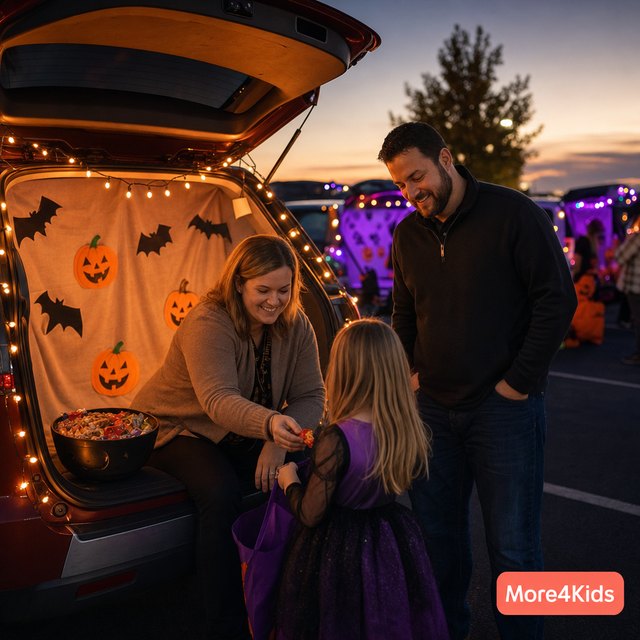
That’s the pitch for trunk-or-treat, if you haven’t done one yet: it’s Halloween with the hard parts removed. No sidewalks to navigate in the dark, no strange porches, no walking a toddler eight blocks past their bedtime for candy they can’t even chew yet. Cars line up in a lot, trunks open, kids go car to car in a contained, well-lit space, and everyone’s home by 7. It’s become the dominant version of Halloween in a lot of neighborhoods for exactly that reason — and if you’re the parent tasked with decorating a trunk for the first time, it can also feel like a whole separate project you didn’t sign up for.
It doesn’t have to be. I’ve done trunks that took twenty minutes and trunks that took two hours, and honestly the twenty-minute ones got just as many compliments. These are the trunk-or-treat ideas that have actually worked for us — decorating that doesn’t eat your whole Saturday, treats that work for the kid with allergies, lighting that’s genuinely safe instead of just genuinely charming, and the etiquette nobody tells you about until you’ve already gotten it wrong once.
What Trunk-or-Treat Actually Is, If This Is Your First One
Table of Contents
A trunk-or-treat is a group Halloween event — usually run by a school, church, neighborhood association, or local business — where cars park in a lot facing inward or in rows, open their trunks or tailgates, and decorate that space like a mini Halloween station. Kids walk between cars instead of between houses, collecting candy or small treats from each one. Some events run for an hour, some are folded into a bigger fall festival with games and a bounce house.
The appeal for parents is pretty concrete. Everything happens in one flat, lit, closed-off space instead of spread across a neighborhood with uneven sidewalks and no crosswalks. You can see your kid the entire time instead of losing sight of them between houses. It’s shorter — most events run 60 to 90 minutes, not the two-plus hours a full trick-or-treat loop can take with a toddler in tow. And for a family with a child who uses a wheelchair or has mobility differences, a flat parking lot is a genuinely easier surface than a decade of uneven porch steps.
None of this means trunk-or-treat replaces neighborhood trick-or-treating for every family — plenty of us do both, decorate a trunk on Saturday and walk the block on the actual 31st. But if you’ve only ever done the door-to-door version, it’s worth going into your first trunk event knowing it’s a genuinely different format, not a downgraded one.
Where to Park and What to Actually Check Before You Open the Trunk
This is the part that gets skipped in every “cute trunk ideas” list I’ve read, and it’s the part that actually matters. A parking lot full of strangers’ kids walking between cars is a specific hazard profile, and most of it is preventable in about two minutes before the event starts.
Turn the car off and set the parking brake. Not “in park.” Off, brake set, keys somewhere you won’t grab them by reflex. I have watched a well-meaning parent bump a gearshift while reaching for a candy bowl. Nothing happened, because the lot was flat and the brake was set — but it’s exactly the kind of near-miss that’s a five-second fix in advance and a genuine problem after the fact.
Headlights off, hazards optional, no engine running for lighting. Bright headlights pointed across a lot full of kids in dark costumes is a real visibility problem for other drivers still arriving. Battery-powered lights inside your trunk display do the job without the glare, and they don’t burn gas or exhaust into a space full of children for two hours.
Check your gap. Leave real walking room between your car and the next one — organizers usually mark this, but if they don’t, err wide. A toddler weaving between bumpers to see three trunks at once is a normal thing that happens, and you want space for it to happen safely.
Mind the trunk itself. A power liftgate that closes on a motor can genuinely catch small fingers if a kid leans in to grab candy while it’s mid-cycle. Prop it manually or disable auto-close for the event, and keep an eye on where little hands go near the hinge.
None of this is meant to make a fun, low-stakes evening sound like a safety briefing. It’s five things, they take two minutes total, and then you get to just enjoy handing out candy in a witch hat for an hour, which — I promise — is genuinely fun.
If your kid is also wearing a costume to the event, the same fit-and-visibility basics from what to check on a costume before it leaves the house apply here too — trip hazards matter just as much walking a parking lot as they do walking a sidewalk.
Decorating the Trunk Without Losing Your Whole Saturday
There are two honest paths here, and neither one is the “right” one — it’s whichever one fits the week you’re having. Both are real trunk-or-treat ideas we’ve used ourselves, not a Pinterest board neither of us is actually going to build.
Path one: buy a kit. A pre-made trunk-or-treat decorating kit — usually a fabric or cardstock backdrop that hangs across the open trunk, plus a theme’s worth of coordinated cutouts, balloons, or banners — solves the whole problem in the time it takes to unpack the box and tape a backdrop to your liftgate. This is the move if you’re doing this for the first time, if your week is already full, or if you just don’t want to think about a theme. What we’d look for: a backdrop with reinforced grommets or ties (not just tape tabs, which fail in wind), and a theme that isn’t going to feel dated if you reuse it next year — a farm, a jungle, a “friendly ghosts” theme ages better than a movie tie-in that’ll be irrelevant by next fall.
→ Trunk-or-treat car decorating kits on Amazon
Path two: build it from what you already have. This is genuinely the more fun option if you have twenty extra minutes, and it’s the one that actually gets compliments. A folded picnic blanket as a base layer. String lights from the garage (battery-powered ones, more on that below). A cardboard box theme — I’ve seen a “gas station” trunk made from two spray-painted boxes and a pool noodle “hose” that took one parent an hour and won the unofficial lot vote three years running. Kids’ old stuffed animals arranged as a “monster daycare.” The bar for a memorable trunk is much lower than Pinterest makes it look — a consistent color scheme and one good visual joke beats an expensive kit every time.

Whichever path you pick, resist stacking too much inside the trunk itself. Kids are reaching in at kid height, in a hurry, often in a costume that limits their vision. A cluttered trunk with props at knee level is a trip-and-grab hazard in a way a clean, mostly-empty trunk with a good backdrop is not. Decorate the space around the trunk — the car’s hood, the pavement in front, a folding table beside it — and keep the actual candy-reaching zone simple.
The Non-Candy Question (And Why It’s Worth Taking Seriously)
Every trunk-or-treat lot has at least one teal pumpkin these days, and if you haven’t seen the symbol yet: it means a car is offering non-food treats, signaling to families managing food allergies that this stop is safe regardless of what’s in the bowl. It started as an awareness campaign and it’s become genuinely useful shorthand at group events specifically, where a kid is moving car to car fast and a parent scanning for allergens from twenty feet away doesn’t have time to read every ingredient label.
You don’t have to go all-non-candy to participate in this — plenty of trunks do half a bowl of wrapped candy and half a bowl of stickers or small toys, which covers more kids than either option alone. What we’d look for in a non-candy bowl: stickers, small erasers, glow bracelets (below), bouncy little notebooks, mini bubbles — genuinely, kids are just as happy with a good sticker as a fun-size candy bar, and it solves the allergy problem for the whole car, not just the kids you happen to notice.
The one thing worth flagging before you buy in bulk: read the actual piece count and size on whatever novelty toy assortment you’re eyeing. Bulk party-favor bags marketed for exactly this occasion sometimes include small figurines, mini toys, or trinkets sized for an under-3 choking hazard — the toilet-paper-tube test applies here same as anywhere else in this house: if it fits through a 1.25-inch tube, it’s not appropriate for a bowl that a toddler is going to reach into unsupervised. Stick with stickers, larger erasers, and glow items over anything with small, separable pieces if your event skews toward younger siblings.
As an Amazon Associate, More4Kids earns from qualifying purchases. We only recommend products we would use in our own homes, and we check every brand against current CPSC recall data before it appears here. Our recommendations are never paid placements.
→ Non-candy Halloween treats on Amazon
Making It Glow, the Safe Way
A dusk parking lot event basically demands some kind of glow — it’s atmospheric, kids love it, and it does real safety work by making your trunk (and the kids near it) more visible in a lot full of moving cars still arriving. The easy answer is glow sticks and glow bracelets: cheap, genuinely fun, and they solve a real problem instead of just decorating one.
Two things I’d actually check before handing these out. First, the snap-and-shake glow sticks are a one-time chemical reaction inside a sealed plastic tube — they’re not a choking hazard the way a small toy is, but a cracked or bitten tube can leak the glow liquid, which isn’t dangerous in small contact amounts but does sting eyes and isn’t something a toddler should be chewing on. Supervise the littlest kids with these the same way you’d supervise any new snack-adjacent object. Second, if you’re buying battery-powered glow items instead — the little LED versions — check the battery compartment the same way you would on any light-up Halloween accessory: it should need a small screwdriver or a firm push-and-twist to open, not a snap-fit tab a curious four-year-old can pop with a thumbnail. Coin and button batteries are a genuine swallowing hazard, and we’ve written more about that specific risk if you’re buying any light-up accessory this season, not just for a trunk-or-treat bowl.

→ Glow sticks and glow bracelets for kids on Amazon
What Kids Should Bring: Buckets, Bags, and the Case Against the Pillowcase
A trunk-or-treat moves faster than door-to-door candy collecting — kids are hitting a car every fifteen to thirty seconds instead of walking between houses — which means whatever they’re carrying needs a wide-open top they can approach at a jog without slowing down, and handles that won’t cut into a small hand after forty cars’ worth of candy weight.
The classic plastic trick-or-treat bucket does this better than most alternatives — wide mouth, sturdy handle, and it stands up on its own when a kid sets it down to both hands the next thing they’re offered. A tote bag with a shoulder strap works for older kids who can manage it without dragging the bottom on pavement. What I’d steer away from for the youngest trick-or-treaters specifically: a full pillowcase, which has no rigid opening and gets surprisingly heavy and awkward for a five-year-old by the halfway point of even a short lot.
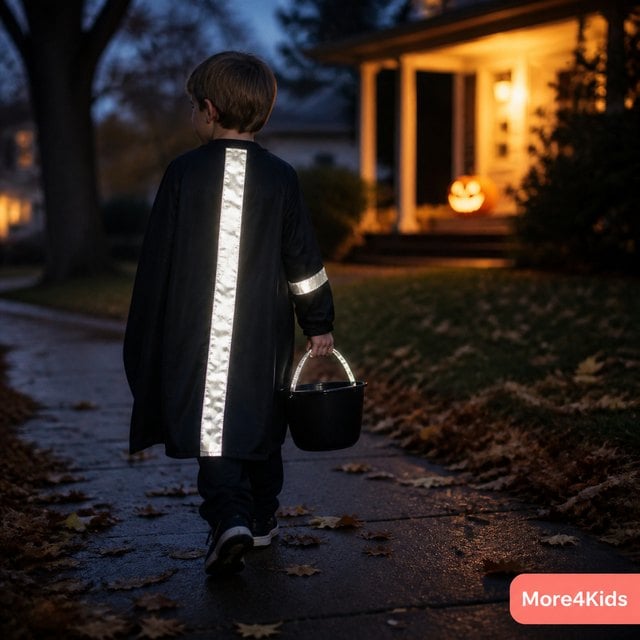
If your lot event includes a reflective element for the walk to and from parking — and it’s genuinely worth building one in even for a well-lit event, since cars are still arriving and leaving the whole time — a bucket with a built-in reflective strip or a stick-on reflective patch does double duty as both the candy container and part of your kid’s visibility gear for the walk in.
→ Trick-or-treat buckets on Amazon
Trunk-or-Treat Etiquette (What We’d Skip)
This is the deliberately link-free section, because none of it is a product problem — it’s a courtesy problem, and it’s the stuff nobody mentions until you’re standing in the lot doing it wrong.
Skip the jump scare. A parent popping out from behind the trunk in a mask is a genuinely fun bit for a nine-year-old and a genuinely upsetting one for a toddler three cars down who just heard the shriek. If your trunk has a scare element, keep it low-key and readable from a distance — kids and parents should be able to tell at a glance whether a car is the friendly-farm trunk or the haunted-house trunk before they walk up to it.
Skip the “one per kid” enforcement drama. Some cars run out of candy before the event ends, and that’s fine — a friendly “sorry, we’re out, happy Halloween!” beats rationing pieces so precisely that kids feel watched doing basic trick-or-treating.
Skip judging another car’s decorations. The twenty-minute trunk and the two-hour trunk are doing the same job. Nobody at this event benefits from a decorating arms race, and the kids genuinely do not care whether your backdrop was store-bought or a bedsheet with a face drawn on it.
Skip letting your own kids treat other families’ trunks like a photo backdrop without asking first — a lot of parents put real effort into a display and are happy to have kids pose with it, but it’s a thirty-second courtesy to ask before you plant a toddler in the middle of someone’s set piece for a picture.
If your event doubles as a bigger fall festival with games and activities on top of the trunk lineup, our roundup of Halloween party games and activities has ideas that translate well to a parking-lot setup — most just need a flat stretch of pavement instead of a backyard.
Frequently Asked Questions
What age is trunk-or-treat best for?
Genuinely all ages, but it shines hardest for toddlers and preschoolers who can’t yet manage a two-hour neighborhood walk. The short, flat, contained format means a three-year-old can participate fully instead of getting carried home halfway through.
Do I have to decorate my trunk if I’m attending?
No — most events welcome families who just want to walk through and collect candy without hosting a car. Check your specific event’s sign-up; some ask hosting cars to register in advance so there’s an accurate headcount for candy and parking.
How much candy do I need for a trunk?
Ask the organizer for an expected attendance number — most trunk-or-treat events can tell you roughly how many kids came last year. As a rough floor, plan for at least one piece per attending kid with 20-30% extra, since cars near the entrance tend to see more traffic than cars at the far end of the lot.
Is trunk-or-treat safer than traditional trick-or-treating?
It removes some risks (street crossings, unlit sidewalks, unfamiliar porches) and introduces others specific to a parking lot full of cars (backing vehicles, trip hazards near trunks). Neither format is risk-free — the car safety basics above are what actually make the difference, not the format itself.
Whatever trunk-or-treat ideas you land on this year — one trunk, a full neighborhood loop, or both on back-to-back nights — the twenty minutes you spend on the boring safety stuff up front buys you the rest of the night to just enjoy watching your kid run up to a decorated bumper in a costume they picked out themselves. That part never gets old, however many Octobers you’ve done it.

Meet Sophia Richards Sophia Richards is an early childhood educator, passionate writer, and the proud mom of three energetic kids. With a degree in Education and over a decade of hands-on classroom experience, Sophia bridges the gap between professional teaching strategies and everyday family life. At More4Kids, she translates complex child development concepts into practical, actionable parenting tips that families can use at home.
Whether she is sharing positive reinforcement techniques, educational crafts, or honest reflections on the chaos of raising three children under one roof, Sophia’s goal is to empower parents to foster resilience and joy in their kids. When she isn't writing or lesson planning, you can find her organizing neighborhood scavenger hunts or trying out new kid-friendly recipes.
Areas of Expertise: Early Childhood Education, Positive Parenting, Sibling Dynamics, Educational Play, Family Wellness.

Add Comment