













By Sophia Richards
Last October 30th, my middle one announced at bedtime that he’d changed his mind and wanted to be a black cat instead of the store costume already hanging on his door. Not a meltdown, just a flat, cheerful reversal, the kind eight-year-olds specialize in. We didn’t have a costume shop trip left in us. What we had was a black hoodie he already owned, a headband, two triangles of black felt, and a glue gun. Twenty minutes later he had ears. He wore that costume two years running.
That’s really the whole case for DIY Halloween costumes, and for closet halloween costume ideas generally: half of what’s hanging in your child’s closet right now is already most of a costume, and the gap between “regular clothes” and “costume” is usually one accessory, not an entire outfit. This isn’t a guide about elaborate sewing projects or a hot-glue-gun personality transplant. It’s about looking at what you already own with slightly different eyes, and knowing which few cheap supplies close the gap when you need them.
As an Amazon Associate, More4Kids earns from qualifying purchases. We only recommend products we would use in our own homes, and we check every brand against current CPSC recall data before it appears here. Our recommendations are never paid placements.
Why DIY Halloween Costumes Beat a Store Costume Most Years
Table of Contents
Store costumes have gotten genuinely nice looking, but they come with three problems a closet costume mostly sidesteps: cheap synthetic fabric that runs hot and scratchy, a size that’s either baggy enough to trip on or tight enough to fight, and a design built for a photo, not for three hours of actual kid movement.
A costume built from clothes your child already wears solves the fit problem automatically, because it’s their actual size in fabric they’ve already broken in. It solves the fabric problem because it’s whatever cotton or fleece they wear every day, not stiff printed polyester. And it’s genuinely faster once you know the formulas — a last-minute costume from the closet takes fifteen minutes; a last-minute costume from a crowded store on October 30th takes an evening you don’t have.
There’s also a cost angle worth naming honestly: a single licensed costume can run $30–45 and gets worn once. A few dollars in felt, tape, and face paint can outfit two or three kids in homemade halloween costume ideas that get reused for dress-up play long after Halloween is over — the same handful of supplies covers homemade halloween costume ideas for a whole sibling group, not just one kid.
The No-Sew Toolkit: What Actually Earns a Spot in the Drawer

You do not need a sewing machine, and you do not need to know how to sew, for anything in this guide. Every idea here is a no sew costume built from a small supply drawer that covers almost every homemade halloween costume idea below:
- Felt sheets in a few core colors (black, orange, white, gray) — cut into ears, patches, or simple shapes and pinned or taped on. Felt doesn’t fray at the edges, which is the whole reason it’s the standard no-sew craft fabric.
- No-sew fabric tape, a double-sided or iron-free fusible tape that bonds two pieces of fabric without a needle. It’s what turns “a cape-shaped piece of fabric” into “a cape that stays attached to a shirt.”
- Safety pins, a full-size assorted pack, for anything that needs to hold temporarily rather than permanently — a cape at the shoulders, a hem that’s too long, a patch that isn’t going anywhere important.
- Fabric scissors, kept sharp and used only on fabric, because dull scissors are what actually makes cutting felt frustrating for a kid trying to help.
- A basic ribbon or elastic, for anything that needs to tie or stretch — a belt, a headband base, a simple tail.
→ Compare no-sew fabric tape and felt fabric sheets for costume projects
Keep the safety pins in a small tin, not loose in the drawer. Loose pins are an easy thing for a toddler sibling to find on the floor, and they’re exactly the kind of small metal object that’s worth being deliberate about storing.
→ See multicolor felt fabric sheets for kids’ craft projects
DIY Halloween Costumes: Formulas That Actually Work
These aren’t specific characters so much as patterns — a base you already own plus one or two accessories that do all the transformation work. Every closet halloween costume formula below starts with clothes your child already wears, so mix and match by what’s actually in the drawer.
All-black clothes + felt ears + a tail. The most versatile formula in the book. Black leggings and a black long-sleeve shirt, felt ears on a plain headband, and a strip of black felt or fleece pinned at the waistband for a tail turns into a cat, a bat (add felt wing shapes pinned to the shoulders), or a black panther with face paint whiskers. Swap the ears for a witch hat and it’s a witch instead.
A gray or brown hoodie + ears + a tail. The same formula in a different color reads as a wolf, a fox, a mouse, or a bear, depending on the ear shape and whether you add a round pom-pom tail or a longer pointed one. A hood that already exists on the sweatshirt does most of the “animal head” work without needing an actual headpiece.
A plain white or light shirt + a role, not a costume. A white button-down with a stethoscope-shaped felt cutout and a name tag becomes a doctor. The same shirt with a black bowtie made from felt and a name tag becomes a waiter or a magician’s assistant. A collared shirt with a whistle on a short ribbon (never a long cord — more on that below) and a felt badge is a referee. These “occupation” costumes are consistently underrated: they use clothes almost every kid already owns, and the transformation is instantly readable to anyone at the door.
Pajamas they already love + one accessory. If your child has a favorite set of pajamas in a solid or simple print, a felt patch or a printed sign pinned to the front (“I’m dreaming of Halloween,” a simple ghost face, a pumpkin shape) turns “pajamas” into a costume in about two minutes, and it’s genuinely comfortable for a whole evening of walking.
A single bold color, head to toe. Dress a child entirely in one color — all orange, all green, all yellow — and they instantly read as a crayon, a jellybean, or (with a felt stem and leaf pinned at the shoulder) a piece of fruit. This is the easiest group-costume formula too: three siblings in three different bold colors is a box of crayons with zero additional pieces needed.

The Two Ideas That Sound Easy but Aren’t: Ghosts and Mummies
The classic bedsheet ghost and toilet-paper mummy get recommended constantly as the ultimate no-cost costume, and they deserve one honest caveat before you build one.
A full sheet draped over a child with eye holes cut out blocks peripheral vision almost completely, which is a real problem for a kid who’s about to be walking on uneven sidewalks and steps after dark. If your child wants a ghost, cut the sheet well above the ground (ankle length at the longest, not floor length) so it isn’t a trip hazard, and cut the eye holes generously wide rather than small and spooky-looking. A ghost costume that’s actually a poncho — a sheet with a head hole and cut sides rather than a fully draped shape — keeps the look with far better mobility and visibility. The same no-mask logic runs through our sensory-friendly costume guide, which goes deeper into why anything covering the face is worth avoiding regardless of what’s driving the discomfort.
If you’re building this for a toddler rather than a school-age kid, it’s worth reading our Halloween ideas for toddlers guide first — the mask-and-mobility rules below get even stricter at that age, and a poncho-style costume is almost always the better choice for a two- or three-year-old.
Toilet-paper “mummy” costumes look fun in photos but don’t hold up to actual walking around a neighborhood; the wrapping unravels, and kids end up trailing loose strips that catch on things. If your child wants a mummy look, strips of torn white fabric or an old white t-shirt cut into rag strips and safety-pinned onto a base layer holds together far better than paper for an evening outdoors.
Face Paint Does More Transformation Work Than Any Accessory
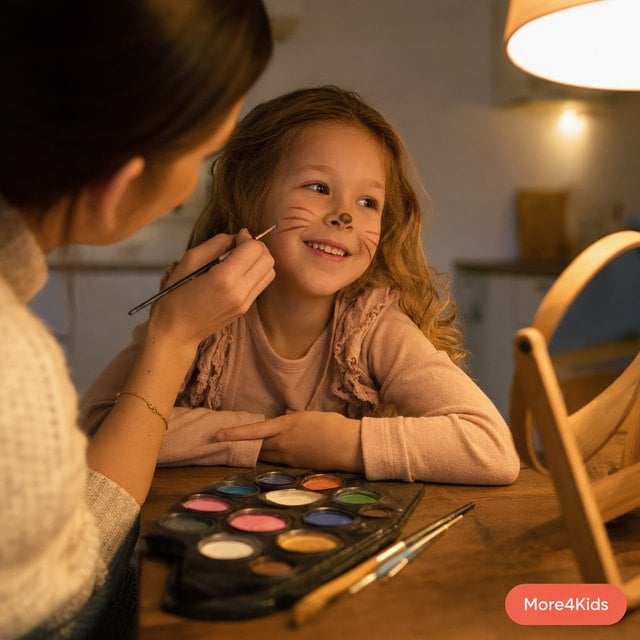
If there’s one closet-costume trick worth actually buying a supply for, it’s a basic non-toxic face paint kit. A cat costume with painted whiskers and a black nose reads completely differently than the same costume without it. A plain black outfit with white skeleton hand-prints on the front, or simple color blocking on the cheeks, does more visual work in two minutes than most accessories manage in twenty.
What we’d look for and why:
- Water-based, non-toxic, labeled specifically for face use — not craft paint, not regular kids’ tempera, which isn’t formulated for skin contact. Look for a kit that specifically markets itself as face paint.
- Patch-test it on the inside of your child’s wrist the day before, not the night of. Skin reactions show up within a few hours, and finding out on October 30th instead of the actual evening gives you time to switch to a plan B.
- Remove it before bed with a gentle cleanser, not just a wet wipe. Face paint left on overnight is a common cause of the morning-after breakout parents blame on “sensitive skin” when it’s really just leftover product in the pores.
→ Compare non-toxic kids’ face paint kits
The Safety Details That Matter More on DIY Halloween Costumes
A closet costume skips a lot of the safety problems that come pre-packaged with store costumes — no synthetic fabric that ignites easily, no plastic mask blocking a child’s vision — but a homemade halloween costume introduces a few safety details of its own worth checking before the actual night.
Hem length is a trip hazard, not just a fit issue. Anything you’re adding length to — a cape, a robe, a skirt made from a sheet — should clear the ankle with room to spare. Pin or tape a hem up rather than leaving fabric pooling at the feet, especially for anything worn on stairs or uneven sidewalks after dark.
Skip anything long and loose around the neck. A cape that ties with a long cord, a scarf-style accessory, or a costume piece with a drawstring around the collar is a strangulation risk, especially for a younger sibling who might grab at it. Use a short strip of ribbon, a snap, or hook-and-loop tape at the shoulders instead of anything that loops or ties long around the neck.
No full masks, homemade or store-bought. The same rule applies whether the mask came from a store or was cut from a paper bag: anything that narrows a child’s field of vision or muffles their hearing is a real problem for walking a dark neighborhood safely. Face paint or a simple headband accessory does the transformation without the vision cost.
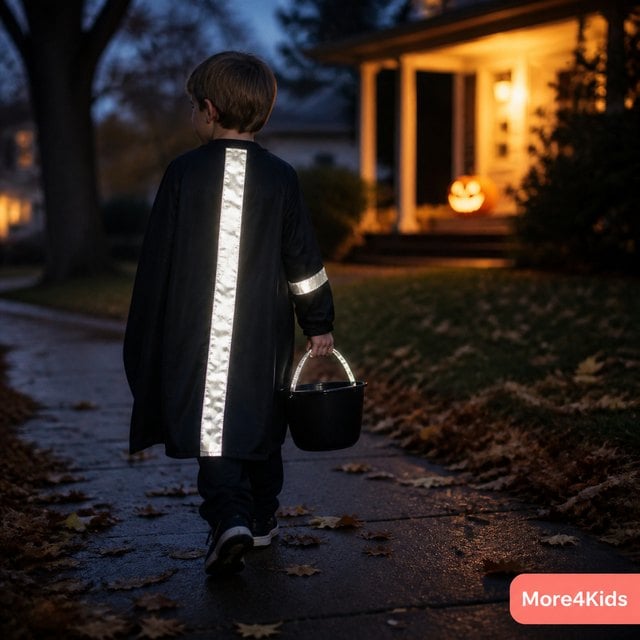
Add visibility, since a homemade costume usually doesn’t come with any. Store costumes occasionally build in a reflective trim; a closet costume almost never does. A strip of reflective tape on a trick-or-treat bucket, a sleeve, or a bag makes a real difference to drivers after dark, and it’s a five-minute add-on to any costume in this guide.
→ See reflective tape strips for adding visibility to any DIY costume
Check any small pieces against the toilet-paper-tube test. If you’re adding felt shapes, buttons, or small accessories and there’s a younger sibling in the house, anything that fits through a 1.25-inch tube is a choking risk for a child under three. Glue or tape small pieces down securely rather than using loose pins a toddler could pick up off the floor.
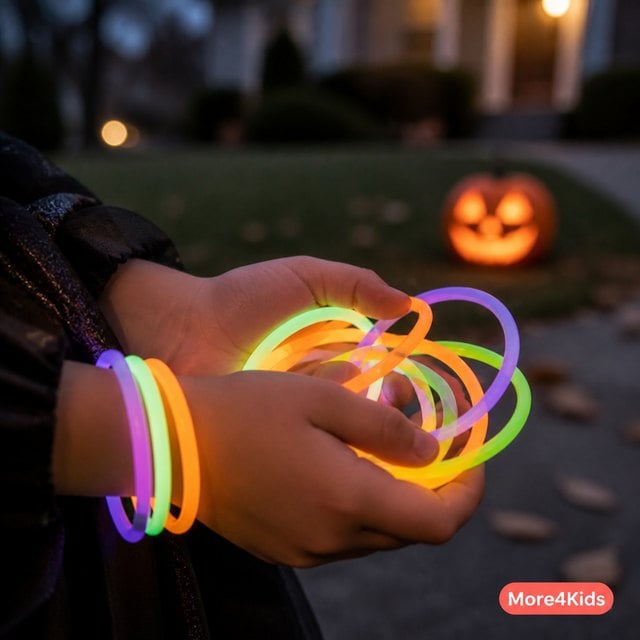
If you’re tempted to add a battery-powered light-up piece, read the fine print first. A homemade costume sometimes gets a store-bought light-up accessory clipped on for extra visibility, and that’s genuinely useful — but our light-up costume battery safety guide covers the coin-battery risk in those pieces in detail before you add one to a child’s costume. For our full walkthrough on what makes any costume, homemade or store-bought, actually safe to wear for a whole evening, see our Halloween costume safety guide.
What We’d Skip
No shopping links in this section, on purpose. A few things we wouldn’t put on a homemade costume, full stop.
Anything with a long cord or ribbon around the neck. A whistle, a mask string, a cape tie — if it loops around the neck and is longer than a few inches, use a shoulder pin or hook-and-loop closure instead.
Loose safety pins as a decorative element. Pins belong holding a seam closed on the inside of a garment, not exposed as part of the look where a younger sibling could reach them or an open pin could scratch.
Floor-length fabric on stairs or uneven ground. However good it looks standing still, hem anything that drags to ankle length before your child is walking around a dark yard in it.
A paper or plastic bag as a mask. It comes up every year as a “free costume” idea and it’s a real suffocation and vision risk. Skip it entirely — face paint or a simple headband gets the same character across.
Craft paint or regular tempera paint on skin. It isn’t formulated for skin contact the way labeled face paint is, and it’s much harder to remove cleanly at the end of the night.
Frequently Asked Questions
What's the fastest DIY Halloween costume for a last-minute idea?
All-black clothes with felt ears pinned to a headband and painted-on whiskers is close to a five-minute costume, and it reads clearly as a cat, panther, or bat depending on the ear shape. It’s the formula we reach for most often when a costume plan changes the night before.
Do I need a sewing machine for any of these ideas?
No. Every idea in this guide uses no-sew fabric tape, safety pins, or hook-and-loop closures instead of stitching. Felt in particular doesn’t fray, which is why it’s the standard material for no-sew costume accessories.
Is a bedsheet ghost costume actually safe for trick-or-treating?
With one adjustment, yes. Cut the sheet to ankle length rather than floor length so it isn’t a trip hazard, and cut the eye holes wide enough for full peripheral vision — a narrow eye slit is the real safety problem with a classic ghost costume, not the sheet itself.
How do I make a DIY costume more visible at night?
Add reflective tape to a trick-or-treat bucket, bag, or sleeve. Homemade costumes rarely include any built-in reflective element the way some store costumes do, so it’s worth adding as a five-minute step regardless of which costume formula you use.
Is face paint safe for young kids?
Water-based, non-toxic paint labeled specifically for face use is generally fine, but patch-test it on the inside of the wrist a day ahead to check for a reaction, and wash it off with a gentle cleanser before bed rather than leaving it on overnight.
One Last Thing
The best DIY Halloween costumes aren’t the ones that look the most elaborate in a photo — they’re the ones your child can actually run around a neighborhood in for three hours without fighting the fabric, tripping on a hem, or asking to take the mask off. A kid in their own hoodie with felt ears pinned on, who made it to every house on the block comfortably, had a great Halloween. That’s the whole goal, and it costs about four dollars in felt.
Related Articles
- Sensory Friendly Halloween Costumes
- Halloween Ideas For Toddlers
- Light Up Halloween Accessories Battery Safety
- Halloween Costume Safety 2026

Meet Sophia Richards Sophia Richards is an early childhood educator, passionate writer, and the proud mom of three energetic kids. With a degree in Education and over a decade of hands-on classroom experience, Sophia bridges the gap between professional teaching strategies and everyday family life. At More4Kids, she translates complex child development concepts into practical, actionable parenting tips that families can use at home.
Whether she is sharing positive reinforcement techniques, educational crafts, or honest reflections on the chaos of raising three children under one roof, Sophia’s goal is to empower parents to foster resilience and joy in their kids. When she isn't writing or lesson planning, you can find her organizing neighborhood scavenger hunts or trying out new kid-friendly recipes.
Areas of Expertise: Early Childhood Education, Positive Parenting, Sibling Dynamics, Educational Play, Family Wellness.

Add Comment