















By Sophia Richards
If you’ve seen a headline this year about a “teen homelessness crisis,” you’ve probably also seen the number that goes with it: something close to 1 in 30 teenagers experiencing homelessness. It sounds urgent, current, and precise. It’s also, as of this writing, nine to ten years old — collected in 2016 and 2017, before most of today’s high schoolers were out of elementary school. That doesn’t mean the problem isn’t real. It means the real story is more complicated, and in some ways more useful to a parent, than a single scary number.

I went looking for what the actual, current, traceable data says about teen and youth homelessness in America — not the number everyone repeats, but the ones with a year attached and a primary source behind them. What I found is a genuinely mixed picture: one measure that’s actually improving, one that’s genuinely getting worse and deserves your attention, a live federal funding fight nobody’s resolved yet, and real gaps where honestly, nobody knows the answer. If your family is untouched by this directly, it’s still worth the read, because homelessness among teens rarely looks like what you picture — and the kids living through it are more often sitting in a classroom near your own child than sleeping on a park bench.
The number that’s going down: HUD’s official count
Table of Contents

Let’s start with the number that gets cited as proof things are getting worse, because it’s actually moving the other way. Each January, HUD coordinates a single-night count of people experiencing homelessness across the country — sheltered and unsheltered — called the Point-in-Time count. The most recent one was conducted in January 2025 and the results were published May 29, 2025, in HUD’s Annual Homelessness Assessment Report.
The topline: 745,652 people were counted homeless nationwide that night, down 3.4% from January 2024 — the first national decline in homelessness since 2016. Break it down further and the youth-specific numbers look even better on paper. Unaccompanied youth and young adults under 25 numbered 35,159, down about 8% from 38,170 the year before. People in families with children came in at 230,366, down 11.2% — the single biggest driver of the overall national decline.
If that were the whole story, “teen homelessness crisis” wouldn’t be a fair headline at all. But it isn’t the whole story, for one specific and important reason: the Point-in-Time count structurally misses most homeless teenagers. It only captures people who are in an emergency shelter, transitional housing, or visibly unsheltered on one specific night in January. It does not count kids who are couch-surfing with a friend’s family, staying with a relative because there’s nowhere else to go, or otherwise “doubled up” — which, as you’ll see in the next section, is exactly where the majority of homeless teens actually are. And as of now, there’s no 2026 HUD release yet; the next Point-in-Time report likely won’t land until late 2026 or into 2027. Anyone telling you they have “2026 HUD numbers” on this is simply wrong.
The number that’s actually rising: what schools are seeing
Here’s where the honest, current, and genuinely concerning data lives. The U.S. Department of Education, through its National Center for Homeless Education, tracks how many students public schools identify as homeless under federal law — a definition broader than HUD’s, because it includes kids who are doubled up, not just those in shelters or on the street. The newest release covers school year 2023–24 and was published in February 2026, which makes it genuinely the most current dataset in this entire research pass.
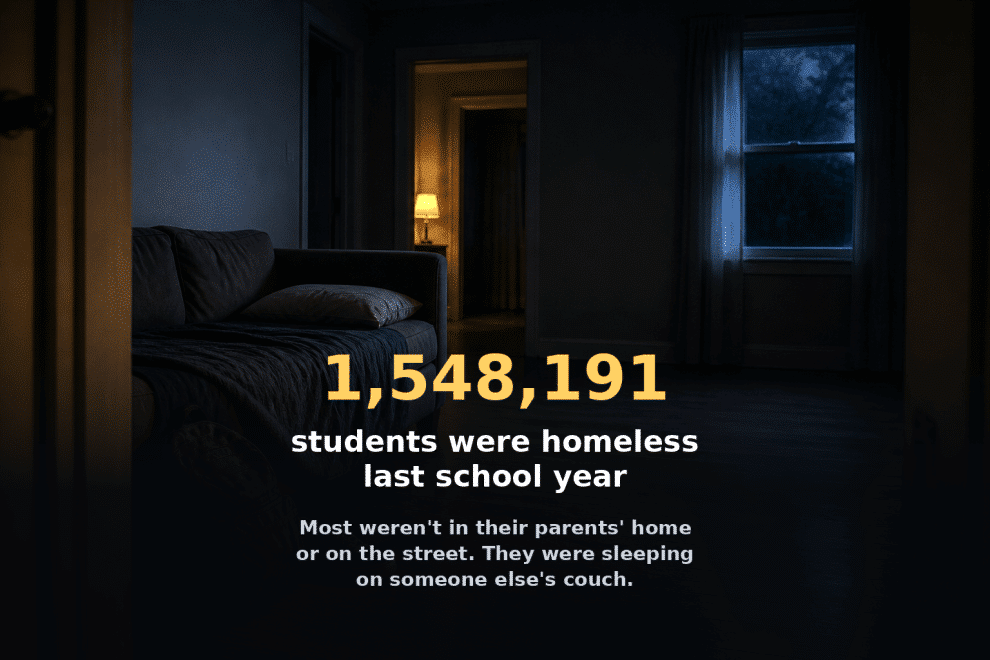
The number: 1,548,191 children and youth identified as homeless by public schools nationwide in the 2023–24 school year — an all-time high in the years this data has been tracked, and up 28.5% over the three years from school year 2021–22. Of those, 127,848 were unaccompanied homeless youth specifically, up 15.5% over that same three-year window.
Here’s the honesty check that I think matters most, and that most coverage of this topic skips: teenagers are not the fastest-growing group in this data. Pre-K children, ages three to five, grew 47.1% over the same period — more than three times the rate of growth among high schoolers. Twelfth graders had the smallest increase of any grade level tracked, at 16.0%. That doesn’t make the roughly 440,000 high-school-age kids identified as homeless any less real, or any less deserving of attention — it’s a large, verified, current number. It just means if an article (including this one) leans on “teen homelessness is exploding,” the data itself pushes back a little: it’s rising across every age group, and it’s rising fastest among the youngest kids, not teenagers.
One more detail worth sitting with: 84.5% of unaccompanied homeless youth identified by schools are “doubled up” — staying with another family, not in a shelter or visibly on the street. That’s the population HUD’s January headcount almost entirely misses, and it’s probably closer to what teen homelessness actually looks like in most communities: a kid sleeping on a friend’s couch, going to school like normal, and not showing up in any official homelessness count at all unless a teacher or counselor happens to ask the right question.

For families managing school stress even without a housing crisis in the mix, our guide on teen stress and anxiety covers how instability of any kind shows up in a teenager’s daily life and mood.
The “1 in 30” statistic: why it needs a permanent asterisk
If you’ve read anything about teen homelessness in the past several years, you’ve almost certainly seen this figure: roughly 1 in 30 teenagers ages 13 to 17, and 1 in 10 young adults ages 18 to 25, experience homelessness in a given year. It comes from Chapin Hall’s Voices of Youth Count study — a genuinely rigorous, nationally representative phone survey. It is also, as of this article, a 2016–2017 dataset. The survey was conducted in two rounds (July–September 2016 and May–July 2017), and the comprehensive report was published in 2018 and 2019.
I looked specifically for a national update or replication of this survey published anywhere near recently — through 2026 — and found none. No agency or research institution has run a comparable national prevalence study since. That means every time you see “1 in 30 teens,” someone is quoting data that predates a global pandemic, several years of housing-cost increases, and an entire generation’s worth of smartphone-driven social change, without saying so.
That’s not a reason to throw the number out. It’s a genuinely researched, credible figure — it just needs to be labeled every time it’s used: based on 2016–17 data, not a current measurement. The same caveat applies to two other frequently cited statistics from the same study: that LGBTQ+ youth face roughly 120% higher risk of homelessness than their peers, and that Black, Indigenous, and other youth of color face roughly 83% higher risk, as a group. Both are real, credible findings from real research — and both are also nine to ten years old with no independent, more recent national study behind them.
Where the research runs out: real gaps worth naming
Good research means being honest about what you don’t know, not filling the gap with a number that sounds close enough. A few things came up empty, or close to empty, in this pass:
- No Hispanic/Latino-specific risk multiplier exists in the national research literature — only the aggregate “youth of color” figure above.
- Foster care exits and homelessness: there’s strong, consistent agreement among researchers that aging out of foster care raises homelessness risk substantially, but the commonly repeated “1 in 4” or “1 in 5” figures could not be traced back to a confirmed, current primary source in this research pass.
- Juvenile justice exits: no national statistic on homelessness risk after leaving the juvenile justice system turned up at all.
- Several widely shared figures about pregnant and parenting homeless teens — including claims that “nearly half of homeless youth are parents” and that homeless family counts jumped sharply in a single year — trace back to one advocacy organization’s materials without a primary study we could independently verify. Where a family-homelessness number is needed, HUD’s own verified figure is the safer one to use: 230,366 people in families experiencing homelessness in January 2025, down 11.2% from the year before.
None of these gaps mean the underlying concerns aren’t real. They mean nobody currently has a solid, current number to point to — which is worth knowing before you repeat one anyway.
What happens to teens once they’re on their own: trafficking and exploitation
This is the part of the research that’s genuinely hard to read, and it holds up under scrutiny better than most of the headline statistics.
A study from Covenant House and Loyola University, using data collected between 2014 and 2016 and published in 2017, surveyed 641 homeless youth ages 17–25 across ten U.S. cities. 19% reported experiencing human trafficking — of those, 76% reported sex trafficking, 43% reported labor trafficking, and 18% reported both. This is one of the few numbers in this entire research set that survived direct, independent re-verification against the original peer-reviewed source without any adjustment.
A newer and considerably more troubling data point comes from a study by NYU’s Marron Institute, using data collected between 2021 and 2023 and published in 2025 — the single newest dataset used anywhere in this article. Among roughly 400 unstably housed youth in New York City, 46% disclosed experiencing trafficking, and 18% said they had traded sex for survival before turning 18.

It’s tempting to put those two numbers side by side and say trafficking risk has more than doubled. That would be a mistake, and it’s worth explaining why: these are different cities, different populations, years apart, and measured with different survey instruments. What both studies agree on, independently, is that trafficking and exploitation risk among homeless youth is real, serious, and almost certainly higher than most parents assume — even if the exact percentage isn’t directly comparable across studies.
One more honest gap: despite multiple searches, no credible, current, homeless-youth-specific national mortality statistic exists. Rather than reach for an adjacent statistic about adult homelessness (which measures something different and shouldn’t be mixed in here), the honest answer is that this particular number simply isn’t available.
The policy fight that’s actually happening right now
If there’s one part of this story that’s genuinely breaking news rather than old data with a new headline, it’s this. In June 2026, HUD proposed a major overhaul of its Continuum of Care funding — the roughly $4 billion in annual federal money that supports local homelessness services nationwide — that would have shifted funding away from permanent supportive housing and toward shorter-term “transitional” and services-only programs, while also bundling in funding for the Youth Homelessness Demonstration Program. HUD’s own framing described it as moving away from a “Housing First” approach. Advocacy organizations, including the National Alliance to End Homelessness, projected that roughly 97,000 people nationally could lose access to permanent housing support if the changes went through as proposed — though it’s important to say clearly that this is a modeled projection against a proposed rule, not a measured outcome, since the rule never actually took effect.
That’s because a federal court vacated the entire rule on August 7, 2026 — the second time in this rulemaking process that HUD has been blocked by a court, this time for skipping the legally required public notice-and-comment period. The application deadline that had been set for August 26, 2026, was eliminated, and as of the writing of this article, no new deadline has been set. HUD is reportedly considering whether to appeal.
Even though the rule didn’t survive, some of its disruption already happened: at least one provider, a homelessness services organization in Fort Worth, Texas, reportedly began converting its program model in anticipation of the rule before the court stepped in. Two things about this story remain genuinely unconfirmed as of this writing: whether youth-specific demonstration funding was actually bundled into the vacated notice in the way some reporting described, and the current status of funding and reauthorization for the Runaway and Homeless Youth Act, which multiple searches turned up nothing on at all — a real information gap, not a quiet “no news.”
What parents and communities can actually do
This is the part of the story that matters most if you’re reading this as a parent rather than a policy watcher — because none of the numbers above change what you can actually do, today, in your own family or community.

Save this number: 1-800-RUNAWAY. The National Runaway Safeline has operated for fifty years, is available 24/7, is completely free, and does not require anyone to identify themselves to get help. It exists for exactly the situations where a teen — yours, or one of their friends — needs somewhere to turn before things escalate to actual homelessness: a blowup at home, a friend who mentions they have nowhere to sleep, a teenager who’s scared to go home. You don’t need a crisis to already be underway to use it.
Know your child’s school has a legally required homeless liaison. Under the McKinney-Vento Act, every school district in the country must have a designated liaison, and any student experiencing homelessness — including doubled-up, couch-surfing situations — has the legal right to immediate enrollment, without the paperwork delays that would normally apply. In practice, funding and staffing shortages mean these liaisons are often stretched thin and can’t proactively find every family that needs them. The practical takeaway: if your family or a family you know needs this support, ask for the district’s homeless liaison by name rather than assuming the school will identify the need on its own.
Direct financial help works better than most people expect, with one caveat. A seven-state pilot program run by Point Source Youth, evaluated by researchers at Johns Hopkins, found that 92% of young people who received a one-time cash payment (averaging around $3,700) remained stably housed six months later. That’s a striking result, and it’s been reported by multiple outlets — but the sourcing traces back through the organization’s own framing of the evaluation rather than an independently located, published academic paper, so it’s fair to describe this as an org-reported, university-evaluated result rather than an independently confirmed peer-reviewed study. Even with that caveat, it points toward something practical: for a teen close to housing stability, direct financial support at the right moment can matter more than another program.
For LGBTQ+ teens specifically, family acceptance is the single biggest lever parents have. The 120% elevated risk figure cited earlier is real, even if it’s older data — and the research is consistent that family rejection, not just external circumstances, is a primary driver of LGBTQ+ youth homelessness. Family mediation and simply staying in relationship with a teen through a coming-out process is one of the most concretely protective things a parent can do — a well-established pattern, not a brand-new discovery.
If your teen is going through a rough patch — withdrawing, anxious, hard to reach — before it becomes anything close to a housing crisis, our guides on getting your teen talking and parenting teenagers and responsibility are good starting points for keeping the door open while the stakes are still low.
What teen homelessness in America actually adds up to
Here’s the honest bottom line, and it’s more useful than a single dramatic number would be. The official street-and-shelter count of homeless youth is actually falling — down 8% in a year, as of the most recent 2025 data. But that count structurally misses most homeless teens, who are overwhelmingly doubled up rather than visibly unsheltered, and the measure that actually captures that hidden population — schools identifying homeless students — genuinely is rising, up 28.5% over three years to an all-time high, even though teenagers specifically are growing more slowly within that number than younger kids. The statistic everyone quotes about 1-in-30 teens is a decade-old survey with no update in sight. And right now, there’s a real, unresolved fight in federal housing policy that could still affect how much support is available to homeless youth and families, twice blocked by courts and still unsettled.
None of that is a single dramatic headline. It’s a more complicated, more honest picture — and per the standard I set out to hold this research to, that’s not a disappointing finding. It’s the real one. If there’s one thing worth taking away and acting on, it’s this: most teen homelessness in your community isn’t visible the way you’d picture it. It’s a kid at your child’s school sleeping on someone else’s couch, still showing up to class, still easy to miss unless someone asks. Knowing the number for the National Runaway Safeline, knowing your school has a homeless liaison, and staying close enough to your own teen and their friends to notice when something’s wrong costs nothing and matters more than any statistic in this article.
Frequently Asked Questions
Is teen homelessness getting worse in the U.S.?
It depends which measure you look at, and both are true at once, which is why a single yes-or-no answer would be misleading. HUD’s official street-and-shelter count actually fell about 8% for unaccompanied youth under 25 between January 2024 and January 2025. But the U.S. Department of Education’s count of students identified as homeless by public schools — which captures the much larger “doubled up” population that HUD’s count misses — rose 28.5% over the three years through school year 2023–24, reaching an all-time high. Teenagers specifically are not the fastest-growing age group in that school data; younger children are growing faster in percentage terms.
Is it true that 1 in 30 teenagers experience homelessness?
That figure comes from a real, credible national study — Chapin Hall’s Voices of Youth Count — but the underlying survey data was collected in 2016 and 2017, and no national update or replication has been published since, as of 2026. It’s reasonable to cite as “based on 2016–17 research,” but it should not be presented as a current, up-to-date statistic.
What should I do if I think a teenager might become homeless or already is?
Contact the National Runaway Safeline at 1-800-RUNAWAY — it’s free, available 24/7, and doesn’t require identifying yourself. If the teen is in school, ask the district directly for its McKinney-Vento homeless liaison by name; federal law guarantees homeless students, including those doubled up with another family, the right to immediate school enrollment. Staying in close, nonjudgmental contact with a teen through a housing crisis — rather than treating it as something to hide — is consistently one of the most protective steps a family or community member can take.
What federal policy changes could affect homeless youth funding right now?
As of August 2026, a major HUD funding overhaul proposed in June 2026 — which would have shifted federal Continuum of Care money away from permanent housing toward shorter-term programs and bundled in youth-specific funding — was vacated by a federal court on August 7, 2026, for skipping required public notice-and-comment. No new application deadline has been set, and HUD is reportedly weighing an appeal. The outcome of this fight is genuinely unresolved.
Related Articles

Meet Sophia Richards Sophia Richards is an early childhood educator, passionate writer, and the proud mom of three energetic kids. With a degree in Education and over a decade of hands-on classroom experience, Sophia bridges the gap between professional teaching strategies and everyday family life. At More4Kids, she translates complex child development concepts into practical, actionable parenting tips that families can use at home.
Whether she is sharing positive reinforcement techniques, educational crafts, or honest reflections on the chaos of raising three children under one roof, Sophia’s goal is to empower parents to foster resilience and joy in their kids. When she isn't writing or lesson planning, you can find her organizing neighborhood scavenger hunts or trying out new kid-friendly recipes.
Areas of Expertise: Early Childhood Education, Positive Parenting, Sibling Dynamics, Educational Play, Family Wellness.

Add Comment