
















By Sophia Richards
You ask once. Nothing. You ask again, a little louder — still the back of a small head aimed at the television, like you’re not even in the room. By the third round you can hear it creeping into your own voice, that tight, climbing edge that means you’re two seconds from saying something you’ll regret. If you’ve been searching how to get kids to listen at eleven at night while the house is finally quiet, pull up a chair. I’ve stood exactly where you’re standing, and here’s the good news: most of this is fixable, and almost none of the fix involves yelling.
I’m a mom of three, and before my own kids came along I spent years in early childhood classrooms, where “everyone please line up” either works like a magic word or lands on twenty pairs of very deaf little ears. So I’ve had a lot of practice telling the difference between what actually gets kids to listen and what just makes the grown-up hoarse. Let me walk you through what’s held up, in my house and in every other one I’ve watched up close.
First, understand why your kids tune you out
Table of Contents
Before you can fix the listening, it helps to know what’s actually happening on the other end. A child who isn’t listening is almost never being defiant for sport. More often they’re deep inside their own world — that focused, faraway place kids go when they’re building, watching, or playing — and your words arrive like a radio playing in a different room. Their brains are still learning to switch attention from one thing to the next, and that switch is slow.
There’s also the plain math of it: if a kid hears “come here” forty times a day and only has to move on, say, the fifth ask, they’ve quietly learned the first four don’t count. We train that in without meaning to. The fix isn’t a louder voice — it’s an approach that respects how their attention really works. The same patient lens that helps with the contrary, “no”-to-everything stage is exactly what gets kids to listen here too.
How to get kids to listen: get close before you say a word
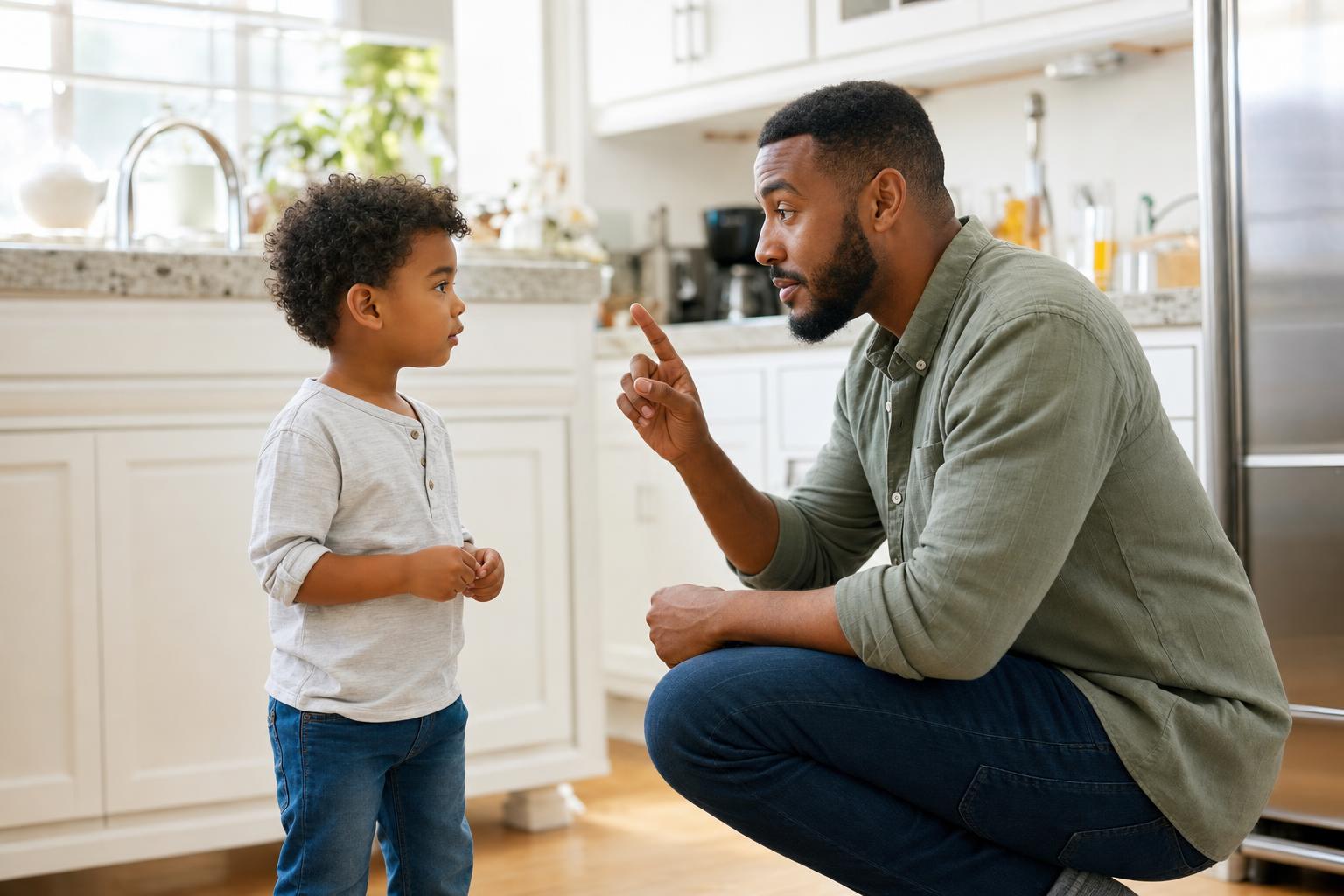
This was the single biggest change I ever made, and it’s almost embarrassingly simple. Stop talking across the room. If you want to get your kids to listen, close the distance first. Walk over, get down to their eye level, and gently get their attention — a hand on the shoulder, their name, a moment of real eye contact — before you say the thing you need them to hear.
Calling instructions from the kitchen while they’re parked in front of a screen is like texting someone whose phone is off and feeling betrayed when they don’t reply. Proximity tells a child’s brain “this is for you, right now.” It takes ten extra seconds and saves you the next four rounds of escalating. The words you choose once you’re close matter too, which is why I love this piece on the power of words in parenting — connection first, then the request.
Say it once, clearly, and keep it short
So much of what looks like not listening is really a kid who got a foggy, stacked-up instruction and quietly checked out. “Go upstairs, brush your teeth, grab your shoes, and don’t forget your water bottle” is four commands fired at a brain that can barely hold one. Then we call the freeze that follows “ignoring me.”
Give one clear instruction at a time, in plain words, and then pause to let it land. The Child Mind Institute has an excellent breakdown of effective instructions — make them specific, doable, and few. I also had to break my own habit of phrasing things as questions when they weren’t optional. “Can you put your shoes on?” invites a “no.” “It’s time to put your shoes on” doesn’t. Small shift, surprisingly big difference in how fast kids follow directions.
Drop your volume instead of raising it
I know — every instinct says go louder when you’re not being heard. But yelling teaches kids to wait for the yell. If the only volume that ever gets action is your top one, that’s the volume they’ll hold out for, and you’ve trained the whole family to run on shouting. There’s a reason yelling at kids tends to backfire: it floods everyone’s nervous system and makes the words harder to absorb, not easier.
Try the opposite. Lower your voice, slow it down, get close. A calm, quiet, serious tone often lands harder than a shout, because it signals you’re in control and you mean it. The American Academy of Pediatrics points parents the same direction in its guidance on discipline — the goal is to teach and guide calmly, never to frighten. You can be firm about the limit while staying warm with the child; those two things live together fine. And on the days your own reserves are gone, that steadiness gets harder, which is why taking care of yourself isn’t a luxury here — it’s part of the equipment.
Offer choices, then follow through
One more trick that quietly helps you get kids to listen: stop cornering them. Kids listen better when they don’t feel backed into a corner in the first place. A little control, handed back on your terms, lowers the resistance. “Do you want to hop to the bath like a bunny or tiptoe like a mouse?” still gets them to the bath — but now they’re a decision-maker instead of a prisoner. Inside the limits that genuinely matter, give them a real say.
Then — and this is the part we skip when we’re tired — follow through. If you’ve asked once, gotten close, given a clear choice, and it still doesn’t happen, calmly help it happen. Walk over and guide them through it without a lecture. Empty repeats teach kids that your words are negotiable; gentle, consistent follow-through teaches them that what you say is simply what happens. This steady, connected style is the heart of positive parenting, and it’s what makes listening stick over time.
Catch them listening and say so
If you’re still hunting for one more lever to get your kids to listen, this is it, and it feels almost too small to matter — it’s the quiet engine behind all the rest. Kids will take negative attention over no attention every single time, so if the only moment they reliably get your full focus is when they’re ignoring you, guess what they’ll keep doing. Flip it. The second they come the first time you call, notice it out loud: “You came right away — that was such a big help.” “You stopped the moment I asked. Thank you.”
It feels lopsided at first, because the rough moments are loud and the cooperative ones are easy to miss. But attention is fertilizer; whatever you shine it on grows. That’s the same principle behind the practical, research-backed strategies for cultivating better behavior — you build the listening you want by catching it, not just by correcting what you don’t.

Build routines so listening isn’t a nightly battle
Half of the not-listening in my house used to happen around transitions — the jump from playing to dinner, from screen to bath, from home to out the door. Transitions are hard for kids, and a request that interrupts something fun gets the worst reception of the day. This is where routines quietly do the work of getting kids to listen without you saying a single extra word. Predictable routines take the surprise — and a lot of the fight — out of those moments. When bath always follows dinner, you’re not issuing a fresh order every night; you’re just naming what already comes next.
A little warning helps too: “Five more minutes, then we clean up.” It gives that slow attention-switch time to catch up so the request doesn’t feel like an ambush. I’ve watched a simple daily routine do more for cooperation than any clever trick, because it turns listening from a battle of wills into something the day just does on its own.
When listening trouble might be something more
Most not-listening is ordinary, exhausting, age-appropriate kid stuff, and these calm, consistent steps will move the needle on most of it. But it’s worth keeping your eyes open. If your child genuinely seems not to hear you — not just tuning you out, but missing sounds, turning the volume up, watching faces hard to follow conversation — it’s reasonable to ask your pediatrician about a hearing check.
The same goes if the difficulty following directions shows up as more than the usual not-listening — constant across every setting, well beyond what you see in other kids the same age, or paired with a lot of frustration they can’t name. That can sometimes travel alongside attention or learning differences, and a gentle conversation with your doctor gets you support and answers, never a label to fear. Asking isn’t failing — it’s parenting with your eyes open.
Frequently Asked Questions
Why won't my kids listen to me?
Usually it isn’t defiance — it’s attention. Young children get absorbed in what they’re doing and their brains are still learning to switch focus on demand, so words called from across the room land like background noise. If they’ve also learned that the first few asks don’t really count because nothing happens until you raise your voice, they’ll wait for that. Getting close, saying it once clearly, and following through calmly fixes most of it.
How do I get my child to listen without yelling?
Lower your voice instead of raising it, and close the distance first. Walk over, get to their eye level, get their attention, then give one short, clear instruction. Yelling teaches kids to wait for the yell, while a calm, firm tone plus consistent follow-through teaches them that your normal voice is the one that means it. It feels slower at first and saves you the shouting later.
How many times should I ask my child to do something?
Ideally once — clearly, after you have their attention — and then you help it happen. Repeating an instruction ten times quietly teaches a child that your words are negotiable and the real deadline is somewhere around ask number eight. Ask once, give a beat for it to land, and if it still doesn’t happen, calmly walk over and guide them through it rather than asking again.
At what age should kids be able to follow directions?
Toddlers can usually follow a single simple instruction, and the number of steps they can hold grows with age — but even school-age kids do far better with one short direction than a long stacked list. If your child consistently struggles to follow directions well below what’s typical for their age, seems not to hear you, or it shows up in every setting, it’s worth mentioning to your pediatrician.
Does ignoring or not listening mean my child is being defiant?
Not usually. Most of the time it’s immaturity and absorbed attention, not a power play. Reading it as defiance tends to make us harsher, which raises the heat without improving the listening. Treating it as a skill that’s still developing — and supporting it with closeness, clear instructions, and routines — works far better than treating it as a battle to win.
A gentle word before you go
So how do you get kids to listen? You get close before you speak, you say it once and clearly, you drop your volume instead of raising it, you offer real choices and then follow through, you catch them listening and name it, and you lean on routines so cooperation isn’t a fresh fight every night. None of it is fancy. All of it works better than the forty-asks-and-a-shout cycle most of us fall into when we’re worn out.
Some evenings you’ll do every bit of it right and still find yourself standing in the hallway asking a small person to please, for the love of everything, put on one shoe. That’s not failure — that’s parenting a little human whose brain is still under construction. Stay close, stay calm, and trust that the patient version of you is teaching them how to listen far better than any raised voice ever could.
Related Articles
- Parenting Tips For Contrary Kids
- The Power Of Words
- Why Yelling At Kids Does Not Work
- Creating A Self Care Plan For Parents
- What Is Positive Parenting
- Cultivating Better Behavior In Children

Meet Sophia Richards Sophia Richards is an early childhood educator, passionate writer, and the proud mom of three energetic kids. With a degree in Education and over a decade of hands-on classroom experience, Sophia bridges the gap between professional teaching strategies and everyday family life. At More4Kids, she translates complex child development concepts into practical, actionable parenting tips that families can use at home.
Whether she is sharing positive reinforcement techniques, educational crafts, or honest reflections on the chaos of raising three children under one roof, Sophia’s goal is to empower parents to foster resilience and joy in their kids. When she isn't writing or lesson planning, you can find her organizing neighborhood scavenger hunts or trying out new kid-friendly recipes.
Areas of Expertise: Early Childhood Education, Positive Parenting, Sibling Dynamics, Educational Play, Family Wellness.

Add Comment