





Last Christmas my middle one tore through the paper on the biggest box under the tree, looked at what was inside for maybe four seconds, and then spent the next forty minutes building a fort out of the box itself. The gift was fine. The gift was, honestly, expensive. The box was better.
I have thought about that morning a lot while putting this list together, because it is the exact thing that goes wrong with Christmas gifts for 6 and 7 year olds. This is the age where the marketing gets loud — licensed characters, blinking screens, anything with the word ultimate in the name — and where kids are suddenly capable of so much more than the toy aisle gives them credit for. A six-year-old can follow a two-page instruction sheet. A seven-year-old can lose a board game without melting down, most days. They can read a whole chapter to themselves and then tell you about it at dinner in exhausting detail.
So the question I ask before I buy anything now is not “will they like it.” They will like almost everything for about a day. The question is: will this still be in play in February?
What actually changes between five and seven
Table of Contents
I taught this age group before I had my own, and the shift between kindergarten and second grade is one of the more dramatic ones in childhood. It is easy to miss from inside the house because it happens in small increments — but it changes what a good gift looks like.
They can follow multi-step directions now. A five-year-old needs an adult to read the build sheet. A six- or seven-year-old wants you to go away so they can do it themselves, and the doing-it-themselves is the fun part. Toys that were “too complicated” last year are suddenly the right amount of hard.
Reading opens up. Somewhere in this window most kids go from decoding words to actually reading — not fluently, not all of them, and not on the same schedule as their friends. But the door cracks open, and a book at the right level lands very differently than a book at the wrong one.
Rules start to matter enormously. Fairness becomes a moral emergency. This is why board games work now and did not work at four: they can hold the rules in their head, and they care, sometimes tearfully, whether you followed them.
They want to be good at something. Six and seven is when kids start comparing themselves to other kids and deciding what they “are” — a builder, a reader, a fast one, an artist. A gift that gives them a thing to get better at is worth more than a gift that entertains them.
None of that means the gift has to be educational, by the way. Some of the best presents at this age are just good. But the ones that stay in rotation almost always leave room for the child to bring something to them.
As an Amazon Associate, More4Kids earns from qualifying purchases. We only recommend products we would use in our own homes, and we check every brand against current CPSC recall data before it appears here. Our recommendations are never paid placements.

Building sets, because the instructions are finally the fun part
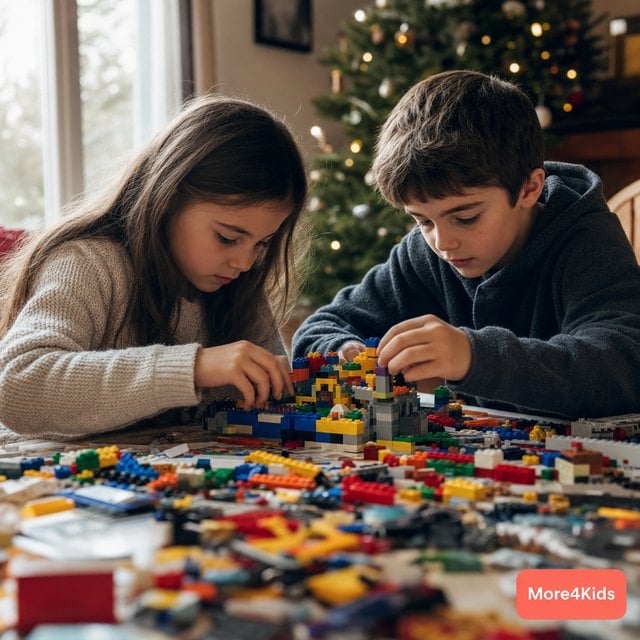
If I could only put one category under the tree for this age, it would be this one. Not a specific themed set — those get built once, admired, and then live on a shelf collecting dust until somebody knocks them over. I mean a big open box of bricks, ideally with a couple of instruction booklets in it so there is a guided on-ramp for the kid who freezes at a blank page.
Here is the thing nobody tells you: the branded kit and the generic bulk bucket end up in the same bin by March anyway. What matters is volume and compatibility. A kid with 800 mixed bricks builds every day. A kid with one 120-piece licensed set builds once.
What I look for:
- Piece count over theme. More bricks, more colors, more of the boring flat baseplates that everything gets built on top of.
- A lid that flips into a baseplate, or a storage box that is actually part of the design. This sounds like a minor feature. It is the difference between a set that gets played with and a set that gets vacuumed up.
- Compatibility with what is already in the house. If you have bricks, buy bricks that click into them. Mixing systems creates a bin of orphans.
- Wheels, doors, windows, hinges. The moving pieces are what turn a tower into a story.
→ Browse building brick sets for six- and seven-year-olds
The honest downside is that bricks colonize a house. We lost that battle for about two years before I gave up on bins entirely and switched to a rolling cart — I wrote about what finally worked for our brick storage, and I stand by it. If you are gifting a big set to a household that does not already have a system, consider gifting the storage alongside it. It is an unglamorous present that saves everyone’s feet.
One safety note that matters more at this age than people expect: if there is a younger sibling or a crawling cousin in the house, small bricks are a genuine choking risk, and a six-year-old is not a reliable containment system. Build on a table, or on a blanket that can be lifted and poured back into the box.
The first chapter book that actually hooks them
There is a specific magic in handing a newly-reading kid a book they can finish. Not a book you read to them — a book they take to their room and come back out of an hour later having read four chapters and needing to tell you all of it.
The trap is buying up. A seven-year-old who is proud of reading will absolutely tell you they want the thick novel their older cousin has, and it will sit on the nightstand accusing them until February. Chapter books that land in this window are usually short, illustrated on maybe a third of the pages, and part of a series — because the second one is the real gift.
What I look for in chapter books for this age:
- A series, not a standalone. Momentum matters more than any single title. Boxed sets of four are the format built for exactly this.
- Illustrations that continue past page ten. Pictures are not training wheels — they are how a six-year-old rests their eyes and stays in the story.
- Short chapters. A chapter that ends before the kid’s stamina does is what builds the habit.
- Something funny. Humor carries a struggling reader further than any reading-level algorithm.
- Decodable options if reading is coming slowly. There are lovely series written specifically for kids who need the phonics to stay predictable, and they do not read like workbooks.
→ See beginning chapter book sets for ages six and seven
If reading has become a nightly negotiation at your house, a book alone will not fix it — the structure around it usually needs a reset first. Our reading routine reboot is the approach I use when the whole thing has gone sour, and it works better than any book bribe I have tried.
Board games, and the very good reason to buy one now
I am going to make an unfashionable argument for board games as one of the best Christmas gifts for 6 and 7 year olds, and it is not about “quality family time,” which is a phrase that makes me tired.
It is that this is the age where a child learns to lose.
Losing is a skill. It is genuinely hard, it does not develop on its own, and a board game is the safest possible practice arena — low stakes, clear rules, an adult right there, and another round starting in ninety seconds. Every game of Sorry! where a kid gets sent home three squares from the finish and does not flip the board is a rep. My kids are not naturally good at this. They got better at it across a lot of Tuesday nights.
What makes a game work for six and seven:
- Under thirty minutes. Attention is the constraint, not intelligence.
- No reading required, or very little — otherwise the newest reader at the table is disadvantaged in a way that has nothing to do with the game.
- Real decisions. Pure-luck roll-and-move games get boring fast at this age, because they have just figured out that choices exist.
- Playable with two. Half the games in our house get played by one kid and one parent while the others are doing something else.
- Cooperative options if you have a kid who is still tender about losing — everybody-against-the-board buys you a year of practice before competitive games.
→ Compare strategy board games for ages six and up
Games are also a sneaky-good vehicle for the thinking skills schools keep asking about. Planning two moves ahead, changing tactics when a plan fails, tolerating a bad turn — those are the same muscles in our guide to teaching kids problem-solving skills, just wearing a cardboard box.
Art supplies, not a craft kit that does the thinking for them
Craft kits sell beautifully at Christmas because they photograph well and they promise a finished object. But most of them are a paint-by-numbers with extra steps: follow twelve instructions, produce the thing on the lid, done forever.
What holds up at six and seven is a genuinely well-stocked supply box — the kind where the kid decides what is being made. Pipe cleaners, real scissors, a proper roll of tape they are allowed to use without asking, construction paper, glue that actually sticks. A kid at this age will build a robot, a birthday card for someone with no birthday, and a trap for the dog. The materials are the gift.
What I look for:
- Consumables in quantity. The value is in running out and asking for more, not in a display case.
- Real tools sized for kids — scissors that cut, a stapler that works. Fake tools teach kids that making things is frustrating.
- A container with compartments. Same principle as the brick storage: findable supplies are used supplies.
- Non-toxic, and check the age label. Bulk craft boxes are full of pom-poms, beads, googly eyes and small foam shapes. Those are choking hazards for anyone under three, full stop, and this is the single most common way a wonderful gift becomes a problem in a house with a toddler.
→ Browse open-ended kids’ art and craft supply sets
If the phrase “open-ended” sounds like educational jargon, it is worth reading why unstructured play matters so much at this stage. The short version: a toy that can only be used one way gets used one way.
Something that gets them outside and slightly out of breath
Six and seven is a wonderful age for wheels. Balance is good, nerve is high, and judgment is — let us be generous — developing. A scooter is the gift my kids have collectively logged the most hours on, and the one I am most particular about.

What I check before buying:
- Weight limit and deck width. A scooter bought “to grow into” wobbles now and gets abandoned. Buy for the kid you have.
- Adjustable handlebars so it survives a growth spurt without a wobble.
- A real rear brake the child can reach and press with their own foot, not a hopeful drag-your-shoe arrangement.
- Two wheels versus three. Most six-year-olds are ready for two. A cautious kid, or one who has not ridden before, does better on three for a season.
- Helmet in the same box. Not later, not “we’ll get one” — in the box, wrapped, non-negotiable, so the first ride and the first helmet happen on the same morning.
→ Compare kick scooters sized for six- to eight-year-olds
One caution specific to this category: a lot of kids’ scooters advertise light-up wheels. Most are perfectly fine — they generate light from the motion of the wheel and contain no batteries at all. But some light-up gear does run on coin-cell batteries, and button batteries are one of the hazards that shows up over and over in the recall data we track. If it lights up and it is not motion-powered, look for a battery compartment that needs a screwdriver to open before it goes to a child.
If the weather where you are makes December wheels a cruel joke, that is fine — the gift is the promise. Wrap the helmet, wrap the scooter, and pull out our list of outdoor activities that work with kids the first mild Saturday in March.
Science kits: how to pick one that is not a single afternoon
Every science kit on the market promises a hundred experiments. Most deliver about six good ones and then a lot of “observe the results and discuss.” That is not a scam exactly — but it is worth knowing before you buy.
The kits that hold up at six and seven are the ones where the experiments are repeatable with kitchen refills. A volcano you can only erupt once is a toy. A volcano you can erupt every time there is baking soda in the house is a hobby.
What I look for:
- Refillable with pantry staples — baking soda, vinegar, food coloring, salt. This is the whole ballgame.
- Real tools in the box: goggles, a beaker, a pipette. Kids take science more seriously when the equipment does.
- Age labeling that matches your kid, not the kid you are hoping for. Many of the good chemistry sets are honestly labeled 8+ and mean it.
- Adult-supervision-required steps flagged clearly, so you know what you are signing up for on a Sunday.
→ See science and STEM kits for ages six to eight
The six-point safety pass before anything goes under the tree
We run the Recall Center at More4Kids, which means I read children’s product recalls as a job, and it has permanently changed how I shop in December. Before anything on this list — or anything else you are buying this year — gets wrapped, it goes through the same six checks:
- The toilet-paper-tube test. If a piece fits through a cardboard tube, it is a choking hazard for a child under three. Six-year-olds are past that risk themselves; their younger siblings are not, and a bulk craft box or a bin of small bricks lives in the same house as everyone.
- Button batteries. If it lights up, beeps, or sings, find the battery door. It should require a screwdriver. Coin-cell batteries cause severe internal burns within hours of being swallowed, and light-up wearables are the single most recurring category in the recalls we track.
- Loose magnets. High-powered magnets are a surgical emergency when two are swallowed — they attract through intestinal walls. A magnetic building set recalled in 2026 sent two children to surgery. Check that magnets are sealed inside pieces too large to swallow, and check the set for cracked or shedding pieces every few months, not just on day one.
- Cords, ribbons and drawstrings. Anything long enough to go around a neck. This includes gift ribbon, which is why I clear the wrapping debris before the toddler-height wandering starts.
- Tip-over risk. Tall, light, climbable things — easels, play structures, tall shelves for the new supplies. If it will be climbed, and it will, anchor it.
- Volume. Hold the toy where a child holds it, which is right against their ear, not at arm’s length. Some toys marketed to this age are genuinely too loud at that distance.
One honest caveat, because I would rather say it than have you rely on us: our recall database is thorough but it is not complete, and a brand not appearing in it is not proof of anything. For anything safety-critical, search the product at cpsc.gov directly before you buy. It takes about thirty seconds. There is also a good general refresher on keeping the holidays safe when there are younger children in the house, which is most of us.
What we would skip
This section has no links in it on purpose. These are the categories I have bought, regretted, and would not buy again for a six- or seven-year-old.
Single-purpose electronic “learning” toys. The tablet-shaped thing that quizzes them on spelling. It has exactly one right answer to every interaction, which means the child is being tested, not playing. They are also the toys most reliably abandoned by January in our house — and the ones with the most batteries.
Blind bags and miniature collectibles. I understand the appeal; my kids understand it far better than I do. But the pieces are choking-hazard-sized, they scatter into every room, the collecting instinct is engineered rather than earned, and the actual play value after unboxing is close to zero. If your child is deep into a collecting phase, one deliberate set they choose beats six mystery bags.
Anything requiring reading fluency they do not have yet. A game with dense text cards or a kit with a paragraph of instructions per step turns a gift into a chore, and worse, into evidence that they are behind. Buy at the level they read comfortably, not the level you wish they read.
A second version of something they already have. The new one does not get played with twice as much. It gets played with the same amount, in a house with more stuff in it.
Big-ticket gifts chosen to make an impression. The four-second box moment I opened with was a lesson I paid real money for. Kids at this age are not calibrated to price. They are calibrated to whether the thing does something interesting when they touch it.
How many presents is the right number?
Fewer than you think, arranged more deliberately than you think.
The framework I keep coming back to is the four-gift rule — something they want, something they need, something to wear, something to read. Not because there is anything magic about four, but because it forces a decision about categories instead of a slow accumulation of whatever was on sale in November. If you want a fifth, make it the boring practical one: the storage cart, the helmet, the supply refill.
The other habit that has helped us more than any purchasing decision is one-in-one-out, done in the week before Christmas rather than after. Kids at six and seven are old enough to be genuinely part of that choice, and they are surprisingly reasonable about it when it is not framed as a punishment. It also makes room, literally, for the good stuff. If you are already working on that kind of ownership, it fits naturally alongside age-appropriate responsibilities at home.
Frequently asked questions
What are the best Christmas gifts for 6 and 7 year olds who already have everything?
Consumables and experiences. A kid with a full toy room does not need another object — they need art supplies that run out, a science kit that gets refilled from the pantry, a game that a person plays with them, or tickets to something. The one physical category that still lands in an overstuffed house is more bricks, because they merge into what is already there rather than competing with it.
Are board games really a good gift for a six-year-old?
Yes, with two caveats: keep it under thirty minutes, and pick something that does not require reading. Six is right at the edge where rules become interesting rather than confusing. If your child is still very tender about losing, start with a cooperative game where everyone plays against the board — it buys a year of practice before you introduce head-to-head.
Is a scooter safe for a six-year-old?
Generally yes, with a properly fitted helmet, and most six-year-olds are ready for a two-wheeled scooter. A child who has not ridden before, or who is cautious about balance, will have a better first season on three wheels. Look for a rear brake the child can operate with their own foot and a deck wide enough for their actual shoe size. Buy the helmet in the same order so the first ride is never the helmetless one.
How do I choose chapter books when my child reads below grade level?
Ignore grade level entirely and buy for comfort and interest. A book that is easy and funny builds a reader. A book that is a stretch builds avoidance. Look specifically for decodable chapter book series written for kids who need consistent phonics patterns — several are genuinely good stories, not workbooks in disguise, and they let a struggling reader finish something, which is the whole point.
What toy safety checks matter most at this age?
Button batteries and magnets, in that order, plus small parts if there is a younger sibling in the house. Any battery door on a child’s toy should need a screwdriver. Magnetic sets should have magnets fully sealed inside pieces too large to swallow, and should be re-checked for cracks periodically. And always check the specific product at cpsc.gov rather than assuming a brand’s overall reputation covers a particular item.
Should I buy a gift that is a little advanced so it lasts longer?
Rarely. Six- and seven-year-olds abandon things that are frustrating, and once a toy has been abandoned it usually stays abandoned even after they grow into it. The exception is anything adjustable — a scooter with a telescoping handlebar, an open brick set, a supply box. Buy adjustable rather than oversized.
The short version
The best Christmas gifts for 6 and 7 year olds are the ones that hand the child something to do rather than something to watch. Bricks with enough volume to build daily. A chapter book series short enough to finish. A game with real decisions and a fast next round. Supplies with no instructions on the lid. Something with wheels, and the helmet that goes with it.
Run every one of them through the six-point safety pass, check the specific product against current recall data, and then let it go. Because after all that careful thinking, there is still a decent chance the box wins. Mine did.
Merry Christmas from our house to yours — and may whatever you wrap still be in play come February.

Meet Sophia Richards Sophia Richards is an early childhood educator, passionate writer, and the proud mom of three energetic kids. With a degree in Education and over a decade of hands-on classroom experience, Sophia bridges the gap between professional teaching strategies and everyday family life. At More4Kids, she translates complex child development concepts into practical, actionable parenting tips that families can use at home.
Whether she is sharing positive reinforcement techniques, educational crafts, or honest reflections on the chaos of raising three children under one roof, Sophia’s goal is to empower parents to foster resilience and joy in their kids. When she isn't writing or lesson planning, you can find her organizing neighborhood scavenger hunts or trying out new kid-friendly recipes.
Areas of Expertise: Early Childhood Education, Positive Parenting, Sibling Dynamics, Educational Play, Family Wellness.



Add Comment