














By Sophia Richards
If you have ever watched your child melt down because a puzzle piece would not fit, or freeze the moment a friend took the swing they wanted, you already know why so many parents wonder how to teach kids problem solving skills. Our instinct in those moments is to swoop in and fix it, and honestly, sometimes that is exactly what a tired parent has the energy for. But every time we solve the problem for them, we quietly take away the practice they needed.
Here is the good news I wish someone had handed me sooner. Problem solving is not a fixed trait that some kids have and others do not. It is a skill, built the same way reading or riding a bike is built, through many small tries, a lot of support, and a little patience. A child who falls apart over a stuck zipper today can absolutely become a kid who takes a breath and works the problem next year.
As a mom of three and a former early-childhood educator, I have learned that the best teaching almost never happens in a big sit-down lesson. It happens at the kitchen counter, on the way to school, and in the middle of a squabble over the last cookie. So this guide skips the theory and walks through seven everyday practice ideas you can actually use, the ordinary moments where problem solving skills quietly take root.
Why Problem Solving Is a Skill You Build, Not a Trait Kids Are Born With
Table of Contents
Before the how, a quick word on the why, because it changes everything about how we respond in the hard moments. The mental tools behind problem solving, holding a goal in mind, weighing options, staying flexible when the first idea flops, all live under an umbrella researchers call executive function. Harvard’s Center on the Developing Child explains that executive function and self-regulation skills are not innate; children build them over years through practice and supportive relationships, the way a muscle grows with use.
The Child Mind Institute describes these same executive functions as the skills that help us plan, focus, remember instructions, and juggle more than one thing at a time, and notes they develop gradually all through childhood. That single fact takes a lot of pressure off. When your seven-year-old cannot figure out how to share a toy, they are not being difficult on purpose. They are running a brain that is still under construction, and you are the scaffolding.
So when we talk about how to teach kids problem solving skills, we are really talking about giving a child enough guided practice that, bit by bit, they can do it without us. We hold the harder parts now so they can hold them later. Every idea below is just a way to hand over a little more of the thinking, at a pace your child can handle.
1. Pause Before You Rescue
The very first skill to build is one you practice on yourself: the pause. When your child hits a wall, that beat before you jump in is where all the learning lives. If we always fix it first, our kids never get to feel the productive struggle that grows the skill.
Try this. When your child says “I can’t,” take a breath and say something calm and open, like “Hmm, that is tricky. What do you think you could try?” Then wait. The waiting is the hard part, I know. It feels like forever. But that silence is your child’s brain reaching for a strategy, and reaching is exactly the exercise.
You are not abandoning them. You are staying close, staying warm, and letting them do the reaching. In my classroom years, the children who got the most practice at solving their own problems were almost never the ones with the “easiest” personalities. They were the ones whose grownups had learned to pause a few seconds longer before stepping in.
Save your rescue for real safety or genuine overwhelm. For the everyday stuck zipper or the sibling standoff, the pause is the gift.
2. Ask Questions Instead of Handing Over Answers
Once you have paused, the next move is to become a coach with good questions rather than a vending machine of answers. When we hand kids the solution, we teach them to come to us. When we ask a guiding question, we teach them to think.
The trick is asking questions that open up the problem instead of closing it down. A few that earn their keep in our house:
- “What is the problem you are trying to solve?”
- “What have you tried so far?”
- “What is one thing you could do differently?”
- “What do you think would happen if you tried that?”
Notice that none of these give the answer. They just point the flashlight. Your child still has to do the mental work, which is the whole point of teaching problem solving skills. Keep your tone genuinely curious, not quizzing. Kids can smell a test, and a test makes them shut down instead of open up.
Some days they will land on a great idea. Some days they will look at you blankly, and that is fine too. You can offer a gentle nudge, “Would it help to look at it from the other side?” and let them take it from there.
3. Brainstorm More Than One Solution Together
A lot of kids, and plenty of adults, treat the first idea that pops up as the only idea. A powerful problem solving skill is learning that most problems have several possible answers, and that it is worth generating a few before picking one.
Make it playful. When a problem comes up, say “Let us think of three different ways we could handle this.” Then throw ideas into the ring together, even the silly ones. “We could build a taller tower. We could use the couch cushions. We could ask your brother to help.” The goal at this stage is quantity, not quality; you are teaching your child that the mind can produce options.
This is also where you gently teach that a bad-sounding idea is not a failure, it is information. “Okay, that one might not work because the cushions are too wobbly. Good thing we thought of others.” You are modeling flexible thinking, the ability to let go of one plan and reach for another, which is one of the most valuable problem solving skills a child can carry into adulthood.
Then, and this matters, let your child pick which idea to try, even if it is not the one you would have chosen. Ownership is where motivation comes from.
4. Calm the Body First, Then Solve
Here is the step parents most often skip, and it is the one that makes all the others possible. A child in the grip of big feelings cannot problem-solve, because the thinking part of the brain goes offline when the alarm bells are ringing. You cannot reason with a flooded child any more than you can read in a dark room.

So before any of the strategies above, help your child settle. PBS Kids for Parents points out how much emotions and self-awareness shape a child’s ability to handle a challenge; naming a feeling and calming the body come before any clear thinking can happen. Try naming it for them: “You are really frustrated that the tower fell. That makes sense.” Then offer a simple reset, a few slow breaths, a drink of water, a minute on the couch.
Only once the storm passes do you move into “Okay, now what could we try?” Teaching kids problem solving skills without teaching them to calm down first is like handing someone tools while the room is still on fire. Regulate, then reason. In our home, “let us get calm, then we will figure it out” became a phrase my kids eventually started saying to themselves.
5. Turn Everyday Play Into Problem-Solving Practice
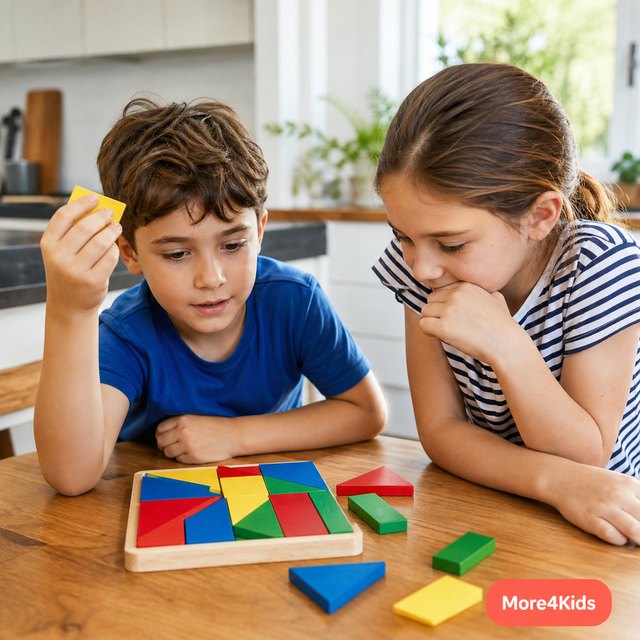
You do not need worksheets or a special program. Some of the richest problem-solving practice is already sitting in your toy bin. Puzzles, building blocks, board games, obstacle courses, and open-ended pretend play are all tiny problem-solving gyms, and the reps add up.

Blocks that keep toppling teach a child to test, fail, and adjust. A board game teaches planning ahead and handling the disappointment of a bad roll. A jigsaw puzzle is nothing but sustained problem solving with a satisfying payoff. Cooking together, “we are out of eggs, what could we use instead?”, turns a real snag into a shared puzzle. Even boredom is useful; a child with an unscheduled afternoon has to solve the problem of what to do, and that is a skill worth having.
Your job during play is light. Resist the urge to fix the wobbly tower or win the game for them. Instead, narrate and wonder aloud: “Hmm, it keeps falling on that side. I wonder what would make the bottom stronger?” That kind of thinking-out-loud shows your child how a problem-solver’s mind works. Our roundup of learning activities for preschoolers is full of low-prep play that doubles as problem-solving practice, and the whole learning section has more ideas as kids grow.

6. Let Them Try, and Let Some Attempts Flop
This is the bravest step for us parents, because it means letting our kids experience not getting it right the first time. But mistakes are not the enemy of problem solving; they are the raw material. A child who never gets to fail safely never learns that a flopped attempt is just step one of a longer process.
When your child picks a solution and it does not work, resist the two big temptations: fixing it for them, and saying “I told you so.” Instead, treat the flop as neutral, even interesting. “Well, that did not work the way we hoped. What did we learn? What could we try next?” That reframe teaches resilience and keeps the problem-solving loop going instead of ending it in shame.
This is the same muscle behind learning from mistakes, and it grows best when the stakes are low and you are warm about it. Let the block tower fall. Let the science-fair volcano fizzle. Let them forget the library book and feel the small, safe sting of a consequence. Every low-stakes flop now is a rehearsal for the higher-stakes problems coming later, and it is far kinder to practice at seven than to first stumble at seventeen.
Your steady, unbothered response is the lesson: problems are normal, mistakes are survivable, and we simply try again.
7. Reflect Afterward So the Skill Sticks
The final idea is the one that turns a single win into a lasting skill: look back once the problem is solved. Kids rarely pause to notice what they just pulled off, so a little reflection helps them realize, “Hey, I can do hard things.” That belief is the engine that keeps a child willing to tackle the next problem.
Keep it short and warm, not a debrief. After your child works through something tricky, name it: “You were really stuck on that, and you kept going until you figured it out. How did you do that?” Let them tell the story back. When a child can describe how they solved a problem, the strategy moves from a lucky accident into a tool they know they own.
You can do this reflecting anywhere, at bedtime, in the car, over dinner. “Remember when the group project felt impossible? What ended up helping?” These little look-backs are how to teach kids problem solving skills in a way that actually transfers, because your child starts to see themselves as a capable problem-solver, not a kid who needs rescuing. That identity does more heavy lifting than any single strategy.
Over time, this reflection also builds independence and ownership, the same roots behind teaching kids responsibility and steady daily routines. A child who trusts their own problem-solving is a child who needs you a little less each year, which, painful as it is, is exactly the goal.
How to Teach Kids Problem Solving Skills at Different Ages
The seven ideas above work across childhood; you just adjust the size of the problem to match the child.
- Toddlers and preschoolers: keep it concrete and playful. Puzzles, stacking, “which cup fits,” and naming feelings. You do a lot of the scaffolding out loud.
- Early elementary: start asking more questions and stepping back a little. Board games, simple chores with a snag to solve, and short brainstorms of two or three options.
- Older kids and tweens: hand over bigger, real problems, a scheduling conflict, a friendship snag, a tough homework assignment, and shift into consultant mode. Ask, reflect, and resist fixing.
The pattern is always the same: as your child’s skill grows, you say less and let them do more. That is not stepping away; it is trusting the work you have already put in.
A Gentle Word on When to Seek Support
Some struggle with problem solving is completely normal at every age, and a bad day does not mean anything is wrong. But if your child consistently finds it much harder than same-age peers to work through frustration, plan simple steps, or bounce back from small setbacks, and it is affecting daily life, it is worth a calm conversation with their teacher or pediatrician. Persistent difficulty can sometimes point to attention or executive-function needs that respond well to the right support. Asking for guidance is a sign of a tuned-in parent, not a failing one.
Frequently Asked Questions
At what age can I start teaching problem solving skills?
You can start in the toddler years, just in a very hands-on way. For little ones, teaching problem solving skills looks like simple puzzles, stacking cups, naming feelings, and lots of “let us try together.” You do most of the scaffolding out loud. As your child grows, you gradually ask more questions and step back, until by the tween years they are working through real problems with you acting as a consultant rather than a fixer.
How do I teach kids problem solving skills without just giving them the answer?
Lead with questions instead of solutions. When your child is stuck, ask things like “What have you tried?” or “What is one thing you could do differently?” and then wait long enough for them to think. Brainstorm a few options together rather than naming the one right answer, and let your child choose which idea to try. The goal is to point the flashlight, not to walk the path for them, so their brain gets the practice.
My child gives up the moment something is hard. What can I do?
Start by shrinking the problem and calming the body first, because a frustrated child cannot think clearly. Name the feeling, offer a reset like a few breaths or a drink of water, then break the task into one small next step so success feels reachable. Celebrate effort and strategy, “you kept going,” rather than just the result. Over many low-stakes tries, your child learns that being stuck is temporary and that they are capable of pushing through it.
Are there toys or games that build problem solving skills?
Plenty, and most are things you already own. Puzzles, building blocks, board games, obstacle courses, and open-ended pretend play are all excellent problem-solving practice because they require testing, adjusting, and planning ahead. Cooking together and even plain old boredom help too, since both hand your child a real problem to solve. The specific toy matters far less than letting your child do the thinking instead of stepping in to fix it.
How long does it take for problem solving skills to develop?
Years, and that is completely normal. Problem solving is an executive-function skill that builds gradually all through childhood and into the teen years, not something a child masters in a week. What you are doing with these everyday practice ideas is stacking up hundreds of small reps over time. You may not see a dramatic change month to month, but the child who gets steady, patient practice grows into a far more capable problem-solver than one who is always rescued.
The Bottom Line
Learning how to teach kids problem solving skills comes down to a quiet shift in what we do when our children get stuck: pause instead of rescue, ask instead of tell, and let them try, flop, and reflect with us cheering them on. None of it requires a curriculum. It just requires noticing the ordinary snags of daily life and treating each one as a chance to practice.
So pick one idea from this list and try it this week. Maybe it is simply pausing three seconds longer before you fix the next problem, or asking “what could you try?” instead of handing over the answer. Small, warm, repeated moments are how real skills grow. Your child will not become a master problem-solver overnight, but with your steady support, they will get there one everyday challenge at a time. For more practical, parent-to-parent guidance, our whole parenting section is here to walk it with you.
Related Articles
- Learning Activities For Preschoolers
- Learning
- Teaching Kids To Learn From Their Mistakes
- Teaching Kids Responsibility
- A Secret To Happy Kids Daily Routines
- Parenting

Meet Sophia Richards Sophia Richards is an early childhood educator, passionate writer, and the proud mom of three energetic kids. With a degree in Education and over a decade of hands-on classroom experience, Sophia bridges the gap between professional teaching strategies and everyday family life. At More4Kids, she translates complex child development concepts into practical, actionable parenting tips that families can use at home.
Whether she is sharing positive reinforcement techniques, educational crafts, or honest reflections on the chaos of raising three children under one roof, Sophia’s goal is to empower parents to foster resilience and joy in their kids. When she isn't writing or lesson planning, you can find her organizing neighborhood scavenger hunts or trying out new kid-friendly recipes.
Areas of Expertise: Early Childhood Education, Positive Parenting, Sibling Dynamics, Educational Play, Family Wellness.

Add Comment