





Somewhere around eight, my kids stopped wanting toys and started wanting gear. Not “a game,” but a specific game they’d seen a friend play at recess and could describe in exhausting detail. Not “art supplies,” but the right pencils, because the ones from two years ago were, apparently, for babies. It’s a subtle shift, and it is easy to miss if you’re still shopping the way you did when they were five.
Good Christmas gifts for 8 and 9 year olds are a genuinely fun category to shop, because kids this age have opinions and the vocabulary to defend them, but they are also still young enough that a good gift gets real, sustained use — not the four-minute interest span of a toddler, and not the eye-roll of a twelve-year-old. As an Amazon Associate, More4Kids earns from qualifying purchases. We only recommend products we would use in our own homes, and we check every brand against current CPSC recall data before it appears here. Our recommendations are never paid placements.
The question I ask before I add anything to a cart at this age is not “will they open it and smile.” They will. The question is: will they still be asking for this by name in February, or will it get buried in a bin because it was pitched at a seven-year-old and they’ve already moved past it?
What actually changes between seven and nine
Table of Contents
I’ve taught this age band and raised through it, and the shift from second grade to third and fourth grade is a real one — it just happens quietly, a little at a time, so it’s easy to keep buying an 8 and 9 year old the same category of gift you bought them at six.
Patience for a real project shows up. A build that takes an afternoon, not twenty minutes, stops being a source of frustration and starts being the point. A kid this age will walk away from a tricky step, think about it, and come back — that’s new.
Reading fluency is usually solid, and reading stamina is catching up. Most eight- and nine-year-olds can handle a real chapter book without a parent nearby, though how much they want to read on their own varies enormously kid to kid, and that’s normal, not a red flag.
Rules stop being a fight and start being the fun part. Somewhere in here, kids go from “I don’t want to lose” to “wait, let me think about my move” — which is exactly when strategy games start to click instead of ending in a flipped board.
They want to be good at something specific, not just praised in general. This is the age where “you’re so smart” starts to feel hollow and “you figured out that puzzle by yourself” lands. Gifts that let them get visibly better at a skill over weeks tend to outperform anything that’s “done” the moment it’s unwrapped.
Independence outdoors expands. Riding to the end of the block without a hand on the handlebar, trying a trick on a skateboard, being the one who reads the instructions out loud to a sibling — eight and nine is often the year a kid starts operating a little further from arm’s reach, which changes what “safe” needs to mean for outdoor gear.
Building sets that reward more patience
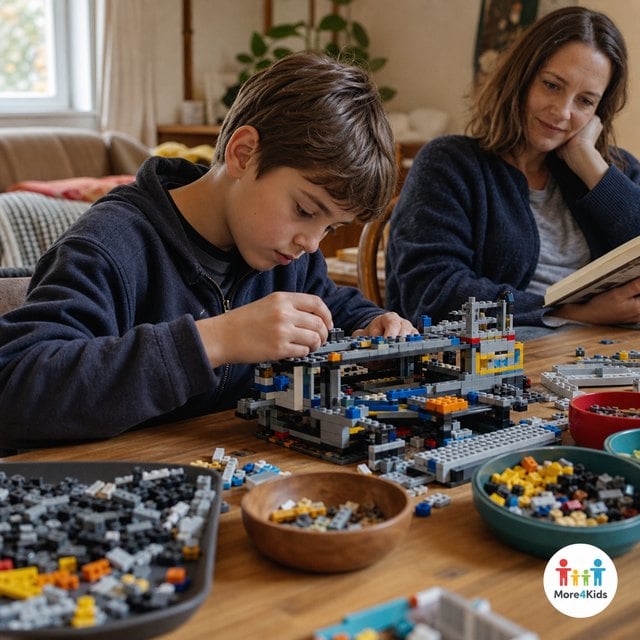
At five or six, a building set is really a parent-assisted activity with extra steps. By eight or nine, a kid can sit with an instruction booklet, work through a multi-stage build across more than one sitting, and take real pride in having done it without help. That’s the gift, more than the finished model — the sitting-with-it.
Look for sets in the 300- to 800-piece range with a genuine build arc rather than a single flat structure: something with an interior, moving parts, or a build-then-rebuild option gives more mileage than a static display piece. Bulk brick tubs are great for open-ended building, but for this age a set with an actual instruction sequence is usually the one that gets finished rather than dumped into the bin with everything else.
→ Building brick sets for kids age 8+ on Amazon
One thing worth checking before you buy for this age specifically: sets marketed at 8+ sometimes include smaller detail pieces than the classic large-brick lines aimed at younger kids. If there’s a younger sibling in the house who still mouths things, keep any loose small pieces well out of their reach between building sessions, not just during them. If storage is the actual problem in your house — bins everywhere, pieces underfoot — we’ve got a simple system for sorting and storing loose bricks that keeps a big collection usable instead of just piled up.

Chapter books that don’t feel babyish
This is the age where a book either “counts” to a kid or it doesn’t, and getting that wrong is how a genuinely good reader ends up saying they hate reading. The trick isn’t reading level — it’s whether the cover, the length, and the premise read as “for someone my age” rather than a hand-me-down from a younger sibling’s shelf.
Series fiction does a lot of work here because it removes the risk: if book one lands, there are eleven more waiting, and a kid who finishes a series start to finish gets a real sense of accomplishment that a single standalone doesn’t always deliver. Mix in a graphic novel or two if your reader is more visual — it’s not a lesser form of reading, and for a lot of eight- and nine-year-olds it’s the bridge that keeps them reading at all during a season as distracting as December. If reading has become a battle rather than a habit in your house lately, a simple reading routine reset tends to do more good than any single book, no matter how well-chosen.
→ Middle-grade chapter books for ages 8-9 on Amazon
Board games that don’t end in tears — as much
Board games are where the shift from “rules are unfair” to “rules are the game” shows up first, and it’s a genuine joy to watch. A game that would have caused a meltdown at six can be handled at eight — losing still stings, but it’s not the whole afternoon anymore.
The games that hold up longest at this age are the ones with a real decision in them: a trade to weigh, a route to plan, a hand to manage — not just a spinner or a die roll deciding everything for you. Cooperative games are worth having in the mix too, since “we win or lose together” takes the sting out of losing entirely and tends to produce a lot less arguing at the table on a night when everyone’s tired. A strategy game is also a genuinely painless way to work on real problem-solving skills without it ever feeling like a lesson — the game teaches the patience, not a worksheet.
→ Family strategy board games for kids age 8+ on Amazon
Art and making kits for growing independence
By eight or nine, a lot of kids have opinions about their own materials — they want the pencils that actually blend, not the 8-pack that came free with something else. A step up in real supplies, rather than a bigger box of the same basics, tends to land better than volume alone.
Look for kits built around a skill rather than a pile of loose materials: a sketching set with an actual technique guide, a set that teaches shading or perspective, something that treats them as a beginner artist rather than a kid coloring inside the lines. It’s a small distinction, but it’s the difference between a kit that gets used twice and one that gets used all winter.
→ Drawing and art supply kits for kids on Amazon
Outdoor gear that keeps up with them
This is the age a lot of kids start asking for their first skateboard, and it’s worth taking that request seriously rather than treating it as a phase — a kid who’s ready to try is usually also ready to fall, a lot, in the first few weeks. That’s normal and not a reason to say no; it’s a reason to gear up properly before the first ride.
A helmet is not optional here, and it’s worth buying it with the board rather than assuming one is already in the garage or will get added “later” — later is exactly when it doesn’t happen. Pads for wrists and knees are worth the mild embarrassment they cause a nine-year-old the first time a friend sees them; that embarrassment fades fast, and a broken wrist does not. If your kid is more into open outdoor play than wheels specifically, our roundup of outdoor activity ideas for kids is worth a look before you commit to any single piece of gear.

This is also a good age to hand over a little more day-to-day responsibility alongside the independence — a kid who’s trusted to ride to the corner and back is usually also ready for a bit more at home. If you haven’t revisited what’s reasonable to expect lately, our age-by-age chores guide lines up well with where most eight- and nine-year-olds actually are.
→ Beginner skateboards for kids ages 8-10 on Amazon
STEM and coding kits for how-things-work kids
Eight and nine is a sweet spot for kits that let a kid build something that actually does something — a robot that rolls across the floor, a circuit that lights up, a program that makes a little on-screen character move where they told it to. The appeal isn’t screens for their own sake; it’s cause and effect they engineered themselves, which is a very different feeling from watching a screen do things to them.
Kits that pair a physical build with simple block-based coding tend to hold attention longest, because there are two separate satisfactions stacked on top of each other: assembling the thing, and then making it behave. Look for a kit that’s genuinely buildable by the kid, with an adult available for the first attempt rather than doing it for them — the troubleshooting is most of the actual learning.
→ Coding and robotics STEM kits for kids ages 8-10 on Amazon
The safety pass — read this before you wrap anything
We check every brand we can name against current CPSC recall data before it goes in an article like this one. Our recall database still has ingest gaps from earlier in the year, so a “clear” result is useful, not proof — for anything you’re genuinely unsure about, a direct check at cpsc.gov/Recalls takes thirty seconds and is worth it. If you want the fuller version of this checklist, we keep a standing holiday toy safety guide updated every season.
A few things worth checking specifically for this age band and the households around it:
The toilet-paper-tube test still matters if there’s a younger sibling in the house. An eight- or nine-year-old is well past the choking-hazard age themselves, but building sets, craft kits, and board game pieces don’t stay in one kid’s room. Anything that fits through a 1.25-inch tube is a real risk for a toddler or preschooler who wanders in — store loose small pieces up and away between play sessions, not just during them.
Button and coin-cell batteries deserve a locked compartment. Light-up wheels, some STEM kits, and small electronics can use these, and swallowed coin batteries are one of the most serious pediatric emergencies there is. If a battery door isn’t screwed shut, that’s worth flagging before it goes under the tree, not after.
Loose small magnets are a hard pass in a house with younger kids. Multi-magnet ingestion can require surgery — we’ve covered a real case in our own reporting — so any kit with small magnetic pieces needs to stay genuinely out of reach of anyone younger than the child it’s intended for.
Cords, drawstrings, and long straps on backpacks, art smocks, or protective gear are worth a quick check for length near the neck, especially if a younger child will also be handling the item.
Tip-over risk applies to anything with a tall easel or stand — anchor it or choose a tabletop version if you have a climber in the house.
Volume and impact matter for anything worn — a helmet should fit snugly with no rock side to side, and it’s worth having your kid try it on and take a few practice falls in the yard before the first real ride.
What we’d skip
Not every popular category earns a spot on a list of Christmas gifts for 8 and 9 year olds, and we think a genuinely useful gift guide says so out loud.
Single-purpose electronic toys that do one flashy thing and nothing else tend to get a week of interest and then silence — the ones that stay in rotation are the ones that can be used a dozen different ways.
Blind bags and mystery collectibles are genuinely fun in small doses but a poor primary gift; the thrill is the unwrapping, not the object, and it fades within days.
Anything that assumes reading fluency they don’t have yet — a board game with paragraphs of card text, for instance — can turn a fun night into a frustrating one. Read the box copy, not just the age label.
A straight duplicate of something they already own is an easy trap during a season when everyone’s shopping the same trending lists. A quick check-in with whoever spends the most time with your kid day to day usually catches this.
Big-ticket “impression” gifts bought mainly for the reaction on Christmas morning, with no plan for where they’ll actually get used, tend to be the ones gathering dust by February.
Frequently asked questions about Christmas gifts for 8 and 9 year olds
What’s a reasonable number of gifts for an 8- or 9-year-old?
There’s no magic number, but a mix that covers something to build, something to read, something to play together, and something for outside tends to feel more generous than a pile of similar items, even at the same total cost.
Should I worry about screen time with coding and robotics kits?
Kits that pair a physical build with simple coding are a different category from passive screen time — the screen is a tool for making something happen, not the destination. Set a normal household expectation around it the same way you would for any device, and it tends to self-regulate.
My kid says they’re “too old” for building sets. Now what?
Look at sets marketed around the model rather than the age — architecture builds, vehicle sets with real mechanisms, or licensed sets tied to something they’re actually into right now. The building-set format hasn’t lost its appeal; the packaging just needs to stop looking like it’s for a younger kid.
Is a skateboard safe for a first-time nine-year-old?
With a properly fitted helmet, wrist guards, and a flat, quiet surface to start on, yes — the early falls are part of learning, and they’re much less risky with the right gear on than without it. Skip the busy driveway or street for the first few weeks.
What if my two kids are close in age but at very different reading or skill levels?
It’s worth buying to the individual kid rather than matching gift “value” item for item — a slightly simpler chapter book for one and a longer series for the other, for instance. Kids this age notice fairness in effort and thoughtfulness more than they notice an identical price tag.
How do I know if a recommended brand has had a recall?
We screen every product we can name against current CPSC data, but the database still has known gaps from earlier this year, so we treat a clear result as a good sign, not a guarantee. For anything safety-critical, a direct search at cpsc.gov/Recalls before you buy is worth the extra minute.

Meet Sophia Richards Sophia Richards is an early childhood educator, passionate writer, and the proud mom of three energetic kids. With a degree in Education and over a decade of hands-on classroom experience, Sophia bridges the gap between professional teaching strategies and everyday family life. At More4Kids, she translates complex child development concepts into practical, actionable parenting tips that families can use at home.
Whether she is sharing positive reinforcement techniques, educational crafts, or honest reflections on the chaos of raising three children under one roof, Sophia’s goal is to empower parents to foster resilience and joy in their kids. When she isn't writing or lesson planning, you can find her organizing neighborhood scavenger hunts or trying out new kid-friendly recipes.
Areas of Expertise: Early Childhood Education, Positive Parenting, Sibling Dynamics, Educational Play, Family Wellness.



Add Comment