







By ten a.m. on Christmas morning last year, my five-year-old had abandoned a $60 talking robot in favor of the cardboard box it came in, three couch cushions, and a wooden spoon she was using as a “royal scepter.” My four-year-old nephew, unwrapping presents twenty minutes later at my sister’s house, did almost the same thing with a set of magnetic building tiles — except instead of the box, it was the tiles themselves that held his attention for the rest of the morning, long after the flashier toys were forgotten on the rug. If you’ve raised a four- or five-year-old through even one holiday season, none of this will surprise you. It’s the same lesson every year, and it still catches parents off guard every single time.
Four and five are a strange, wonderful, in-between stretch. Your child isn’t a toddler anymore — they can follow a two- or three-step direction, they’re starting (or about to start) kindergarten, and their imaginary play has real plots now, with characters who have jobs and problems and feelings. But they’re also not big kids yet. Attention spans are still short, fine motor control is still developing, and “sharing” is a skill they’re actively practicing, not one they’ve mastered. The best Christmas gifts for 4 and 5 year olds respect both halves of that — sophisticated enough to hold their growing brains, simple enough that a preschooler can actually use them without a meltdown three minutes in.
I’m Sophia — early childhood educator, mom of three, and by this point in December I’ve usually already wrapped and re-wrapped half my own kids’ gifts twice because I changed my mind about what would actually get played with. Here’s my honest list of Christmas gifts for 4 and 5 year olds, why each category earns its spot, and what I’d skip entirely no matter how good the marketing looks.
A quick note before the list: I’m not ranking these by “best,” because the right answer genuinely depends on your kid. A quiet builder and a kid who narrates entire imaginary restaurants at dinner need different things under the tree, even if they’re the same age. What follows are five categories that consistently earn their keep with four- and five-year-olds, in whatever order fits your family and your budget.
What’s actually going on developmentally at 4 and 5
Table of Contents
Somewhere in this stretch, kids move from parallel play (side-by-side, mostly independent) into real cooperative play — building something together, running a “restaurant” where one kid is the cook and the other is the customer, negotiating who gets to be the dragon this time. That shift is a big deal, and it’s the reason so many of the best gifts for this age aren’t single-purpose toys at all. They’re open-ended materials that can be a castle one afternoon and a spaceship the next, because the play itself is where the developmental work is happening — not the object.
At the same time, most four- and five-year-olds are deep in the business of learning letters, numbers, and early reading skills, whether that’s through a preschool program, kindergarten, or just picking it up at home. Fine motor skills — the ones needed for holding a pencil, using scissors, buttoning a coat — are also getting real workouts through building, cutting, and pretend-cooking play. A gift that quietly supports one of these skills, without turning playtime into a worksheet, tends to get more mileage than a gift that’s purely entertainment.
As an Amazon Associate, More4Kids earns from qualifying purchases. We only recommend products we would use in our own homes, and we check every brand against current CPSC recall data before it appears here. Our recommendations are never paid placements.
Open-ended building sets: the gift that keeps working
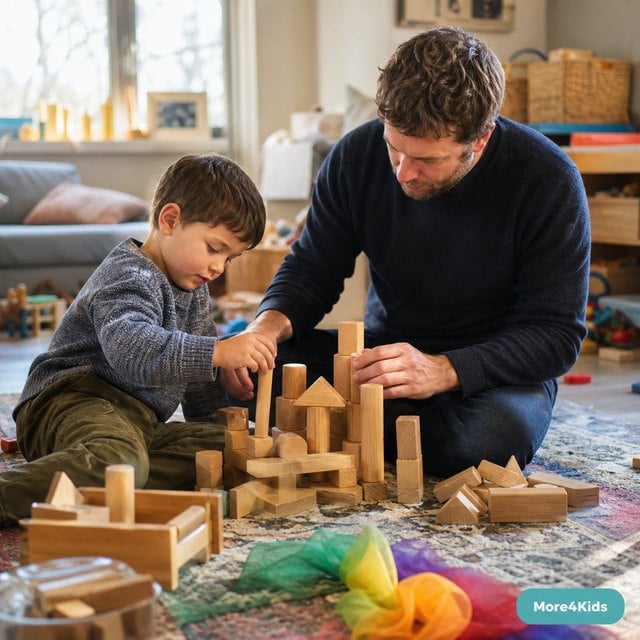
If I had to pick one category to recommend above all the others for this age, it’s open-ended construction toys — magnetic building tiles, chunky wooden blocks, interlocking sets. The reason isn’t nostalgia. It’s that a four-year-old builds something completely different with the same set of pieces than they will at five, and different again once a sibling joins in. There’s no “finishing” it, no version where the toy gets boring because you’ve done the one thing it does. My own kids have had the same box of magnetic tiles cycle through being a garage, a zoo enclosure, a “hotel for bugs,” and — memorably — a wall specifically built to keep the dog out of the living room.

These sets also happen to be some of the most durable gifts you’ll buy this year. Pieces that survive one holiday season tend to survive five, which matters if you’re the parent doing the December math on cost-per-play.
→ Magnetic building tile sets on Amazon — look for tiles with rounded edges and a piece count of at least 60, since a bigger set means bigger builds and less sibling fighting over pieces.
Pretend and dramatic play: where the real stories happen
This is the age where pretend play gets genuinely elaborate — full storylines, assigned roles, running commentary. A play kitchen, a set of cuttable play food, a doctor’s kit, or a cash register with pretend money gives that imagination somewhere concrete to land. It’s also some of the richest language-development play there is: kids narrate what they’re doing, negotiate roles with playmates, and practice real-world sequences (order the food, cook the food, serve the food, “pay” for the food) that build the same organizational thinking they’ll need for following multi-step directions at school.
One practical note from a mom of three: buy the food set before the kitchen, if you’re only buying one. A pile of pretend food will get used on the actual kitchen counter, a blanket fort, or a toy stove you already own. A full play kitchen is wonderful if you have the floor space for it, but it’s the one gift on this list I’d actually go measure your living room for first. Whatever pieces you choose, pretend play is doing real cognitive work here — it just doesn’t look like it from the couch.
→ Pretend kitchen and play food sets on Amazon — look for wooden or heavy plastic pieces over thin, easily-cracked plastic; it’s the difference between a set that lasts one winter and one that lasts three kids.
Cooperative games: the gift that teaches turn-taking without a lecture
Somewhere around four, most kids are ready for their first real board games — but “ready” comes with a caveat. Classic competitive games, where one kid wins and everyone else loses, can go sideways fast at this age; losing gracefully is a skill four- and five-year-olds are still building, not one they’ve arrived with. Cooperative games, where the whole table works together against the game itself, sidestep that entirely. Everyone wins together or the game ends together, and the actual skill being practiced — following rules, taking turns, waiting your turn without grabbing — gets to happen without anyone walking away from the table upset.
I’ve watched a room full of four-year-olds who couldn’t sit through five minutes of a “regular” game stay locked in for twenty straight minutes of a cooperative one, simply because nobody was losing.
→ Cooperative board games for preschoolers on Amazon — a 10-to-15-minute play time is the sweet spot; anything longer tends to lose a four-year-old halfway through.
Books for brand-new and early readers
Four and five is exactly the stretch where kids move from being read to, toward starting to read themselves — sounding out simple words, recognizing sight words, “reading” a favorite book from memory before they can technically read it. Books built for this transition, whether that’s a phonics-based early reader series or a short, illustrated chapter book meant to be read aloud together, tend to get pulled off the shelf on repeat far more than a single picture book would.
A boxed set is genuinely one of the best gift-value moves you can make here — it solves “what do we read tonight” for weeks, and kids at this age tend to want to reread a favorite five times before moving to the next one anyway, so a set holds up.
→ Early reader and first chapter books on Amazon — mix a phonics-level early reader with one read-aloud chapter book so there’s something for both “I’m sounding this out myself” nights and “read to me” nights.
Active, outdoor, big-muscle play
It’s easy for a gift list to skew entirely toward quiet indoor play, but four- and five-year-olds are also working hard on gross motor skills — balance, coordination, the confidence to pump their legs and go. A balance bike, a scooter, or simple outdoor gear that gets a preschooler moving fast and independently does real developmental work, and it’s one of the few gift categories that gets used the exact same day it’s unwrapped, weather permitting.
This is also the age a lot of kids graduate from a balance bike to a first pedal bike, so if your child already has one, this might be the year to skip straight to the next size up rather than buying a second balance bike.
→ Balance bikes for 4 and 5 year olds on Amazon — an adjustable seat matters more than almost any other feature here, since it’s the difference between one growing season of use and two or three.
Our six-point safety check before anything goes under the tree
Before anything on this list — or anything else you’re buying this year — goes under the tree, I run it through the same six checks every time:

- Choking hazard, the toilet-paper-tube test: if a piece fits through a standard cardboard toilet paper tube (about 1.25 inches), it’s a choking risk for children under three, and worth a second look even for a four- or five-year-old if there’s a younger sibling in the house.
- Button batteries: anything with a button or coin-cell battery needs a screwed-shut compartment, not a snap lid. More4Kids has tracked more than 20 recalls tied to button batteries, almost all involving light-up or musical toys with an accessible battery door — check before you buy, not after.
- Loose magnets: small, high-powered magnets that can come loose from a set are a genuine medical emergency risk if swallowed — we’ve covered a real magnetic-cube recall on this site that led to a child needing surgery. Look for magnets embedded in larger, non-removable pieces.
- Cords, ribbons, and drawstrings: keep an eye on anything with a long cord or drawstring near where it could loop around a neck — this applies to costumes and dress-up accessories more than toys, but it’s worth a habit year-round.
- Tip-over risk: play kitchens, dollhouses, and other tall, freestanding toys should be checked for a stable, wide base, especially if you have a climber in the house.
- Volume: a surprising number of “musical” toys for this age are loud enough to be genuinely uncomfortable at close range — if you can, check reviews for volume complaints before buying anything with sound effects.
A “clear” search on any recall database, including ours, isn’t proof of safety — recall data has gaps, and new recalls are issued constantly. For anything safety-critical, it’s always worth a direct check at cpsc.gov before you buy, especially for categories like magnets and button batteries where the stakes are highest.
What we’d skip this year
Not everything that sells well earns a place under the tree. A few categories I’d personally pass on for this age group, no affiliate links attached because these are genuinely just my honest read:
- Single-purpose electronic “learning” toys. The ones that light up, ask a multiple-choice question, and reward a correct tap with a jingle. They’re not harmful, but they tend to get a week of interest and then sit untouched, and they crowd out open-ended play that does more for a four- or five-year-old’s development.
- Miniature collectible or “blind bag” toy lines. Tiny pieces, constant pressure to collect “just one more,” and — depending on the line — genuine choking-hazard size on many of the pieces. Skip.
- Anything that requires reading fluency to actually use. Board games with dense instruction cards, or “educational” apps that assume independent reading, tend to frustrate rather than engage a child who’s still sounding out three-letter words.
A quick word on how many gifts to buy
If you’re feeling the pull to buy more because the pile under the tree “should” look a certain size, it’s worth remembering that this age group genuinely does better with fewer, richer options than with a mountain of unwrapped toys competing for attention on Christmas morning. A four- or five-year-old faced with fifteen new things to open often ends up more overwhelmed than delighted, bouncing from box to box without settling into real play with any of them. One open-ended toy, one book, one active-play gift, and one small “just for fun” item is a genuinely full holiday for this age — the leftover budget is better spent on a slightly nicer version of fewer things than a pile of forgettable extras.
If you’re shopping for more than one child this season, it’s worth pulling from a couple of different categories above rather than doubling up on the same toy for a four-year-old and a five-year-old sibling. A shared magnetic tile set or cooperative game actually plays better with two kids of slightly different ages in the mix than two separate solo toys do — and it sidesteps the “why does my present look different from theirs” conversation entirely.
Frequently Asked Questions
What are the best Christmas gifts for 4 and 5 year olds this year?
If I had to pick one category, it’s open-ended building toys like magnetic tiles or chunky wooden blocks. They flex with your child’s developing imagination instead of doing one fixed thing, which means they hold attention across an entire year instead of a single afternoon. Beyond that, a mix of pretend-play props, a cooperative game, an early reader book, and something active tends to cover the full range of what four- and five-year-olds are working on developmentally.
Are board games appropriate for 4 and 5 year olds?
Yes, especially cooperative games where the whole table plays as a team rather than competing against each other. Look for a play time under 15 minutes and simple, visual rules — a four-year-old shouldn’t need a paragraph of instructions read aloud to understand what to do.
How many Christmas gifts should a preschooler get?
There’s no universal rule, but fewer, more open-ended gifts genuinely tend to get more play than a large pile of smaller toys. A mix of one building or creative toy, one book, one active-play item, and one small extra covers most of what this age group needs from a holiday.
What should I check before buying a toy for this age?
Run it through a quick safety pass: no small pieces that fit through a toilet-paper tube, no accessible button batteries, no loose small magnets, a stable base if it’s freestanding furniture-style like a play kitchen, and a reasonable volume level if it makes noise. A recall-database “clear” is a good first step, not a final answer — check cpsc.gov directly for anything safety-critical.
However this year’s list shakes out at your house, I hope it’s a holiday morning where at least one gift gets played with well past lunchtime — even if, like my five-year-old’s cardboard box, it isn’t the gift you expected.

Meet Sophia Richards Sophia Richards is an early childhood educator, passionate writer, and the proud mom of three energetic kids. With a degree in Education and over a decade of hands-on classroom experience, Sophia bridges the gap between professional teaching strategies and everyday family life. At More4Kids, she translates complex child development concepts into practical, actionable parenting tips that families can use at home.
Whether she is sharing positive reinforcement techniques, educational crafts, or honest reflections on the chaos of raising three children under one roof, Sophia’s goal is to empower parents to foster resilience and joy in their kids. When she isn't writing or lesson planning, you can find her organizing neighborhood scavenger hunts or trying out new kid-friendly recipes.
Areas of Expertise: Early Childhood Education, Positive Parenting, Sibling Dynamics, Educational Play, Family Wellness.




Add Comment