












By Sophia Richards
Every year I have the same conversation with myself around dusk on October 31st: the costume looks great, the kids are thrilled, and then I look at the street and remember that a kid in a dark hoodie under a dark cape is nearly invisible to a driver by 6:30. It’s not a costume problem. It’s a physics problem — dark fabric against a dark street, and a driver who has maybe half a second to register a small, fast-moving shape stepping off a curb.
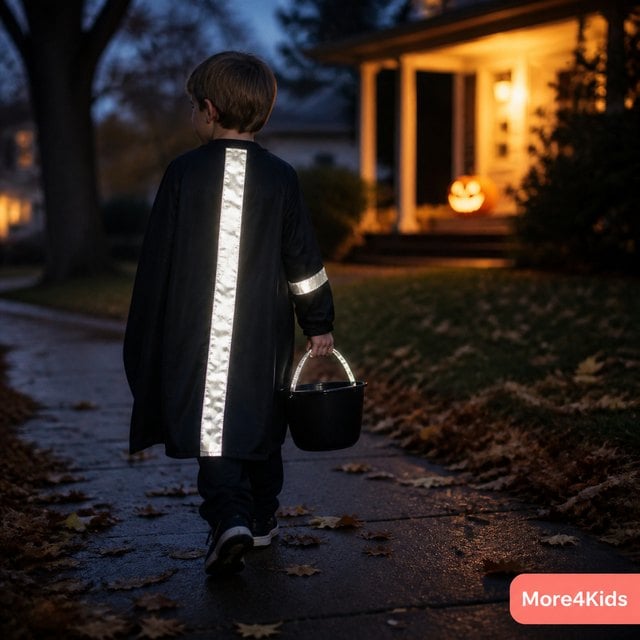
This isn’t me being the anxious parent at the party. A JAMA Pediatrics study that looked at 42 years of national crash data found pedestrian deaths jump by 43% during Halloween evening hours compared to an ordinary evening, with the increase concentrated even more heavily among children. That’s not a reason to keep kids home. It’s a reason to spend the five minutes it takes to make them visible before they leave the porch, because reflective trick-or-treat safety gear is the cheapest, easiest safety upgrade in the entire Halloween shopping list — cheaper than the costume, faster to add than a fit adjustment, and it works with literally any costume you’ve already bought.
Why visibility matters more than costume color
Table of Contents
Most costumes are dark by design. Witches, vampires, ninjas, superheroes in navy and black — the popular characters this year lean dark, and dark fabric that looks great under porch string lights disappears completely under a streetlight fifty feet away. A driver doesn’t need to be distracted or careless to miss a child in dark clothing crossing mid-block between parked cars; low light plus low contrast is enough on its own.
Reflective and light-up gear solves this without touching the costume at all. A strip of reflective tape, a clip-on LED, a glow bracelet — none of it changes how the costume looks up close, but from a car’s headlights at a distance, it’s the difference between a shape that catches the light and one that doesn’t register until it’s too close.
As an Amazon Associate, More4Kids earns from qualifying purchases. We only recommend products we would use in our own homes, and we check every brand against current CPSC recall data before it appears here. Our recommendations are never paid placements, and we haven’t personally tested every item below — this is what we’d look for and why, not a claim that we’ve used each one ourselves.
Clip-on LED lights — the easiest single add
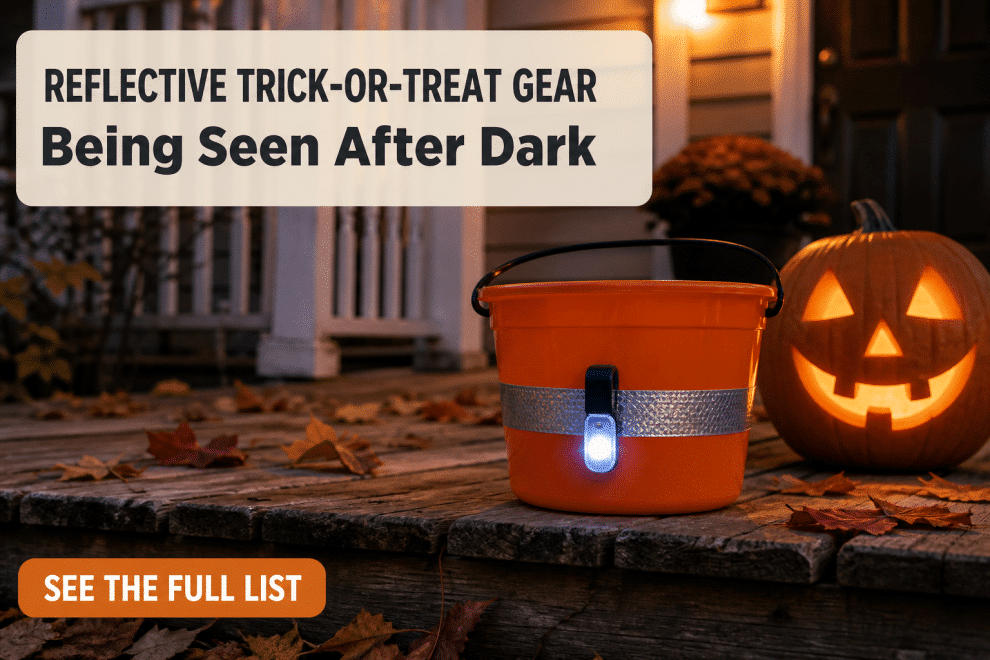
If I had to pick one piece of reflective trick-or-treat gear to add to every costume in the house, it would be a small clip-on LED safety light. They cost a few dollars, they clip onto a bucket handle, a costume seam, or a backpack strap in about two seconds, and unlike reflective tape, they actively flash or glow instead of just bouncing back a driver’s headlights — which matters most on residential streets without much overhead lighting.
Clip-on LED safety lights for kids covers the category — most run on small replaceable or rechargeable batteries, clip on with a simple spring clasp, and have a steady and a flashing mode. Flashing catches a driver’s eye faster than steady light, so I’d default to flashing mode for the actual walk and save steady for photos.
What to check before buying: the battery compartment should need a small screwdriver or a firm push-and-twist to open, not just a fingernail. That single detail is the whole difference between a safe accessory and a choking-hazard battery sitting loose in a five-year-old’s hand two blocks from home. If a listing shows the battery door popping open with light pressure, skip it regardless of price.
Reflective tape and stickers — add it to anything you already own
This is the option I’d point to first for anyone who doesn’t want to buy a new accessory at all, because it goes directly onto gear you’re already using. A few strips of adhesive reflective tape on the outside of a trick-or-treat bucket, the back of a jacket worn under a costume, or a backpack turn something completely non-reflective into something that lights up in headlights from a real distance.
Reflective tape and stickers is genuinely one of the least glamorous purchases on this whole list and also one of the most effective — it’s the same category of material used on road signs and safety vests, engineered specifically to bounce headlights back toward the driver rather than just being a bright color. A strip on each side of a bucket and a strip across the back of a jacket takes about three minutes for one kid and covers the two places drivers are most likely to see: at hip height, walking toward or away from traffic.
One practical note: buy it before the week of Halloween. Reflective tape and safety-light multipacks are exactly the kind of thing that sells out at the drugstore by October 28th, and ordering it with everything else avoids a last-minute scramble.
Glow sticks, bracelets, and necklaces — the fun option, with one real caution
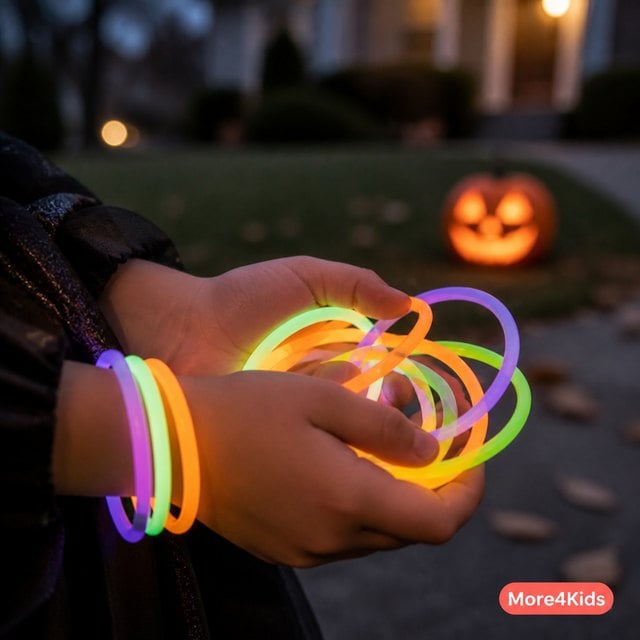
Glow sticks and glow bracelets are the visibility gear kids actually ask for, because they double as a toy. A glowing bracelet or a handful of glow sticks stuffed in a bucket does real visibility work while also being something a seven-year-old wants to wear regardless of the safety argument, which matters — gear a kid resists wearing doesn’t help anyone.
Glow sticks and glow bracelets for Halloween covers bulk multipacks, which is genuinely the smart way to buy this category — a bag of fifty costs about the same as a handful from a party store, and you’ll want spares since these are meant to be handed to friends, siblings, and the kid who inevitably drops theirs on someone’s lawn.
The one caution I’d actually flag: glow necklaces specifically. They’re the same tube as a bracelet, just longer, worn as a loop around the neck — and for a toddler or a young preschooler, anything looped around the neck is worth a second look regardless of how soft the material is. I’d default to bracelets and clip-on styles for kids under about five, and save necklaces for older kids who aren’t going to end up tangled in one during a costume change or a car seat buckle. It’s a low-probability risk with a soft plastic tube, not a hard rule, but it’s an easy substitution that costs nothing.

Reflective vests and sashes for the whole group
If you’re walking a group — your own kids plus cousins, neighbors, or a trunk-or-treat crowd — a reflective vest or sash does more visibility work per dollar than almost anything else on this list, because it covers the whole torso rather than one small point like a clip light or a bucket strip.
Reflective safety gear for kids includes vests, sashes, and armbands sized for kids, most with hook-and-loop closures rather than anything tied. A vest goes on over any costume in about ten seconds and comes off just as fast for the photo at the door, so it doesn’t have to compete with how the costume looks — it’s a layer, not a replacement.
This is also the option I’d reach for on the parent side of things, honestly. If you’re walking behind a pack of kids in dark clothing yourself, a reflective vest or sash on you does the same job — a driver who sees the adult first tends to slow down before spotting the kids beside them.
Reflective trick or treat safety gear: what to check before you buy
A few things apply across every category above, not just one:
- Every battery compartment should require a tool or real force to open, not a fingernail. This is the single most important check for any light-up item, and it’s the one recalls trace back to most often.
- No cords, ribbons, or long loops that sit near a young child’s neck. Clip-ons, bracelets, and vests solve this automatically; necklaces are the one category where I’d pay attention to age.
- Check the actual brightness in a dark room before Halloween night, not just in a lit store aisle. A clip light that looks bright under fluorescent lighting can be nearly invisible in genuine outdoor dark, and you want to know that before 6 p.m. on the day, not after.
- Buy one size up on batteries or a spare set. Nothing deflates a five-year-old faster than a dead clip light halfway through the block, and cheap coin or AAA batteries are a two-dollar problem to avoid in advance.
Layering gear with the costume itself, not against it
The easiest way to make reflective gear actually get used is to treat it as part of the costume rather than a safety add-on bolted on top. A witch’s broom with a strip of reflective tape wound around the handle. A superhero cape with a light clipped to the inside seam so it peeks out at the hem. A pirate’s eye patch swapped for a reflective sash styled as a “captain’s belt.” Kids resist gear that looks like a parent’s compromise; they wear gear that looks like it was always part of the plan.
If the costume itself runs dark — witch, vampire, ninja, most of this year’s superhero trends — that’s exactly the costume that benefits most from a light or reflective strip, because there’s nothing else in the outfit doing any visibility work on its own. Our costume safety checklist goes through the rest of the fit and material checks worth doing at the same time you’re adding visibility gear, since you’re already looking the costume over.

Trick-or-treat buckets that pull double duty
A trick-or-treat bucket is already in every kid’s hand for the entire night, which makes it one of the most efficient places to add visibility — you’re not asking a kid to wear or carry anything extra, just choosing a bucket that already does the job or adding a strip of tape to the one you have.
Trick-or-treat buckets for kids covers the usual pumpkin and character styles; a few come with a reflective panel built in, which is worth the small price difference over an identical bucket without one. If yours doesn’t have one built in, a strip of the reflective tape mentioned above on two sides takes under a minute and works just as well.
An age-by-age approach
Toddlers and preschoolers (roughly 2-4): Skip anything with a neck loop, a small battery door that opens easily, or a piece that could separate and end up in a mouth. A clip-on light on the stroller or wagon and a strip of reflective tape on the bucket covers this age well, since a toddler isn’t reliably going to keep a wearable accessory attached to themselves for an entire block anyway.
Early elementary (roughly 5-8): This is the sweet spot for glow bracelets, clip-on lights, and simple vests — old enough to keep gear on, young enough to genuinely enjoy the glow-in-the-dark novelty rather than finding it babyish.
Older kids (roughly 9 and up): Reflective gear starts competing with “looking cool” at this age, which is exactly why the low-key options matter — a clip-on light tucked under a hoodie hem or reflective tape hidden on the inside of a jacket seam does the safety work without the kid feeling like they’re wearing a parent’s safety vest over their costume.
What we’d skip
A few pieces of reflective trick-or-treat gear I wouldn’t buy, and no links in this section, because this is the part where I’m telling you not to buy something rather than pointing you toward it.
- Any light-up accessory with a battery compartment that pops open with light thumb pressure. This is the exact failure pattern behind most of the button-battery recalls we track; our light-up accessories and battery risk piece goes into why this specific hazard matters more than most parents expect.
- Glow necklaces for kids under about five, for the neck-loop reason above. Swap to a bracelet or clip-on instead.
- Reflective vests or sashes with a tied, rather than hook-and-loop, closure. It’s not safer just because it’s marketed as safety gear.
- Bulk light-up rings and finger lights from the clearance bin with no visible brand or battery-safety labeling. Cheap and unlabeled is exactly the combination behind the recall pattern; a labeled, reputable listing costs a dollar or two more and is worth it.
- Waiting until October 31st to buy any of it. This category sells out fast and ships slow once the week starts; add it to the cart with the costume, not after.
A parent’s honest take
None of this reflective trick-or-treat gear is complicated or expensive, which is honestly why it’s easy to skip — nothing about a clip-on light or a strip of tape feels urgent the way picking the right costume does. But it’s the cheapest, fastest safety upgrade available for trick-or-treating, and it works on any costume you’ve already committed to, dark or not. I don’t treat it as optional in my house anymore. Every kid leaves with something reflective on the outside of their costume and something on the bucket, and it takes less time to add than it did to write this sentence.
If you’re also decorating for a trunk-or-treat or a classroom party this year, our trunk-or-treat ideas guide and our classroom Halloween party guide cover the rest of the season’s planning — but the reflective gear question is the one I’d settle first, because it’s the one that matters most once the sun goes down.

Frequently Asked Questions
What's the most effective reflective trick-or-treat gear for kids?
A combination works best: a clip-on LED light for active visibility, plus reflective tape on the bucket or costume for passive visibility that works even if a battery dies. Together they cover both close-range and longer-distance visibility, and neither one requires changing the costume itself.
Are glow sticks or reflective tape better for trick-or-treating?
They do different jobs. Glow sticks and bracelets are fun and genuinely visible up close, but they fade over a few hours and don’t reflect a driver’s headlights the way reflective tape does. Reflective tape doesn’t glow on its own, but it stays effective as long as it’s on the costume and works at a real driving distance. Using both covers more ground than either alone.
Is it safe to put a glow necklace on a toddler?
I’d skip it for kids under about five and use a glow bracelet or a clip-on light instead. A glow necklace is a soft plastic loop worn around the neck, which is a low-probability but easy-to-avoid risk for a young child who might get tangled in one during a costume change or while buckling into a car seat. Older kids who aren’t likely to get tangled can wear one without the same concern.
Why does reflective gear matter more on Halloween than other nights?
A JAMA Pediatrics study of national crash data found pedestrian deaths rise 43% during Halloween evening hours compared to an ordinary evening, with the increase falling hardest on children. The combination of dark costumes, excited kids darting between houses, and low light after sunset is unique to this one night, which is exactly why visibility gear is worth the few minutes it takes to add.
Related Articles
- Halloween Costume Safety 2026
- Light Up Halloween Accessories Battery Safety
- Trunk Or Treat Ideas
- Classroom Halloween Party Ideas

Meet Sophia Richards Sophia Richards is an early childhood educator, passionate writer, and the proud mom of three energetic kids. With a degree in Education and over a decade of hands-on classroom experience, Sophia bridges the gap between professional teaching strategies and everyday family life. At More4Kids, she translates complex child development concepts into practical, actionable parenting tips that families can use at home.
Whether she is sharing positive reinforcement techniques, educational crafts, or honest reflections on the chaos of raising three children under one roof, Sophia’s goal is to empower parents to foster resilience and joy in their kids. When she isn't writing or lesson planning, you can find her organizing neighborhood scavenger hunts or trying out new kid-friendly recipes.
Areas of Expertise: Early Childhood Education, Positive Parenting, Sibling Dynamics, Educational Play, Family Wellness.

Add Comment