






By Sophia Richards
The first year I volunteered to run a classroom Halloween party, I showed up with three bags of supplies, a game I’d found online that needed a projector, and absolutely no idea that the whole thing had to be finished, cleaned up, and out of the way in forty-five minutes. The teacher was lovely about it. She also, very gently, moved my elaborate plan to the side and handed the kids a sticker sheet each while I was still untangling an extension cord.
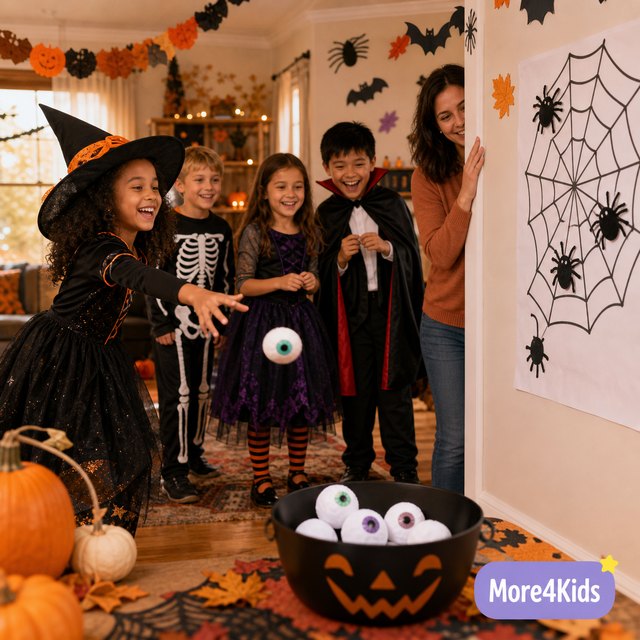
I’ve run a lot of these since then, from both sides — as a room parent and as an early childhood educator watching a room parent try. And the classroom Halloween party ideas that actually work are almost never the ambitious ones. They’re the ones built around the three constraints nobody mentions in the sign-up email: the clock, the allergy list, and the fact that a teacher has to get twenty-four kids back into a learning state afterward.
So this is the version I wish someone had handed me that first October. Not the Pinterest version of classroom Halloween party ideas — the version that survives a real classroom, with a real clock on the wall.
Ask the teacher these five questions before you buy anything
Table of Contents
This is the single highest-value thing in this whole article, and it costs nothing. Send one short email before you spend a dollar.
- How much time do we actually have, door to door? Forty-five minutes is common. Thirty happens. The answer changes everything downstream.
- What’s the food policy? Some rooms are nut-free, some are no-outside-food entirely, some require store-sealed labels. Assume nothing.
- Are there allergies or sensory needs I should plan around — without you telling me who?
- Is there a costume policy, and is there a kid who won’t be in costume? There usually is, and it matters more than the theme does.
- What do you want me to not do? Teachers will tell you if you ask directly. Glitter, silly string, and anything requiring a sink are the usual answers.
Every good party I’ve been part of started with that email. Every rough one started with a cart.
As an Amazon Associate, More4Kids earns from qualifying purchases. We only recommend products we would use in our own homes, and we check every brand against current CPSC recall data before it appears here. Our recommendations are never paid placements.
If you want one place to start browsing before you narrow it down, Halloween classroom party supplies in bulk is the broad category, but I’d genuinely wait on that email before adding anything to a cart. Half of what’s in those bulk assortments won’t clear your teacher’s rules, and the other half you’ll double up on with another parent who also volunteered.
Classroom Halloween party ideas that start with stations, not one big game
Here’s the structural thing that separates a party that works from one that unravels: a whole-group activity puts twenty-four kids at the mercy of the slowest step, and the kids who finish early become the problem. Stations don’t have that failure mode.
Three or four stations, kids rotate every ten to twelve minutes, each station is self-contained and needs no adult explanation after the first thirty seconds. That’s it. That’s the format.
What it buys you:
- Nobody waits. There’s no line, because the room is split four ways.
- Volume is manageable. Twenty-four kids talking in four small clusters is a different noise level than twenty-four kids in one circle.
- A station that flops doesn’t sink the party. It’s ten minutes, then everyone moves.
- Cleanup happens in parallel. Each station’s parent tidies their own three feet of table while the last rotation is still going.
A reasonable four-station layout: a craft, a low-mess game, a snack or treat-bag stop, and a quiet corner. I’ll go through each of those, because the details are where these go wrong.

The craft station that actually finishes in twelve minutes
The number one craft mistake is picking something that takes an adult twelve minutes, which means it takes a six-year-old twenty-five. The second mistake is anything that needs to dry before it can go in a backpack.
What works: pre-cut pieces, one tray per child, stick-on rather than glue-on wherever possible, and a finished object that’s dry the second it’s done.
Sticker-based pumpkin decorating kits that skip the carving are the most reliable version of this I’ve used in a classroom. No knives, no scooping, no mess, and every kid ends up with something recognizably theirs. Mini foam or plastic pumpkins hold up better than real ones on a school desk, and they don’t leak.
If you’d rather do a flat craft, Halloween craft kits with pre-cut pieces — suncatchers, foam shapes, sticker scenes — are built for exactly this constraint. What I’d look for specifically, in this order:
1. Pre-cut, not “kids cut it out.” Scissors in a forty-five-minute window with one adult is a bottleneck and a risk. 2. Adhesive already on the pieces. Glue sticks are fine; liquid glue in a classroom is not. 3. Pieces bigger than a child’s palm. More on why below, but for a mixed-age school event this matters a lot. 4. A kit count higher than your class size. Always buy over. Somebody’s piece will end up on the floor, and a spare fixes it in two seconds. 5. No fine glitter. I know. But ask any teacher.
Set the trays out before the kids arrive. Every minute you spend distributing supplies is a minute of twenty-four kids with nothing to do, which is how a party turns into a situation.
Prize tables and goodie bags without the small-parts problem
The favor bag is where the safety thinking has to happen, and it’s where most classroom party guides just say “grab a bulk pack” and move on.
Here’s the issue. The bulk Halloween favor assortments are genuinely convenient, and they are also, very often, a mixed bag in the literal sense — a 200-piece pack will contain sticker sheets and bookmarks alongside bouncy balls, tiny figurines, and small spring-loaded things. I searched non-candy Halloween treats for kids while writing this and the third result on the page was a pack of bouncy balls. That’s not a knock on the search — it’s the reality of the category, and it’s why “I bought the assortment” is not the same as “I checked it.”
The rule I use: if a piece fits through a toilet paper tube, it doesn’t go in a kindergarten or first-grade favor bag. That’s the standard-issue small-parts test, and it’s fast enough to actually do while you’re sorting. For a K–2 classroom, or any school-wide event where younger siblings are in the room, I sort the assortment first and set the small pieces aside rather than assuming a pack labeled “for kids” is sorted by age.
Sorted properly, a favor bag is the cheapest part of the whole classroom party and the part kids talk about on the ride home. What clears that bar easily, and what I’d reach for first:
- Halloween stickers and classroom prizes — flat, universally liked, no choking risk, no allergy risk, and they cost almost nothing per kid. Stickers are the most underrated classroom party favor there is.
- Bookmarks, pencils, and mini activity books — same logic, and they go home in a backpack without getting crushed.
- Larger single items — a full-size crayon pack, a foam glider, a paper mask kit. One good thing beats twelve tiny things every time.
- Halloween party favors in bulk if you’re filling twenty-four bags on a budget — just plan to open it and sort it on your kitchen table first, not in the classroom doorway.
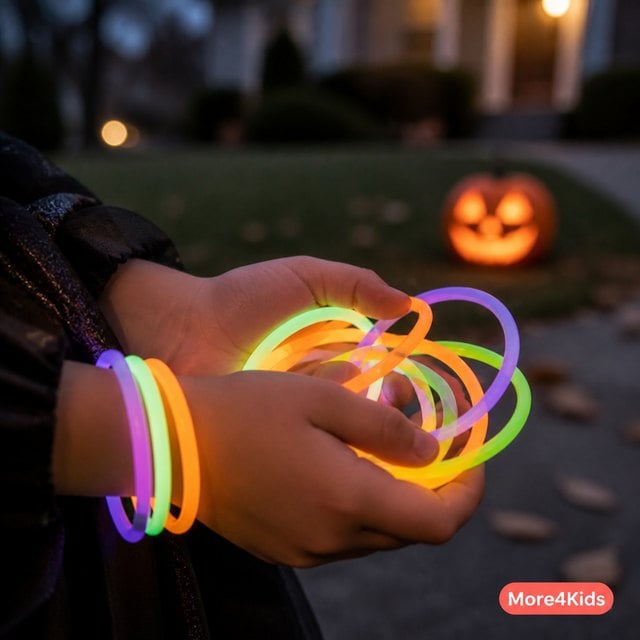
One more thing on favors that I’d have skipped past a few years ago: light-up rings, glowing wands, and light-up jewelry are button-battery items. Those are the small coin cells that cause severe internal burns within hours if a child swallows one, and they’re the single most recalled category we track. Two separate light-up Halloween ring products were recalled in 2026 for exactly this. If a favor lights up, it has a battery in it, and a favor bag handed to twenty-four kids is the worst possible distribution channel for one. We went through the full picture in our guide to light-up Halloween accessories and the button battery risk — the short version is that a secured compartment needs a screw, and most party-favor light-ups don’t have one.

Snacks, allergies, and the two-bowl habit
Food is the part with the highest chance of hurting a child, and the lowest tolerance for winging it.
Whatever the teacher tells you about the room’s policy, that’s the policy — this is the one area of a classroom party where there is no room for improvising. If food is allowed, individually wrapped and clearly labeled beats homemade, every time, in a classroom — not because homemade is worse, but because a parent reading an ingredient label at the door is a check that a plate of unlabeled brownies can’t offer.
The habit worth building is the two-bowl setup: a food option and a non-food option, side by side, so that a child with an allergy takes something from a table rather than being handed a substitute in front of everyone. That’s the whole idea behind the Teal Pumpkin Project and what an allergy-friendly Halloween actually looks like, and it transfers to a classroom cleanly. The non-food bowl isn’t a consolation prize — set it up so it’s the more appealing bowl and watch how many kids with no allergy at all pick from it.
A few classroom-specific notes:
- Grapes, popcorn, hard candies and marshmallows are choking risks for the youngest end of an elementary school, and popcorn especially shows up at parties without anyone thinking twice.
- Check the room’s snack policy for the whole building, not just the class — school-wide Halloween events often have a stricter rule than a single classroom.
- Bring your own trash bags. Genuinely. The room’s bin will not hold twenty-four plates.
Games that don’t need the projector, the floor, or a referee
The existing More4Kids piece on Halloween party games and activities has the full list of game ideas, and I’d rather point you there than pad this out with a second version of the same thing. What I’ll add is the classroom filter to run them through, because a game that’s great at a backyard party can be a disaster at a desk, and most published classroom Halloween party ideas never mention the difference.
A classroom game needs to: work in a space the size of a rug, need no explanation past thirty seconds, produce no winner-loser meltdown, run in under ten minutes, and generate roughly zero cleanup.
The ones that survive that filter tend to be quiet, parallel, and self-scoring. Pumpkin bowling with a soft ball and empty cups. A guessing jar. A “how many candy corn in the picture” counting sheet at each desk. Halloween bingo with sticker markers, which doubles as a favor. Musical statues with the lights down, if your teacher is up for the noise.
The ones that reliably go sideways: anything involving blindfolds, anything where kids are eliminated one at a time and then sit and watch, anything requiring a projector or the classroom sound system (the technology will fail, and you will spend eight of your forty-five minutes on it), and anything with a single winner and no consolation.
The quiet corner is not optional
This is the station most classroom party plans skip, and it’s the one I’d fight to keep.
A Halloween party is loud, bright, socially intense, and it happens in a room that is normally none of those things. For a kid with sensory sensitivity, that combination is a lot, and the alternative to a quiet corner isn’t “they’ll be fine” — it’s a child in the hallway with a teacher instead of at their own class party.
It doesn’t need much, and it costs a classroom party almost nothing. A beanbag or a rug in the corner, a couple of picture books, a small basket of quiet fidget items. That’s the entire setup, and every year it gets used by more kids than the one or two you set it up for.
Halloween sensory and fidget toys fill that basket well — pop-style silicone toys, stretchy strings, squishy toys. Check the sizing on anything going into a K–1 room, since some of these come in mini keychain versions that fall under the small-parts rule above. If a child in the room has known sensory needs, our guide to sensory-friendly Halloween costumes covers the costume side of the same problem, which often shows up on party day before the party even starts.
And a read-aloud is the single most reliable way to bring the volume down before the bell. Ten minutes, one book, everyone on the rug. Halloween picture books for kids has plenty that land in the warm-and-silly range rather than the genuinely scary one, which is the range you want for a mixed group where you don’t know each child’s threshold. A donated copy to the classroom library afterward is a small, extremely welcome gesture.
The costume question, handled kindly
Not every child will be in costume. Sometimes it’s a family’s beliefs, sometimes it’s cost, sometimes it’s a kid who changed their mind in the car and is now quietly devastated.
Two things fix almost all of it. First, ask the teacher in advance and bring a few neutral extras — a set of paper masks kids decorate themselves, or a simple accessory anyone can put on. Something a child can opt into without it being labeled the spare costume. Second, don’t build any activity around costumes. No costume parade as the centerpiece, no “guess who’s who,” no prize for best costume. Costume contests in a classroom sort children by what their family could spend, and they do it publicly.
If costumes are worn, the usual checks still apply in a school setting: nothing that drags on the floor near a doorway, no rigid masks that block vision in a crowded room, and no long ties near a neck. A costume that was fine on a sidewalk at night can be a trip hazard between rows of desks.
What we’d skip
No links in this section, on purpose — this is the part where being useful means telling you what not to buy for a classroom party.
- Bulk favor assortments handed out unsorted in a K–2 room. The convenience is real and the small-parts contamination is real too. Sorting takes ten minutes at home.
- Anything that lights up, as a giveaway. Button batteries, twenty-four distribution points, kids who put things in their mouths. It’s the wrong risk for a party favor.
- Latex balloons. They’re the most common choking-death cause among children’s products, uninflated or popped, and they’re everywhere at parties because they’re cheap. Foil balloons or paper decorations instead.
- Silly string, confetti poppers, and fine glitter. Not a safety issue so much as a “you will be asked not to come back” issue.
- Face paint applied by a volunteer to twenty-four faces. Time, hygiene, and allergy exposure all stacked into one station. Send it home in a favor bag if you want it at all.
- A costume contest. Covered above, but it belongs on this list too.
- Elaborate themed decor. The kids do not notice. The teacher notices that you took eleven minutes to hang it and eleven more to take it down.
A parent’s honest take
The best classroom Halloween party I ever helped run had four stations, a read-aloud, sticker favors, and cost under thirty dollars. It ended five minutes early, which meant the teacher got her room back with time to spare, and I got invited to run the spring one.
The classroom Halloween party ideas that teachers actually approve of all share one quality: they respect that this is somebody’s workplace and somebody else’s whole social world. Keep it small, keep it fast, sort the favors before you show up, and put a quiet corner in the plan. The kids will remember that they got to do something fun with their friends. They will not remember the theme.
Send the email. Buy less than you think you need. Sort the favor bags at your own kitchen table. Show up early.
Frequently Asked Questions
What are the best classroom Halloween party ideas for a 45-minute window?
Three or four rotating stations rather than one whole-group activity — typically a pre-cut craft, a low-mess game, a snack or favor-bag stop, and a quiet corner with books. Kids rotate every ten to twelve minutes, each station runs without adult explanation, and cleanup happens in parallel while the last rotation finishes. Set every station up before the children arrive.
What should I put in a classroom Halloween favor bag instead of candy?
Stickers, bookmarks, pencils, mini activity books, and larger single items like a crayon pack or a paper mask kit. Skip anything small enough to fit through a toilet paper tube in a K–2 room, and skip light-up items entirely — they contain button batteries, which are the most frequently recalled hazard in children’s Halloween accessories.
How do I handle food allergies at a school Halloween party?
Follow the teacher’s stated policy exactly, use individually wrapped and clearly labeled items rather than homemade food, and set out a non-food option beside the food one so a child with an allergy chooses from a table instead of being handed a substitute. Ask about allergies in advance without asking which child has them.
Should we have a classroom costume contest?
I’d skip it. A contest sorts children publicly by what their family was able to spend, and there is always at least one child in the room who isn’t in costume. Keep a few neutral extras on hand — decorate-your-own paper masks work well — and don’t build any activity around who is wearing what.
How much should a room parent spend on a classroom Halloween party?
Far less than most first-time volunteers expect. A four-station party with sticker favors and a read-aloud runs comfortably under thirty dollars for a class of twenty-four, especially if two or three parents split the stations. Cost has close to zero correlation with how much the kids enjoy it.
Related Articles
- Light Up Halloween Accessories Battery Safety
- Teal Pumpkin Allergy Friendly Halloween
- Halloween Party Games And Activities
- Sensory Friendly Halloween Costumes

Meet Sophia Richards Sophia Richards is an early childhood educator, passionate writer, and the proud mom of three energetic kids. With a degree in Education and over a decade of hands-on classroom experience, Sophia bridges the gap between professional teaching strategies and everyday family life. At More4Kids, she translates complex child development concepts into practical, actionable parenting tips that families can use at home.
Whether she is sharing positive reinforcement techniques, educational crafts, or honest reflections on the chaos of raising three children under one roof, Sophia’s goal is to empower parents to foster resilience and joy in their kids. When she isn't writing or lesson planning, you can find her organizing neighborhood scavenger hunts or trying out new kid-friendly recipes.
Areas of Expertise: Early Childhood Education, Positive Parenting, Sibling Dynamics, Educational Play, Family Wellness.

Add Comment