













By Sophia Richards
Every October our kitchen table disappears under a pile of tulle, capes, plastic swords and one very determined child explaining why this costume and only this costume will do. I love it. I also know that the moment a costume is chosen, nobody in the house is thinking about hems or headlights — least of all the one who has just become a dragon.
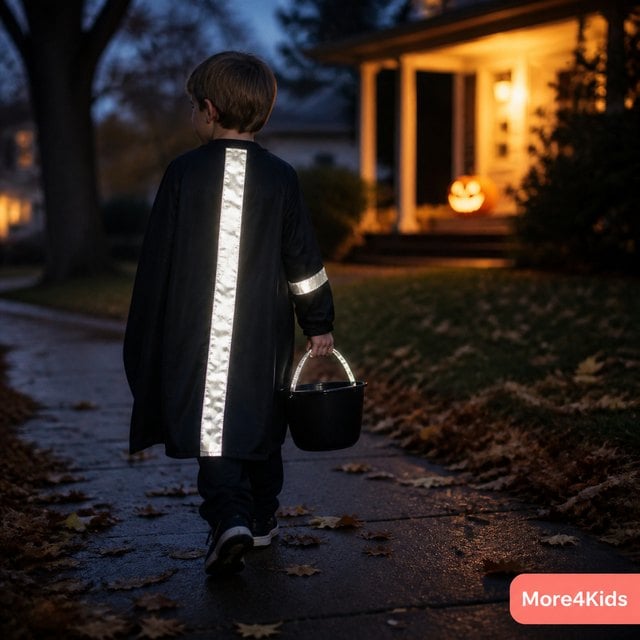
So this is the part I handle quietly, before the excitement takes over. Halloween costume safety is not about talking your child out of the costume they want. It is about making the one they want work on a dark street, in a crowd, next to a lit pumpkin. Almost every problem I have seen or read about is fixable in about five minutes, if you catch it at the buying stage instead of at 6:45 on the thirty-first.
Here is the Halloween costume safety check we run every year, and why each part of it is on the list — including the bits that come straight out of the recall data we track here every week.
As an Amazon Associate, More4Kids earns from qualifying purchases. We only recommend products we would use in our own homes, and we check every brand against current CPSC recall data before it appears here. Our recommendations are never paid placements.
Halloween Costume Safety: The Six Things That Actually Go Wrong
Table of Contents
I want to start here because it reframes the whole shopping trip. Most Halloween costume safety advice is a list of tips with no spine to it; this one has a spine. When we go through children’s product recalls month after month, the same handful of hazards keep coming back around: flammability, choking on small parts, button and coin batteries, magnets, tip-over, and cords and strangulation. That is not a Halloween list. That is the list, all year. Trick-or-treating then adds a sixth that our recall data does not capture but every parent will recognise: falls in the dark.
What makes Halloween different is that a costume can stack three or four of them into one outfit — a flowing synthetic gown, a mask that cuts your child’s vision in half, a light-up accessory with a battery door a toddler can open, and a hem that drags on somebody’s porch steps in the dark. None of those are exotic risks. They are the ordinary ones, wearing a cape.
So the Halloween costume safety check we run is really just those six hazards, applied to one outfit.
Start With the Label, Not the Character
The first thing I look for is a label that says the costume is flame resistant. It is a boring sentence on a tag and it is the single most useful thing on the garment.
Flame resistant does not mean fireproof — it means the fabric is treated or constructed so it does not catch and race the way untreated synthetic fabric does. That distinction matters on a night when children walk past open flames in jack-o-lanterns, luminaries on walkways, and the occasional fire pit in a driveway.
If you want a sense of how seriously this is taken, look at what happens when sleepwear fails the standard. We have covered several children’s pajama recalls this year alone where the entire reason for the recall was that the garment failed the federal flammability standard for children’s sleepwear — including Michley children’s pajamas sold through SHEIN, pulled in 2026 for exactly that. That standard is federal law (16 CFR part 1615 for sizes up to 6X). Costumes are generally not held to it, which is precisely why the label is worth finding yourself.
What we’d look for and why:
- A sewn-in or hang tag with the words flame resistant or flame retardant. If a listing does not say it anywhere, treat that as unknown, not as safe.
- Avoid trailing sleeves, long flowing capes and full skirts on younger children — more fabric, more chances to brush something hot.
- Tightly woven fabrics over loose, gauzy, “wispy” ones. Cheesecloth ghosts look wonderful and behave badly near a flame.
I am deliberately not sending you to a shopping link for this one. I have not found a retail filter that reliably surfaces them — when I checked, searching those words mostly returned flame-themed costumes, which is the opposite of helpful. This check has to happen on the product page, in the description or the tag photo, with your own eyes. A costume without a flame-resistant label is not necessarily dangerous, but it is a costume you should plan to keep well away from candles.
Masks Cost More Vision Than Parents Expect
If I could change one thing about Halloween, it would be masks.
A full-face mask does two things to a child at once: it narrows their field of view, often dramatically, and it muffles their hearing. Then we send them onto a street after dark, in dark clothing, where drivers are also struggling to see. Children dart. That is not a character flaw, it is childhood. A mask removes the peripheral vision they would normally use to catch a car out of the corner of their eye.
If your child is set on a mask, and sometimes they are:
- Try it on before Halloween night, in your hallway, and ask them to look left and right without turning their whole body. If they cannot, the eye holes need enlarging or the mask needs to live on top of their head between houses.
- Have them wear it pushed up while walking and pull it down at the door. Kids are surprisingly agreeable to this if you frame it as “so people can see how good it looks.”
- Make sure it is secured well enough not to slip sideways over their eyes mid-step.
In a classroom you learn fast which dress-up pieces get abandoned by ten in the morning, and it is almost always the ones that cover a face. Honestly, the better answer for most families is face paint. It gives you the full transformation with none of the vision cost, it survives being crawled on by a toddler, and my kids have always preferred it once they see the result in the mirror.
If you go that route, patch test a small spot on the inside of the arm a day or two ahead — a reaction discovered on a cheek at 5 p.m. on Halloween is a bad evening for everyone. Look for kits that state they are non-toxic and cosmetic-grade, skip anything that arrives without an ingredient list, and never use craft or acrylic paint on skin.

→ Compare non-toxic kids’ face paint kits
Hem Length: The Boring Check That Prevents the Most Injuries
This is the one I nag about, and I am not sorry.
Trick-or-treating happens on other people’s property, in the dark, on unfamiliar steps, at speed, in a group, while carrying a bucket. A costume that pools on the floor at home becomes a genuine trip hazard on a stranger’s porch stairs. So we hem. Every year.
The rule we use: the hem clears the top of the shoe, and the child can climb your own stairs in it without looking down. Test it on real stairs, not on flat carpet.
The same goes for capes, which are wonderful and also the single most snag-prone thing a child can wear. If a cape fastens with anything that would not give way — a knotted ribbon, a tight elastic loop, a fixed clasp at the throat — replace the fastening with hook-and-loop tape or a light plastic breakaway clip. Anything around a child’s neck should come apart under a firm pull. That is the same principle behind the drawstring rules on children’s outerwear, and it applies just as much to a homemade Batman cape.
And shoes: your child’s own well-fitting shoes, every time. Costume shoes and character slippers are made to look right for a photograph, not to walk two miles of sidewalk in. Nobody has ever regretted sneakers.
Being Seen in the Dark Is the Whole Game

Most Halloween costumes are dark. Black cats, witches, vampires, ninjas, superheroes in navy and charcoal. Then the sun goes down and we walk them along the edge of a road.
This is the highest-value thing you can do to a costume, and it takes about four minutes. If you only do one thing on this entire Halloween costume safety list, do this one. Add reflective material to the front, back and sides — reflective tape on the trick-or-treat bucket, strips down the back of the cape or the outside of each sleeve, a slap band around a wrist or ankle. Reflective works differently from anything glowing: it throws a car’s own headlights straight back at the driver, which is exactly the signal a driver needs, and sooner than anything glowing gives them.
Two small details that make it actually work:
- Put it where it moves. Reflective on a swinging arm or leg reads to a driver as a person, faster than a static patch on a back.
- Cover more than one side. A child crossing in front of a car is not showing you their back.
What we’d look for and why: reflective tape rated for outdoor use, so it does not peel off in damp air halfway down the street; and if you are buying bands rather than tape, reflective and high-visibility gear made for kids with an intact fabric cover — a split cover on a snap band exposes a sharp metal core. Vests and bands are sized for roughly ages three and up.
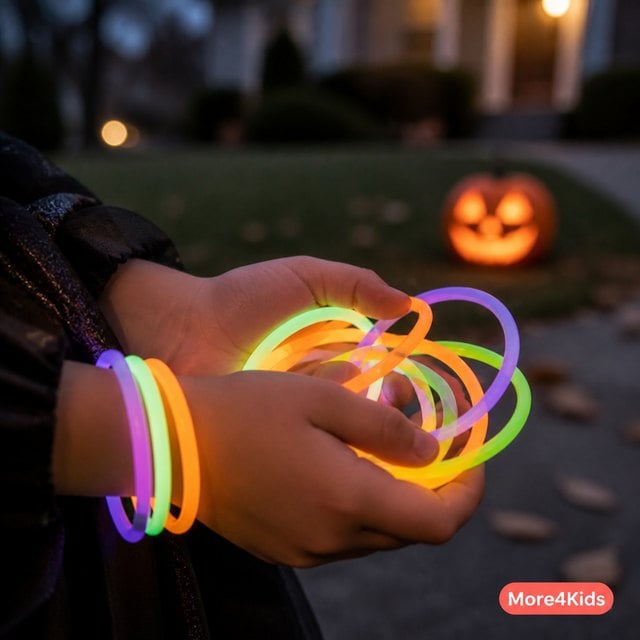
Add a flashlight or a glow bracelet on top of that, and now your child is visible and has light for the steps. We hand out a glow bracelet each as we leave the house; it has become one of my favorite small traditions, and it doubles as the thing that lets me spot my own kid in a herd of ten. If you are buying glow bracelets and glow sticks, keep them away from children under three — the connectors are small parts, and the liquid inside is not something a toddler should get hold of. For that age, reflective tape on the stroller or the bucket does the same job with nothing your child can pull off and put in their mouth.
What We’d Skip
No shopping links in this section, on purpose — just the recalls. These are the things we leave in the store.
Anything light-up with an accessible battery door. This is the one that has changed most for us since we started publishing recall data. Button and coin batteries are in an enormous number of cheap light-up party favors, and when a small child gets one out and swallows it, it can cause serious injuries, internal chemical burns and death — that is CPSC’s own wording, not ours. This is not a theoretical risk: Gavoyeat Halloween Light-Up Rings — a 50-pack of light-up party favor rings, each with three preinstalled button cells — were recalled in 2026 specifically because the battery compartment could be easily opened by children. Light-up wearables are one of the most recall-heavy categories we track. If you do buy one for an older child, the battery door must require a screwdriver, full stop, and it does not go in a house with a baby.
Costume contact lenses. Decorative contacts sold without a prescription are not a costume accessory; they are a medical device being sold as a toy, and they can scratch a cornea or cause an infection. If your teen wants them, that is a conversation with an eye doctor, not a checkout cart.
Loose small accessories for under-3s. Clip-on fangs, tiny gemstones, doll-sized props, anything smaller than a toilet paper tube. If it fits through the tube, it fits in a windpipe.
Magnetic accessories for young children. Small high-powered magnets are the hazard I dread most. When more than one is swallowed, they can attract each other through the intestinal wall and pinch it between them. Goody King’s magnetic building cubes were recalled this August; CPSC’s notice reports two children who ingested magnets and required surgery to remove them, plus at least 27 reports of the cubes breaking open. Magnetic costume clasps and jewelry sit in the same family.
Sharp or rigid props. Swords, wands, staffs and scythes should be soft and flexible enough to bend if a child falls onto one — which they will, because they are running.
Novelty makeup that arrives without an ingredient list. If you cannot find out what is in it, it does not go on a face.
None of that list makes anyone a killjoy. Good Halloween costume safety is subtraction, not sacrifice. Every single item on it has a fun, safe substitute, and your child will not notice the swap.
The Halloween Costume Safety Rule We Use for Accessories
One line, and it settles most arguments in the store: if it does not pass the stairs, the dark, or the tube, it does not come home.
- The stairs — can they walk up and down a flight in it, carrying a bucket, without looking at their feet?
- The dark — would a driver pick them out well before they are close, from any side?
- The tube — is every removable piece too big to fit through a toilet paper tube?
One addition to the tube test: anything that lights up. Light-up rings, glowing wands, LED headbands and clip-on badges usually run on button cell batteries, and a swallowed button battery can burn through a child’s oesophagus in about two hours. We have logged 23 button battery recalls this year alone, including Halloween light-up rings handed out as party favours. Before it goes in the bucket, check that the battery compartment needs a screwdriver to open. If it pops open with a fingernail, it is not coming home with us.
That is the entire Halloween costume safety check, and it takes less time to run than it takes your child to decide between two shades of purple.
Your Five-Minute Halloween Costume Safety Check
Run this final Halloween costume safety pass on the night, in the front hall, with shoes already on:
1. Hem clears the shoes. Cape releases with a tug. 2. Mask pushed up, or face paint on and no one is scratching at it. 3. Reflective on front, back and sides. Glow bracelet or flashlight in hand. 4. Nothing in the outfit or the bucket that fits through a tube — this matters most if you have a younger sibling coming along in a stroller. 5. Your phone number written on their wrist or tucked in a pocket, and a quick “what do you do if you can’t see me?” out loud.
That last one has nothing to do with costumes and it is the one I would keep if I could only keep one.
Where Costume Safety Fits in the Rest of the Night
Halloween costume safety is the part parents shop for, so it gets the attention, but they are one piece of a bigger evening. If you want to think the rest of it through, Halloween safety tips covers the walking route, the candy check and the group plan, and Halloween home safety covers your own porch — the steps, the walkway lighting and the open flames that everyone else’s children will be walking past.
If you have a toddler, Halloween ideas for toddlers is a gentler starting point, and if you are making the costume yourself, making your own Halloween costumes lets you build the safety features in from the first cut instead of retrofitting them.
And if you want to know what has actually been pulled from shelves this year before you buy anything at all, our product recall center is updated from CPSC data as recalls are issued. It is the reason this article says what it says.
Frequently Asked Questions
At what age can my child wear a Halloween mask?
There is no magic age, because it depends entirely on the mask and the child. The test is functional, not numerical: put it on, stand them in a hallway, and see whether they can spot you approaching from the side without turning their head. If they cannot, it is a mask for photos and porches, not for walking. For most children under about eight, face paint is the easier answer.
Are store-bought costumes flame resistant by default?
No, and this is the most common misunderstanding in Halloween costume safety. Children’s sleepwear is covered by a federal flammability standard. Costumes generally are not held to that same standard, which is why the label matters so much and why you should not assume.
Is glow-in-the-dark the same as reflective?
They are completely different, and the difference matters after dark. Glow-in-the-dark material emits its own faint light and fades over the course of an evening. Reflective material bounces a car’s headlights straight back at the driver, and it works from much farther away. Glow is fun. Reflective is the one doing the safety work. Ideally your child has both.
Do we still need reflective gear for a trunk-or-treat?
Yes u2014 arguably more. A parking lot at dusk is full of slow-moving cars, reversing vehicles with limited sightlines, and children moving unpredictably between them. It is a different risk profile from a sidewalk, not a smaller one.
What is the single highest-value Halloween costume safety fix?
Visibility, without much competition. Hemming prevents falls and the label matters near flames, but our read is that being seen by a driver is the one addressing the most serious kind of harm u2014 and it takes about four minutes.
One Last Thing
I have never once had a child upset that I hemmed a costume or stuck reflective tape on a bucket. I have had a child heartbroken about a costume being vetoed outright — which is why almost everything in this guide is a small modification rather than a no.
Halloween costume safety is mostly this: buy the one with the label, hem it, make them visible, skip the batteries and the tiny parts, and then go enjoy watching your kid be a dragon. The five minutes you spend on the front end is what lets you stop thinking about it for the rest of the night.
Have a good one. Take the picture on the porch before the candy.
Related Articles
- Michley Children S Pajamas Recall
- Gavoyeat Halloween Light Up Rings Party Favors Recall
- Goody King Magnetic Building Cubes And Blocks Recall
- Halloween Safety Tips
- Halloween Home Safety
- Halloween Ideas For Toddlers

Meet Sophia Richards Sophia Richards is an early childhood educator, passionate writer, and the proud mom of three energetic kids. With a degree in Education and over a decade of hands-on classroom experience, Sophia bridges the gap between professional teaching strategies and everyday family life. At More4Kids, she translates complex child development concepts into practical, actionable parenting tips that families can use at home.
Whether she is sharing positive reinforcement techniques, educational crafts, or honest reflections on the chaos of raising three children under one roof, Sophia’s goal is to empower parents to foster resilience and joy in their kids. When she isn't writing or lesson planning, you can find her organizing neighborhood scavenger hunts or trying out new kid-friendly recipes.
Areas of Expertise: Early Childhood Education, Positive Parenting, Sibling Dynamics, Educational Play, Family Wellness.

Add Comment