









By Sophia Richards
Last Halloween my youngest was eight months old, and I had this idea in my head of the four of us matching — a whole woodland-creatures thing, fox ears for everyone, very cute in my imagination. We got as far as the driveway before she pulled her own ear headband off, chewed on the elastic, and started fussing in a way that made it clear the headband was going in my pocket for the rest of the night. My older two didn’t care. They ran the block twice. The baby rode in the carrier in a plain fleece bunting and slept through most of it.
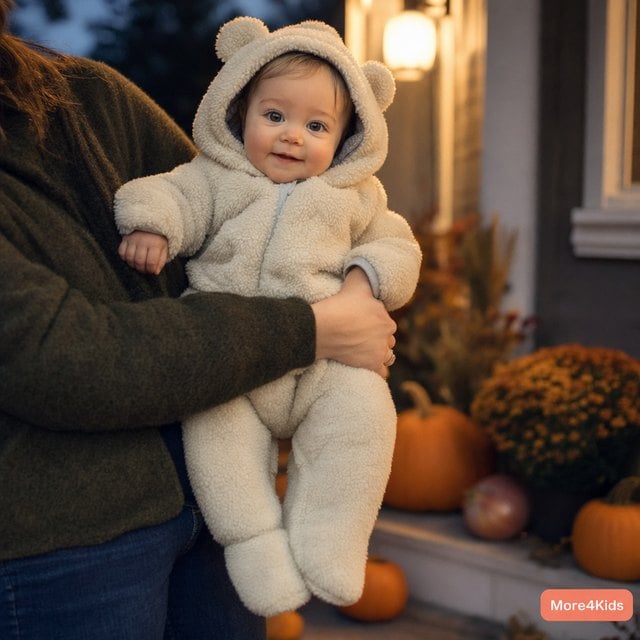
That’s basically the whole lesson of family halloween costumes with baby: the baby doesn’t need to match. She needs to be warm, comfortable, and not wearing anything near her face. Everyone else can have the fun theme. This piece is about how to build a family costume plan that includes a baby without the baby becoming the reason the evening falls apart — what actually works, what to skip, and how to think about the parts of the night that have nothing to do with the costume at all.
The baby’s job is different from everyone else’s
Table of Contents
Every older kid in the family costume has the same job: look like the character, walk the route, hold up for a couple of hours. A baby has a completely different job, which is just to stay regulated — not too hot, not too cold, not overstimulated, not stuck in something she can’t signal discomfort about until she’s already miserable.
Once I started thinking about it that way, the planning got a lot easier. The baby’s “costume” is really just baby’s actual outfit, dressed to a theme, with the same rules you’d already use for any cold-weather outing: layers, no loose pieces near the face, and an easy way to check on her without unwrapping half a costume to get to a diaper.
If your family theme genuinely doesn’t work without every member in a distinct costume, that’s worth reconsidering for the year the baby is very small. A theme that scales down to “everyone but the baby is fully costumed, and the baby’s onesie or bunting just picks up the color palette” is not a compromise — it’s the version that actually survives contact with a real evening.
Baby-safe basics for family halloween costumes with baby
A few rules cover almost every mistake I’ve seen (and made) with a baby in a family costume lineup:
No masks, ever, at any age under about three. A baby or young toddler in a full face mask can’t easily signal that she’s overheated, can’t see well enough to judge her footing if she’s mobile, and a mask that shifts can genuinely restrict breathing for a very small child. This isn’t a “some parents are extra careful” thing — it’s one of the more consistent warnings across pediatric safety guidance, and it’s the easiest rule to follow because there’s no good version of a baby mask. Skip it entirely.
No tight elastic near the head or neck. Ear headbands, tight hoods with drawstrings, anything with elastic that could catch or leave a mark — babies pull at anything near their face, and a headband that seemed secure in the store can end up as a choking or strangulation risk if she gets it wrapped around a hand or, worse, works it toward her mouth. A soft, loose hood that she can’t cinch is a completely different level of risk than an elastic headband.
No small attached decorations. Sequins, tiny buttons, bows on elastic loops, anything glued or stitched on that could work loose — apply the toilet-paper-tube test. If a piece is small enough to pass through a cardboard tube, it’s a choking hazard for a baby who mouths everything, which is most babies. A costume with a printed design has the same visual effect with none of the risk.
Temperature regulation over theme accuracy. A baby overheats faster than an older kid in the same costume-plus-layers setup, partly because she can’t tell you she’s too warm and partly because infant thermoregulation just isn’t as efficient yet. Dress for the actual temperature at trick-or-treat time, not for how the costume photographs. A breathable cotton or fleece base layer under a light costume topper beats a thick all-in-one suit almost every time.
Easy diaper access. If the “costume” is a full bunting or one-piece suit with no opening, you’re doing a full unzip-and-redress every diaper change, in the cold, possibly on a porch. Snap closures at the bottom or a costume that’s really just a themed layer over a normal onesie solve this before it becomes a problem.

Themes that scale down to a baby without a fight
The best family themes for a year with a baby in the mix are the ones where the baby’s role can be “wears a soft, simple version of the palette” rather than “performs a specific character.”
Animal family. A fox family, a bear family, a duck family — pick one and let the older kids wear the full ears-and-tail version while the baby just wears a plain, soft hooded bunting in the same color with maybe a printed (not attached) face on the front. Nobody looking at the photo will think the baby is “less” in costume; she reads as part of the set.
Storybook cast. If you’ve got a favorite book, the baby can be cast as the smallest or quietest character — the one who gets carried, rides along, or just watches. That role exists in most stories anyway, and it means the baby’s outfit can be simple without breaking the concept.
Color-coordinated instead of character-matched. This is the one I’d actually recommend if the baby is under about a year: skip the literal matching costume entirely and coordinate on a color palette instead. Everyone in orange and black, or everyone in a jewel-tone theme, with the older kids doing full costumes and the baby just in a onesie or bunting in the family color. It photographs just as well and removes every single safety concession you’d otherwise have to make for her outfit.
A theme built around what you’re already carrying. If you’re using a stroller or a baby carrier, build the theme around that piece of equipment instead of around the baby’s clothing — a stroller decorated as a pumpkin patch wagon, or a carrier with a simple themed cover, lets the visual concept exist without asking the baby’s actual outfit to do anything but keep her warm.
I’ll be honest about the one thing that doesn’t really work: trying to put a baby in a literal miniature version of a specific character costume with the same accessories as the older kids. It looks great in the store and for about four minutes at home. Somewhere between the car seat and the first porch, the hat comes off, the cape gets balled up, and you’re carrying more costume than the baby is wearing.
Costumes that actually work in a stroller or carrier
However you’re moving a baby around the neighborhood, the costume needs to work with that setup, not against it.
Stroller. A costume with any bulk at the back — a big attached tail, a stiff cape, a padded shell — fights the stroller seat and usually ends up bunched or removed within the first block. A flat-backed bunting or a simple front-facing themed layer travels much better. If it’s cool out, a themed stroller blanket or cover does more visual work than the outfit itself, and it’s one less thing zipped tight against her.
Carrier. If you’re babywearing, skip anything with a stiff structure, a hood that can’t fold flat, or leg openings that fight the carrier’s leg positioning. A soft, stretchy layer that moves with her — and with you — is the only version that survives an actual walking route. Whatever carrier you use, follow its own fit and positioning instructions over any costume’s marketing photos; the carrier’s safety comes first, and the costume is layered over that, not the other way around.
Either way, check her regularly. Every fifteen minutes or so, glance at her face and hands. Flushed cheeks, sweaty hair at the neckline, or hands that feel notably warmer than yours are your cue to peel a layer, not push through to the end of the block.

Timing the night around a baby’s actual schedule
This is the part that made the biggest difference for us, and it has nothing to do with the costume: go earlier than you think you need to.
Healthychildren.org, the American Academy of Pediatrics’ parent site, recommends trick-or-treating while it’s still light out when your schedule allows it, specifically so a baby or toddler’s regular bedtime routine doesn’t get thrown off — and if trick-or-treating in your area doesn’t start until after dark, they suggest checking a local library, rec center, or community page for an earlier daytime event instead. That one shift solved more problems for us than any costume decision did: better light for photos, an easier temperature window in most climates, and a baby who was tired but not overtired by the time we got home.
The same source also has a genuinely useful tip worth repeating here: pack a “Plan B” outfit. Between a diaper blowout, spit-up, or a costume that turns out to be scratchier than expected once she’s actually wearing it, having a plain backup onesie in the diaper bag means one bad moment doesn’t end the whole outing.
Watch for the obvious overstimulation signs too — a baby who’s rubbing her eyes, arching away from noise, or going stiff in your arms is telling you the night is over for her, even if the older kids have another hour in them. It’s completely fine to split up: one parent finishes the route with the older kids, the other heads home early with the baby. Nobody’s Halloween gets ruined by that.
Matching family costumes without overcomplicating it
If you do want the classic matching-family-costumes photo, here’s the version that’s held up for us: buy or build the older kids’ pieces first, in a theme with a clear color story, and then dress the baby last in whatever piece of that palette is simplest — a plain onesie, a soft hooded bunting, or even just a themed bib over normal clothes. The photo reads as coordinated because of the color and the concept, not because every family member is wearing an identical structured costume.
If you’re shopping, browsing matching family halloween costume sets is a reasonable starting point for the older kids’ and adults’ pieces — just plan to swap out whatever the baby’s version of the set includes for a simpler, softer layer using the same color, rather than the literal miniature costume that ships with most matching sets. For the baby’s own piece specifically, soft baby Halloween costumes without a mask or attached small pieces tend to be the safest starting point — look for snap closures, an open face, and nothing elastic near the head before you buy.
As an Amazon Associate, More4Kids earns from qualifying purchases. We only recommend products we would use in our own homes, and we check every brand against current CPSC recall data before it appears here. Our recommendations are never paid placements.
If you’re using a stroller for the night, a soft fleece stroller bunting or cover in your family’s color does a lot of the visual “matching” work without asking the baby to wear anything structured at all.
For the older siblings walking the route
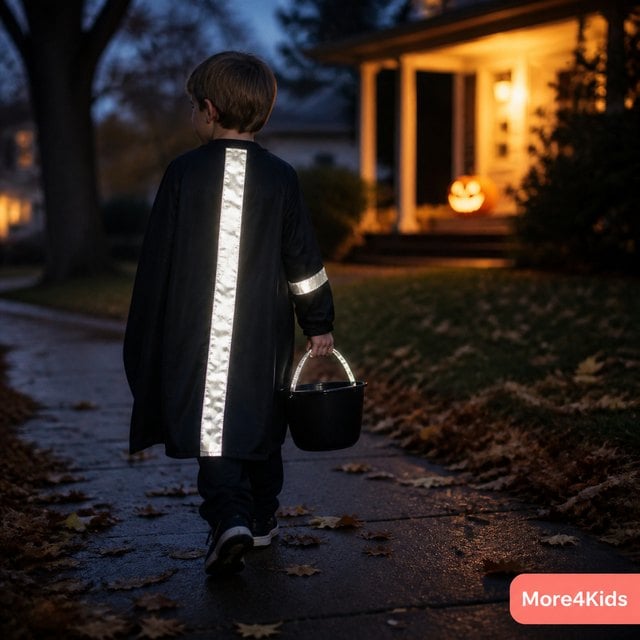
If you’ve got older kids trick-or-treating alongside a baby who’s riding in a stroller or carrier, the family unit as a whole needs to stay visible after dark — both for cars and for each other in a crowded neighborhood. This overlaps with a topic we’ve covered in more depth: our halloween costume safety guide walks through hem length, visibility, and the small checks worth doing before anyone leaves the house, and it applies just as much to the year there’s a baby along for the ride.
A sibling who’s sensitive to scratchy fabric, tight collars, or an unfamiliar costume texture isn’t unusual, and it’s worth reading through our sensory-friendly halloween costume ideas if that’s part of your family too — a lot of the same soft-fabric, no-mask, easy-on-easy-off thinking that keeps a baby comfortable applies directly to a sensory-sensitive older kid.
And if the actual walking route feels like a lot with a baby in tow, trunk-or-treat is worth considering as a lower-effort alternative for the year the family includes an infant — a single stationary lot instead of a long block-by-block walk, which is a lot easier to manage with a stroller and a diaper bag.
What we’d skip
A few things I wouldn’t put on a baby in a family costume lineup, regardless of how good they look in the store:
- Literal miniature versions of a specific character costume, especially ones with stiff structure, attached hats, or small trim pieces. They photograph well for a few minutes and cause more fuss than they’re worth.
- Anything with elastic straps or headbands near the face — ears, antennae, tiny crowns. Babies pull at exactly this kind of thing.
- Wigs of any kind. Hot, itchy, and easy for a baby to pull off and mouth.
- Face paint or makeup on a baby’s skin. Even labeled “non-toxic” products aren’t formulated with infant skin sensitivity in mind, and a baby can’t tell you it’s stinging her eyes.
- A costume with no diaper access. If changing her means fully undressing the costume, you’ll be doing that on a stranger’s porch step at some point in the evening.
- Spray-on hair color or temporary tattoos on an infant. Both are unnecessary skin exposure for a baby who has no say in the matter.
A parent’s honest take
The year my youngest was a baby, I let go of the matching-family-costume idea I’d had in my head, and honestly, the night was better for it. She wore a plain cream fleece bunting with a little knit hood, no theme at all beyond “warm and soft,” and rode the whole route in the carrier looking, frankly, adorable by accident. The older two got the elaborate costumes they’d actually asked for. Nobody spent the evening readjusting a headband on a baby who didn’t want it there.
If you get the matching photo, great — it’s a genuinely sweet thing to have. But I’d rather have an evening where the baby stayed comfortable and everyone came home without a meltdown than a coordinated photo where she spent the whole night fighting her own costume. Most years, you can actually have both. The year she’s very small usually isn’t that year, and that’s fine.
Frequently Asked Questions
Is it safe for a baby to wear a Halloween costume?
Yes, with a few adjustments: skip masks entirely for any child under about three, avoid elastic headbands or anything tight near the face and neck, choose soft fabric with no small attached decorations, and prioritize easy diaper access and temperature regulation over an exact character match. A plain, soft bunting or onesie in your family’s color usually works better than a structured miniature costume.
What should a baby wear for a family Halloween costume theme?
The simplest and safest option is a soft hooded bunting or onesie in the family’s color palette, without a mask, elastic headband, or small attached pieces. The baby doesn’t need to be dressed as the exact same character as older siblings — coordinating on color rather than costume structure gets the same photo result with far fewer safety trade-offs.
How late should you take a baby trick-or-treating?
Going out while it’s still light, before a baby’s usual bedtime, tends to work better than an after-dark route — it keeps her regular sleep schedule closer to normal and gives you better visibility and easier temperature judgment. If trick-or-treating in your area doesn’t start until dark, an earlier daytime Halloween event at a library or recreation center can be a good substitute for the youngest family member.
What Halloween costume accessories should I avoid for a baby?
Skip masks, tight elastic headbands or ear pieces, wigs, face paint, and any costume with small attached trim like sequins, buttons, or bows on elastic loops. Apply the toilet-paper-tube test to anything small enough to be handled — if it fits through the tube, it’s a choking risk for a baby who mouths everything.
Can a baby wear a costume in a stroller or baby carrier?
Yes, but choose a flat, soft, non-structured layer rather than a costume with a stiff back, big attached tail, or bulky cape — those fight the stroller seat or carrier fit and usually end up removed within the first block. A themed stroller cover or a soft carrier-friendly layer that follows the carrier manufacturer’s own fit instructions works much better than a store-bought costume built for standing and walking.
Related Articles

Meet Sophia Richards Sophia Richards is an early childhood educator, passionate writer, and the proud mom of three energetic kids. With a degree in Education and over a decade of hands-on classroom experience, Sophia bridges the gap between professional teaching strategies and everyday family life. At More4Kids, she translates complex child development concepts into practical, actionable parenting tips that families can use at home.
Whether she is sharing positive reinforcement techniques, educational crafts, or honest reflections on the chaos of raising three children under one roof, Sophia’s goal is to empower parents to foster resilience and joy in their kids. When she isn't writing or lesson planning, you can find her organizing neighborhood scavenger hunts or trying out new kid-friendly recipes.
Areas of Expertise: Early Childhood Education, Positive Parenting, Sibling Dynamics, Educational Play, Family Wellness.

Add Comment