
















By Sophia Richards
The question came up in my kitchen the way most big parenting questions do: sideways, over a sticky counter, while I was trying to do four other things. One of my kids had just finished wiping down the table and looked up at me with a hopeful little face and asked, “So how much do I get for that?” I froze for a second, dish towel in hand, because I honestly didn’t have a clean answer. Should helping out at home come with a paycheck? Or is pitching in just part of being in a family? That messy little moment is where the whole chores and allowance debate lives, and if you’ve wrestled with it too, you’re in very good company.

Here is the honest truth up front: there’s no single right answer, and any expert who tells you otherwise is selling something. Thoughtful, loving parents land in different places on this, and their kids turn out just fine. What matters far more than the exact system is that you pick an approach on purpose, explain it clearly, and stay consistent enough that your child knows what to expect. As a mom of three and an early-childhood educator, I’ve tried this a few different ways, changed my mind more than once, and finally settled into something that works for us. Let me walk you through what I’ve learned about chores and allowance so you can build the version that fits your family.
What “Chores and Allowance” Actually Means
Table of Contents
Let’s start by pulling the two apart, because they aren’t the same thing and treating them as one is where a lot of the confusion begins.
Chores are the routine tasks that keep a household running: clearing the table, feeding the dog, sorting laundry, taking out the trash. They’re the ordinary work of living together, and every member of a family, down to the smallest, can do some version of them. An allowance is money you give your child on a regular basis, usually weekly, that they get to manage themselves. It’s a teaching tool for money, not a reward for existing.
The reason chores and allowance get tangled together is that the obvious-seeming move is to connect them: do the work, get the money, just like a job. That instinct is completely understandable. But whether you should actually link the two is the real heart of this whole conversation, and it deserves more than a knee-jerk answer. Before we get there, it helps to be clear on why chores matter in the first place, because that reason shapes everything else.
Why Chores Matter, With or Without Money
Chores aren’t busywork, and they aren’t about you getting a cleaner house, though that’s a nice bonus. They’re genuinely good for children’s development. The American Academy of Child and Adolescent Psychiatry notes that research suggests benefits to including chores in a child’s routine as early as age three, and that children who do chores may show higher self-esteem, be more responsible, and be better equipped to handle frustration, adversity, and delayed gratification. Those are not small things. They are the exact skills that carry a person through school, work, and relationships for the rest of their life.
The list of specific benefits is worth sitting with. Through regular chores, kids build time-management and organizational skills, learn to accept responsibility as part of the family, get real opportunities to succeed at something concrete, and start balancing work and play early. AACAP frames chores as a foundation for functioning independently one day, which is, when you think about it, the whole job of parenting in miniature.
The American Academy of Pediatrics agrees that age-appropriate chores are an important part of a child’s development and that helping keep the home running smoothly actually boosts a child’s self-esteem. Young children, the AAP points out, are naturally eager helpers, so the earlier you invite them into the teamwork of a household, the more it just becomes normal. If you’re not sure which jobs suit your child’s age, our guide to age-appropriate chores for kids breaks it down stage by stage so you’re not guessing.
Notice that none of these benefits require money. A child gets the self-esteem, the responsibility, and the life skills from doing the chore itself, not from being paid for it. That’s a crucial point to hold onto, because it reframes the money question entirely. Allowance is not the reason chores are valuable. Which brings us to the debate everyone actually wants settled.
The Big Question: Should You Tie Allowance to Chores?
There are two main camps here, and both have real merit. Let me lay them out fairly, because you deserve the actual trade-offs, not a sales pitch for one system.
### The case for paying kids for chores
The argument for tying allowance directly to chores is intuitive and honestly pretty compelling: it mirrors real life. In the adult world, work earns money. Parents in this camp believe that connecting effort to a paycheck teaches the work-to-money link early, motivates kids who might otherwise dodge their tasks, and gives an allowance a clear, understandable reason to exist. When my oldest was going through a phase of pure inertia, a “you get paid when the job is done” system did light a fire that nothing else had. There’s something to it.
The AAP itself acknowledges this approach, noting that among ways to motivate a reluctant child, you may want to consider tangible rewards like allowances and stickers tied to completed chores. So paying for chores isn’t some fringe idea. It’s a legitimate, mainstream tool.
### The case for keeping them separate
The other camp worries about what a pure pay-for-chores system quietly teaches. If every contribution comes with a price tag, a child can start to believe that helping the family is optional unless there’s cash involved. You end up hearing “how much do I get?” for emptying a dishwasher that, frankly, they dirtied too. Parents in this camp keep a baseline of unpaid chores that everyone does simply because they belong to the family, and they give an allowance separately, as a steady tool for practicing with money. The chores teach responsibility; the allowance teaches money management; the two just aren’t welded together.
### The middle path that works in our house
After trying both, I landed somewhere in between, and it’s the setup I recommend most often to friends. We keep a short list of baseline family chores that are never paid, because contributing to the home you live in isn’t a job, it’s membership. On top of that, we offer a handful of bigger “extra” jobs, the washing-the-car, weeding-the-garden kind, that a child can choose to do to earn money. Everyone still gets a small base allowance to practice managing, separate from the chores entirely. This way, chores and allowance both exist, they both do their real work, and neither one holds the other hostage. My kids learn that some things you do out of love and some things you can do to earn, which is a pretty accurate picture of adult life.
Whatever you choose, the key is to decide on purpose and say it out loud. A child who understands the rule can live within it. A child who is guessing will negotiate everything.
When to Start and How Much
You can start chores far earlier than you might think. AACAP points to benefits beginning around age three, and the AAP notes that most preschool-age kids can pitch in with simple tasks. A three-year-old putting toys in a bin is doing meaningful work. Start there, with tiny jobs, and grow the responsibility as your child does. Our overview of teaching kids responsibility by age can help you match the expectation to the child.
Allowance usually starts a little later, often around ages five to seven, when a child understands that money can be exchanged for things and can wait a few days for something they want. There’s no magic age, though. The real signal is whether your child grasps that coins and bills have value and can be saved. If they can, they’re probably ready for a small, regular allowance to practice on.
As for how much, I am going to gently decline to hand you a dollar figure as if it were a rule, because the right amount depends entirely on your family’s budget, your values, and what you expect the allowance to cover. A common, sensible approach many families use is a modest weekly amount that rises with age, but “modest” for one household isn’t “modest” for another, and that’s completely fine. Far more important than the number is that it’s predictable, that it’s small enough to leave room for wanting more, and that you can sustain it without resentment. An allowance you quietly stop paying because it strained the budget teaches the wrong lesson. Start lower than you think and adjust up; that’s a much easier direction to move.

How to Set Up Chores and Allowance Without the Nagging
This is where most systems quietly fall apart, so let me share what actually keeps chores and allowance running instead of dying in a heap of reminders and eye-rolls.
Make expectations crystal clear. The AAP is direct that you should carefully spell out the tasks your child must perform so they understand exactly what is expected on a daily and weekly basis, and it recommends introducing one new task at a time for a school-age child, because a long list can be overwhelming. “Please take the kitchen trash out after breakfast” beats “help around the house” every single time. AACAP echoes this: set clear, reasonable expectations and establish regular routines like “clean up before dinner.”
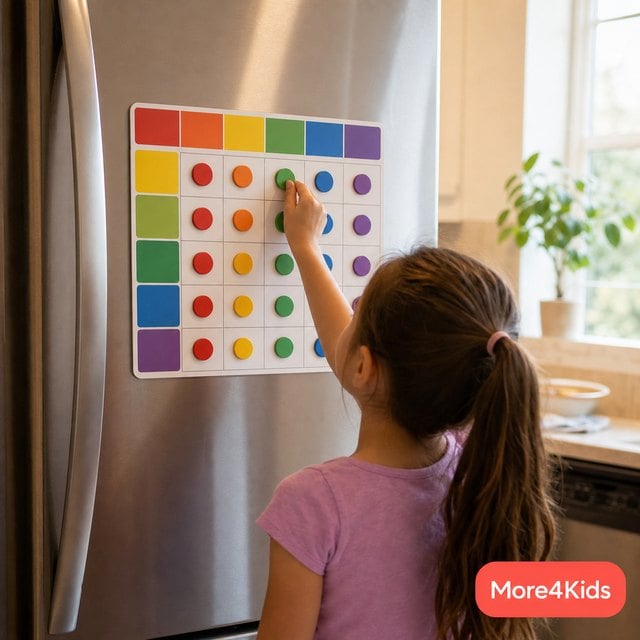
Use a chart, and let it do the nagging for you. Both the AAP and AACAP recommend a chore chart or star chart as a visual reminder that keeps everyone on task and gives a child a real sense of accomplishment as each item gets checked off. A chart on the fridge is neutral in a way your voice at 7 a.m. isn’t. The kids can see what is theirs without you saying a word.
Praise effort, not perfection. This one changed everything for me. The AAP reminds parents not to expect perfection, because chores are a learning process, and to praise your child’s effort in each task rather than the outcome. Honest praise, it says, is one of the most effective ways to motivate a child. If you redo their wobbly bed-making in front of them, you teach them not to bother trying. Let the lumpy bed stand.
Be consistent, and skip the badgering. AACAP stresses consistency, warning that changing rules and expectations creates confusion and frustration. And when a child chooses not to do their chores, the AAP suggests calm consequences, such as pausing a privilege, rather than nagging, because badgering and scolding are simply not effective. Notably, the AAP reminds us that electronic devices and screen time are privileges, not rights, which makes them a natural, logical consequence when work goes undone. You can find more calm strategies in our piece on chores and teaching responsibility.
Model it yourself. Kids learn to keep their space tidy far more easily when they watch the rest of the family doing the same. Chores land better as a family culture than as a punishment handed down from above.
Teaching Money Habits: Save, Spend, and Give
An allowance is only as valuable as the habits it builds, and this is where the real magic of the money side lives. The whole point isn’t that your child has a few dollars; it’s that they learn to make choices with those dollars while the stakes are gloriously low.
The Consumer Financial Protection Bureau runs a research-based program called Money as You Grow to help parents build children’s money skills, habits, and attitudes, and its most reassuring message for the rest of us is that you don’t need to be a money expert to raise a money-smart kid. The CFPB frames these conversations as something you adapt to wherever your child is developmentally, and it insists it’s never too early or too late to start. That takes the pressure off beautifully.
The simplest, most durable habit I know is the three-part split: save, spend, and give. When allowance day comes, help your child divide their money into a little to save toward something bigger, a little to spend freely and joyfully with no lecture attached, and a little to give to someone or something they care about. Three small jars or envelopes make it visible and concrete. Over months, your child watches the save jar grow into a real toy and feels, in their own hands, why waiting can be worth it. That lived experience of delayed gratification is worth more than any lecture you could deliver. For more on weaving money skills into everyday routines, our guide to life skills for early elementary kids is a gentle place to start.

Resist the urge to rescue every bad money choice. If your child blows their whole allowance on candy on day one and is broke when something better appears on day three, that sting is the lesson, and it’s a cheap one to learn at seven instead of twenty-seven. Let the small mistakes teach what your words can’t.
Common Mistakes to Avoid
A few traps catch almost everyone, myself included, so learn from my stumbles rather than your own.
The first is demanding perfection. When you criticize how the chore was done or redo it while your child watches, you drain all the pride out of the accomplishment and teach them that trying is pointless. The AAP is clear that this is a learning process; a job done imperfectly by a child is still a win.
The second is turning allowance into a bribe in the heat of the moment. Offering money to stop a meltdown or rushing to pay for a chore mid-tantrum teaches your child that big emotions are a negotiating tool. Keep the system calm and predictable, separate from the drama of any given afternoon.
The third is overloading. The AAP warns that assigning too many responsibilities can leave kids feeling overwhelmed and resistant to doing anything at all. A short list done consistently beats a long list done never. Start small and add slowly.
And the last is inconsistency, the quiet killer of every good intention. A system you abandon after two weeks teaches your child that rules are optional and that your word has a short shelf life. Better to pick a simple approach you can genuinely sustain than an elaborate one you will quit.

Frequently Asked Questions
Should I pay my child for doing chores or not?
Both approaches can work, so choose the one that fits your values and be consistent about it. Many families keep a baseline of unpaid chores that everyone does as part of belonging to the household, then offer pay for bigger extra jobs and give a separate small allowance for practicing money management. The AAP recognizes allowances tied to completed chores as one legitimate motivation tool, so there is no wrong answer as long as your child understands the rule clearly.
At what age should chores and allowance start?
Chores can begin remarkably early. AACAP points to benefits from around age three, and simple tasks like putting toys away suit even a preschooler. Allowance typically starts a bit later, often between ages five and seven, once a child understands that money holds value and can be saved for a few days. There is no perfect age; readiness matters more than the number on the birthday cake.
How much allowance should I give?
There is no universal figure, because the right amount depends on your budget, your family’s values, and what you expect the allowance to cover. A common approach is a small weekly amount that grows with age, but keep it modest and, above all, sustainable. Start lower than you think and adjust upward, since raising an allowance is far easier and happier than quietly cutting one.
What if my child refuses to do their chores?
Stay calm and lean on clear expectations and consistent, logical consequences rather than nagging, which the AAP notes is not effective. Pausing a privilege such as screen time, which the AAP calls a privilege rather than a right, is a natural response. Persistent, worsening refusal can occasionally signal a deeper struggle, and AACAP suggests talking with your pediatrician if the conflict escalates over time.
How do I teach my child to save instead of spending it all?
Make saving visible and concrete with a simple save, spend, and give split using three jars or envelopes. Watching the save jar grow toward a real goal lets your child feel the payoff of patience firsthand. The CFPB’s Money as You Grow program emphasizes that these everyday habits, practiced over time, are exactly how children build lifelong financial capability.
The Bottom Line
Chores and allowance are really two separate gifts you give your child that happen to sit near each other. Chores hand them responsibility, competence, and the quiet self-respect that comes from contributing to something bigger than themselves. An allowance hands them a safe, low-stakes place to practice the money decisions they will make for the rest of their lives. Whether you weld the two together, keep them apart, or land on a middle path like ours matters far less than choosing on purpose, explaining it kindly, and holding steady.
So the next time a hopeful little face looks up from a wiped-down table and asks how much they get, you will have an answer ready, and it will be yours. Start small, keep it clear, praise the effort, and let the everyday work of family life do its slow, wonderful job. You are not just raising a child who does chores or spends an allowance. You’re raising a capable, responsible, money-wise person, one ordinary afternoon at a time.
For more calm, practical help with the everyday work of raising kids, our parenting section is here whenever you need a steadier next step.
Related Articles
- Age Appropriate Chores For Kids
- Teaching Kids Responsibility
- Chores And Teaching Responsibility
- Life Skills For Early Elementary
- Parenting

Meet Sophia Richards Sophia Richards is an early childhood educator, passionate writer, and the proud mom of three energetic kids. With a degree in Education and over a decade of hands-on classroom experience, Sophia bridges the gap between professional teaching strategies and everyday family life. At More4Kids, she translates complex child development concepts into practical, actionable parenting tips that families can use at home.
Whether she is sharing positive reinforcement techniques, educational crafts, or honest reflections on the chaos of raising three children under one roof, Sophia’s goal is to empower parents to foster resilience and joy in their kids. When she isn't writing or lesson planning, you can find her organizing neighborhood scavenger hunts or trying out new kid-friendly recipes.
Areas of Expertise: Early Childhood Education, Positive Parenting, Sibling Dynamics, Educational Play, Family Wellness.




Add Comment