
















By Sophia Richards
If you are searching for how to help a child who gets frustrated easily, I want to start with the thing I wish someone had told me sooner: a child who melts down over a stuck zipper is not broken, spoiled, or behind. They are a small person whose feelings are, for now, bigger than the tools they have to handle them. I have watched all three of my kids hit that wall at different ages, and I have sat on the floor with plenty of families as an early childhood educator while a puzzle piece that would not fit turned into a full-body storm.

Frustration is not the enemy. It is a signal. It shows up the moment a child wants something they cannot yet do, say, or wait for. The zipper, the shoe, the tower that keeps falling, the sibling who touched the drawing, the word that will not come out right. For a child who gets frustrated easily, that gap between what I want and what I can do feels enormous, and their body reacts before their thinking brain ever gets a vote.
Here is the hopeful part. Frustration tolerance is a skill, not a fixed personality trait. The American Academy of Pediatrics notes that children build resilience and coping skills gradually, through supportive relationships and lots of low-stakes practice. That means your easily frustrated child can absolutely learn to cope. Not overnight, and not perfectly, but steadily, with a calm adult walking alongside them. This guide on how to help a child who gets frustrated easily walks through seven ways to do exactly that.
How to Help a Child Who Gets Frustrated Easily Starts With This Reframe
Table of Contents
Before the strategies, it helps to understand what is actually happening, because how we read the behavior shapes how we respond to it. When a child gets frustrated easily, adults around them often reach for labels: dramatic, sensitive, stubborn, too much. I understand the temptation. When you are late, tired, and your child is sobbing because the banana broke, “difficult” is the word that fits the moment.
But a low frustration tolerance is not a character flaw. It is a developmental stage crossed with temperament. Young children live in bodies that feel emotions at full volume while the part of the brain that manages those emotions is still under construction for years. Nemours KidsHealth explains that tantrums and frustration are a normal part of early development, especially when a child’s desires outpace their ability to communicate or wait, and that these moments tend to ease as language and self-control grow.
Temperament matters too. Some children are simply wired to feel things more intensely and to recover more slowly. Those are often the same kids who love hard, notice everything, and care deeply. The goal was never to erase that intensity. The goal is to hand them tools so their big feelings do not run the whole show.
A frustrated child is not giving you a hard time. They are having a hard time. That single reframe changes almost everything about how the next seven strategies land. The whole approach to how to help a child who gets frustrated easily rests on one gentle idea: we are patiently building frustration tolerance, not demanding it on schedule.
1. Stay Calm So You Can Lend Your Calm
The first and most important way to help a child who gets frustrated easily has nothing to do with the child. It is about you.
Children borrow regulation before they build their own. When your child is spinning out, their nervous system is scanning yours for a signal: Is this an emergency, or is this handle-able? If you match their storm with your own raised voice, the message is that things really are out of control. If you stay steady, you become the calm they can co-regulate with. Researchers call this co-regulation, and it is the quiet engine behind almost every strategy that works.
This is hard. I am not going to pretend I float through my kids’ meltdowns like a spa candle. But I have learned to buy myself three seconds. A slow breath. Unclenching my jaw. A private phrase I repeat: small body, big feeling, my job is calm. Sometimes I narrate it out loud in a low voice: “I’m right here. We’re okay. This is a big feeling and it will pass.”
You do not have to feel calm to act calm. Lower your voice instead of raising it. Slow your movements. Get down to their level. Your steady body is the most powerful tool in the room, and it teaches your easily frustrated child what regulation actually looks like from the inside out.
2. Name the Feeling Before You Fix the Problem
When a child gets frustrated easily, our instinct is to jump straight to solutions. Here, let me do the zipper. Just use the other cup. Stop crying and I’ll help you. It is loving, and it almost always backfires, because a flooded child cannot hear a solution yet.
Feelings first, fixing second. Naming what your child feels does something real in the brain: it helps move the experience from the panicky lower brain up toward the language and reasoning parts. You are not agreeing that the broken cracker is a tragedy. You are showing your child that their inner storm has a name and a witness.
Keep it simple and warm:
- “You’re so frustrated. That tower kept falling and you worked really hard on it.”
- “This is really hard right now. You wanted to do it all by yourself.”
- “You’re mad that it’s time to stop. I get it. Stopping something fun is tough.”
Notice there is no but in those sentences. The moment you add “but you still have to…” you cancel the empathy. Let the feeling land fully first. Once your child feels understood, their body settles, and then the thinking brain comes back online and can actually take in help. If naming feelings is new in your house, our guide on emotional regulation for kids offers gentle scripts you can practice when everyone is calm.
3. Shrink the Task and Scaffold the Win
A huge amount of childhood frustration comes from a task that is simply a size too big. The frustrated child is not refusing to cope; they are drowning in a challenge that outmatches their current skill by just a little too much.
The fix is scaffolding: quietly making the task smaller until success is within reach, then slowly stepping back as they grow. This is where an easily frustrated child can surprise you, because the intensity often flips into pride when the win finally lands.
Try these in the moment:
- Break it into pieces. Instead of “put on your shoes,” try “let’s get your toes in, then I’ll help with the strap.”
- Do the hard part together. “You start the zipper, I’ll pinch the bottom so it catches.” Shared effort is not failure. It is a bridge.
- Offer the just-right challenge. If the 100-piece puzzle ends in tears every time, put it away for now and celebrate the 24-piece one. Confidence is built on a stack of small wins, not one crushing struggle.
- Pre-teach when it’s calm. Practice the tricky skill during a relaxed moment, never in the heat of the meltdown.
Scaffolding is not doing it for them. It is holding the ladder steady while they climb one more rung than they could yesterday. Over time, you offer less, and they reach further. That gradual handoff is exactly how frustration tolerance gets built.

4. Teach a Calm-Down Plan Before You Need It
You cannot install a new skill during a meltdown any more than you can teach someone to swim while they are underwater. The work of helping a child who gets frustrated easily happens mostly in the calm hours in between. This is the quiet secret of how to help a child who gets frustrated easily: the coaching lands long before the storm, when their thinking brain is available and building frustration tolerance actually feels possible.
Sit down together when everyone is regulated and build a simple calm-down plan. Make it concrete, make it theirs, and keep it to two or three steps a young child can actually remember.
A plan might be:
1. Notice the body. “My hands get tight and my face gets hot.” Kids cannot use a tool if they miss the early warning signs, so help them learn their own. 2. Pick a reset. Blow out an imaginary birthday candle three times. Squeeze and release fists. Push against a wall like a strong tree. Go to a cozy corner with a pillow and a stuffed animal. 3. Come back and try or ask for help. The plan is not about disappearing. It is about resetting enough to re-enter.
Practice it like a game when nobody is upset. Draw it, act it out, let them “teach” it to a stuffed animal. Give the reset spot a friendly name, never a punishment name; this is a calm-down corner, not a time-out chair. When the real frustration hits, you are not introducing something new and scary. You are gently reminding: “Remember our plan? Let’s do the candle breaths together.”

5. Let Them Struggle a Little (This Is Where the Growth Lives)
This one is the hardest for loving parents, and I include myself. When your child gets frustrated easily, watching them wrestle with something feels almost physically uncomfortable. Every instinct says rescue. But if we swoop in every single time, we accidentally send the message: frustration is an emergency, and you can’t handle it without me.
Frustration tolerance is a muscle, and muscles only grow against a little resistance. Your job is not to remove every obstacle. It is to keep the struggle in the safe, productive zone and stay close while they work.
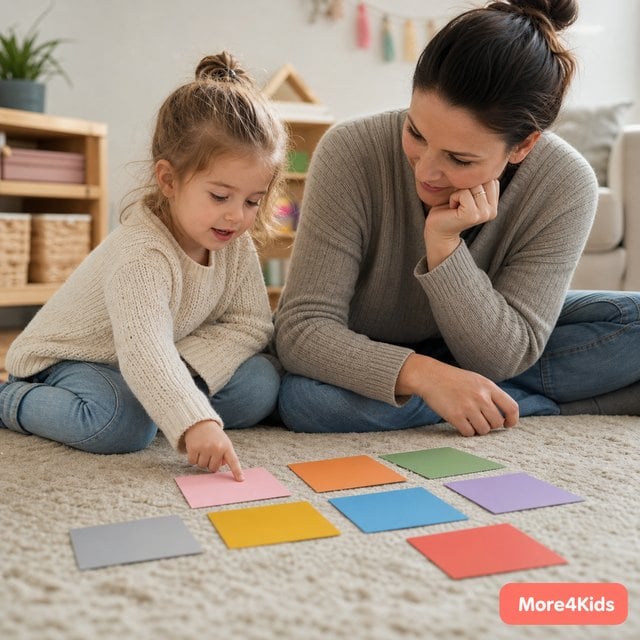
Watch for the difference between productive struggle and true overwhelm. Productive struggle looks like effort with grumbling, a few tries, a furrowed brow. That is gold; let it happen. True overwhelm looks like flooding, sobbing, hitting, or complete shutdown; that is your cue to step in and co-regulate, not to keep pushing.
When you do hold back, narrate your confidence instead of the answer: “This is tricky. I’ve seen you figure out tricky things before. I’m right here if you want a hint.” You are not being cold. You are being the steady presence that says, I believe you can do hard things. That belief, repeated over years, becomes the voice in their own head. Our piece on how to build confidence in a child digs deeper into praising effort over outcome, which pairs beautifully with this.
6. Adjust the Environment and the Timing
Sometimes the most effective way to help an easily frustrated child is not a new script at all. It is quietly removing the fuel that feeds the fire. A frustrated child is far more fragile when they are hungry, tired, overstimulated, or rushed, and most of the day’s biggest blowups cluster right around those windows.
You are not lowering your standards by doing this. You are setting your child up to succeed instead of ambushing them with challenges at their weakest moments. A lot of what looks like low frustration tolerance is really a child running on empty, and no amount of coaching competes with a full stomach and a rested body.
A few adjustments that quietly prevent frustration:
- Protect sleep and snacks. So many “he gets frustrated over nothing” afternoons are really a missed nap or a low blood sugar dip in disguise.
- Build in transition time. Sudden stops are frustration factories. Give a five-minute warning, a two-minute warning, and a predictable routine so change does not feel like an ambush.
- Reduce the pile-on. If mornings are a daily battle, look at the load. Too many steps, too little time, and too much noise overwhelm a developing brain fast.
- Match tasks to energy. Save the fiddly, patience-heavy activities for when your child is fed and rested, not for the ragged end of the day.
When cooperation is the sticking point rather than the task itself, our guide on how to get kids to listen has calm-connection strategies that reduce the standoffs before they start.
7. Model and Celebrate Coping Out Loud
Children learn frustration tolerance far more from what we do than from what we say. If they only ever see us hide our struggles or blow up over the traffic, we teach one lesson. If they catch us coping out loud, we teach another.
So narrate your own small frustrations on purpose: “Ugh, this jar is really stuck. I’m getting frustrated. Okay, deep breath. Let me try running it under warm water.” You just handed your child a live demonstration that frustration is normal, survivable, and workable, all without a single lecture.
Then celebrate coping when you see it, and be specific. We are quick to praise the finished product and slow to notice the effort. Flip it:
- “You were so frustrated with that drawing, and you took a break and came back. That’s exactly how it’s done.”
- “I saw you ask for help instead of throwing the game. That took a lot of self-control.”
- “That was really hard and you stuck with it. I’m proud of how you kept going.”
Praising the coping, not just the outcome, tells your child that the process of handling big feelings is the real win. Over time, that is how a child who gets frustrated easily slowly becomes a child who knows, deep down, this is hard, but I can handle hard things. On the roughest days, when the low frustration tolerance seems to be winning, our thoughts on surviving whining and low-patience moments are a reminder that you are not doing it wrong. You are doing something genuinely difficult, and slowly, it works.
When Frustration Might Be Something More
Big feelings are normal, and so is a wide range of frustration tolerance from one child to the next. Most easily frustrated kids simply need time, practice, and a patient adult. That said, you know your child best, and it is always okay to ask for support.
It can be worth a gentle conversation with your pediatrician if the frustration feels far more intense or frequent than other children the same age, if it regularly involves hurting themselves or others, if it is not improving at all over many months of steady support, or if it comes bundled with big struggles around attention, learning, sleep, sensory experiences, or communication. Reaching out is not an overreaction and it does not mean you failed. It means you are a tuned-in parent gathering more tools. Sometimes an extra set of professional eyes is exactly the support a family needs, and there is real relief on the other side of asking.
For most families, though, the seven strategies above, repeated with patience over months, are enough to help a child who gets frustrated easily grow steadier, more capable, and more sure that their big feelings will not swallow them whole. Frustration tolerance grows in the ordinary moments, one lent breath and one small win at a time. You are not aiming for a child who never gets frustrated. You are raising one who knows what to do when they are. For more calm, practical support, our full parenting section is always here.

Frequently Asked Questions
Why does my child get frustrated so easily over small things?
To a young child, the “small” things are not small. A broken cracker or a stuck zipper collides with a brain that is still learning to manage disappointment and a body that feels emotions at full volume. When a child gets frustrated easily, it usually reflects a normal gap between what they want to do and the self-regulation skills they have built so far. That gap narrows with age, practice, and a calm adult who helps them name and ride out the feeling.
Is a low frustration tolerance something my child will grow out of?
Frustration tolerance is a skill that develops gradually, and most children do become steadier as their language, thinking, and self-control mature, especially with supportive practice at home. It is less about waiting to “grow out of it” and more about actively coaching the skill over time. Naming feelings, scaffolding hard tasks, and celebrating coping all speed the process along. Some intense, sensitive kids simply take a bit longer, and that is within the normal range.
How do I stay calm when my child's frustration triggers my own?
Start by giving yourself permission to be human; you will not be perfectly calm every time, and that is okay. Buy three seconds with a slow breath before you respond, lower your voice instead of raising it, and use a private phrase to steady yourself. Remember that you are lending your calm, not fixing the feeling. If you lose it, repair afterward: “I got frustrated and raised my voice. I’m sorry. Let’s both take a breath.” That models exactly the recovery you want your child to learn.
Should I let my child struggle, or step in and help?
Both, at the right moments. Let your child sit in productive struggle, which looks like effort, grumbling, and a few tries, because that is where frustration tolerance actually grows. Step in to co-regulate when it tips into true overwhelm, which looks like flooding, sobbing, or shutdown. A helpful middle path is to scaffold: do the hardest part together while they do the rest, then slowly hand over more as their skill grows.
What should I avoid saying to a frustrated child?
Skip the phrases that dismiss the feeling or rush past it, like “calm down,” “it’s not a big deal,” “stop crying,” or empathy followed by “but.” A flooded child cannot take in logic or corrections yet, and being told their feeling is wrong usually pours fuel on the fire. Lead with connection first: name the feeling, get close, lower your voice. Save the teaching, the limits, and the problem-solving for after their body has settled and their thinking brain is back online.
Related Articles
- Emotional Regulation for Kids
- How to Build Confidence in a Child
- How to Get Kids to Listen
- How to Deal With a Whining Child
Related Articles
- Emotional Regulation For Kids
- How To Build Confidence In A Child
- How To Get Kids To Listen
- How To Deal With Whining Child
- Parenting

Meet Sophia Richards Sophia Richards is an early childhood educator, passionate writer, and the proud mom of three energetic kids. With a degree in Education and over a decade of hands-on classroom experience, Sophia bridges the gap between professional teaching strategies and everyday family life. At More4Kids, she translates complex child development concepts into practical, actionable parenting tips that families can use at home.
Whether she is sharing positive reinforcement techniques, educational crafts, or honest reflections on the chaos of raising three children under one roof, Sophia’s goal is to empower parents to foster resilience and joy in their kids. When she isn't writing or lesson planning, you can find her organizing neighborhood scavenger hunts or trying out new kid-friendly recipes.
Areas of Expertise: Early Childhood Education, Positive Parenting, Sibling Dynamics, Educational Play, Family Wellness.

Add Comment