


By Sophia Richards
The first truly cold morning of the year, I stood in my own front hallway holding a perfectly good puffy coat while my middle one stood three feet away in a T-shirt, arms clamped to her sides like I was coming at her with a cactus. It was twenty-eight degrees. The bus was coming. Her brother was already out the door, and here we were in a standoff over a coat she had happily worn, I swear, eleven months earlier. I remember thinking, I have fed, clothed, and kept this child alive for years, and I cannot get one jacket onto one small body. If your cold mornings have a version of this — a child who won’t wear a coat, who goes stiff and furious the second the sleeve comes near, or who sheds it in the parking lot the instant your back is turned — put the coat down for a second and sit with me, because when your child won’t wear a coat, you are not failing at the one simple job of keeping them warm, and there is a calmer way through.
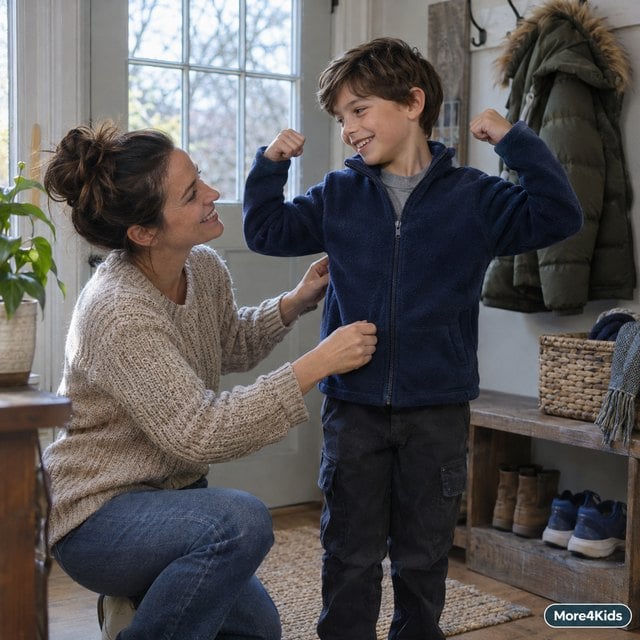
Here’s the short version, and then we’ll take it apart together: a child who won’t wear a coat is almost never being difficult just to wind you up. Under the refusal there’s usually a very ordinary mix — a fierce, developmentally normal need for control, a coat that genuinely feels bad on their body (heavy, scratchy, too hot, pinning their arms), and the plain fact that busy little kids run warm and don’t register cold the way we do until they’re already miserable. It feels like defiance on an icy morning when you’re late. It’s mostly a little person who can’t yet say this thing is uncomfortable and I didn’t get a vote. There’s one piece of this that surprises almost every parent — the car seat — where the coat you’re fighting to put on is actually the one you’re supposed to take off, and I’ll show you exactly why. Let me walk you through what’s really going on, and seven calm, doable ways to turn the morning coat battle into something closer to peace.
What It Really Means When Your Child Won’t Wear a Coat
Table of Contents
The most freeing thing I ever learned about the coat war is that it is rarely about the coat. Putting on a jacket sits right on top of something toddlers and preschoolers find genuinely hard — being told what to do with their own body — and for a lot of kids it also lands on a second hard thing: a real, physical discomfort they can’t name. ZERO TO THREE, in its guidance on coping with defiance, puts it plainly: “It is a toddler’s job to be oppositional.” Far from a warning sign, they explain, this push-back is healthy — “the drive to assert one’s self is useful as it motivates your child to want to make things happen… The key is to find ways to show your child how she can be in control and make her own choices in positive ways.” A coat going onto their body, on your schedule, is just about the least in-control a small person can feel.
So when your child won’t wear a coat and plants their feet, try to hear the sentence underneath the “NO.” Very often it means you are putting something on me and I didn’t choose it. Or this coat is heavy and scratchy and I can’t move my arms. Or, honestly, I’m not even cold — I was in the middle of something and you’re rushing me. The coat just happens to be where the morning’s powerlessness comes to a head. Once you can hear that, you stop wrestling the sleeve and start answering the bossed-around, uncomfortable little person inside it — and that shift changes the whole doorway.
Why Your Child Won’t Wear a Coat — and Why It’s So Normal
Getting dressed to leave is a transition, and transitions are prime meltdown territory — especially for certain kids. ZERO TO THREE notes that some children “are simply, by nature, more likely to be oppositional than others,” particularly “children whose emotional reactions are big and intense, as well as children who are more cautious and timid,” precisely “because these children tend to have a difficult time with changes.” If you’ve got a spirited or a sensitive kid and every cold morning is a battle, that is about your child’s wiring, not your parenting.
Then there’s the physical layer, which I underestimated for years. For a lot of kids the problem genuinely is the coat itself. Little bodies are sensory bodies: a bulky jacket can feel like a weighted straightjacket, a fleece lining can itch, a hood drags, a zipper pinches, and a snowsuit turns a child who wants to run into a stiff little starfish who can barely bend their arms. A toddler who won’t wear a coat is very often reacting to how awful the last coat felt. These are big, hard-to-name feelings, and they’re exactly the kind our guide to emotional regulation for kids digs into — the discomfort is real and valid; it’s the shrieking-and-flailing we gently coach, not the feeling, which we actually want to track down and fix.
And here’s the piece parents forget on a freezing morning: young kids genuinely don’t feel the cold the way we do, at least not until it’s too late. They’re moving, they’re busy, they’re warm from the inside, and a jacket just reads as a hot, heavy nuisance in the way of their plans. That’s not stubbornness — it’s a mismatch between your thermostat and theirs. Underneath all of it is that normal, fierce hunger for control. A child who gets told what to eat, where to go, and when to sleep sees the coat as one more thing happening to them. ZERO TO THREE frames the fix beautifully: validate first, because acknowledging a child’s feelings “lets her know you understand where she’s coming from.” None of this makes a doorway standoff fun. But it does mean that if your child won’t wear a coat, you are not raising an ungrateful kid who’ll freeze out of spite — you’re raising a normal one whose need for control and whose uncomfortable little body are, for now, bigger than their words.
When Your Child Won’t Wear a Coat: 7 Calm Ways Through the Standoff
None of these are scripts to perform perfectly. Think of them as a path you walk with your child, cold morning after cold morning, until getting dressed stops being a fight. Do them warmly, do them imperfectly, and give each one more than a single try before you decide it didn’t work. And hold onto the one place where safety doesn’t bend — the car seat — which gets its own step below.
1. Start with the real reason — figure out what the coat battle is actually about
Before you change a single thing, play detective for a few mornings. A child who refuses because the coat is scratchy and heavy needs a completely different fix than one who’s furious you ended her game, or one who genuinely isn’t cold. ZERO TO THREE’s first move for any defiance is to “anticipate the kinds of situations that lead to defiance from your child and help him problem solve and cope in advance” — and you can’t anticipate what you haven’t pinned down. Watch when the “no” shows up. The moment any coat comes near, every time? Suspect the sensory feel of coats in general. Only the puffy one, never the fleece? It’s that specific coat. Fine at home, melts down only when you’re rushing out? It’s the transition and the control, not the coat. Peels it off the second they’re outside and moving? They’re probably just not cold. The battle you think you’re having is usually not the one you’re actually having, and naming the real one is half the calm.
2. Hand over bounded choices so the coat feels partly theirs
So much coat resistance is really a power outage, so flip the switch: give your child real, safe choices around the non-negotiable. Going out into the cold is happening — but which coat, the red one or the blue one? Do you want to put it on by the door or carry it and put it on outside? Zip it yourself or have me help? Coat on first, or boots on first? ZERO TO THREE’s prevention example is exactly this — heading off a transition battle by “offering him the choice of a book or toy” — and the guardrail is simple: two options, not twenty. A preschooler who won’t wear a coat but gets to decide which coat and who zips it climbs into it feeling like a partner instead of a prisoner, and a kid who feels some control fights you a whole lot less. That small daily handover is the same quiet soil that grows genuine confidence in a child.
3. Rethink the coat itself — fix the sensory problem
If the real reason is bodily, no amount of patience will talk a child into a coat that feels terrible — you have to fix the actual thing. Go hunting for the specific offender: is it the weight, the scratch of the lining, the stiffness that pins their arms, a tag, a hood that drags, a zipper that bites? Then solve it. A soft, light, flexible jacket a child can actually move and play in beats the warmest puffy coat they refuse to wear — a coat on a running kid keeps them warmer than the perfect coat left in a heap by the door. Bring your child into the choosing, even just picking between two you’d approve of; a coat they had a say in is a coat with a fighting chance. This isn’t spoiling a picky kid. It’s taking a real discomfort seriously, which is exactly how a sensitive child slowly learns that “coat” doesn’t have to mean “misery.”
4. Use thin layers instead of one big coat
Here’s the reframe that saved our winter mornings, and it comes straight from the pediatricians. You do not actually need one giant coat to keep a child warm — you need smart layers. The American Academy of Pediatrics, in its guidance on cold weather safety, advises that “several thin layers will keep them dry and warm,” and offers a rule of thumb I lean on constantly: “dress them in one more layer of clothing than an adult would wear in the same conditions.” Layers do two magic things for a coat-refuser. They let a too-warm kid shed one piece instead of melting down in an all-or-nothing puffy coat, and a soft long-sleeve plus a light fleece almost always feels better on a sensory kid than a single heavy jacket. Add the AAP’s “warm boots, gloves or mittens, and a hat,” and you’ve kept your child warm without staking the whole morning on winning the coat war outright.

5. The car seat exception — the one coat you take OFF
This is the step that surprises almost every parent, and it’s the one place in this whole article where safety doesn’t flex: a child should not ride in a car seat wearing a bulky coat. It feels completely backwards on a freezing morning, but the American Academy of Pediatrics is clear in its winter car seat safety tips that “bulky clothing, including winter coats and snowsuits, should not be worn underneath the harness of a car seat.” The reason is sobering and worth knowing: “in a car crash, fluffy padding in a coat immediately flattens out from the force, leaving extra space under the harness. A child can then slip through the straps and be thrown from the seat.” So in the car, you want thin, snug layers under a properly tightened harness — and then, the AAP notes, “a safer option is to drape a blanket or coat over the car straps” to keep them toasty. The quiet gift here? If your coat-refuser is heading into the car anyway, you and they are briefly on the same team: the coat comes off, the harness goes snug, the coat goes back on or a blanket goes over the top once you arrive. One less fight, and a genuinely safer ride.

6. Build a predictable going-out routine with a fair warning
Children settle into things they can see coming. ZERO TO THREE is lovely on this in its guidance on routines: “Consistent routines, activities that happen at about the same time and in about the same way each day, provide comfort and a sense of safety to young children,” and better still, “routines can bring you and your child closer together and reduce power struggles… this gives young children confidence, and also a sense of control.” So give leaving the house its own dependable rhythm — potty, shoes, coat on the same hook by the same door, the same silly “out we go” song — and pair it with a heads-up. ZERO TO THREE recommends you “give children a warning before a transition needs to be made,” even suggesting a kitchen timer “so they can actually see and track the time.” In our house it was a five-minute warning, then two: “when the timer beeps, shoes and coat, then we go.” A child who feels the moment coming is far less likely to go rigid when the sleeve arrives. The warning isn’t a negotiation — it’s a kindness, a little on-ramp for a busy brain.
7. Stay calm, validate the feeling, and pick your battle
Here’s the one that ties it all together, and it’s the hardest when you’re late and freezing. You get to do two things at once: welcome the feeling fully and keep your own cool. It sounds like, “You really don’t want this coat on. I hear you — it feels hot and bunchy, and it’s cold out there, so the coat is coming with us.” Notice what that isn’t: a lecture, a bribe, or a wrestling match. For a child who simply isn’t cold, one of the most powerful tools in your kit is a small, safe natural consequence — let them carry the coat instead of wear it, walk to the car, and feel the actual air. A kid who discovers for themselves that it’s cold and reaches for the coat they’re holding has learned something no amount of door-handle arguing could teach. Keeping your own voice calm is half of it; if the morning rush is where you lose it, the same breathe-first skill runs through our guide to dealing with a defiant child, and the art of being heard without raising your voice is the heart of getting kids to listen. Not every coat has to be a battle you win at the door — sometimes you win it in the driveway, thirty seconds later, when the cold makes your case for you.

When Coat Refusal Is More Than a Phase
For the big majority of kids, the coat war is a passing stage that softens with choices, better-feeling layers, and a calm routine. But trust the little alarm bell if it’s ringing. If the refusal is part of a much bigger pattern — a child who is distressed by most clothing, tags, seams, socks, or textures to a degree that disrupts daily life, who can’t tolerate layers or temperature changes most kids manage, or who melts down over being touched and dressed far beyond the usual — it’s worth a calm conversation with your pediatrician about sensory sensitivities. The same goes if the coat refusal appears suddenly alongside other changes, or if the distress feels far bigger than the coat alone. You know your child better than any checklist. ZERO TO THREE’s whole approach assumes a child who’s basically coping and just needs help feeling some control; a little one who truly can’t get there sometimes needs a bit of extra support, and asking for it early is a strength, not a failure. Reaching out isn’t admitting you can’t handle a jacket — it’s exactly the kind of attentive parenting that handles it best.
The arms-clamped kid in my twenty-eight-degree hallway? She’s older now, and she grabs her own coat off the hook most mornings — the light one, the one she picked — and complains bitterly on the genuinely cold days that I was right, which I savor more than I should admit. The mornings of warnings and silly songs and letting her carry the coat to the car felt endless while we were in them, and then one ordinary winter it simply… wasn’t a fight anymore. That’s how it tends to go. Be patient with your child, and be just as patient with yourself. A kid who won’t wear a coat today is not a kid who will fight you about it forever — they’re a little person learning, with your calm, steady help, that staying warm and staying in charge of their own body are not, in the end, enemies.
FAQ
Why won't my toddler wear a coat even when it's freezing?
A toddler who won’t wear a coat in the cold usually isn’t being defiant on purpose — they’re reacting to one of three very normal things: a fierce need to control their own body, a coat that genuinely feels bad (heavy, scratchy, arm-pinning), or the simple fact that busy little kids run warm and don’t register cold until they’re already uncomfortable. ZERO TO THREE notes that more spirited and more cautious children find changes and being told what to do especially hard, so a cold-morning standoff is often about temperament and comfort, not stubbornness.
Is it okay to let my child go outside without a coat to prove they're cold?
For a child who insists they’re not cold, a small, safe natural consequence is one of the most effective tools you have — let them carry the coat and feel the air for themselves on a short walk to the car, staying nearby and keeping it brief and low-stakes. Most kids reach for the coat they’re holding within a minute. Use judgment with the actual temperature and your child’s health; this is a quick lesson in mild cold, never prolonged exposure. The AAP warns that hypothermia “can occur more quickly in children than in adults,” so keep natural consequences short and sensible.
My child won't wear a coat in the car seat — is that actually safer?
Yes, and this surprises almost everyone. The American Academy of Pediatrics advises that bulky coats and snowsuits should not be worn under a car seat harness, because in a crash the padding flattens and leaves dangerous slack, letting a child slip through the straps. The safe approach is thin, snug layers under a tight harness, then a blanket or the coat draped over the buckled straps for warmth. So a child who won’t wear a coat in the car is, for once, lined up with the safety guidance.
What kind of coat is easiest for a coat-refusing child to accept?
Go lighter and softer, not warmer and bulkier. A flexible, lightweight jacket a child can run and bend their arms in usually wins over the heaviest puffy coat they refuse to put on — and a coat that’s actually worn keeps a child far warmer than the perfect one left by the door. Watch for scratchy linings, stiff sleeves, biting zippers, and dragging hoods. The AAP’s layering approach helps too: “several thin layers” plus a hat and mittens let a sensory-sensitive or easily-overheated child stay comfortable without one oppressive coat.
How do I get my child to wear a coat without a daily fight?
Hand over control inside safe limits: offer two coats to choose from, let them decide whether to wear it or carry it, and let them zip it themselves. Build a predictable going-out routine with a timer warning so the coat isn’t an ambush, fix any sensory problem with the coat itself, and stay calm — validate the feeling (“it feels hot and bunchy, and it’s still coming with us”) instead of lecturing or wrestling. Over time the routine and the choices do far more than winning any single morning’s standoff ever could.
Related Articles
- Emotional Regulation For Kids
- How To Build Confidence In A Child
- How To Deal With A Defiant Child
- How To Get Kids To Listen

Meet Sophia Richards Sophia Richards is an early childhood educator, passionate writer, and the proud mom of three energetic kids. With a degree in Education and over a decade of hands-on classroom experience, Sophia bridges the gap between professional teaching strategies and everyday family life. At More4Kids, she translates complex child development concepts into practical, actionable parenting tips that families can use at home.
Whether she is sharing positive reinforcement techniques, educational crafts, or honest reflections on the chaos of raising three children under one roof, Sophia’s goal is to empower parents to foster resilience and joy in their kids. When she isn't writing or lesson planning, you can find her organizing neighborhood scavenger hunts or trying out new kid-friendly recipes.
Areas of Expertise: Early Childhood Education, Positive Parenting, Sibling Dynamics, Educational Play, Family Wellness.
Add Comment