














By Sophia Richards
When parents ask about a sibling age gap, they usually want a neat answer. Is two years best? Is five years too much? Will a teenager resent a baby? Will two toddlers become built-in best friends or tiny rivals with matching juice cups? I understand the question because I have asked my own version of it while watching three kids move through the same house at completely different speeds.
Here is the steadier truth: a sibling age gap shapes family life, but it does not decide the whole story. Close-in-age siblings may share toys, friends, and bedtime rhythms, but they can also compete for the same lap, the same truck, and the same sense of fairness. A wider sibling age gap can bring tenderness, patience, and a helpful older-child perspective, but it can also bring a toddler who adores a teenager who would really like to finish homework in peace.
As an early childhood educator, I have seen sibling relationships stretch across every version of spacing. Some close siblings are inseparable. Some need serious referee work. Some wide-gap siblings build a sweet bond over pancakes on Saturday morning and then go days with almost no overlap. None of those patterns means parents did something wrong. Children are not math problems. Temperament, stage, routine, attention, family stress, and the way adults coach conflict all matter.
Nemours KidsHealth notes that sibling rivalry often starts even before a new sibling arrives and that children’s changing developmental needs affect how they relate to one another. That is the piece parents can work with. We cannot rewrite the calendar, but we can help each child feel known, protect them from unfair roles, and create small chances for connection that fit the actual ages in front of us.
Why the Sibling Age Gap Feels So Personal
Table of Contents
A sibling age gap can feel loaded because parents often carry private stories around it. Maybe you loved being close in age with your sister and hoped your kids would have that too. Maybe you were ten years younger than everyone and always felt left behind. Maybe family spacing was shaped by infertility, loss, adoption, blending households, military schedules, finances, divorce, remarriage, or a surprise pregnancy that arrived when the big-kid gear had already been donated.
That is why I try to speak about sibling age gap questions gently. Parents do not need another chart telling them they missed the perfect window. They need a realistic look at what different age gaps tend to require.
Very close siblings, often under two years apart, may move through similar routines together. Diapers, naps, preschool pickups, and toys can overlap. That can build companionship, but it also means two very young children may need the same adult at the same time. No amount of good parenting makes a toddler naturally generous with the baby who just grabbed their favorite cup.
A three- to five-year sibling age gap often creates a little more verbal understanding. The older child may help fetch wipes, sing to the baby, or proudly explain household rules. But this is also the age when fairness feels enormous. A preschooler or early school-age child may think, The baby gets held whenever she cries, so why do I have to wait?
A wide sibling age gap, six years or more, can feel like parenting two seasons at once. You may be discussing fractions or friend drama with one child while packing a diaper bag for another. The older child may adore the baby and still feel embarrassed, displaced, or drafted into more maturity than they asked for. The younger child may worship the older sibling and then feel crushed when the older one wants privacy.
The sibling age gap is not the problem to solve. It is the landscape to parent inside.
1. Stop Asking Which Sibling Age Gap Is Best
The internet loves a best age gap. Real families are more complicated. There may be easier and harder parts at every spacing, but there is no age gap that automatically creates lifelong closeness, and there is no age gap that dooms siblings to distance.
I have watched siblings twelve months apart fight over the same blanket and then comfort each other in the car. I have watched siblings eight years apart invent a bedtime handshake. I have watched a big sibling love the baby fiercely and still slam a door because everyone keeps calling them “such a good helper.” Those contradictions are normal.
A better question than “Which sibling age gap is best?” is “What does this particular age gap ask from us right now?”
If your children are close in age, it may ask for more duplicate tools: two safe cups, two bedtime books, two chances to sit with you. If your children are farther apart, it may ask for more translation: “Your brother is two, so grabbing is still hard for him. That does not make it okay. It means I will help him, and I will protect your things.” If your gap is very wide, it may ask for more respect: “You are his sister, not his third parent.”
That shift matters. When parents stop defending or regretting the spacing, they can start reading the children in front of them.
2. Protect Each Child from an Unfair Role
Every sibling age gap has a role trap.
Close siblings can get treated like a matched set: the little ones, the boys, the girls, the twins even when they are not twins. Wide-gap siblings can get assigned a hierarchy: the big responsible one and the little cute one. Middle gaps can create an in-between child who is expected to be old enough to know better and young enough to need help, often in the same hour.
Children feel those roles. A big sibling may enjoy helping, but they should not become a built-in babysitter unless the family has clearly agreed on age-appropriate chores, limits, and thanks. A younger sibling may be small, but they still need boundaries. A close-in-age child may be “the younger one,” but they do not need to be compared to the older sibling’s reading, sports, appetite, bravery, or sleep.
This is where sibling age gap parenting becomes less about spacing and more about fairness. Fair does not mean identical. A fourteen-year-old and a four-year-old will not have the same bedtime, screen rules, chores, or freedoms. But fair should mean each child is seen as a whole person, not as a role in the family machine.
Try these small phrases:
- “You are allowed to be a kid too.”
- “Helping is kind. Parenting is my job.”
- “Your sister is learning. I will not let her wreck your things.”
- “Your brother gets different rules because he is older, not because we love him more.”
- “You do not have to be best friends today to be family forever.”
Those sentences can soften years of resentment before they take root.
3. Translate Developmental Stages Out Loud
Kids often assume unfairness when what they are really seeing is development.
A toddler grabs because impulse control is still under construction. A school-age child wants rules to be consistent because fairness feels like safety. A tween wants privacy because identity is blooming. A teenager may love a younger sibling and still need space from noise, toys, and constant questions.
KidsHealth explains that changing needs can affect how siblings relate: toddlers protect belongings, school-age children notice fairness, and teens may resent chores, caretaking, or being required to spend time together. That is such a useful parent lens. The child who is furious about a sibling age gap may not be rejecting the sibling. They may be reacting to a stage collision.
Translate it in plain language:
“Your little brother is not taking your markers to be mean. He is two, and two-year-olds touch before they ask. I am going to move the markers and teach him.”
“Your big sister closing her door does not mean she hates you. She is eleven, and eleven-year-olds need private time. We can ask when she might want to play.”
“You both want me right now. I hear that. I am going to help the baby get safe, and then I will come back to your Lego roof.”
Translation does not excuse hurtful behavior. It helps children understand what is happening without writing an ugly story about each other. It also works best when we use the same calm habits that help with getting kids to listen: fewer words, clear limits, and one next step at a time. That is one of the quiet gifts parents can give siblings.
4. Create Connection That Fits the Actual Ages
Some parents try to build sibling closeness by insisting that children do everything together. That can backfire, especially with a wide sibling age gap. A ten-year-old does not need every Saturday shaped around toddler play. A preschooler cannot keep up with every big-kid board game. A teenager may bond beautifully with a baby in ten-minute bursts and then need to disappear with headphones.
Instead of forcing sameness, build short rituals that fit both stages.
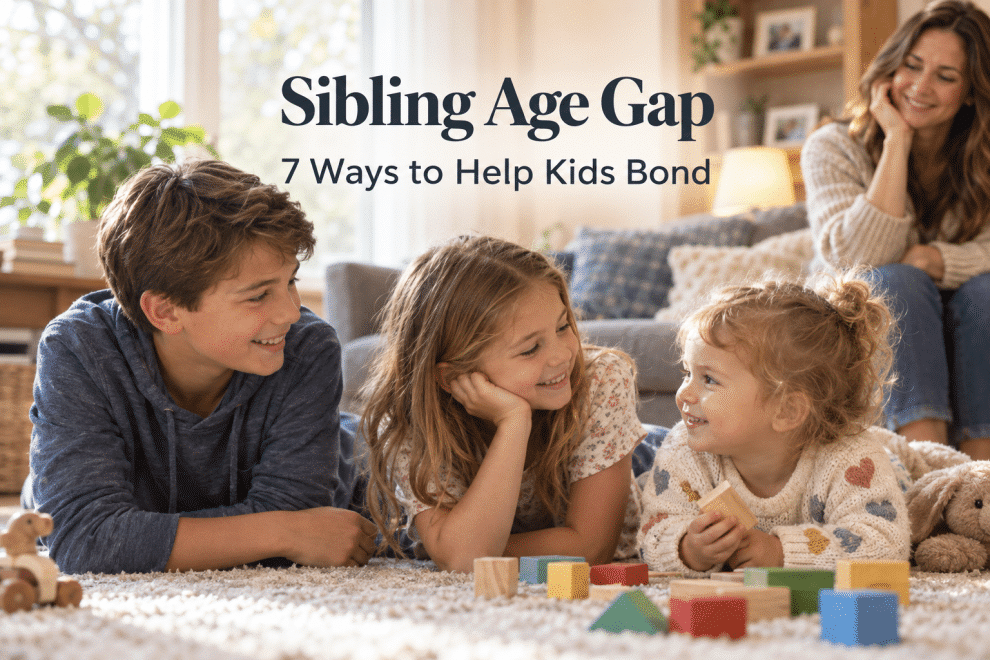
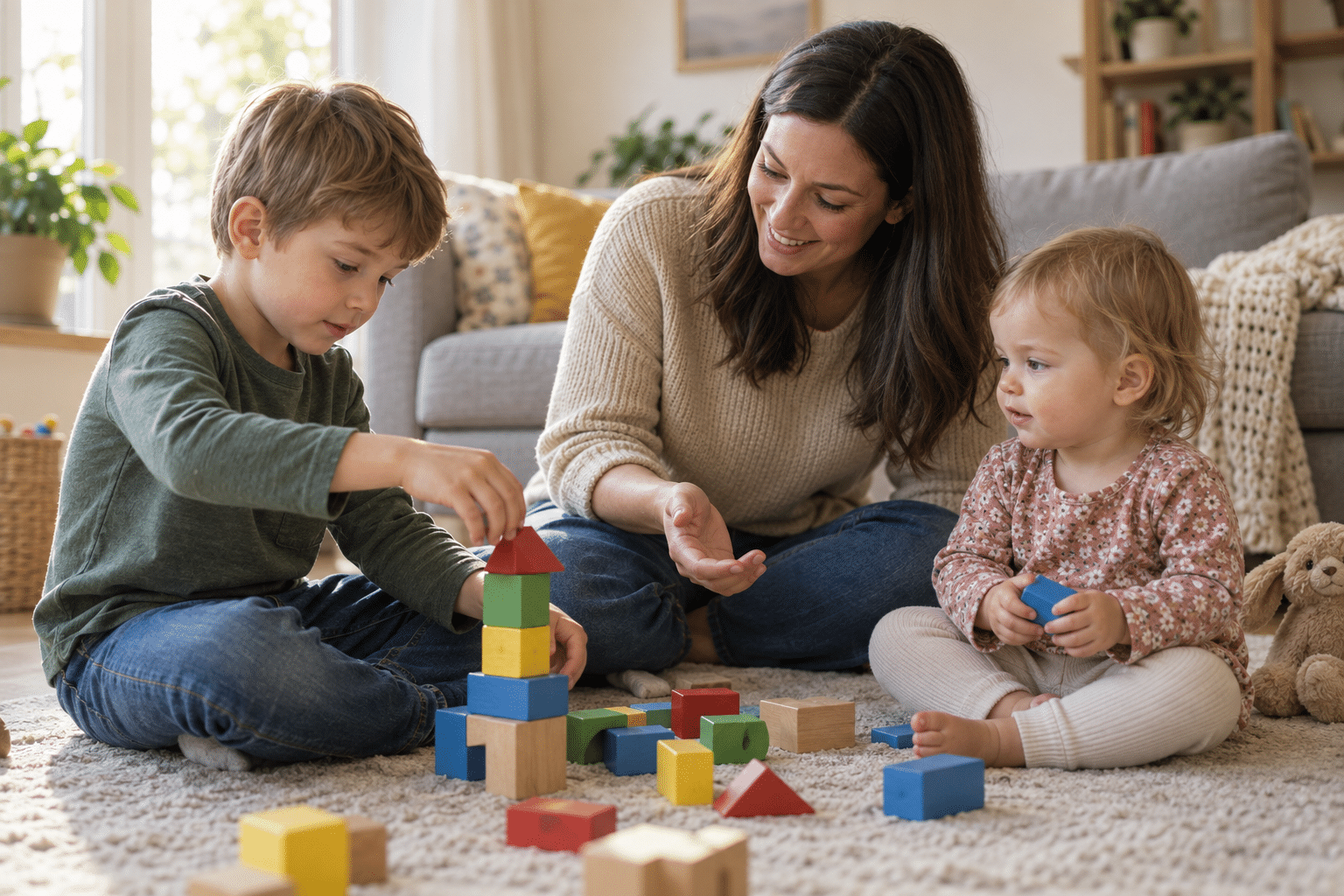
For close siblings, that might be a shared bedtime song, a “team cleanup” race, or a snack picnic after school. For a four-year gap, it might be letting the older child choose one book to read to the younger sibling twice a week, with no pressure to perform. For a wide sibling age gap, it might be Saturday pancakes, a stroller walk where the older child picks the music, or ten minutes of the younger child watching the big kid shoot baskets.
The ritual should be small enough that nobody dreads it. Sibling bonding usually grows better from repeatable low-pressure contact than from one grand family activity where everyone is expected to feel grateful.
I like to ask, “What can they enjoy together for ten minutes?” Ten minutes is not a small thing. Ten minutes of laughing over a silly song, sorting sprinkles for cookies, building a blanket fort entrance, or letting the baby hand the older child blocks can become family memory without asking children to erase their age difference.
If your house has been tense, start even smaller. One shared joke. One kind job. One moment when the older child is not responsible for the younger one but gets to enjoy them. Connection needs oxygen, not a spotlight.
5. Give the Older Child Privacy, Not Just Praise
Older siblings in a wide sibling age gap often receive praise that sounds lovely but can feel heavy: “You are such a little parent.” “The baby just loves you.” “You are so mature.” “I do not know what I would do without your help.”
A child may glow under that praise at first. Then the role can start to pinch. Being admired for maturity does not erase the fact that the older child still needs downtime, privacy, peer life, and the right to be ordinary.
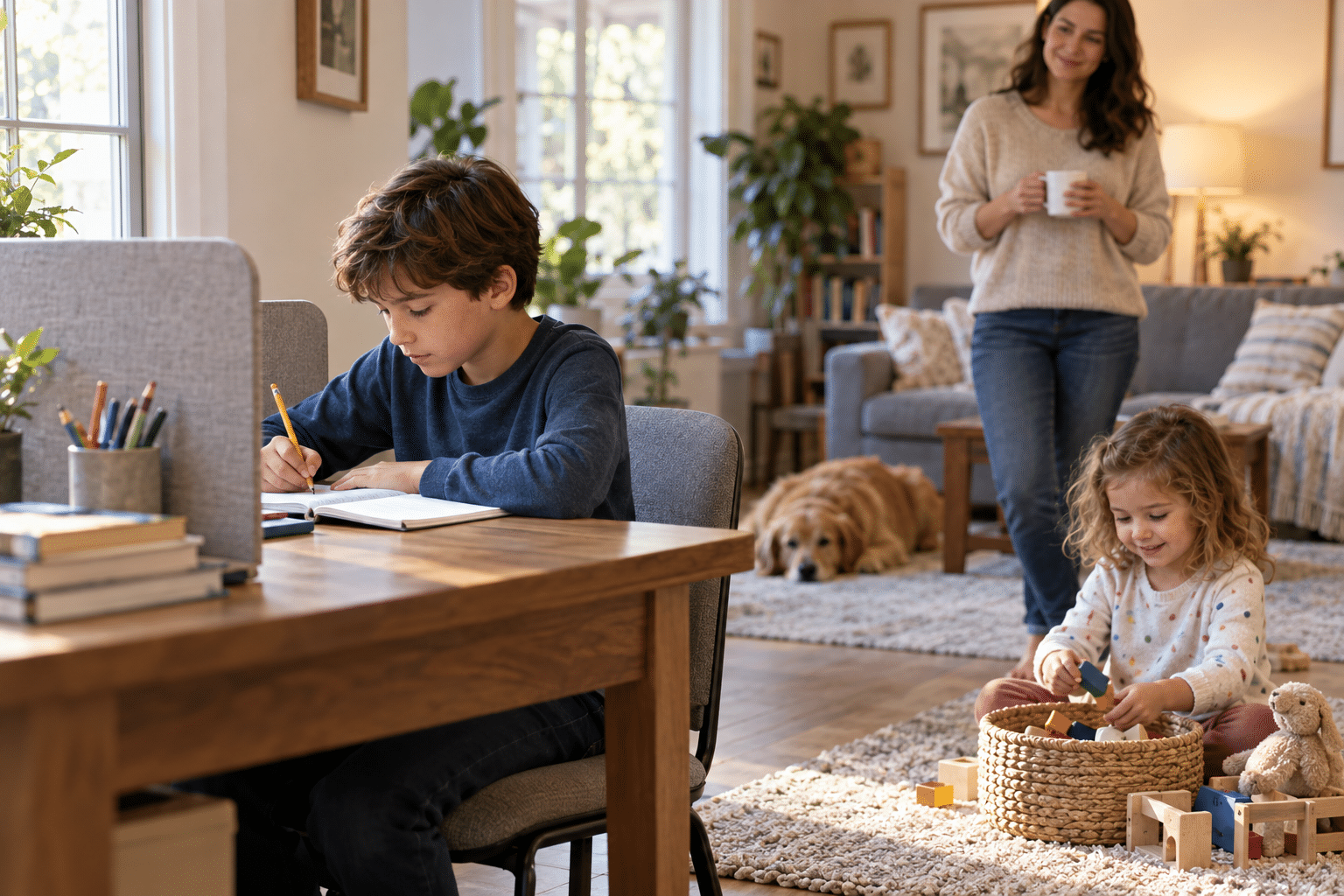
If the younger sibling is always allowed into the older child’s room, always touching their things, always interrupting homework, the older child may start to see the sibling as an invasion. That is not a character flaw. It is a boundary problem.
Protect the older child’s space in visible ways:
- A shelf or bin the younger child may not touch.
- A door rule, even if the door is only closed during homework.
- Baby-safe versions of tempting items so the little one has something else to explore.
- A clear “ask first” rule for entering, borrowing, or joining.
- A regular time when the older child is off helper duty.
This protection is especially important if your older child is a tween or teen. A strong sibling age gap relationship does not require constant access. Sometimes the younger child learns love through limits: “Your brother loves you, and he is not available right now.”
You can still invite the older child into warm leadership. “Would you like to show her how to stack those?” is different from “Watch her while I make dinner.” One is an invitation. The other may be a job.
6. Handle Jealousy Without Shaming It
Jealousy is not a sign that your sibling age gap is wrong. It is a sign that a child notices love, time, attention, and power moving around the family.
KidsHealth’s new-sibling guidance says it is common for older children to feel jealousy or act out after a baby arrives, and that daily one-on-one attention can ease resentment. That advice still matters when the “baby” is now a toddler, preschooler, or elementary child. Children keep asking, in different ways, Do I still matter?
Answer that question with attention before it becomes a behavior storm whenever you can. Ten minutes of full attention can be powerful when it is predictable and undistracted. It does not need to be fancy. Fold laundry beside the big kid while the baby naps. Let the middle child choose the errand playlist. Sit on the floor for a puzzle without checking your phone. Invite the teen for a late grocery run and buy the ridiculous cereal.
If jealousy spills out as meanness, hold both truths. “I understand you wanted me. I will not let you shove your brother.” Or, “It is hard when the baby gets so much attention. You may tell me that. You may not call her names.”
This is the same gentle firmness that supports emotional regulation for kids. Feelings are allowed. Harm is not. The sibling age gap may explain why the feeling is intense, but it does not remove the need for repair.
Repair can be simple: check on the sibling, rebuild the tower, return the toy, say the honest sentence, or help make a plan for next time. The goal is not shame. The goal is learning how to be angry and still stay connected.
7. Build Family Rules That Grow with the Gap
Family rules need to flex as children grow. A rule that worked when one child was seven and the other was two may not fit at twelve and seven. A rule that worked before phones, sleepovers, homework loads, sports, and friend groups may need a second look.
This is where a sibling age gap can create sneaky resentment. The younger child sees the older child get a phone, later bedtime, or more freedom. The older child sees the younger one get more help, more reminders, or more forgiveness. Everybody thinks somebody else has the better deal.
Narrate the “why” without over-explaining:
“Different ages come with different responsibilities and privileges.”
“You will get a later bedtime when your body and schedule are ready for it.”
“She gets help tying shoes because she is still learning. You get help with harder things.”
“He may use a tablet for schoolwork. That does not mean the toddler gets one at dinner.”
If screens are part of the gap, keep the family system clear. Younger children do not need big-kid media just because an older sibling is watching. Older children do not need every privilege removed because a younger sibling cannot handle it. A calm guide to how much screen time is healthy can help parents set age-aware rules without turning every evening into a negotiation.
Rules should protect both connection and individuality. Shared chores matter, but so does privacy. Family dinners matter, but so do age-appropriate friendships. Sibling kindness matters, but so does the right to say, “I do not want to play right now.”
When the Sibling Age Gap Feels Hard Right Now
Some seasons are just hard. A baby arrives when the older child is starting middle school. A toddler ruins an older sibling’s project. A teenager wants quiet while a preschooler wants a playmate. A child with extra needs requires more parent time, and a sibling feels overlooked. A blended family is trying to become real before everyone feels ready.
If your sibling age gap feels hard right now, try not to decide the whole future from this one season. KidsHealth notes that temperament, changing needs, special needs, and parent role-modeling all influence sibling conflict. In other words, hard does not mean hopeless. It means the family system needs support.
Start with one pressure point. Is there a privacy problem? A fairness story? Too much forced togetherness? A younger child touching unsafe or precious items? An older child expected to supervise too much? A parent trying to split attention in a way that leaves everyone feeling shortchanged?
Pick one small repair. Add a protected shelf. Restore a bedtime story. Stop calling the older child “little mom.” Make a baby-safe basket for the toddler. Give the teen a closed-door hour. Teach one script: “I want to play with you after I finish this.”
Sibling relationships are built in small repetitions. We do not have to fix every age-gap tension by Friday.
What Parents Can Say When Kids Complain About the Gap
Sometimes kids say the sentence straight out: “I wish I had a sibling my age.” Or, “Why did you have another baby?” Or, “He ruins everything.” Or, from the younger child, “She never wants to play with me.”
Try not to panic. Complaints are not prophecies. They are information.
You might say:
“I hear you. It can be hard to have a much younger brother when you want big-kid space.”
“You wish she could play the same games you play. That makes sense. Let’s find something she can do for a few minutes, and then you can have your own time.”
“You did not choose the sibling age gap. I understand that. My job is to help our family work with it kindly.”
“You are allowed to feel frustrated. You are not allowed to be cruel.”
Those words do two things at once. They validate the child’s experience, and they keep the family value clear. We can tell the truth and still practice respect.
If complaints become constant, look underneath. A child may need more one-on-one time, more protected belongings, less babysitting, more sleep, fewer comparisons, or help with a sibling who is genuinely aggressive or intrusive. A younger child may need a friend their own age, not just more access to the older sibling.
The Quiet Goal: Belonging Without Pressure
The goal of sibling age gap parenting is not to produce a perfect photo of children smiling in matching pajamas. The goal is belonging without pressure.
Belonging says, “You have a place here.” Pressure says, “You must feel the way adults hoped you would feel.” Kids can tell the difference.
A child can love a sibling and need space. A child can resent a baby and still become a protective older brother later. A teenager can roll their eyes at a preschooler and quietly save the drawing that preschooler made. Two close siblings can fight all morning and then build a couch fort after lunch. Families hold all of that.
Parents help by refusing to make the sibling age gap the villain or the magic answer. We can protect space, coach repair, explain stages, keep routines, and make room for small shared joy. We can apologize when we have leaned too hard on the older child or compared the younger one too much. We can keep noticing each child as a person, not just a birth order.
That steady attention is what children remember. Not that every age gap was easy. Not that every season was sweet. But that home was a place where their needs were translated, their feelings were not mocked, their boundaries mattered, and their family kept making room for connection.
Frequently Asked Questions
What is the best sibling age gap?
There is no single best sibling age gap for every family. Close gaps can bring shared stages and companionship, while wider gaps can bring patience, perspective, and less direct competition for the same toys or school world. Every spacing also has hard parts. A healthier question is what your children’s particular ages, temperaments, and routines need right now.
Is a big sibling age gap bad for kids?
A big sibling age gap is not automatically bad. It may mean siblings need more help finding shared activities, and the older child may need extra privacy and protection from being treated like another parent. With realistic expectations, one-on-one attention, and low-pressure rituals, wide-gap siblings can still build a warm and lasting bond.
How can I help siblings with a large age gap bond?
Keep bonding small and age-appropriate. Try short rituals like pancakes, stroller walks, reading one book, music in the car, a ten-minute game, or letting the older child teach a simple skill when they want to. Do not force constant togetherness. A sibling age gap bond often grows through brief, repeatable moments that respect both children’s stages.
Why do siblings close in age fight so much?
Siblings close in age may fight because they need many of the same things at the same time: attention, toys, space, sleep, and help managing big feelings. They may also compare privileges and fairness constantly. Clear rules, duplicate tools when practical, calm conflict coaching, and regular one-on-one attention can reduce the pressure without expecting toddlers or young children to share like adults.
Should older siblings help with younger siblings?
Older siblings can help in age-appropriate ways when it feels like a choice, a chore with limits, or a kind family contribution. They should not be treated as substitute parents. Protect their privacy, schoolwork, friendships, and downtime. Thank them for real help, and make sure they also hear that being a kid is still allowed.
Related Articles

Meet Sophia Richards Sophia Richards is an early childhood educator, passionate writer, and the proud mom of three energetic kids. With a degree in Education and over a decade of hands-on classroom experience, Sophia bridges the gap between professional teaching strategies and everyday family life. At More4Kids, she translates complex child development concepts into practical, actionable parenting tips that families can use at home.
Whether she is sharing positive reinforcement techniques, educational crafts, or honest reflections on the chaos of raising three children under one roof, Sophia’s goal is to empower parents to foster resilience and joy in their kids. When she isn't writing or lesson planning, you can find her organizing neighborhood scavenger hunts or trying out new kid-friendly recipes.
Areas of Expertise: Early Childhood Education, Positive Parenting, Sibling Dynamics, Educational Play, Family Wellness.

Add Comment