
















By Sophia Richards
Here’s the short version before we take it apart together: a child who asks question after question after question is running the single most important program a young mind has — curiosity, the engine that turns a confusing world into an understandable one. Every “why” is your child reaching for a handhold on reality. The reason it lands on you specifically, over and over, is that you are their trusted source, their search engine, their safe place to be confused out loud. That is a compliment wearing a very exhausting costume. So the goal of this piece is not to make your child ask fewer questions — please don’t aim for that — it’s to help you keep up with all those questions warmly, protect your own patience, and turn the endless “why” into the best thing it can be instead of the thing that frays you by 5 p.m.
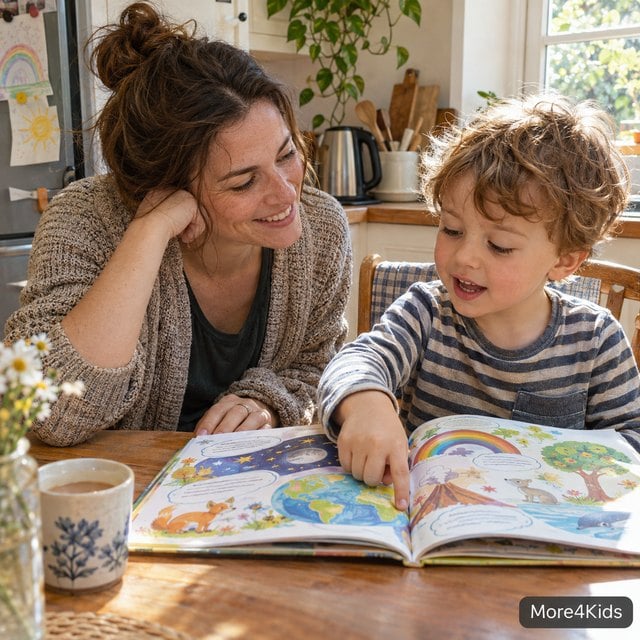
Why It Feels Like Your Child Asks Too Many Questions
Table of Contents
Let’s start with the number, because the number is genuinely wild. Researchers who have actually counted put a preschooler’s daily questions somewhere in the hundreds, and any parent who has survived a long car ride already believes it. But the feeling that your child asks too many questions usually isn’t really about the raw count — it’s about the timing and the depletion. The questions arrive while you’re merging onto the highway, while you’re on an important call, while you’re trying to get dinner on the table with a toddler on your hip. They don’t wait for a good moment, because a four-year-old has no concept of a bad one. And they come at you because you are the safest, most reliable grown-up in their world.
Here’s the reframe that changed everything for me: those questions are not an interruption of your child’s development — they are your child’s development, happening out loud, in real time, in your kitchen. A child who asks so many questions is actively building a map of how the world works, and they can’t build it silently. They need to say the question, hear your answer, bump it against what they already believe, and ask the next thing. When it feels like your child asks too many questions, what’s really happening is that you have a front-row seat to a mind under construction. It’s one of the quiet truths that runs under so much of gentle, connection-first parenting: the behavior that tests your patience is often the very growth you were hoping for, just wearing a tiring disguise. The exhaustion is real. The behavior is not a problem to fix. Both of those sentences are true, and holding them together is the whole game.
The Science: Why Your Child’s Endless Questions Are Doing Real Work
Here is the part that took the guilt off my shoulders. Those back-and-forth exchanges — your child serves a question, you return an answer, they serve again — are not just sweet, they are literally building brain architecture. The Harvard University Center on the Developing Child, in its work on serve and return, describes “responsive, back-and-forth exchanges between a young child and a caring adult” as interactions that “play a key role in shaping brain architecture.” They compare it to “a lively game of tennis,” and note that when an adult responds “with eye contact, words, or a hug, this back-and-forth interaction — known as serve and return — helps to build and strengthen neural connections in the child’s brain.” Every single one of those questions you’re fielding is a serve. Your answer is the return. You are not just surviving the volley; you are the other half of how your child’s brain wires itself.
Language works the same way — through sheer repetition and practice, most of it driven by the child, not by any lesson plan. The American Academy of Pediatrics, writing about early language development, points out that “without any formal instruction, just by listening and practicing, your child will master many of the basic rules of grammar by the time she enters school.” Asking is the listening and practicing. When your child asks too many questions, they are running thousands of tiny experiments in words, cause and effect, and meaning. The AAP also reminds parents that you can “enrich his vocabulary and language skills by making reading a part of your everyday routine” — which is why, as we’ll see, “let’s go find out” is such a powerful answer. The questions and the answers together are the curriculum, and it’s one your child wrote.
Two very ordinary things turn “wonderful curiosity” into “I can’t take one more question,” and naming them helps. The first is your own empty tank: a parent running on no sleep, a skipped lunch, and a hard day has almost nothing left for the two-hundredth “why,” and that’s about your depletion, not your child’s worth. The second is that not every question is actually a question — some are connection, some are stalling, some are worry in disguise — and answering all of them like a quiz show is exhausting precisely because many of them don’t want facts at all. Name those two, and you’ve already drained half the pressure out of the afternoon.
When Your Child Asks Too Many Questions: 7 Gentle Ways to Keep Up
None of these are scripts to perform perfectly. Think of them as a gentle rhythm you fold into ordinary days until the endless questions feel less like a drain and more like the running conversation of your life together. Do them warmly, do them imperfectly, and give each one more than a single afternoon before you decide it didn’t help.
1. Reframe the questions as the work, not the interruption
The biggest shift happens in your own head, before your child opens their mouth. If you hear each question as “one more thing pulling at me,” you’ll be frayed by noon. If you can genuinely reframe all those questions as the sound of a healthy brain doing its job, the exact same Tuesday feels completely different. This isn’t toxic positivity — some days are still long — it’s accuracy. A child who asks so many questions is curious, engaged, and bonded to you enough to think out loud in your presence. Researchers studying curiosity consistently find it’s one of the strongest engines of learning there is. So the next time it feels like your child asks too many questions, try silently renaming it: my kid is learning, right now, out loud. The behavior didn’t change. Your shoulders did. And a parent whose shoulders are down answers far more patiently than one braced for an assault of “why.”
2. Return the serve — you don’t have to know the answer
Here is the enormous relief buried in the Harvard serve-and-return idea: the point is the response, not the correct answer. When your child serves a question, what their brain needs is the return — eye contact, warm words, a real reaction — not a doctoral thesis on photosynthesis. “You know, I’m not sure why the sky is blue — isn’t that a great thing to wonder about?” is a complete, beautiful return. It teaches your child that their curiosity is welcome, that not-knowing is normal and even exciting, and that questions lead somewhere. You are allowed to not know. You are allowed to say so. Taking the pressure off yourself to be an encyclopedia is one of the fastest ways to make the flood of questions feel survivable, because you stop treating each one as a test you might fail.
3. Turn the question back to them
One of the gentlest, most useful moves in the whole toolbox is to lob the serve back: “Hmm — what do you think?” This does three wonderful things at once. It buys you a breath. It tells your child their own ideas matter. And it turns a one-way interrogation into actual thinking, which is where the real learning lives. A child who is asked “what do you think happens to the puddle when the sun comes out?” has to reason, predict, and imagine — far richer work than passively catching your answer. You’ll be amazed how often a child who seemed to want facts actually just wanted to think with you. This is the same quiet, two-way attention at the heart of getting kids to listen — connection and conversation, not performance. Not every one of all those questions needs your answer; many of them bloom into something better when you hand them back.

4. Build a “let’s find out together” habit
You cannot, and should not, answer every single thing on demand — but you can model something better than instant answers: the joy of finding out. Keep a running “wonder list” on the fridge or in a little notebook, and when a question lands that you can’t answer (or can’t answer right now), you write it down together: “Great question — let’s add it to our wonder list and look it up after dinner.” Then actually do it sometimes — a library book, a short video, a walk to go see for yourselves. This turns the pressure of too many questions into a shared adventure, teaches your child that answers are things you seek rather than things that magically appear, and models real curiosity instead of Google-reflex. Making wondering a normal part of everyday life is close cousin to what our guide to the importance of play is really about — a child exploring the world with you beside them, not performing for a grade.

5. Give yourself permission to pause without shutting them down
There is a world of difference between “Stop asking me questions!” and “I love your questions — my brain needs a quiet minute, so ask me again when we get home.” The first shames the curiosity. The second honors it and protects you. Children can absolutely learn that you are a person with limits, not an always-on answer machine, and learning that is good for them. So set the limit warmly and specifically: a question jar they can “post” questions into for later, a “quiet car for ten minutes, then questions” rhythm, a “Mommy’s talking on the phone, hold that thought” signal you practice together. You are not refusing the question; you are scheduling it. Holding a kind limit while keeping the warmth is the exact same muscle our guide to the defiant child leans on — the feeling is always welcome, even when “right this second” has to wait.

6. Learn to tell a curiosity question from a connection or worry question
This one quietly fixes a lot, because once you can hear it, you stop answering the wrong thing. Not all of those questions are hunting for facts. Some are pure connection — the bedtime “but WHY do I have to sleep” is often “stay with me a little longer.” Some are stalling, plain and simple. And some are worry wearing a question’s clothes: a child who asks the same reassurance question over and over (“Are you SURE the door is locked? Are you SURE?”) may be anxious, not curious, and piling on facts won’t soothe a feeling. When a question repeats no matter how well you answer it, pause and answer the heart instead: “You keep checking — I wonder if your body feels a little worried tonight.” Naming the feeling underneath is the real work, and it’s exactly the kind of thing our guide to emotional regulation for kids digs into. Match your answer to the real question, and a surprising amount of the “too many questions” exhaustion simply dissolves.
7. Protect your own patience — and choose your moments
The endless questions don’t live in a vacuum; they land on a parent with a finite battery, and guarding that battery is not selfish, it’s strategic. Two levers matter most. The first is your own baseline: a rested, fed parent has three times the patience of a depleted one, so the kindest thing you can sometimes do for your child’s curiosity is take care of you. The second is choosing your moments to go deep. You don’t have to bring equal energy to all two hundred questions — let some get a warm “mm-hmm, interesting!” and save your real, eyes-lit-up attention for the ones you have the bandwidth to savor. Kids feel the difference between a distracted answer and a delighted one, and a few delighted ones a day feed the bond more than a hundred dutiful ones. And on the hard days, when the questions are relentless and one of them is about screens, it’s okay to let a thoughtfully chosen show carry a stretch — our calm guide to screen time can help you do it without guilt. Protecting your patience is how you make sure that when your child asks too many questions tomorrow, there’s still a warm person on the other end of the serve.
When the Questions Might Be Something More
For the big majority of kids, a torrent of questions is a wonderful, completely normal stage that simply means curiosity is firing on all cylinders — and it eases on its own as children get older and gather more of their own answers. But trust the little alarm bell if it’s ringing. A few patterns are worth a calm conversation with your pediatrician: questions that are really the same anxious reassurance-seeking over and over, no matter how fully you answer (“Are you sure? Are you sure? Are you sure?”), especially if they come with worry, rituals, or distress; a child who seems unable to move on from a topic or to tolerate any answer; or question-asking that appears alongside new struggles with sleep, friendships, eating, or mood. On the flip side, if a child who used to be chatty and curious suddenly goes quiet, or isn’t developing language the way you’d expect, that’s also worth raising — the AAP notes that early attention to a possible language delay matters because “early detection and identification” lets any help “begin before the problem interferes with learning in other areas.” You know your child better than any checklist. Reaching out early isn’t admitting you can’t handle the questions — it’s exactly the attentive parenting that handles them best.
The curious little girl who asked why worms have mommies? She’s older now, and the questions never stopped — they just grew up with her, from “why is the sky blue” to the kind of question I have to sit down and really think about. Some evenings I’m still wrung out by dinner, and I’ve made peace with that. Because here’s what I finally understand: a child who asks too many questions is a child who still believes the world is worth understanding and that you are the person to understand it with. That’s not a phase to endure. It’s a window that won’t stay open forever. Be patient with your curious child in the tiring hours, and be just as patient with yourself in them — answer what you can, hand back what you can, write the rest on the wonder list, and trust that every served-and-returned “why” is building something real. When your child asks too many questions tomorrow, and the next long afternoon after that, you’ll know the flood for what it is: a growing mind, reaching for the world, with you as its favorite handhold.

FAQ
Is it normal that my child asks too many questions all day long?
For most kids, yes — it’s not only normal, it’s a sign of healthy development. Preschoolers are famous for asking hundreds of questions a day because curiosity is the main engine driving how young brains learn about the world. The questions can genuinely wear a parent out, and feeling tired by them doesn’t make you a bad parent. A child who asks so many questions is usually a child who is engaged, bonded to you, and actively building their understanding of how everything works.
Why does my child ask me questions they clearly already know the answer to?
Because many of those questions aren’t really about the facts at all — they’re about connection, practice, or reassurance. A child who asks something they know often wants the back-and-forth with you, the comfort of a predictable answer, or simply the practice of using language. The Harvard Center on the Developing Child describes these responsive, back-and-forth exchanges as a kind of “serve and return” that helps build the child’s brain. So the “pointless” question is doing real work; it just isn’t the work you assumed.
How do I answer when I genuinely don't know the answer?
Say so, warmly — not knowing is a feature, not a failure. A response like “I’m not sure, but what a great thing to wonder about — let’s find out together” teaches your child that curiosity is welcome and that answers are things we seek. You can add the question to a “wonder list” and look it up later with a book or a short video. Modeling the joy of finding out matters far more to your child’s learning than you having every fact instantly ready.
My child's questions exhaust me — does that mean something is wrong with me?
Not at all. Fielding a nonstop stream of questions is genuinely depleting, especially when you’re tired, hungry, or stretched thin, and being worn out by it is a normal human limit, not a character flaw. You’re allowed to set gentle limits, like a question jar for later or a few quiet minutes, without shaming your child’s curiosity. Protecting your own patience by resting and choosing which questions to go deep on is good parenting, not selfishness.
When should I worry about how many questions my child asks?
Worry is rarely warranted for ordinary curiosity, but a few patterns deserve a calm check-in with your pediatrician. Watch for questions that are really repeated anxious reassurance-seeking no matter how fully you answer, an inability to move on from a topic, or question-asking paired with new trouble in sleep, mood, friendships, or eating. Also raise it if a once-chatty child goes suddenly quiet or language seems delayed. You know your child best, and asking early is always reasonable.
Related Articles
- Parenting
- How To Get Kids To Listen
- Importance Of Play
- How To Deal With A Defiant Child
- Emotional Regulation For Kids
- How Much Screen Time For Kids

Meet Sophia Richards Sophia Richards is an early childhood educator, passionate writer, and the proud mom of three energetic kids. With a degree in Education and over a decade of hands-on classroom experience, Sophia bridges the gap between professional teaching strategies and everyday family life. At More4Kids, she translates complex child development concepts into practical, actionable parenting tips that families can use at home.
Whether she is sharing positive reinforcement techniques, educational crafts, or honest reflections on the chaos of raising three children under one roof, Sophia’s goal is to empower parents to foster resilience and joy in their kids. When she isn't writing or lesson planning, you can find her organizing neighborhood scavenger hunts or trying out new kid-friendly recipes.
Areas of Expertise: Early Childhood Education, Positive Parenting, Sibling Dynamics, Educational Play, Family Wellness.

Add Comment