












By Sophia Richards
In my first year teaching preschool, one of my students spent the entire Halloween party in the reading corner. Not because she didn’t want to be there — she’d talked about her costume for two weeks straight. Her costume had a stiff plastic shell that didn’t sit right in her chair, and by the time the parade started she was uncomfortable enough that the whole thing had stopped being fun. Her mom, who had clearly done this dance before, said something I’ve never forgotten: “I bought the costume for the picture. I should have bought it for the four hours.”
That’s the whole problem in one sentence. Most costumes are designed for a kid who is standing still, facing forward, for about ninety seconds. Adaptive halloween costumes are designed for the other four hours — the sitting, the transferring, the sensory load, the bathroom trip, the ride home. And for a long time, families who needed that had exactly two options: sew it yourself, or accept that the costume was going to be a compromise.
That’s genuinely changed in the last several years, and not just at the margins. Adaptive halloween costumes have gone from a homemade workaround to a real product category. Major costume manufacturers now produce licensed character costumes with adaptive features built in, and mainstream retailers carry wheelchair covers as a stocked seasonal category rather than a specialty order. Which means the question for most families has shifted from “can I find anything” to “what should I actually look for” — a much better problem, and the one this guide is about.
What Adaptive Halloween Costumes Actually Change
Table of Contents
The phrase gets used loosely, so it’s worth being specific. When a costume is genuinely adaptive, it usually means one or more of these things has been redesigned:
The closures. Standard costumes fasten in the back, which assumes the wearer can reach behind their own shoulder blades or be turned over to be dressed. Adaptive versions move the opening to the front or side, and swap small buttons and tricky zippers for hook-and-loop panels or magnetic closures. This is the single biggest difference for a child who dresses with help — it can turn a fifteen-minute wrestling match into a two-minute one.
The seams and tags. Costume fabric is notoriously cheap, and the interior finishing is usually an afterthought — raw serged seams, a scratchy screen-printed panel, a tag right at the nape of the neck. Adaptive lines tend to use flat seams, tagless labels, and softer knit fabric because the same design choices that help a sensory-sensitive kid also help a kid with limited sensation who can’t reliably tell you something is rubbing.
The cut, for a seated body. A costume designed for standing has length distributed for standing. Sit down in it and the front bunches at the hips while the back rides up and the hem pools in the wheels. Adaptive cuts shorten the front, lengthen the back, and lose the long trailing pieces entirely.
Access panels. Some lines build in discreet openings for a feeding tube, a port, or an insulin pump, so the costume doesn’t have to come off for a scheduled feed or a site check.
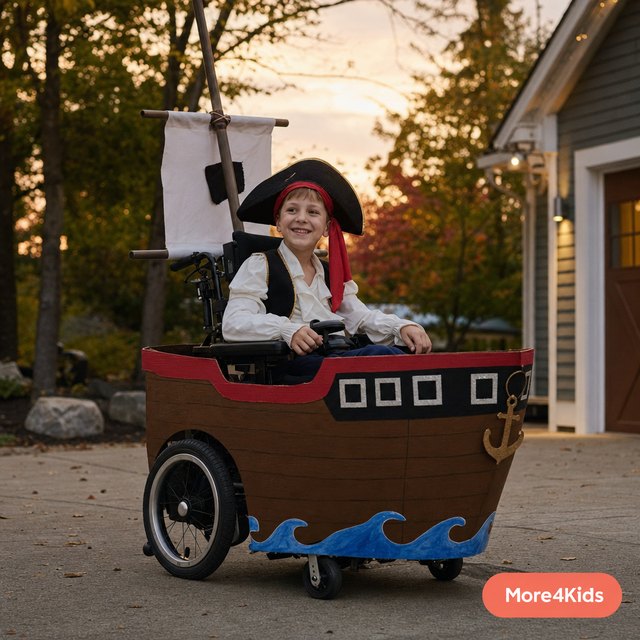
The wheelchair as part of the design. This is the fun one, and it’s what most people picture when they hear wheelchair costume. Rather than treating the chair as a thing to hide, the costume treats it as the vehicle — a pirate ship, a fire truck, a princess carriage, a rocket. The chair stops being the thing everybody politely doesn’t mention and becomes the reason the costume is the best one on the block.
If you want to see the full range of what’s out there before you narrow anything down, browsing the adaptive costume category for kids is a reasonable starting point — most of the major licensed characters now have an adaptive version, which surprises a lot of parents who stopped checking a few years ago.
As an Amazon Associate, More4Kids earns from qualifying purchases. We only recommend products we would use in our own homes, and we check every brand against current CPSC recall data before it appears here. Our recommendations are never paid placements.

Start With the Body, Not the Character
I know this is the least fun advice possible, and I’m giving it anyway, because it’s the thing that separates a good Halloween from a long one.
Before you look at a single character, get clear on what the costume has to survive. Roughly: How long will your child be in it? Will they be transferring in and out of a chair, a car seat, a stander? Does anything need to stay reachable — a tube, a port, a pump, a monitor? Are they wearing it over braces or orthotics that change how sleeves and pant legs fit? Is the sensory load the limiting factor, or is it the mechanics?
Answer those five, then go shopping. It sounds clinical, but it collapses a thousand options down to about a dozen, and it prevents the specific heartbreak of the costume that looked perfect online and lasted eleven minutes in real life. Most of the adaptive halloween costumes that disappoint families aren’t badly made — they’re just the wrong answer to a question nobody asked first.
One more thing worth saying out loud: let your kid pick the character. Every practical constraint above is a constraint on execution, not on who they get to be. If they want to be the villain, be the villain. There’s a version of almost anything that works — that’s the entire point of an adaptive wheelchair costume in the first place.
When the Chair Is the Costume
If your child uses a wheelchair full-time or part-time, the chair is your biggest creative asset, and a wheelchair costume can go two directions.
Buy the cover. Manufacturers now sell wheelchair costume covers as their own product — a themed shell that attaches around the chair frame. They’re lightweight, they come apart for the car ride, and they turn the chair into the centerpiece without a weekend of cardboard engineering. If you’re comparing options, the kids’ wheelchair costume cover category will show you what the licensed and generic versions look like side by side. Two things to check before you commit: whether it fits your specific chair’s dimensions (a small pediatric chair and a growing tween’s chair are very different objects), and whether it obstructs the push handles, brakes, or anti-tip bars. A costume that blocks a brake isn’t a costume, it’s a hazard.
Or build it. A wheelchair costume built from cardboard, pool noodles, and duct tape is a genuinely great craft project, and a homemade wheelchair costume can be more spectacular than anything you can buy. If you go this route, keep the weight low and keep it off the wheels — the two most common mistakes are building something so heavy it changes how the chair handles, and building something so wide it can’t get through a doorway or up a ramp. Test-drive it in your own hallway before Halloween night, with your child in the chair, doing an actual turn.
There’s also a third option a lot of families don’t know about. Magic Wheelchair is a nonprofit that builds elaborate custom wheelchair costumes for kids at no cost to the family, with volunteer build teams. Applications are limited and competitive, and it isn’t a same-week solution — but if you’re reading this in August with a kid who’d light up over it, it’s worth knowing the organization exists rather than finding out about it on November 1st.
The Costume Still Has to Work Sitting Down
Even with a great chair cover, what your child is wearing matters, and a seated fit has its own rules.
Nothing long enough to reach a wheel. Capes, gowns, tails, trailing ribbon — anything that can drop into a moving wheel is out, or gets shortened until it can’t. This is the single most common problem with off-the-rack costumes on a seated kid, and it isn’t a hypothetical risk; a hem in a wheel can stop a chair hard or pull a child sideways.
Watch the neckline. Neck ties, drawstrings, and long beaded strands are a strangulation risk generally, and more so for a child who may not be able to free themselves quickly. If a costume closes with a cord at the throat, cut it off and replace it with a hook-and-loop tab. It takes two minutes.
Check the seat and back panel. Bulky decorations on the seat or the back of a costume press into the body for hours and can cause real pressure problems for a child who can’t shift their own weight. Whatever’s on the back needs to be soft, thin, or removable.
Think about temperature. A full-body plush costume is a wonderful thing right up until it isn’t. Some kids — including many with neurological conditions — regulate temperature poorly, and a costume that traps heat for two hours is a genuine issue. Layers you can peel beat one hot piece.
Sleeves over braces. If your child wears AFOs, a hand splint, or arm braces, the costume needs to go over them without pinching. Stretchy knit is your friend. Stiff molded plastic is not.
When the Barrier Is Sensory Instead of Physical
Not every kid who needs one of these uses mobility equipment. For a lot of families — especially families of autistic kids and kids with sensory processing differences — the costume itself is the obstacle, and it’s an obstacle nobody outside the house tends to see. A sensory friendly costume is every bit as much one of the adaptive halloween costumes on this list as a chair cover is; the barrier is just made of fabric instead of stairs.
The usual offenders: masks and face paint, scratchy netting and tulle, elastic at the wrists and ankles, anything that makes noise, anything that restricts peripheral vision, and the sudden full-body change in texture that a costume represents when your kid has spent nine years wearing the same three soft shirts.
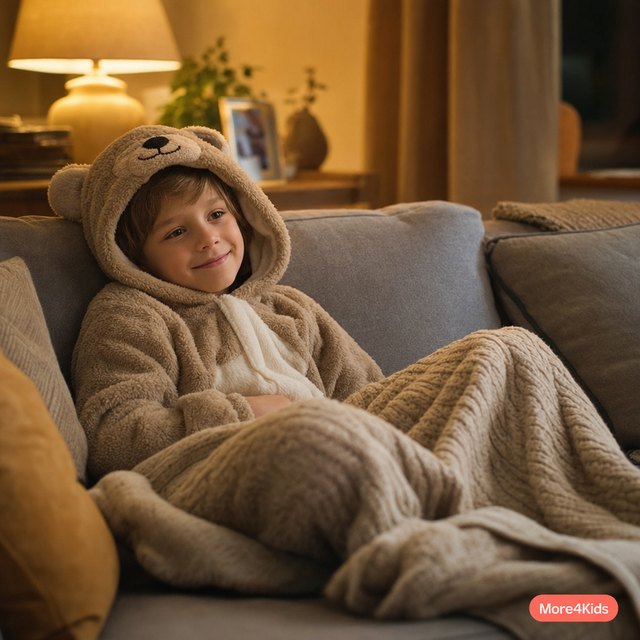
What tends to work instead is a sensory friendly costume built out of clothes. A soft one-piece your child can wear over their own familiar clothing, or a themed hoodie and leggings in their normal fabric, with the costume signal carried by one accessory rather than the entire outfit. Nobody at the door is checking your commitment level. A kid in a soft green hoodie with a felt tail pinned to it is a dinosaur, full stop. The soft one-piece costumes made from plush knit work well for this because they go over regular clothes and come off in one motion when a child is done — which matters more than it sounds like it does. The ability to end a costume immediately is what makes it safe to start one.
Two practical moves that help more than any sensory friendly product you can buy: let your child wear the costume around the house several times before Halloween, so it stops being novel at the exact moment everything else is also novel. And decide in advance what “we’re done” looks like, so nobody has to negotiate it in a stranger’s driveway. We go deeper on this in our guide to sensory-friendly Halloween costumes, which covers the fabric and mask questions in more detail.

Visibility Matters More at Chair Height
This one gets missed constantly, and it’s the safety point I’d argue hardest for.
A seated child is roughly at bumper height. In a dark neighborhood, on a night with an unusual number of cars pulling in and out of driveways, a child in a wheelchair is physically lower than a driver’s natural sightline and is often behind a parked car until the last second. Add a dark-colored costume — and most of the good ones are dark — and you’ve built something genuinely hard to see.
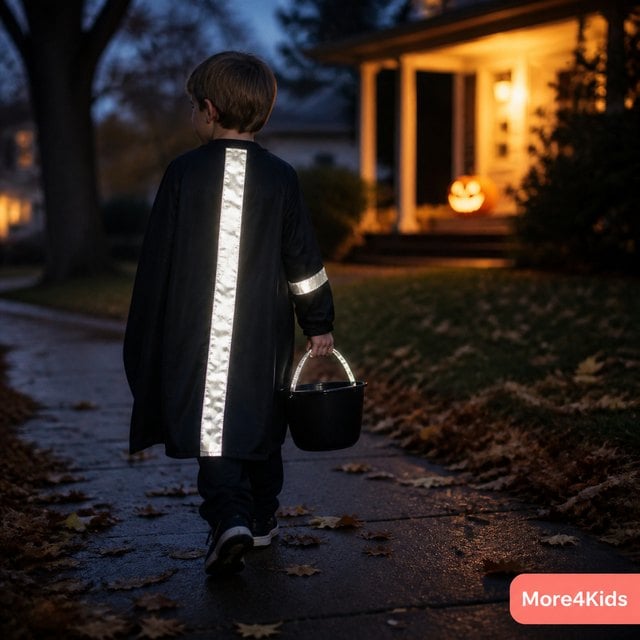
The fix is cheap and boring. A few strips of high-visibility reflective tape along the chair frame, the footplate, and the back of the seat will catch headlights from a long way off, and it costs a few dollars for far more tape than you’ll use. Put it where it stays visible from behind and from the side, since those are the angles a driver backing out actually needs. It doesn’t have to look like safety equipment — silver tape on a pirate ship reads as trim.
If you’d rather add lights than tape, that’s fine too, with one hard rule: check the battery compartment. Small light-up accessories very often run on coin-sized button batteries, and button batteries are one of the most serious hazards in children’s products — swallowed, they can cause severe internal burns within hours. We track children’s product recalls directly, and light-up wearables are one of the most heavily represented categories in our button-battery recall data. If the compartment doesn’t close with a screw, don’t put it on a child. Tape has no such problem, which is most of why I lead with it.
While you’re thinking about the walk itself, our Halloween costume safety guide covers the fit, flammability, and visibility checks that apply to every costume, adaptive or not.
The Route Is Half the Experience
You can get the costume exactly right and still have a hard night if the route fights you the whole way.
An inclusive halloween is as much about pavement as it is about costumes, so do a daylight drive-by of wherever you’re planning to go. What you’re looking for: curb cuts at the corners, sidewalks that aren’t cracked into a washboard, houses with a ramp or a flat walk to the door, and whether the porch itself is reachable or is three steps up behind a hedge. It is completely reasonable to plan a shorter loop of accessible houses rather than the traditional route, and it is completely reasonable to text a few neighbors in advance and ask them to meet kids at the end of the driveway.
Trunk-or-treat events are frequently the better option for an inclusive halloween, and not as a consolation prize. They’re flat, they’re paved, they’re well-lit, they’re compressed into a small area so there’s far less distance between stops, and there are usually bathrooms. If your child fatigues, or if transfers are involved, a parking lot beats a hilly subdivision every time. Our trunk-or-treat guide has more on finding and running these.
And if you’re the one handing out candy this year: come down to the end of the walk when you see a chair coming. Don’t make the kid’s parent decide whether to attempt your steps. That one gesture does more for an inclusive halloween on your street than any decoration you could buy.
What We’d Skip
Here’s what I’d leave on the shelf, and why.
Any costume that requires a full mask. This one applies equally to sensory friendly kids and to kids using mobility equipment, for different reasons. Masks reduce peripheral vision for every child, and for a child who is seated, being able to see approaching movement from the side is more important, not less. Face paint or a headpiece does the same job with none of the tradeoff.
Rigid molded shells and plastic breastplates. They’re designed around a standing torso. Seated, they dig in at the hips and ribs for hours, and a child who can’t easily reposition themselves absorbs all of it.
Any wheelchair costume cover sold as “one size fits all.” Chairs vary enormously. A cover that doesn’t fit doesn’t just look wrong — it slips, it catches, and it ends up blocking something it shouldn’t.
Long trailing anything. Capes to the floor, gowns with a train, ribbon streamers. If it can reach a wheel, it will find the wheel.
Light-up accessories with an unsealed battery compartment. Covered above, and it’s a hard no in our house regardless of how cute the item is.
Costumes with small detachable pieces, if you have a younger sibling in the mix. A tiny clip-on accessory that a nine-year-old handles fine becomes a choking hazard the moment it ends up on the floor near a toddler. The rough test: if a piece fits through a cardboard toilet-paper tube, it’s a choking risk for a child under three.
And the one that isn’t a product: the “just for the photo” costume. If it only works for ninety seconds, it doesn’t work. Buy for the four hours.
A Parent’s Honest Take
The part of this I didn’t understand until I’d taught for a few years is how much of the exhaustion isn’t logistical at all. It’s the being-looked-at. It’s watching another parent decide whether to say something kind and land on something clumsy instead. It’s the fifth house in a row where somebody says “oh, bless her heart” in that particular voice.
Adaptive halloween costumes don’t fix any of that. What they do is remove one variable from a night that has too many of them, and make it more likely your kid gets the thing they were actually promised — which is not a photo, and not a lesson in resilience, but an ordinary good time in a costume they picked.
That’s the whole bar. It’s a lower bar than the internet makes it look, and most families clear it with a soft costume, a few strips of reflective tape, a shorter route, and a plan for going home early without it counting as a failure. An inclusive halloween on your block doesn’t take a committee — it takes a handful of neighbors willing to walk to the end of the driveway.
If food allergies are also part of your family’s Halloween math, our guide to allergy friendly halloween and the Teal Pumpkin Project covers the two-bowl system worth knowing about. And if you’ve got a younger one coming up behind, our Halloween ideas for toddlers is built around the same idea: plan for the kid you have, not the picture you imagined.
Frequently Asked Questions
What are adaptive halloween costumes?
They’re costumes redesigned so a child with a disability can wear them comfortably and independently. Typical features include front or side closures instead of back zippers, hook-and-loop or magnetic fastenings, flat seams and tagless labels, a cut shaped for a seated body, discreet access openings for feeding tubes or ports, and coordinating covers that turn a wheelchair into part of the costume.
Where can I buy an adaptive wheelchair costume?
Both major costume manufacturers and mainstream retailers now carry adaptive halloween costumes with licensed characters, and a wheelchair costume cover is sold as its own seasonal category online. Check the fit against your child’s specific chair dimensions before buying, and confirm the cover doesn’t obstruct the brakes, push handles, or anti-tip bars.
How do I make a regular costume work for a child who uses a wheelchair?
Shorten anything that could reach a wheel, move back closures to the front with hook-and-loop tabs, remove neck cords and drawstrings, keep the back and seat panels soft and thin so nothing presses in, and check that sleeves and legs fit over any braces. Add reflective tape to the chair frame for visibility.
What should I look for in a sensory friendly costume?
The best sensory friendly options use soft knit fabric, no tags or scratchy interior seams, no mask, no tight elastic at the wrists or ankles, and a design that goes over your child’s regular clothes. Let them wear it around the house several times before Halloween so it isn’t new on the night, and make sure it comes off quickly when they’re finished.
Are light-up Halloween accessories safe for kids?
Only if the battery compartment is secured with a screw. Many light-up novelty items run on coin-sized button batteries, which can cause serious internal injury if swallowed, and light-up wearables are one of the most recalled categories in children’s products. Reflective tape achieves the same visibility with none of that risk.
Related Articles
- Sensory Friendly Halloween Costumes
- Halloween Costume Safety 2026
- Trunk Or Treat Ideas
- Teal Pumpkin Allergy Friendly Halloween
- Halloween Ideas For Toddlers

Meet Sophia Richards Sophia Richards is an early childhood educator, passionate writer, and the proud mom of three energetic kids. With a degree in Education and over a decade of hands-on classroom experience, Sophia bridges the gap between professional teaching strategies and everyday family life. At More4Kids, she translates complex child development concepts into practical, actionable parenting tips that families can use at home.
Whether she is sharing positive reinforcement techniques, educational crafts, or honest reflections on the chaos of raising three children under one roof, Sophia’s goal is to empower parents to foster resilience and joy in their kids. When she isn't writing or lesson planning, you can find her organizing neighborhood scavenger hunts or trying out new kid-friendly recipes.
Areas of Expertise: Early Childhood Education, Positive Parenting, Sibling Dynamics, Educational Play, Family Wellness.

Add Comment