





By Sophia Richards
Every October I watch the same thing happen on my own street: somewhere around house number twelve, a plastic pumpkin pail’s handle snaps, candy scatters across somebody’s lawn, and a kid who was having a great night is suddenly crouched on the sidewalk in the dark trying to scoop up loose Skittles. It’s not a big tragedy. It’s just avoidable, and it’s exactly why picking trick or treat bags and buckets deserves a few more minutes of thought than most families give it. The bag or bucket a kid carries all night gets more abuse in three hours than most of their toys see in a year — dragged, swung, dropped on porch steps, stuffed past its actual capacity by hour two — and a lot of what’s sold as a “Halloween bucket” is built for a shelf display, not an evening of real use.

As an Amazon Associate, More4Kids earns from qualifying purchases. We only recommend products we would use in our own homes, and we check every brand against current CPSC recall data before it appears here. Our recommendations are never paid placements, and we haven’t personally tested every item below — this is what we’d look for and why, not a claim that we’ve used each one ourselves.
Why the container matters more than it seems
Table of Contents
A trick-or-treat bag or bucket has exactly one job — hold a growing pile of candy for two to three hours of walking, without failing — and it’s easy to underestimate how much stress that actually is. A dollar-store plastic pail with a thin wire handle looks fine sitting on a store shelf half-empty. Load it with two pounds of fun-size candy by 7 p.m. and have a six-year-old swing it between houses the way kids do, and that thin handle is exactly where things go wrong. The failure point is almost always the same: the handle attachment, not the bucket itself.
The fix isn’t complicated or expensive. It’s just paying attention to a few specific things — handle construction, material, and size for the kid carrying it — instead of grabbing whatever’s shaped like a pumpkin closest to the register.
What actually makes trick or treat bags and buckets last
Before getting into materials and handles, it helps to name the actual failure pattern, because it’s remarkably consistent across brands and price points: the container itself rarely breaks. The attachment point between the container and the handle is almost always where things give out, which means that’s the one spot worth actually inspecting before you buy — not the printed design, not the size claim on the packaging, just that one joint.
Handle attachment is the whole story. On a plastic bucket, look for a handle that loops through a reinforced hole or a molded loop in the rim, not one that’s just hooked through two small punched holes in thin plastic — that’s the exact point that tears out under real weight. On a fabric bag, the handles should be stitched down with a visible reinforced seam (sometimes a small fabric square or extra rows of stitching at the base of the handle), not just sewn on with a single pass of thread.
Material thickness matters more than the design on it. A bucket printed with a fun character is exactly as strong as a plain one from the same manufacturer — the print adds nothing structurally. What matters is wall thickness on plastic (a bucket that flexes and creaks when you squeeze it empty will crack when it’s full) and fabric weight on totes (a lightweight cotton print bag holds up fine for a light candy night; heavier canvas holds up for a genuinely large haul or multiple years of reuse).
Trick-or-treat buckets for kids covers the classic pumpkin-pail and character-bucket styles — worth reading the actual product photos closely for handle construction before buying, since that’s the detail listing titles never mention.
Size should match the kid, not the neighborhood. A bucket a five-year-old can barely lift when empty is going to become a two-hand carry — or a “mom, can you hold this” — by the time it’s a quarter full. A bigger kid covering more houses can handle a larger tote, but for younger kids, a mid-size bucket they can comfortably swing one-handed beats an oversized one that looks impressive in the store.

Buckets vs. bags: the actual tradeoffs
Plastic buckets stand up on their own on a porch step while a kid’s hands are busy with a costume adjustment, which bags can’t do — a fabric tote just flops over. Buckets are also easier to see into at a glance, which matters when you’re doing the end-of-night candy check. The tradeoff is that a cracked plastic bucket is genuinely done; there’s no repairing it.
Canvas or cotton tote bags are the better pick if you want something that survives past this one Halloween. They fold flat for storage, they’re washable, and a good one gets reused for years — plus they don’t shatter if dropped on concrete, which a cheap plastic bucket sometimes does after a season or two in a hot garage. The downside is capacity: a soft bag can get lopsided or start to sag once it’s genuinely full, in a way a rigid bucket doesn’t.
Canvas trick-or-treat tote bags for kids covers the reusable option — look for double-stitched handle bases and a flat, wide bottom so the bag stands up reasonably well on its own even without the rigidity of plastic.
Personalizing without adding a hazard
A bag or bucket with a kid’s name on it solves a real problem: in a crowd of a dozen identical dollar-store pumpkin pails at a school party or a big trunk-or-treat, an unlabeled bucket is genuinely hard to find again once it’s set down. A name in permanent marker on masking tape works in a pinch, but a bag that’s actually made to be personalized — embroidered or printed with a name — holds up better and looks less improvised for group events, teacher gifts, or a bag that’s meant to be reused every year.
Personalized trick-or-treat bags for kids covers embroidered and printed name options — most ship with the customization already done, so order with enough lead time before the last week of October, when production and shipping windows get tight.
What to check before buying a personalized one: confirm the closure is a simple handle or strap, not a drawstring closure that cinches with a long cord — a long drawstring loop is exactly the kind of thing that’s worth avoiding near a young child’s neck, the same reason we flag long cords and ribbons on costumes.
Light-up buckets: the fun option, with the same battery check as everything else
Light-up trick-or-treat buckets — the ones with LED eyes or a glowing jack-o-lantern face — solve two problems at once: they’re genuinely more visible to drivers after dark, and kids like them for their own sake, which means they actually get carried instead of left in the car. That combination of “safer and more fun” is rare enough to be worth calling out.
Light-up and glow-in-the-dark trick-or-treat buckets covers the category. The one thing worth checking before buying, same as any battery-powered kid item: the battery compartment should need a small screwdriver or a firm push-and-twist to open, not just a fingernail. We’ve covered this exact detail before for reflective and light-up gear — it’s the single check that matters most for anything with a coin or button battery, and it applies just as much to a light-up bucket as it does to a clip-on light.
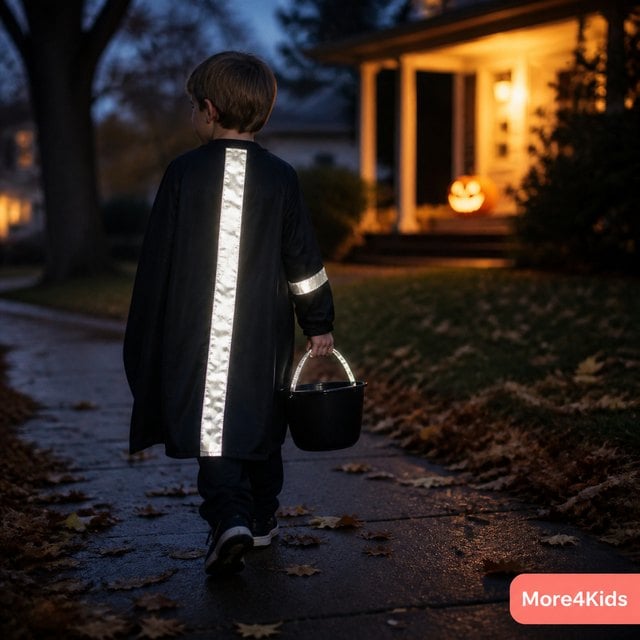
One more job the bucket does: the end-of-night candy check
Whatever container ends up in a kid’s hands, it’s also the thing you’ll be sorting through on the kitchen table afterward, so a bucket or bag that’s easy to see into and dump out actually matters for that step too. A deep, narrow tote makes the candy check slower and more likely to miss something wedged at the bottom; a wide bucket or a bag that opens flat makes it faster to actually look at everything before it gets eaten. If food allergies are part of your household’s Halloween — checking labels, sorting out anything with a stray peanut warning — a container that dumps out easily in one pour is a small thing that makes a real difference at 8:30 p.m. with a tired kid who wants their candy now. Our Teal Pumpkin guide covers the allergy side of trick-or-treating in more depth if that’s a factor in your house.
Trick-or-treat bags and buckets: what to check before you buy
A short list that applies across every style of trick or treat bags and buckets above:
- Squeeze an empty plastic bucket at the handle attachment point. If it flexes or creaks under light pressure, it will fail under a full load of candy.
- Look for stitched, reinforced handle bases on fabric bags, not a single line of thread holding the whole weight of the strap.
- Match the size to the kid, not to how much it can technically hold — a bucket that’s a struggle to carry empty won’t get easier at 7:30 p.m.
- Any battery-powered light-up feature needs a tool-required battery door, not one that opens with a fingernail.
- Skip long drawstring closures on anything a young child will carry close to their body all evening.
What we’d skip
- Ultra-thin dollar-store plastic pails with wire handles hooked through two small punched holes. They’re fine for a photo and rarely survive a full night of real use.
- Oversized totes bought “so they don’t have to go back to the car” for a child who can’t comfortably carry it empty. A too-big bag becomes a two-hand carry that slows down the whole group.
- Light-up buckets with no visible brand name or battery-safety labeling on the listing. A reputable brand with a labeled, tool-required battery door costs a little more and is worth it.
- Bags with long drawstring neck closures marketed for younger kids. A simple handle or strap does the same job without the cord.

An age-by-age approach
Toddlers and preschoolers (roughly 2-4): A small bucket or bag they can lift and carry easily when empty matters more than capacity — they’re not covering many houses solo anyway, and most of what they collect ends up in a parent’s bag by the halfway point regardless. Skip anything with a drawstring neck closure or small decorative pieces that could detach.
Early elementary (roughly 5-8): This is the age where handle strength actually gets tested — kids this age swing buckets, set them down hard on porch steps, and cover real distance. A mid-size bucket with a reinforced handle loop or a sturdy canvas tote both hold up well here.
Tweens (roughly 9-12): Capacity starts to matter more than durability alone, since kids this age often cover more houses and collect more candy. A larger canvas tote or a bigger bucket works, and this is also the age where a bag genuinely gets reused for school events or sleepovers afterward, so a well-made one is worth the slightly higher price.
Storing it between now and Halloween night
If you’re buying early — which is genuinely the right move, since good options thin out fast the closer it gets to October 31st — give a little thought to where the bag or bucket lives between now and then. A canvas tote can just get folded into a drawer or a bin with the rest of the seasonal decor. A plastic bucket is a little pickier: stacking anything heavy on top of it, or leaving it somewhere that gets genuinely hot (a garage shelf in direct sun, a car trunk in September) is exactly the kind of stress that makes the plastic around that handle joint brittle before it’s even been used once. A closet shelf or a bin indoors is a better home for it than the garage.
It’s a small thing, but it’s the same logic as the rest of this article: the failure almost never happens because a bucket or bag was poorly made. It happens because a decent one got stressed in a way nobody thought about in advance — overloaded, swung too hard, stored somewhere too hot, or sized wrong for the kid carrying it. Thinking about trick or treat bags and buckets this way, as something that has a job to do under real conditions rather than just a shelf decoration, is really the whole point of this guide.
The container is the small decision that saves the night
None of this is complicated. A trick-or-treat bag or bucket is a small purchase that’s easy to grab without thinking about, right up until a handle snaps three blocks from home with a genuinely disappointed kid standing next to a pile of spilled candy on a stranger’s lawn. Check the handle, match the size to the kid, and skip the flimsiest option on the shelf — it’s a five-minute decision that quietly prevents one of the most common small Halloween disasters. If you’re also working out the rest of the visibility side of the night, our reflective trick-or-treat safety guide and our battery safety guide for light-up accessories cover the rest of what’s worth checking before the sun goes down.
Frequently Asked Questions
What's the most durable trick-or-treat bucket or bag for kids?
Look at the handle attachment first, on either style. On plastic buckets, a handle looped through a reinforced molded rim outlasts one hooked through two thin punched holes. On fabric totes, a stitched, reinforced handle base outlasts a single line of thread. Beyond that, canvas totes generally survive multiple seasons better than thin plastic, which tends to crack after a year or two of storage in a hot garage or attic.
Are trick-or-treat buckets or bags safer for kids?
Neither style is inherently safer on its own — the details matter more than the category. A light-up bucket adds real visibility after dark, which is a genuine safety plus, as long as its battery compartment requires a tool to open. A bag or bucket with a long drawstring closure is worth avoiding for younger kids regardless of style, since a cord near a child’s neck is the detail to check, not whether it’s a bag or a bucket.
How big should a trick-or-treat bag be for a young child?
Smaller than you’d think. A bucket or bag a toddler or preschooler can comfortably lift and carry when it’s completely empty is the right size — capacity matters far less than that at this age, since most young kids aren’t independently covering enough houses to fill a large container anyway, and an oversized bag just becomes a burden to carry.
Can I reuse the same trick-or-treat bag or bucket every year?
Yes, and a well-made canvas tote is specifically built for that — it folds flat for storage and is washable between seasons. Plastic buckets can be reused too, but check the handle attachment point each year before the first outing, since a season or two of heat and cold in storage is exactly what makes those plastic seams brittle and prone to failure.
Related Articles
- Reflective Trick Or Treat Safety
- Teal Pumpkin Allergy Friendly Halloween
- Light Up Halloween Accessories Battery Safety

Meet Sophia Richards Sophia Richards is an early childhood educator, passionate writer, and the proud mom of three energetic kids. With a degree in Education and over a decade of hands-on classroom experience, Sophia bridges the gap between professional teaching strategies and everyday family life. At More4Kids, she translates complex child development concepts into practical, actionable parenting tips that families can use at home.
Whether she is sharing positive reinforcement techniques, educational crafts, or honest reflections on the chaos of raising three children under one roof, Sophia’s goal is to empower parents to foster resilience and joy in their kids. When she isn't writing or lesson planning, you can find her organizing neighborhood scavenger hunts or trying out new kid-friendly recipes.
Areas of Expertise: Early Childhood Education, Positive Parenting, Sibling Dynamics, Educational Play, Family Wellness.

Add Comment