






By Sophia Richards
The year my three actually agreed on a group costume, it lasted about four days before my youngest decided he didn’t want to be “the small dinosaur” anymore, he wanted to be “the scary one.” We ended up with two dinosaurs and one dragon, which nobody but me seemed to notice didn’t quite match, and honestly, it was fine. Nobody at the door was grading us.
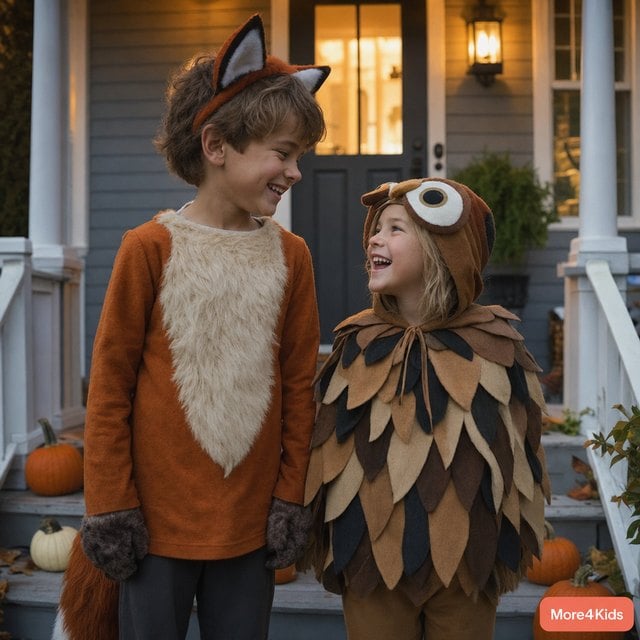
That’s the thing I’d tell any parent starting this process now: good sibling Halloween costumes for a group are less about pulling off a perfect matching set and more about finding a theme loose enough that three kids with three different opinions can each pick their own piece of it. The families who show up looking effortlessly coordinated almost never got there by dictating the plan — they got there by picking a theme with built-in options and then letting each kid choose their spot in it.
Why a group theme works better than a strict match
Table of Contents
A strict matching set — everyone in the exact same costume, just sized down — looks great in the one photo you take at the door. It’s also the version most likely to collapse under real sibling dynamics, because somebody always ends up feeling like they got the boring one.
A theme with roles solves that. Superheroes, pirates, a monster family, a dinosaur pack — anything with more than one character lets each kid claim their own identity inside a shared idea. Your photos still read as “a group,” but nobody spent October arguing about being stuck as the background character in someone else’s costume.
The other real advantage: buying pieces individually instead of a matched three-pack means you can shop each kid’s actual size and actual interest level, rather than forcing a bundle that fits one kid and gaps badly on the others. Sibling group Halloween costume ideas on Amazon is a reasonable starting point for browsing what’s out there by group size, but I’d treat it as inspiration for a theme rather than a single cart you fill all at once.
As an Amazon Associate, More4Kids earns from qualifying purchases. We only recommend products we would use in our own homes, and we check every brand against current CPSC recall data before it appears here. Our recommendations are never paid placements.
Picking a theme that spans different ages
The hardest part of a sibling costume isn’t the theme, it’s the age gap. A theme that reads as fun for a seven-year-old can read as babyish for a twelve-year-old, or genuinely too intense for a toddler.
A few themes hold up well across a wide age range, because they scale in intensity without changing the core idea:
- A monster or creature family — a witch, a vampire, a zombie, a skeleton. Younger kids can go cute-and-cartoonish, older kids can go more detailed, and it still reads as one household.
- A superhero squad — mixing capes and masks means a five-year-old and an eleven-year-old can both be “in it” without either one looking like they’re wearing a costume built for the wrong age.
- A dinosaur pack — genuinely works from toddler through around age eight or nine, and it’s forgiving if a kid changes their mind about which dinosaur they are three separate times, which mine did.
- A pirate crew — captain, first mate, deckhand roles give each kid a distinct identity without anyone needing to be “the baby version.”
If you’re mixing a monster theme, witch costumes for kids, vampire costumes for kids, and zombie costumes for kids are all built loosely enough that a toddler and a tween can both wear a version of the same idea without either one looking out of place next to the other.
The superhero squad approach
If your kids are already sorted into “who’s my favorite hero,” a superhero squad is often the path of least resistance, because the theme selection basically does itself.
The trick is letting the pairing happen naturally instead of assigning roles. My middle one wanted to be Batman for two straight years before switching, unprompted, to wanting to match his little sister instead of me trying to talk him into it. Kids sort themselves into a group faster than you’d expect once they see siblings are actually doing it too, not just being told to.
Batman costumes for kids, Spider-Man costumes for kids, and Supergirl costumes for kids are the three I’d check first if this is the lane you’re in — between them, most superhero-leaning kids find a character they actually want, rather than one they’re settling for so the group photo works.
One thing worth checking across a superhero group specifically: cape length and closure. A cape that trails past mid-back on a younger sibling is a trip hazard the older kids with shorter capes won’t have, so don’t assume the same costume style is equally safe across every kid wearing it — check each one on the actual kid, not just on the size chart.

Sibling Halloween costumes: the fit checks, done per kid
This is the part I don’t skip, and it’s also the part that takes longer with a group than it does with one costume, because “safe for the eight-year-old” and “safe for the toddler” are not the same standard.
Hem length, checked on the actual kid. A robe or dress that clears the ankle on your ten-year-old will drag on the ground on your four-year-old if you bought the whole set in one swept motion without trying each one on the right kid. Lay each costume flat and check the hem against that specific child’s height, not against the size label.
Nothing tied around the neck, on any of them. Cape ties, hooded drawstrings, costume scarves — the rule is the same regardless of age, but it’s easy to check it carefully on your oldest and skip the same check on a squirming toddler because the costume is smaller and feels lower-stakes. It isn’t. Look for hook-and-loop or breakaway closures across the whole group, not just the costumes that look most elaborate.
Room for a layer underneath, especially on the youngest. Toddlers lose body heat faster than older kids and are the least likely to tell you they’re cold until they’re already miserable. If the group theme runs snug, size up specifically for whichever sibling is smallest, even if it means their costume doesn’t match the others quite as precisely.
Separate masks from younger siblings. A rigid full-face mask that’s fine for a ten-year-old is a vision and hearing risk for a four-year-old in the same group. If the theme calls for masks, let the older kids wear them and switch the youngest to face paint or a soft partial mask instead — nobody at the door is going to notice the inconsistency, and it’s a meaningfully safer setup.
And one that applies to the whole group at once: keep everyone away from jack-o’-lantern candles while costumes are on, especially anything with hanging fabric like capes or robes. Battery tea lights solve this without changing how the pumpkins look on the porch.
When siblings genuinely can’t agree
Not every group lands on one theme, and that’s a completely fine outcome. If your kids are dug in on wanting totally different costumes — a dinosaur, a princess, and a skeleton, say — you can still get a coordinated-looking group without forcing a match, by tying them together with one shared element instead of one shared costume.
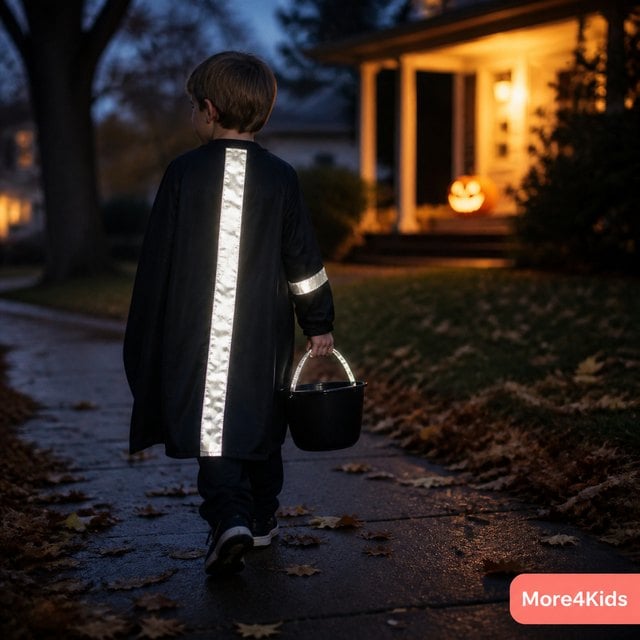
A shared color works well: everyone wears something orange or black somewhere in the outfit, on top of their unrelated main costume. A shared accessory works too — matching trick-or-treat buckets, or the same style of reflective gear on all three kids, does more visual “we’re together” work than people expect, without anyone having to compromise on their actual costume choice.
This is also where I’d point you toward our DIY Halloween costume guide if buying three separate full costumes isn’t in the budget or the plan — a lot of the closet-first builds in there mix and match well across a group even when the underlying characters have nothing to do with each other.

Whatever you land on, reflective tape you can add to any bucket or costume is the cheapest way to make an unmatched group still look and function like a set — one strip on each bucket, one on the back of each costume, done in under ten minutes for all three kids at once.
The pirate crew, and roles instead of ranks
A pirate crew is one of the easier group themes to pull off without anyone feeling like they got the lesser costume, because pirate costuming naturally splits into roles rather than a hierarchy — captain, first mate, deckhand, parrot-keeper, whatever your kids invent. Nobody’s “just” a pirate; everybody has a job.
Pirate costumes for kids covers everything from a simple bandana-and-vest build to a fuller coat-and-hat version, and it’s genuinely one of the more layerable options on this list — a pirate costume goes over a long-sleeve shirt without looking wrong the way some of the more form-fitting hero costumes do, which matters once the temperature drops.
Skip anything with a rigid plastic hook accessory for the youngest kid in the group specifically — a soft version exists for almost every pirate set, and there’s no reason a four-year-old needs a hard plastic hook at eye level in a crowd of other kids on a porch or at a school event.
If there’s a baby in the mix
If your sibling group spans all the way down to an infant, the calculation changes again, because a baby isn’t choosing a role in the theme — you are, and their costume needs to prioritize comfort and safety over matching precision.
We wrote a full piece on this specifically: family Halloween costumes with a baby in the mix goes through what actually works for the youngest member of a group photo, including why a baby’s costume should never depend on anything the baby has to hold, wear on their face, or keep in place themselves. For a sibling group specifically, the easiest version is to let the older kids carry the theme fully and dress the baby in a simple onesie-style costume that echoes the color or general idea — a small dinosaur onesie next to two kid-sized dinosaur costumes reads as a set without asking an infant to do anything more complicated than exist in matching colors.
The rivalry nobody warns you about
Nobody tells you that the actual hardest part of a sibling group costume isn’t picking the theme, it’s managing who gets to be the “main” character once the theme is picked. I have watched a five-minute conversation about which kid gets to be the “leader dinosaur” turn into the loudest disagreement of the week, twice.
A few things that have actually helped in my house: pick roles by interest, not birth order — the oldest doesn’t automatically get first pick just because they’re oldest, and that assumption causes more resentment than it prevents. Let each kid own one specific detail that’s theirs alone within the group theme, even something as small as which color cape or which character name, so nobody feels like an interchangeable extra in someone else’s costume. And if two kids want the exact same specific character, let them both have it — twin dinosaurs are not a failure of planning, they’re just what happened, and nobody outside your house will care.
If this particular flavor of conflict sounds familiar beyond just costume season, our piece on stopping sibling rivalry covers the same underlying dynamic — kids competing for status inside a shared situation — in a lot more depth than Halloween alone can fix.
What we’d skip
These are the sibling Halloween costumes and group add-ons I’d leave alone. No links in this section, because this is the part where I’m telling you not to buy something.
- A single matched three-or-four-pack costume set bought sight unseen for kids of very different sizes. These almost never fit every kid in the set well, and you lose the ability to check hem length and neck ties individually before committing.
- Rigid full-face masks on any sibling under about six, even if the older kids in the group are wearing them. Swap to face paint or a soft partial mask for the youngest instead.
- Matching costumes with any tied — rather than hook-and-loop or breakaway — neck closure, across the whole group. It’s not safer just because it’s part of a themed set.
- Small shared accessories or props meant to be passed between kids — a single prop that gets handed around a group of kids of different ages is exactly the kind of small, detachable item that ends up on the ground and in a younger sibling’s mouth by the second house.
- Forcing a strict role hierarchy on kids who are already showing signs of resenting it. If the “main character” argument is escalating, it’s genuinely easier to let two kids share the lead role than to referee it all night.
A parent’s honest take
The sibling Halloween costumes that actually work aren’t the ones where every piece matches perfectly — they’re the ones where each kid still feels like themselves inside the group idea. My three have never once managed a flawless matched set, and every year the slightly-off version is what ends up in the photo I actually keep.
Pick a theme loose enough to bend, check the fit and the neck ties on every kid individually rather than trusting the size label, and let the youngest one opt out of anything the older kids are wearing that doesn’t actually suit their age. Everything else — who’s the leader, whose cape is longer, whether the dinosaur pack technically includes one dragon — works itself out by the time you’re actually standing on someone’s porch.
Frequently Asked Questions
How do I coordinate sibling Halloween costumes for kids of different ages?
Pick a theme with built-in roles — a monster family, a superhero squad, a pirate crew, a dinosaur pack — rather than one identical matching costume in different sizes. Themes with roles let each kid claim their own character within the group, which holds up better across a wide age range than a strict match, and it lets you shop each kid’s actual size instead of forcing a bundled set.
What if my kids can't agree on one costume theme?
Tie unrelated costumes together with one shared element instead of forcing a match — a shared accent color everyone wears somewhere, or matching trick-or-treat buckets and reflective gear. This gets you a coordinated-looking group photo without any kid having to give up the specific costume they actually wanted.
Is it safe for a toddler to wear the same costume style as an older sibling?
Not automatically. Check hem length, neck ties, and mask use on each child individually rather than assuming a costume style that’s safe for an older sibling is equally safe on a toddler — a robe that clears an eight-year-old’s ankle will drag on a four-year-old, and a rigid mask that’s fine for a ten-year-old is a vision and hearing risk for a much younger child.
What's a good group costume idea that includes a baby?
Let the older kids carry the full theme and dress the baby in a simple onesie-style costume in a matching color or a simplified version of the idea, rather than asking an infant to wear anything with a mask, a held prop, or a piece that needs to stay in place on its own. Our family Halloween costumes with a baby guide goes through this in more depth.
Related Articles

Meet Sophia Richards Sophia Richards is an early childhood educator, passionate writer, and the proud mom of three energetic kids. With a degree in Education and over a decade of hands-on classroom experience, Sophia bridges the gap between professional teaching strategies and everyday family life. At More4Kids, she translates complex child development concepts into practical, actionable parenting tips that families can use at home.
Whether she is sharing positive reinforcement techniques, educational crafts, or honest reflections on the chaos of raising three children under one roof, Sophia’s goal is to empower parents to foster resilience and joy in their kids. When she isn't writing or lesson planning, you can find her organizing neighborhood scavenger hunts or trying out new kid-friendly recipes.
Areas of Expertise: Early Childhood Education, Positive Parenting, Sibling Dynamics, Educational Play, Family Wellness.

Add Comment