















By Sophia Richards
Teaching kids time management is one of those parenting jobs nobody hands you a manual for. We expect our children to “hurry up,” “stop dawdling,” and “just get ready,” and then we are surprised when a six-year-old stares at a sock for four minutes like it holds the secrets of the universe. I have been that parent in the doorway, keys in hand, watching a perfectly capable child move at the speed of cold syrup.
Here is the reassuring part. Time management is not a personality type your child either has or does not have. It is a set of skills, and skills can be taught, practiced, and grown. A child who cannot yet judge how long ten minutes feels is not lazy or difficult. They simply have a developing brain that has not built those tools yet, and that is exactly where we come in.
As a mom of three and a former early-childhood educator, I have watched time management develop the way most real skills do: slowly, unevenly, and best of all in small everyday moments rather than in one big lecture. So instead of a one-size speech, this guide walks through eight age-by-age skills that actually stick, from the preschool years all the way to the edge of middle school.
Why Time Management Is a Skill You Teach, Not a Trait
Table of Contents
Before we get to the how, it helps to understand the why. The part of the brain that handles planning, sequencing, and self-monitoring, often grouped under the label executive function, is still under heavy construction all through childhood and well into the teen years. The Child Mind Institute describes executive functions as the mental skills that help us plan, focus, remember instructions, and juggle tasks, and notes they develop gradually rather than arriving fully formed.
That single fact changes how we parent the clock. When we understand that time management skills are still growing, we stop treating slowness as defiance and start treating it as a teaching moment. We scaffold. We give a little help now so our child can do it alone later, the same way we once held the back of the bike before letting go.
This is also why age matters so much. Asking a four-year-old to independently manage a morning routine is like asking them to reach a shelf they are years from growing tall enough to touch. But asking a ten-year-old to do the same thing, after years of practice, is completely reasonable. The eight skills below are laid out roughly in the order children are ready for them, so you can meet your child where they actually are.
1. Ages 3 to 5: Build Predictable Routines So Time Feels Real
Young children do not understand minutes and hours yet, but they understand order. First we wake up, then we eat, then we get dressed. That sequence is your child’s very first experience of managing time, even though no clock is involved.
The American Academy of Pediatrics, through HealthyChildren.org, explains that family routines give children a sense of security and help them know what to expect, which in turn helps them cooperate. PBS Kids for Parents makes a similar point about the power of routines: predictable patterns are something children can count on, and that predictability is the soil the rest of these skills grow in.
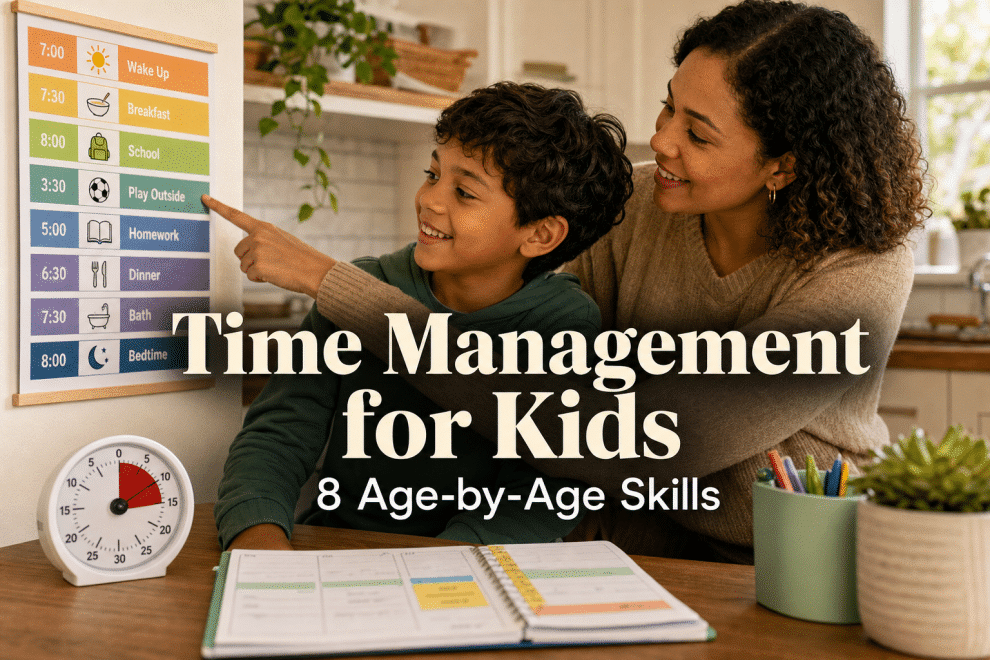
So at this age, teaching kids time management looks less like a planner and more like a rhythm. Keep the morning and bedtime steps in the same order every day. A simple picture chart on the wall, with photos or drawings of each step, lets a preschooler “read” the routine without being able to read words. Our guide to happy kids and daily routines walks through building one of these without turning it into a chore.
The win here is not speed. It is the quiet lesson that time has a shape, and that your child can follow it.
2. Ages 4 to 6: Make Time Visible With Timers and First-Then
Little kids cannot feel abstract time, but they can watch it. This is where a simple timer becomes one of the most useful time management tools in the house.
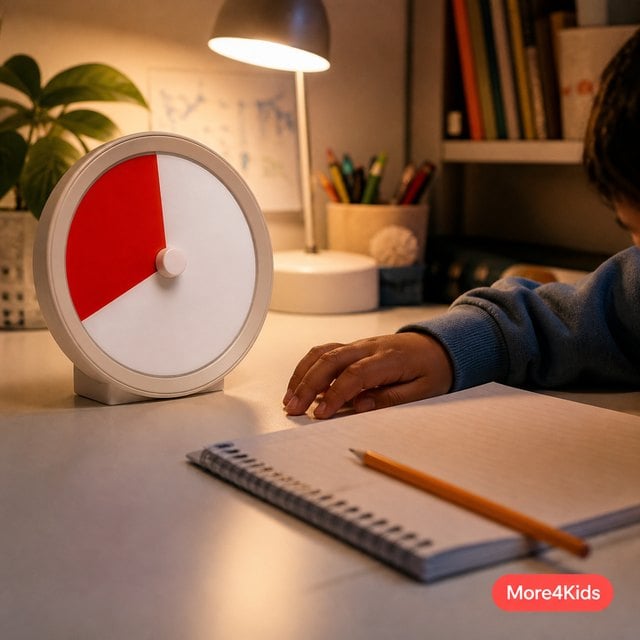
Try a visual timer, the kind that shows a shrinking wedge of color, or even a plain kitchen timer. “We are going to clean up until the timer beeps” turns a vague, arguable request into something concrete a child can see. It also moves you out of the nagging role. The timer becomes the neutral boss, not you.
Pair it with “first, then” language. “First shoes, then we can play in the yard.” “First teeth, then story.” This teaches sequencing and the idea that some things come before others, which is the seed of prioritizing later on. In our house, “first-then” defused about half the morning standoffs, because it gave my kids a finish line they could actually picture.
Keep the windows short and winnable at this age. A four-year-old can manage a two-minute timer long before they can manage a twenty-minute one.
3. Ages 5 to 7: Teach the Actual Language of Time
Around kindergarten and first grade, children start to grasp that time comes in named chunks, and this is a wonderful window for teaching kids time management through everyday narration.
Talk time out loud all day long. “We have five more minutes at the park.” “Dinner is in about half an hour.” “That show is fifteen minutes, then it is bath time.” You are giving your child a vocabulary for something invisible, and you are quietly calibrating their internal sense of how long things take.
A few concrete practices help here:
- Point out the clock and connect it to real events: “When the big hand is at the top, it is time to leave.”
- Use a paper or digital calendar to count down to something exciting, so days and weeks become real units.
- Narrate your own planning: “I need to start dinner now so it is ready by six.”
None of this requires a lesson plan. It is just the ordinary talk of a home, aimed with a little intention. In my classroom years, the children who could pace themselves through a morning were almost always the ones whose families narrated time at home, and children who hear time described all day absorb it far faster than children who only hear “hurry up.”
4. Ages 6 to 8: Use a Simple Morning and After-School Checklist
Once a child can read a few words or follow a picture list, a simple checklist starts doing real work. A short, visible list of morning steps, backpack, shoes, water bottle, lunch, hair, does the remembering so your child does not have to hold it all in a still-developing memory, and so you do not have to be the human reminder alarm.
The magic of a checklist is that it hands ownership to the child. Instead of you saying “did you get your shoes,” your child checks the list and finds the answer themselves. That small shift, from parent-managed to child-managed, is the whole point of teaching kids time management. You are working yourself out of a job on purpose.
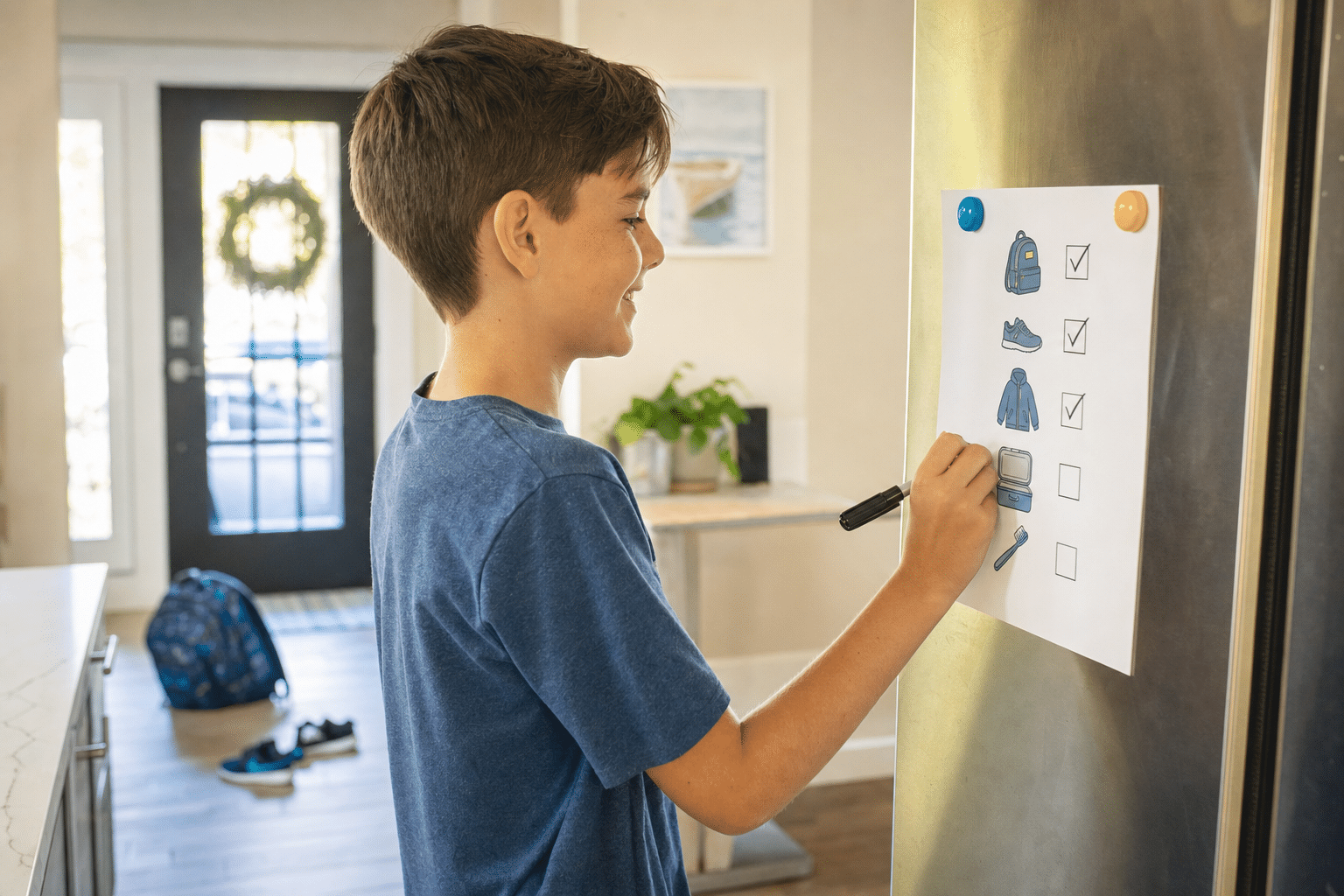
Keep the list short and picture-supported for the youngest readers. Laminate it or slip it in a sheet protector so it can be reused with a dry-erase marker. And expect to coach it for a while before it runs on its own; a checklist is a tool your child learns to use, not a magic spell that works on day one. This is also a natural place to build broader responsibility by age, since owning a routine and owning a chore grow from the same root.
5. Ages 7 to 9: Let Kids Estimate How Long Things Take
Here is a skill most adults never realize they learned: guessing how long a task will take. Kids are famously bad at this, which is why “I will do it in a minute” so often means “not for an hour.” You can teach estimation directly, and it is genuinely fun.
Make it a game. “How long do you think it will take to set the table? Let us guess, then time it.” Write down the guess, run the timer, and compare. Children love beating their own estimate, and over dozens of these little experiments, their sense of time gets sharper and more honest. In our house this turned into a nightly competition, and I watched my kids go from wildly guessing “one minute” to landing within a few seconds of the real time, all without a single lecture from me.
This matters enormously for homework and mornings. A child who can realistically think “reading takes me twenty minutes, so I should start now” is doing real time management. A child who thinks everything takes two minutes will always be caught off guard. Estimating is the bridge between knowing what time it is and actually planning around it.
Keep your tone curious, not corrective. The goal is a child who becomes interested in how time works, not one who feels timed and judged.
6. Ages 8 to 10: Introduce a Family Calendar and Weekly Planning
By the upper-elementary years, life gets busier, practices, projects, playdates, and a shared family calendar becomes a powerful teaching tool. When your child can see the week laid out, time management skills stop being abstract and start being visual.
Put a big calendar or whiteboard somewhere central. Add school events, activities, and family plans, and let your child add their own. Then do a short weekly look-ahead together, maybe Sunday evening. “What is coming up this week? Anything due? Anything we need to get ready for?” That five-minute habit teaches your child to think ahead instead of being surprised, which is the heart of managing their time.

This is also the age to connect time to the school year rhythm. Our guide to back-to-school schedules can help you reset routines each fall, and screens are worth planning too; if device time keeps swallowing the afternoon, our piece on screen time and kids can help you set limits that protect the calendar you just built.
Let your child feel some ownership of the calendar. A plan they helped make is a plan they are far more likely to follow.
7. Ages 9 to 11: Break Big Tasks Into Small Steps
“Clean your room” and “do your book report” are the kinds of jobs that make a kid freeze. They are too big to hold in one thought. One of the most durable time management skills you can teach is chunking, breaking a large task into small, clear steps.
Sit down with your child and a big task, and write the steps together. A book report becomes: pick the book, read it, jot three notes, write a rough draft, fix it, done. A messy room becomes: books on the shelf, clothes in the hamper, toys in the bin, trash out. Suddenly the mountain is a set of stairs.
Then help your child slot those steps across available time. “You have three afternoons before this is due. Which step will you do today?” This is planning, prioritizing, and pacing all at once, and it is exactly the skill that will carry them through middle school, high school, and beyond. Big projects stop being emergencies and become a series of small, manageable moves.
Expect them to still need your help sequencing for a while. You are the coach on the sideline, not the player, and slowly you say less as they do more.
8. Ages 10 to 12: Hand Over the Planner and Let Them Own It
The final skill is the hardest one for us parents: stepping back. By late elementary and early middle school, the goal of all this teaching is a child who manages their own time with a planner, a calendar app, or a notebook, and who feels the natural results when they do or do not.
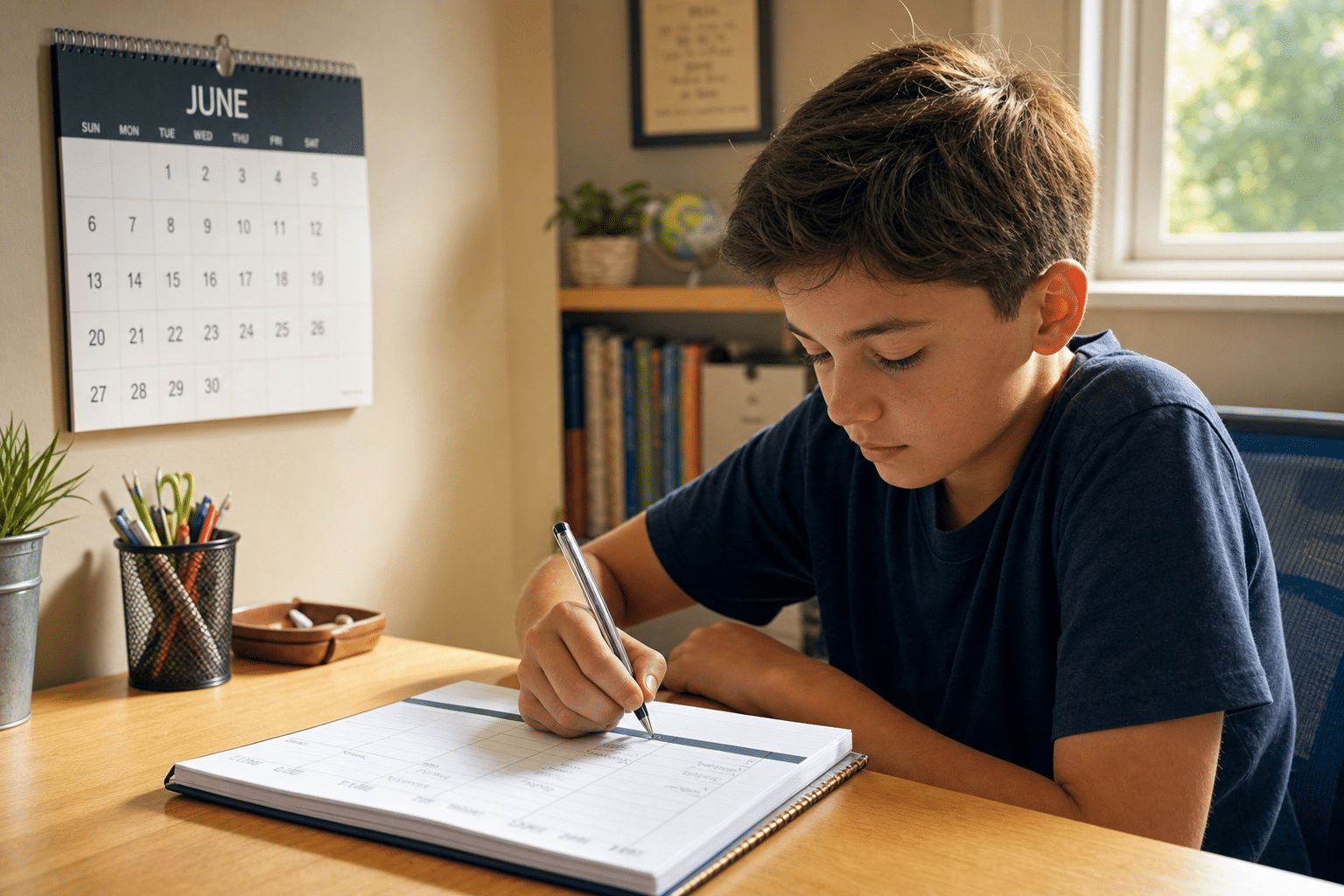
Give your child a real planner or a simple digital calendar and let them run it. Coach them on writing down assignments and checking it daily, then resist the urge to be their backup memory forever. This is where natural consequences do the teaching. A forgotten assignment or a rushed morning, handled with warmth rather than a lecture, teaches more than any reminder from you. Our note on teaching kids stress management and healthy habits pairs well here, because owning a schedule and handling the pressure of it go hand in hand.
That does not mean abandoning them. It means shifting from manager to consultant. You are available for weekly check-ins and big problems, but the day-to-day belongs to them now. That is the whole arc of teaching kids time management: we hold the whole load when they are three, and we hand it over piece by piece until, around adolescence, they can carry it themselves.
A Few Tools That Make Teaching Kids Time Management Easier
You do not need to buy anything fancy. The best time management tools are usually the simplest ones, used consistently:
- Visual timers for young children, so time becomes something they can see shrinking.
- Checklists on the fridge or by the door, picture-supported for early readers.
- A shared family calendar or whiteboard in a central spot everyone passes daily.
- A planner or simple calendar app for older kids ready to own their schedule.
- A consistent “launch pad” by the door where backpacks and shoes live, so mornings have fewer surprises.
The tool matters far less than the habit. A cheap kitchen timer used every day will teach more than an expensive planner that lives in a drawer. Pick one tool that fits your child’s age, and use it until it becomes second nature before adding another.
Common Mistakes to Avoid
A few gentle warnings from someone who has made most of these:
Do not expect adult speed from a child brain. Time management develops over years. A slow morning at seven does not predict a disorganized adult at thirty.
Do not do it all for them. It is faster to pack the backpack yourself, but every time you rescue, you postpone the learning. The messy, slower path of letting them try is the one that actually teaches.
Do not turn the clock into a weapon. If timers and checklists become tools for shame, kids tune them out. Keep the tone warm and curious. You are teaching a life skill, not running a boot camp.
Do not add ten tools at once. One age-appropriate tool, used consistently, beats a whole system that overwhelms everyone by Wednesday.
Frequently Asked Questions
At what age should I start teaching kids time management?
You can start in the preschool years, but not with clocks and planners. For ages three to five, teaching kids time management means building predictable routines and using “first-then” language so time gets a shape. Clocks, checklists, and calendars come later, roughly from kindergarten up, as your child’s brain grows ready for them.
Why is my child so slow and disorganized about time?
Usually because the planning part of the brain is still developing. Judging how long things take, sequencing steps, and remembering a routine are executive-function skills that grow gradually through childhood. A slow or scattered child is far more often a child who has not built the skill yet than one who is being defiant. Your job is to scaffold the skill, not punish the gap.
What are the best tools for kids' time management?
Simple, visible ones. Visual timers for little kids, picture checklists for early elementary, a shared family calendar for the busy upper-elementary years, and a personal planner or calendar app for older kids. The specific tool matters less than using it consistently. A plain kitchen timer used daily beats a fancy planner nobody opens.
How do I teach time management without nagging?
Let the tools do the reminding instead of you. A checklist answers “did you get your shoes” so you do not have to. A timer, not your voice, signals when clean-up ends. As your child gets older, natural consequences, handled kindly, teach more than repeated reminders. The aim of teaching kids time management is to work yourself out of the reminder job.
What if my child still struggles a lot as they get older?
Some ongoing struggle is normal, but if time management, focus, and organization stay very hard well past the point where peers have gotten the hang of it, it is worth a gentle conversation with your child’s teacher or pediatrician. Persistent difficulty can sometimes point to attention or executive-function needs that benefit from extra support, and asking for guidance is a sign of good parenting, not failure.
The Bottom Line
Teaching kids time management is not a single conversation you have and check off. It is an eight-skill journey you walk with your child, from the picture routine on a preschooler’s wall to the planner a middle-schooler finally owns themselves.
Start where your child actually is. Build routines when they are little. Make time visible with timers. Give them the words for time, then a checklist, then the skill of estimating, then a calendar, then chunking big tasks, and finally the planner and the ownership that comes with it. At every step you are doing the same loving thing: holding the skill for them until they are ready to hold it themselves.
Go slowly, keep it warm, and pick one skill to practice this week. Time management, like every good habit, is built one ordinary day at a time. For more practical, parent-to-parent guidance, our whole parenting section is here to walk it with you.
Related Articles
- A Secret To Happy Kids Daily Routines
- Teaching Kids Responsibility
- Back To School Schedules
- Screen Time And Kids
- Teaching Kids Stress Management And Healthy Habits
- Parenting

Meet Sophia Richards Sophia Richards is an early childhood educator, passionate writer, and the proud mom of three energetic kids. With a degree in Education and over a decade of hands-on classroom experience, Sophia bridges the gap between professional teaching strategies and everyday family life. At More4Kids, she translates complex child development concepts into practical, actionable parenting tips that families can use at home.
Whether she is sharing positive reinforcement techniques, educational crafts, or honest reflections on the chaos of raising three children under one roof, Sophia’s goal is to empower parents to foster resilience and joy in their kids. When she isn't writing or lesson planning, you can find her organizing neighborhood scavenger hunts or trying out new kid-friendly recipes.
Areas of Expertise: Early Childhood Education, Positive Parenting, Sibling Dynamics, Educational Play, Family Wellness.

Add Comment