















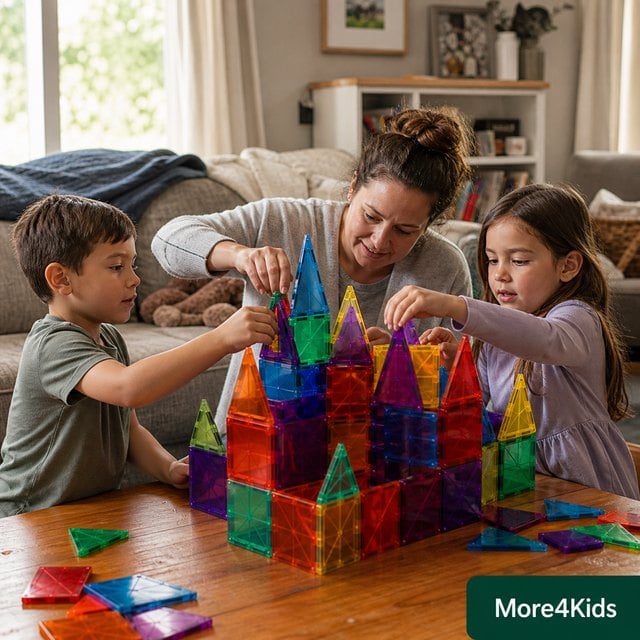
My living room floor has been a magnetic tile construction site for about three years now. There’s a low coffee table that got turned into a “castle base” so many times I finally just moved it. My youngest builds towers until they topple, my middle one builds elaborate multi-room houses with color-coded “walls,” and my oldest — who is technically too old for this, at eleven — still sits down and adds a garage or a bridge when nobody’s looking. Few toys in this house have survived three very different kids, three very different attention spans, and this many years of daily use without a single piece breaking.
That staying power is exactly why magnetic tiles are everywhere on gift lists this year. They’re also, unfortunately, everywhere on marketplace search pages under a dozen different brand names, price points, and build qualities — and “magnetic” is a word that covers both the sturdy, encased, been-tested-for-a-decade sets and a completely different category of small loose magnets that has been showing up in CPSC recalls all year. Before you add a set to your cart, it’s worth knowing what actually separates the two, because they are not the same risk category at all.
As an Amazon Associate, More4Kids earns from qualifying purchases. We only recommend products we would use in our own homes, and we check every brand against current CPSC recall data before it appears here. Our recommendations are never paid placements.
Why this toy earns its shelf space
Table of Contents
Magnetic tiles are, at their core, flat geometric panels — squares, triangles, sometimes rectangles or hexagons — with magnets sealed inside the edges so the pieces snap together into towers, houses, ramps, and increasingly elaborate structures. There’s no instruction booklet telling a kid what to build, which is the whole point. A four-year-old makes a wobbly box. A nine-year-old makes a two-story house with a working door. The same set does both jobs.
Educators like it for reasons that go beyond “it’s quiet for twenty minutes,” although that’s real too. Building with tiles is hands-on geometry — shapes, symmetry, balance, cause and effect when a tower gets too tall and topples. It’s also naturally cooperative: unlike a lot of building toys, magnetic tiles snap together easily enough that a toddler and a ten-year-old can work on the same structure without one of them getting frustrated. I’ve watched my kids build side by side more with this than with almost anything else in the toy rotation.
It also happens to be one of the more convincing screen-free toys I’ve seen, in the sense that it doesn’t need a screen-free “rule” to work — nobody’s negotiating over it. There’s no app, no batteries, no light-up feature competing for attention. The building itself is the whole activity, which means a set that felt exciting on day one still gets pulled out unprompted months later, because the ceiling on what you can build with it is set by the kid’s imagination, not by the toy running out of new tricks.
The safety distinction that actually matters
Here’s the thing that doesn’t get said clearly enough in gift guides: “magnetic toy” is not one product category from a safety standpoint. A well-made magnetic tile set has its magnets permanently sealed inside a hard plastic panel — you’d have to break the tile open with real force to get a magnet out, and each tile itself is far too big to be a choking risk for any age this toy is marketed to. That’s a fundamentally different design than a loose magnetic ball, cube, or fidget piece, which is small, separate, and designed to come apart from its neighbors.
That second category is the one CPSC keeps recalling. I pulled our own recall tracking data before writing this, rather than going on gut feeling, and the pattern is stark: a dozen separate 2026 recalls for magnetic building cubes, magnetic fidget sliders, magnet chess games, magnetic stick-figure sets, and magnetic puzzle balls — all for the same underlying hazard, loose high-powered magnets that can be swallowed. One of the more sobering entries is a magnetic building cube set that used almost identical marketing language to legitimate tile brands — “magnetic building set,” “STEM toy,” “open-ended construction” — but was recalled specifically because the small cubes could crack open and release the magnets inside. When two or more magnets get swallowed separately, they can attract each other through intestinal walls, which is a surgical emergency, not a wait-and-see one.

None of this means large-format magnetic tiles are unsafe. It means the label “magnetic building toy” spans two very different engineering approaches, and the difference is exactly what to check before you buy.
What to check before you buy
A few minutes of comparison shopping catches almost everything that matters here.
Size first. Each individual tile should be clearly too large to fit in a mouth — most reputable sets run tiles in the 2 to 3.5 inch range, which is nowhere near choking-hazard territory on its own. If a listing shows pieces that look small or ball-shaped rather than flat panels, it’s probably not actually a tile set no matter what the title says.
The shake test. This is the single best real-world check, and you can do it in the store or from an unboxing video: a well-sealed tile makes essentially no rattle when you shake it, because the magnet is embedded flush against the plastic with no room to move. A tile that rattles has a magnet that isn’t fully seated, which is a manufacturing red flag whether or not it’s technically passed a safety test.
Edges and seams. Run a finger along the border of a tile. It should feel smooth and continuous, not like two pieces of plastic glued together with a visible seam. Ultrasonic-welded or single-molded tiles hold up to years of dropping and stacking; glued seams are the failure point that eventually lets a magnet work loose.
Compliance labeling. Look for ASTM F963 compliance on the listing or packaging — this is the U.S. toy safety standard that specifically addresses magnet strength and containment for children’s products. It won’t be the only thing on the box, but its absence on an otherwise unbranded set is worth pausing over.
Age grading that matches the piece count. A 100-plus piece starter set graded “3+” should have reasonably large individual tiles; if a huge set is priced suspiciously low, check whether the piece count is being hit by making each tile smaller rather than by including more of them.
None of this requires becoming a materials engineer. It’s a two-minute label check plus a shake test, and it rules out the sets most likely to have cut a safety corner.
Picking a set by age and stage
The right starter set changes more than most parents expect as kids get older.
Toddlers (18 months to 3 years). Look for sets marketed specifically as “toddler” or “large format” — the individual tiles run noticeably bigger than a standard set, sized for hands that are still working on pincer grip and fine motor control. Smaller piece counts (around 20 to 30) are plenty at this stage; a toddler is mostly stacking and knocking down, not architecting.
Preschool through early elementary (3 to 7). This is the sweet spot for a standard 100-to-120-piece starter set in mixed shapes — squares, triangles, and a few specialty pieces. It’s enough volume to build something real (a house with a roof, a simple vehicle) without becoming an overwhelming pile on the floor.

Older builders (7 and up). Once a kid has the basics down, expansion packs and specialty add-ons — wheeled bases, small figures sized to scale with the tiles, arch and window pieces — are what keeps the interest alive instead of a bigger box of the same squares and triangles. My oldest’s actual favorite addition wasn’t more tiles; it was a set of wheeled car bases that turned his houses into garages.
A practical note on gifting across a wide age range at once, which comes up a lot around the holidays with cousins or siblings at different stages: buy for the youngest child’s safety needs first, then let the set scale up for the older kids by adding pieces rather than by choosing smaller tiles. It’s easier to make a large-format set feel advanced with more pieces and accessories than it is to make a small-format set safe for a toddler after the fact.

The compatibility question nobody explains upfront
One of the genuinely useful things about this category: most magnetic tile brands are cross-compatible, because the industry has more or less converged on the same tile thickness and magnet placement. That means you don’t have to stay loyal to one brand if you’re adding to an existing collection — a cheaper expansion pack from a different maker will usually click right into an established set. It’s worth double-checking a specific listing’s reviews for compatibility complaints before assuming it, since there are occasional outliers, but as a general rule this is a toy category where mixing brands to fill out a collection is normal and expected, not a workaround.
For a first set, I’d start with a mid-size magnetic tile building set in the 100-piece range rather than the smallest starter box — it’s enough volume that the first build doesn’t disappoint, without going straight to the largest (and most expensive) option before you know if it’ll stick.
Building toward something bigger
Once a tile set has been in rotation for a while, the question shifts from “will they like this” to “how do we keep it interesting.” A few directions that have worked in our house:
For the youngest builders who are still working on grip and stacking rather than architecture, a large-format toddler tile set sized for smaller hands makes the early building stage a lot less frustrating than handing a toddler standard-size pieces.
For a kid who’s already deep into their collection, an expansion pack is the cheapest way to extend play value — more square and triangle pieces means bigger, more ambitious structures without buying a whole new starter box.
Adding scale figures — little magnetic people sized to fit the doorways and rooms a kid has built — is the single upgrade that turns a pile of geometric shapes into actual pretend play. Look for a set of magnetic figures made to accompany tile sets rather than generic toy people, since the scale matters for them to actually fit the structures.
And for a kid whose interest runs more toward roads and vehicles than houses, a magnetic tile car and road set redirects the same building skill into tracks, garages, and ramps instead of walls and roofs — useful for the kid who’s decided regular tiles are “boring” without actually being done with the toy.
What we’d skip
A few things I wouldn’t put in a cart, none of which need a link:
Unbranded sets with no listed compliance information and a price that’s dramatically lower than every comparable set — if a 100-piece set is a third of the price of the recognizable brands, something was cut to get there, and tile thickness or magnet sealing is the likely place.
Anything marketed as “magnetic” that turns out, on close reading of the listing, to be small loose pieces rather than flat panels — magnetic building cubes, magnetic balls, magnetic construction beads. These sit in the exact hazard category our recall data keeps flagging, and the marketing language is often close enough to legitimate tile sets that it’s easy to grab the wrong thing by accident.
Sets with visibly glued rather than molded seams, based on customer photos in the reviews — a listing’s official photos rarely show this, but real buyer photos usually do.
Any tile set for a child still in the mouthing stage where the piece size isn’t clearly stated — if you can’t tell from the listing how big an individual tile actually is, that’s a reason to keep looking rather than guess.
The five-minute check before you buy or gift
- Read the piece dimensions, not just the piece count — a “100-piece” set with unusually small tiles is a different product than a 100-piece set of standard-size ones.
- Check for ASTM F963 compliance listed on the packaging or product description.
- Look at buyer photos in the reviews, not just the official listing photos, for seam quality.
- If you’re gifting to a toddler, confirm the listing specifically says “toddler” or “large format” rather than assuming a standard set will work.
- Search the brand name plus “recall” before buying, and check cpsc.gov/Recalls directly — our own recall database starts in February 2026 and has known gaps, so a clear search isn’t proof of a clean history, only one more data point.
- If a set arrives and a tile rattles when shaken, that’s a return, not a “we’ll keep an eye on it.”
Frequently Asked Questions
What age are magnetic tiles safe for?
Standard magnetic tile sets are typically graded 3 and up, largely because younger toddlers are still exploring toys by mouth and standard tiles, while too large to swallow, aren’t designed with that stage in mind the way large-format toddler sets are. For 18 months to 3 years, look specifically for sets marketed as toddler or large-format rather than a standard starter box.
Are magnetic tiles safer than magnetic building cubes or balls?
Generally yes, and the difference is the engineering, not the branding. Tiles seal a single magnet inside a large, hard plastic panel that’s difficult to break open. Building cubes, balls, and similar small loose-magnet toys are designed to separate into individual small pieces, which is exactly the hazard CPSC recalls have targeted repeatedly through 2026.
Can I mix magnetic tile brands together?
Usually, yes. Most brands have converged on similar tile thickness and magnet placement, so pieces from different makers typically click together. It’s still worth checking a specific listing’s reviews for compatibility notes before assuming it, especially with off-brand or budget sets.
How do I know if a magnetic tile set is well-made before I buy it?
Check the piece dimensions against the piece count, look for ASTM F963 compliance, and scan buyer review photos for seam quality. If you already own the set, the shake test — a well-sealed tile makes almost no rattle — is the fastest at-home check.
What should I do if a magnetic tile cracks or a magnet comes loose?
Remove that tile from the set immediately and don’t let a younger sibling inherit it. A single loose magnet is a real ingestion hazard, particularly if there’s more than one magnet anywhere in reach that could be swallowed separately.
Are magnetic tiles worth the price compared to other building toys?
In our house, yes — they’ve outlasted plenty of toys that cost more and get used less, partly because the same set works for a three-year-old and a ten-year-old, and partly because they’re genuinely open-ended rather than a kit that gets built once and shelved.
If building toys are already a category you’re thinking hard about, our notes on keeping a growing building-toy collection from taking over the living room and our broader look at why open-ended, hands-on play matters at every age are both worth a read. And if toy safety in general is on your mind heading into the holidays, our guide to keeping the holidays safe for younger kids covers more than just this one category.
However this ends up on your gift list this year, I hope it’s a set that survives three kids and a decade of coffee-table castles the way ours has.

Meet Sophia Richards Sophia Richards is an early childhood educator, passionate writer, and the proud mom of three energetic kids. With a degree in Education and over a decade of hands-on classroom experience, Sophia bridges the gap between professional teaching strategies and everyday family life. At More4Kids, she translates complex child development concepts into practical, actionable parenting tips that families can use at home.
Whether she is sharing positive reinforcement techniques, educational crafts, or honest reflections on the chaos of raising three children under one roof, Sophia’s goal is to empower parents to foster resilience and joy in their kids. When she isn't writing or lesson planning, you can find her organizing neighborhood scavenger hunts or trying out new kid-friendly recipes.
Areas of Expertise: Early Childhood Education, Positive Parenting, Sibling Dynamics, Educational Play, Family Wellness.

Add Comment