












The book box is the one Christmas tradition in our house that has never needed defending. Every December 24th, after the cousins go home and the kitchen is finally quiet, each of my three gets a wrapped box with pajamas, something warm to drink, and a book. That’s it. No batteries, no assembly, no piece that rolls under the couch by December 26th. And every year it is the gift that actually gets used that night, in a way the big flashy present under the tree almost never manages.
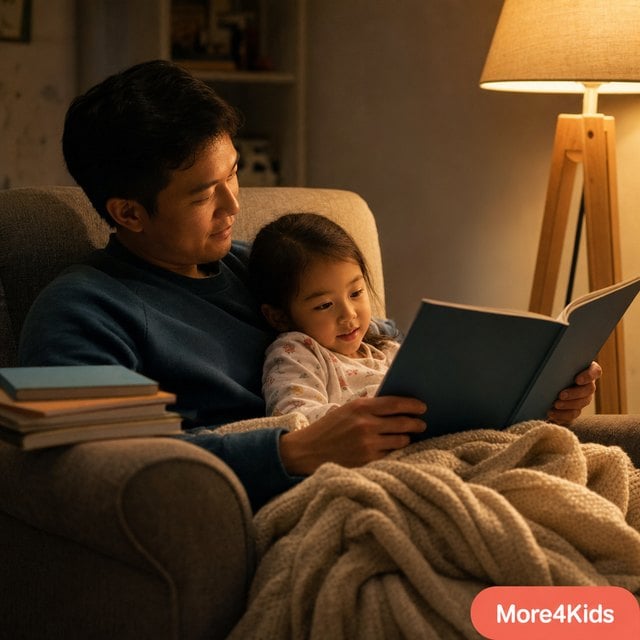
But I’ll be honest about the part that took me a few years to get right: the tradition only works when the book fits. I have handed a four-year-old a chapter book because the cover looked magical, and watched her flip to the middle, find no pictures, and quietly put it down. I have given a confident second-grade reader a picture book she’d have adored eighteen months earlier and gotten a polite thank-you that meant nothing at all. The topic wasn’t the problem either time. The reading stage was.
So this is a guide to choosing christmas books by age — really by developmental stage, which is the more useful number — plus how we build the Christmas Eve book box itself. Everything here works for children’s books by age generally; December just makes the mismatches obvious, because the whole family is watching when the wrapping comes off. I’m Sophia: early childhood educator, mom of three, and someone who has spent a lot of Decembers watching which books get opened twice and which ones migrate to the bottom of the shelf by New Year’s.
One more thing this guide does that most book lists don’t: it tells you the one safety check a book gift can actually fail. Books are, genuinely, one of the safest things you can put under a tree. But we run a recall database here, and there is a children’s story book sitting in it right now. I’ll show you exactly what tripped it, because once you know the pattern you’ll spot it in three seconds in a store aisle.
Why reading stage beats the number on the back cover
Table of Contents
The age range printed on a book is a marketing estimate. It’s not wrong, exactly, but it’s answering a different question than the one you’re asking. What you actually need are two separate numbers for your kid, and they are almost never the same.
Most lists of children’s books by age skip this next part, which is a shame, because it is the entire game. You need two separate numbers for your kid, and they are almost never the same.
The first is their listening level — how complex a story they can follow when someone else is doing the reading. This runs well ahead of everything else. A five-year-old who can’t decode a single sentence on her own can follow a chapter-a-night read-aloud with real plot and real stakes, and love it.
The second is their independent reading level — what they can get through alone without it feeling like homework. This one lags, and it is fragile. Hand a kid a book that’s half a step too hard and they don’t think “this book is hard.” They think “I’m bad at reading.” I have watched that happen in a classroom more times than I want to count, and it takes a lot of easy, confidence-building books to undo.
A gift book should almost always target the listening level if you’re going to read it together, and sit slightly below the independent level if they’ll read it alone. Christmas morning is not the moment to stretch anybody. The stretch book can come in February.
That’s the whole logic behind organizing christmas books by age below. Each stage gets what that stage is actually doing — chewing, memorizing, decoding, bingeing, or arguing about the ending.
As an Amazon Associate, More4Kids earns from qualifying purchases. We only recommend products we would use in our own homes, and we check every brand against current CPSC recall data before it appears here. Our recommendations are never paid placements.
Babies and toddlers, 0 to 2: books built to survive a mouth
At this stage the book is a physical object first and a story second, and pretending otherwise just gets you a torn page and a sad toddler. A one-year-old’s relationship with a book involves teeth. Plan for it.
What I’d look for: thick laminated cardboard pages, rounded corners, and a spine that’s stitched or heavily reinforced rather than glued. Short, rhythmic, repetitive text — the kind you will end up reciting from the car seat without the book in front of you. High-contrast illustrations with one clear subject per page, because a busy spread is visual noise to a nine-month-old. And a length that respects reality: eight to twelve spreads, not thirty.
What I’d check before buying: whether anything on the cover is attached rather than printed. Felt patches, foam shapes, glued-on googly eyes, fabric tails, mirrors, crinkle inserts, sound modules. Every one of those is a part that can come off, and a part that comes off in this age group goes straight in the mouth. A plain printed board book has nothing to detach. That’s not a small distinction — it’s the exact thing that got a story book recalled this year, and I’ll come back to it below.
→ Browse board books for babies and toddlers
A note on lift-the-flap books, which are wonderful and also doomed. Flaps get torn. If you give one to a child under two, give it knowing you’ll be taping it by spring, and buy the sturdy-flap version if there is one. That’s not a reason to skip them — the flap is doing real developmental work, teaching object permanence and cause and effect — it’s just a reason not to be precious about it.

Ages 3 to 5: Christmas picture books that hold up to forty readings
Preschoolers do not want variety. They want the book, again, and they want it read the same way, and they will correct you if you skip a line to save ninety seconds. This is not stubbornness — repetition is how a three-year-old builds prediction, vocabulary, and story structure. It is also why the selection criteria for this age are really criteria for the adult reading it.
What I’d look for: a story that’s genuinely funny or genuinely warm rather than merely cute, because you are going to read it out loud upwards of forty times and cute wears out fast. Rhythm and rhyme you can perform. Illustrations with background detail worth finding on the fifteenth pass, so the book keeps giving something new even when the words are memorized. And an emotional beat a preschooler can actually locate — someone is left out, someone is scared of the dark, someone gives up the thing they wanted.
Christmas picture books have an unfair advantage here, which is that they only come out for one month a year. A book you’d get sick of by March stays fresh when it lives in a box eleven months out of twelve. That seasonal scarcity is genuinely why holiday picture books get remembered into adulthood while the everyday ones blur together.
What I’d check before buying: read the first page in the preview if you can. If the sentences are long and clause-heavy, it’s a book written to impress the gift-giver rather than to be read aloud, and you’ll feel it by night four.
→ See Christmas picture books worth reading forty times
Ages 5 to 7: early readers, and the year you stop correcting
This is the most delicate stage in this whole guide, and the easiest one to get wrong with a gift.
Somewhere between five and seven, a kid crosses from “I am being read to” into “I can do this myself,” and that crossing is almost entirely about confidence. The mechanics come along on their own schedule. What determines whether they choose to pick up a book at all is whether reading has recently felt good or felt like failing.
What I’d look for: leveled early readers, clearly marked, one level below where you think your child is. Big type, generous white space, an illustration on nearly every page carrying half the meaning. Short chapters or clear page-break stopping points so finishing is achievable in one sitting. Series, if you can find one they like, because a kid who finds a character they love will read six books about that character on momentum alone, and volume is what actually builds fluency.
What I’d check before buying: whether it’s a real early reader or a picture book in disguise. Publishers put “Level 1” on things that are genuinely hard. Look at an interior page, count the words on it, and if it’s more than about fifty for a new reader, move down a level.
→ Compare level 1 early reader books
The classroom-tested part, which is really a parenting note: when they read to you at this stage, don’t correct every miss. If they say “horse” for “pony” and the story still makes sense, let it go. Fluency is built by momentum, and a kid who gets stopped every eight words learns that reading aloud is a test. Save corrections for when meaning actually breaks. If you want the longer version of that, we walk through it in our piece on how phonics actually works at home.
Ages 7 to 9: first chapter books and the bingeable series
Here’s where reading either becomes a habit or becomes a chore, and honestly the single best predictor is whether the kid has found a series they’d rather read than stop reading.
First chapter books are engineered for exactly this. Short chapters, illustrations still appearing every few pages, a predictable formula that a seven-year-old finds reassuring rather than boring, and — critically — book two already exists. That last part matters more than literary quality. A kid who finishes a book and immediately wants the next one has just discovered that reading is a thing you do for pleasure. That’s the entire goal of this age band.
What I’d look for: an established series with at least four books out, chapters under ten pages, illustrations still present, and a protagonist roughly the reader’s age or a year older. Boxed sets are the strongest gift value here, because handing a kid four books at once removes the friction of having to ask for the next one.
What I’d check before buying: whether your child has already burned through this series at school. Second and third grade classrooms run on these, and there’s nothing deflating like unwrapping book one of something you finished in October. A quick, casual question in November is worth it.
→ Browse first chapter books and boxed sets
One thing I’d add for reluctant readers specifically: graphic novels count. They count fully. A child reading a graphic novel is decoding text, tracking narrative, reading facial expression and inference and visual sequence, and doing it willingly. I have never once seen a kid harmed by being allowed to read what they enjoy, and I’ve seen plenty stall out because someone decided their choice wasn’t a real book.

Ages 9 to 12: middle grade, where you hand over the wheel
By nine or ten, your gift is no longer really about the book. It’s about whether your kid feels seen by the person who chose it.
This is the age when a wrong pick reads as “you don’t know me.” A too-young book is mildly insulting. A book that’s obviously an educational intervention is worse. And an eleven-year-old can tell the difference between a book you chose because they’d like it and one you chose because it was on a list of what children should read.
What I’d look for: real stakes and real feelings — friendship ruptures, unfair adults, grief, courage that costs something. Kids this age are done with tidy morals. Match the actual interest, not the aspirational one: if they’re deep in survival stories or fantasy or sports, buy in that lane rather than trying to broaden them at Christmas. And consider a book you loved at their age, offered with the story of why. That framing turns a book into something passed down rather than assigned.
What I’d check before buying: content, if it matters to your family. Middle grade spans a wide maturity range at the top end, and the age band on the jacket won’t tell you which side of your line a book falls on. Two minutes of parent reviews is usually enough.
→ See middle grade novels for ages 9 to 12
How we build the Christmas Eve book box
The Christmas Eve book box is the simplest tradition we run, and the most reliably loved. One box per child, opened on the 24th, containing new pajamas, a hot drink situation, and a book chosen for that child.
The rules we’ve landed on after several years of adjusting:
One book, not a stack. A pile invites skimming. A single book, clearly chosen for this person, gets opened that night. If you want to give volume, give the boxed set at Christmas morning and keep the book box to one.
Match the stage, not the occasion. All the same logic for choosing christmas books by age applies here — a book box doesn’t get a pass on fit just because it’s a tradition. If anything the fit matters more, because this one gets opened in front of everyone.
Pick for the night, not the year. Christmas Eve is late, everyone’s overtired, and nobody is starting a four-hundred-page novel. Even for a strong reader, something readable in one sitting — or a read-aloud the whole family does together — fits the night better.
The read-aloud belongs to everyone. Our best version of this has been one shared family book alongside the individual ones, read out loud with all three kids on the same couch. A nine-year-old will absolutely still sit for a read-aloud she’d consider babyish to read alone; the shared-experience part is the draw, not the reading level.
→ Find family Christmas read-aloud collections
Keep the box itself boring. This is the part with a safety edge, and I’ll say it plainly: the book is not the risk. What people put around the book is. A wooden crate, a shirt box, a reusable fabric bin — all fine. It’s the little extras that creep in that need a look, which is exactly what the next section is about.

If the box tradition appeals to you but the budget doesn’t, it pairs naturally with the four-gift rule, where the book box simply becomes the “something to read” slot rather than an additional expense. And if you want the classic titles our readers keep coming back to, our older roundup of Christmas books to share with your children is still one of the most-read things on this site.
What our recall data actually says about books
We maintain our own database of classified children’s product recalls, which is unusual for a parenting site, and it lets me answer this question with numbers instead of vibes. As of this writing it holds 131 children’s product recalls spanning February 3 through August 13, 2026. Twenty-three involve button or coin battery ingestion. Fourteen involve magnet ingestion. Twenty-three involve choking hazards.
Exactly one is a children’s story book. The reason is the whole lesson: the recalled book’s felt parts can detach, posing a choking hazard. Not the paper. Not the printing. The decorative pieces glued to it.
That’s the pattern, and it holds across the rest of the data too. The same importer in that recall also had a children’s flashcard talking toy pulled — that one for lead and phthalate levels above the federal limits, plus a failure to meet the electrical standard for battery-operated toys. Again: not a book problem. A battery-and-coating problem wearing a book’s clothes.
So the practical rule I use is short. A plain paper or cardboard book is about the safest gift in the house. The risk enters the moment a “book” acquires hardware — a sound module, a light, a magnet, a mirror, a fabric or felt appliqué, a plush attached at the spine. Those are the ones that need the same scrutiny you’d give a toy, because functionally that’s what they are.
Sound books deserve a specific flag. The button cell battery in a squeaky book is the same battery class behind twenty-three recalls in our own data set, and a swallowed coin cell can cause internal chemical burns within hours. If a book makes noise, find the battery compartment and confirm it needs a screwdriver to open. If it pops open with a fingernail, it doesn’t belong with a child under three, and I’d think hard about under five.
One honest caveat, because I’d rather you trust the next thing I tell you: our recall database begins on February 3, 2026 and has known gaps in its historical ingest. A product’s absence from it is not proof that product is safe. For anything you’re genuinely unsure about, search the brand directly at cpsc.gov/Recalls, which goes back decades. We also keep a running list of current pulls in our holiday toy safety coverage.
What we’d skip
No links in this section, on purpose. These are the book-shaped gifts I would not put in a young child’s box.
Sound books and light-up books for under-threes. Covered above, and it’s the one I feel strongest about. The story value is near zero anyway — the child is pressing a button, not reading.
Books with glued-on felt, foam, sequins, googly eyes, or mirrors, for anyone still mouthing objects. Give the edge a real tug in the store. If it shifts, it will come off eventually, and eventually is usually at 6 a.m. on a Saturday when nobody’s watching.
Book-and-toy bundles where the toy is the point. These are toys with a booklet stapled to the marketing. Judge the toy on toy criteria, including small parts, and don’t let the book on the box buy it a pass.
Personalized books ordered late from unfamiliar sellers. Not a safety issue — a disappointment issue. December print-and-ship timelines slip constantly, and an empty box on Christmas Eve is a specific kind of sad.
Anything chosen to correct your child. The book about sharing given to the kid who won’t share, the reading-level stretch book given to the struggling reader. Kids read the subtext instantly, and a Christmas gift that says “you need fixing” costs more than it gives. Work on those things in January, in a different format, with no wrapping paper involved.
The five-minute check before you wrap it
Quick pass, works for any book gift, and it’s mostly about the things that aren’t paper.
- Tug every attached piece. Felt, foam, eyes, ribbon, fabric, mirror. If it moves, it fails — and remember the test is the youngest child in the house, not the recipient.
- Open the battery compartment, if there is one. It should require a screwdriver, and the screw should stay captive when loosened. Anything that opens by hand is a no for young children.
- Run the tube test on any bundled extra. If a piece fits through a cardboard toilet paper tube, it’s a choking hazard for under-threes. This applies to bookmarks with charms, mini erasers, and stickers-with-gems more than to the book itself.
- Check for magnets. Magnetic closures on “activity book” style covers can crack loose. Two swallowed magnets can pinch the bowel and require surgery — our data has fourteen magnet-ingestion recalls in six months.
- Read the interior, not the jacket. One page, out loud, in your head. You’ll know within a paragraph whether the level fits.
- Search the brand for recalls if there’s any hardware involved at all. Thirty seconds at cpsc.gov, and it’s the only step on this list that can catch something a tug test can’t.
Questions parents ask
How do I choose christmas books by age when my kid reads above grade level?
Match content maturity to their actual age and reading difficulty to their skill, and accept that those two will pull apart. A seven-year-old reading at a fifth-grade level still has a seven-year-old’s emotional processing, and middle grade novels dealing with grief or bullying can land hard. Look for older classics, longer fantasy, or nonfiction on a deep interest — plenty of text, age-appropriate stakes.
Is a book a boring Christmas gift?
It is if it arrives alone in a pile of exciting things. That’s precisely why the Christmas Eve book box works — it moves the book to its own moment, on a night with nothing competing, with pajamas and cocoa attached. Context is doing most of the work there, and it’s cheap to arrange.
What if my child says they hate reading?
Usually that means reading has felt like failing, or they haven’t found the right thing yet. Try graphic novels, joke and fact books, audiobooks paired with the print copy, or anything about a subject they’re already obsessed with — no obligation to be literary. Drop the reading level a full step below where school has them, too. Confidence first, difficulty later.
How many books should go in a Christmas Eve book box?
One per child, plus optionally one shared family read-aloud. A stack gets skimmed; a single chosen book gets read that night. Save the boxed set for Christmas morning if you want to give more.
Are sound books and light-up books safe for toddlers?
Only with a screwed-shut, captive-screw battery compartment, and I’d still skip them under three. The coin batteries inside are the same category behind twenty-three of the recalls in our own database, and a swallowed one can cause serious internal burns quickly. A plain board book gives more real reading value anyway.
What about used books as gifts?
Genuinely great, especially for building volume for a kid tearing through a series. Two checks: confirm no missing pages, and apply the same tug test to anything attached, since older novelty books predate some current standards. Secondhand chapter books in good condition are one of the best value-per-dollar gifts going.
The part that actually lasts
Every year I forget which toy was the big one, and every year I remember which book we read on the 24th. That’s not sentiment talking — it’s that a book gets used in a specific place with specific people, and it comes back out next December carrying all of it.
Sorting christmas books by age is really just a way of asking what your kid is working on right now — chewing, memorizing, decoding, bingeing, or arguing with the ending. Choose for the stage your child is actually in, keep the hardware out of the box, and let the night do the rest. If you’re still assembling the rest of the pile, our guides to stocking stuffers that get used and giving experiences instead of toys both pair well with a book-first Christmas — and a simple nightly reading routine is what turns one good book into a habit that outlives the holiday.

Meet Sophia Richards Sophia Richards is an early childhood educator, passionate writer, and the proud mom of three energetic kids. With a degree in Education and over a decade of hands-on classroom experience, Sophia bridges the gap between professional teaching strategies and everyday family life. At More4Kids, she translates complex child development concepts into practical, actionable parenting tips that families can use at home.
Whether she is sharing positive reinforcement techniques, educational crafts, or honest reflections on the chaos of raising three children under one roof, Sophia’s goal is to empower parents to foster resilience and joy in their kids. When she isn't writing or lesson planning, you can find her organizing neighborhood scavenger hunts or trying out new kid-friendly recipes.
Areas of Expertise: Early Childhood Education, Positive Parenting, Sibling Dynamics, Educational Play, Family Wellness.

Add Comment