















By Sophia Richards
If you have more than one child, you already know the soundtrack: the bickering over who got the bigger cup, the "she started it," the door that slams a little too hard. Sibling rivalry is one of the most universal — and most exhausting — parts of raising siblings, and after years in early childhood classrooms and a houseful of three kids of my own, I can promise you it does not mean you're doing anything wrong. It means you have more than one human living under your roof, each with their own temperament, their own needs, and their own very strong opinions about fairness. The good news is that the way we respond to the squabbling can either pour fuel on it or slowly, gently teach our kids how to work it out. And the secret that took me far too long to learn is this: the moment we step in as judge and jury, we usually make it worse.
In this article I want to walk you through what actually helps, parent to parent — the strategies I lean on at home and the ones I used for years with little ones in the classroom. None of this is about being a perfect, endlessly patient parent (I am not, and neither is anyone I know). It's about a handful of practical shifts that lower the temperature and, over time, build kids who can sort things out without you refereeing every round.
Why Staying Out of the "Who Started It" Trap Matters
Table of Contents
Here's the trap almost all of us fall into. Two kids come running, both talking at once, both certain they're the wronged party. We try to gather evidence like tiny detectives, figure out who's "right," and hand down a verdict. The problem is that we almost never have the full picture, and even when we think we do, declaring a winner teaches both kids something unhelpful: that the way to win a conflict is to get a parent on your side.
When I stopped playing judge, two things changed. First, the kids stopped racing to me to tattle, because there was no prize at the end of it. Second — and this surprised me — they actually started working more of it out themselves. Not all of it, not magically, but more. The goal isn't to ignore your children. It's to shift from "I will decide who's right" to "I trust you two to figure this out, and I'm here if you get stuck." That single reframe takes a huge weight off your shoulders, and it's one of the most powerful parenting strategies I know.
Treat Their Needs as Different, Not Equal
For a long time I thought fairness meant sameness. Same number of crackers, same minutes of screen time, same everything, measured down to the millimeter. It was exhausting, and it backfired — because the more I tried to make everything mathematically equal, the more my kids scanned for the tiniest inequality.
What works far better is responding to each child's actual needs in the moment. When one of mine asks, "Why does he get to stay up later?" I've learned not to launch into a defense or a lecture. I just say, "Because right now this is what he needs, and when you need something, I'll take care of you too." It's calm, it's honest, and it closes the door on the endless negotiation. Kids don't actually need identical treatment to feel loved. They need to trust that you see *them* — their particular self, with their particular needs. That's a much warmer and more sustainable standard than a measuring tape.
This also means giving each child a little one-on-one time when you can. It doesn't have to be elaborate. Ten minutes of you fully present, no phone, no other kid, fills a cup that a lot of rivalry is really about. So much of the fighting I see — at home and in the classroom — is two kids competing for the same limited resource: a grown-up's attention.
Coach the Skill Instead of Solving the Problem
This is the strategy I wish someone had handed me on day one. When kids are stuck in a conflict, our instinct is to solve it for them — split the toy, send someone to their room, declare the matter closed. But every time we solve it, we rob them of the chance to practice solving it themselves. Conflict, as uncomfortable as it is, is the practice field for skills they'll use for the rest of their lives.
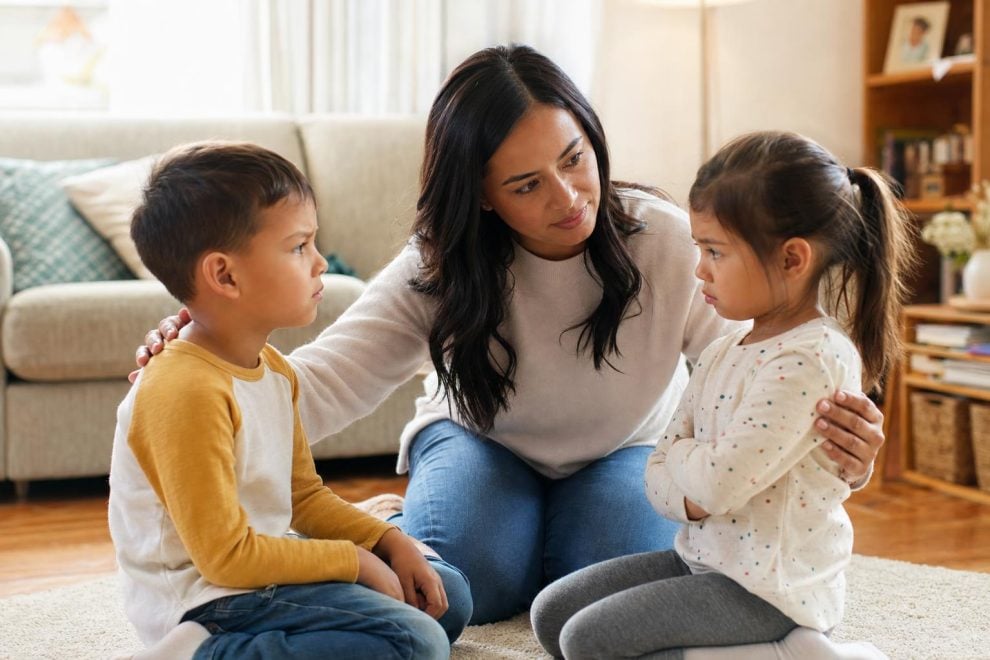
So instead of solving, try coaching. Get down on their level, stay neutral, and narrate what you see. "It looks like you both want the same truck. That's a tricky one. What could we do so you both feel okay?" Then — and this is the hard part — wait. Let the silence sit. You'll be amazed how often a four-year-old will offer "we could take turns" if you just give them room to think instead of filling the space with your solution.
For younger kids, you may need to offer a couple of options: "Would you like to set a timer to take turns, or find something you can both play with?" For older ones, you can hand more of it back: "I'm confident you two can come up with a plan. Let me know what you decide." You're not abandoning them. You're teaching. And like any skill, it gets stronger with reps. If you'd like more grounded approaches to setting limits while you coach, our writing on healthy discipline and boundaries pairs well with this.
Set the House Rules Around Safety, Not Feelings
Here's an important line I draw, both as a teacher and a mom: I don't try to police my kids' *feelings*, but I am firm about their *behavior*. They are allowed to be furious with each other. They are allowed to want space, to dislike a sibling in a given moment, to feel that life is deeply unfair. Feelings aren't up for negotiation, and trying to talk a child out of how they feel usually just adds a second fight on top of the first.
What is not okay is hurting — hitting, name-calling, breaking each other's things. Those are the non-negotiables, and they're worth stating simply and consistently: "You can be angry. You may not hit." When you separate the feeling from the action, you give your kids permission to have big emotions without giving them permission to wound each other. It also keeps you out of the impossible job of deciding whose anger is "justified." Nobody's anger has to be justified. The behavior, though, has a clear and steady line.
A quick note on big flare-ups: when bodies are getting physical or voices are at full volume, that's not the teaching moment. Separate first, let everyone's nervous system settle, *then* circle back to coach once everyone can actually hear you. You cannot reason with a child who is flooded, and honestly, you can't coach well when you're flooded either.
Catch Them Getting Along (and Name It)
We are wired to notice the fighting because it's loud and it grates on us. The quiet stretches when they're building a fort together or one of them helps the other find a missing shoe? Those slip right past us. But those moments are gold, and naming them is one of the easiest ways to get more of them.
I try to point out cooperation specifically and without overdoing it: "I noticed you waited so your brother could go first. That was kind." Not a big production, not a sticker chart — just a quiet, genuine acknowledgment that landed. Kids repeat what gets noticed. When the only attention available comes from conflict, you'll get more conflict. When connection and kindness get a warm little spotlight, you start to tip the balance.
This is also where you can gently build their identity as allies rather than competitors. I talk about my kids as a team when I can — "you guys take care of each other" — because the story kids tell about their relationship shapes how they treat each other. Sibling rivalry thrives on a scarcity story (there's not enough love/attention/stuff to go around). Connection grows from an abundance story. You're the narrator, so choose the story on purpose. For more on nurturing those everyday bonds, you'll find plenty of warm, practical reading across our parenting section.
Take Care of the Conditions That Spark Sibling Rivalry
So many "rivalry" blowups aren't really about the sibling at all. They're about a hungry kid, an overtired kid, a kid who's been cooped up too long, or — let's be honest — a frazzled parent at the end of a long day. In my house, the witching hour before dinner is prime fighting territory, and it has almost nothing to do with whose turn it is on the tablet and everything to do with low blood sugar and tired bodies.
Before you treat a conflict as a relationship problem, it's worth asking the boring questions: Is anyone hungry? Tired? Have they been stuck inside? A snack and twenty minutes outside resolve an astonishing percentage of sibling battles, no mediation required. The American Academy of Pediatrics offers some genuinely reassuring, down-to-earth guidance on sibling relationships at HealthyChildren.org if you'd like a trusted second voice.
And give yourself the same grace. When I'm depleted, my patience for squabbling drops through the floor, and I'm far more likely to snap and pick a side just to make the noise stop. Tending to the conditions — theirs and yours — does more to reduce sibling rivalry than any clever script. It's not glamorous, but it works.
Frequently Asked Questions
At what age does sibling rivalry usually start and stop?
Rivalry can begin the moment a second child arrives and often shifts in flavor through the teen years rather than disappearing. It tends to peak when kids are close in age and competing for the same toys, attention, and space, and it gradually eases as they grow and gain their own friends, interests, and conflict-resolution skills.
Should I ever step in when my kids are fighting?
Yes, absolutely — step in whenever anyone's safety is at risk or the conflict is escalating beyond what they can handle. Once everyone is calm, your role shifts from referee to coach: help them name the problem and find their own solution rather than handing down a verdict about who was right.
Is it normal for one child to always seem like the instigator?
It's very common to perceive one child as the troublemaker, but the dynamic is usually more shared than it looks from the outside. Labeling a child as "the difficult one" tends to lock them into that role, so try to respond to specific behaviors in the moment rather than assigning a permanent reputation.
How do I handle rivalry when my kids have very different temperaments?
Different temperaments are actually one of the most common sources of friction, and the fix isn't to treat them identically. Respond to each child's real needs, name and respect their differences out loud, and help them see those differences as something interesting rather than a source of competition or comparison.
Will my kids grow out of sibling rivalry, or am I doing something wrong?
Some level of sibling conflict is completely normal and is not a sign of bad parenting — it's how children practice negotiation, empathy, and standing up for themselves. With consistent coaching and connection over time, the intensity usually softens, and many siblings grow into genuinely close adults despite years of childhood squabbling.
A Gentle Reminder
If you take only one thing from this, let it be this: you don't have to be a perfect referee, because you were never meant to be the referee at all. Your job isn't to deliver fair verdicts in every dispute — it's to keep everyone safe, to coach the skills patiently, and to keep pouring connection into each child so the well never runs dry. The fighting will still happen. Some days will be loud and hard and you'll lose your cool, and that's okay too; repair matters more than perfection.
What you're building is slow and mostly invisible, but it's real: two (or three, or four) kids who are learning, conflict by conflict, how to live alongside someone they love and sometimes can't stand. That's one of the great quiet gifts of growing up in a family. Be gentle with them, and be just as gentle with yourself. You're doing better than you think. For more warm, practical support on the everyday work of raising kids, we're always here at More4Kids.
Related Articles

Meet Sophia Richards Sophia Richards is an early childhood educator, passionate writer, and the proud mom of three energetic kids. With a degree in Education and over a decade of hands-on classroom experience, Sophia bridges the gap between professional teaching strategies and everyday family life. At More4Kids, she translates complex child development concepts into practical, actionable parenting tips that families can use at home.
Whether she is sharing positive reinforcement techniques, educational crafts, or honest reflections on the chaos of raising three children under one roof, Sophia’s goal is to empower parents to foster resilience and joy in their kids. When she isn't writing or lesson planning, you can find her organizing neighborhood scavenger hunts or trying out new kid-friendly recipes.
Areas of Expertise: Early Childhood Education, Positive Parenting, Sibling Dynamics, Educational Play, Family Wellness.

Add Comment