















By Sophia Richards
There’s a plastic shoebox on the top shelf of my closet with a hospital bracelet rattling around loose in the bottom, a onesie that’s gone slightly yellow, and a stack of cards still in their envelopes. I have three kids. I have three of these boxes. None of them are labeled properly, one has a coffee ring on the lid, and I have never once sat down and arranged the contents in any kind of order. I used to feel a little embarrassed about that — like somewhere out there, other parents had color-coded bins with acid-free tissue paper and a typed inventory taped inside the lid.
They don’t. Or if they do, it’s not most of us, and it’s definitely not sustainable past baby number one. What actually works, for actual tired parents, is a lot simpler than the version we imagine we’re supposed to build. So let’s talk about what a baby memory box really needs to be — and just as important, what it doesn’t.
What a Memory Box Actually Is (Hint: It’s Not a Scrapbook)
Table of Contents
A memory box is not a scrapbook, and treating it like one is where most of us get stuck before we even start. A scrapbook asks you to arrange, caption, and design. A memory box just asks you to keep — put the thing in the container, close the lid, walk away. That’s the whole job.
The container itself matters far less than we think it does. A plastic storage bin with a snap-on lid works. A shoebox works. A banker’s box from the office supply aisle works, especially if you’re planning to keep one per kid and want them to match on a shelf. I’ve used all three across my kids, honestly, because I didn’t plan ahead and just grabbed whatever was nearby when the first hospital bracelet needed a home. Nobody has ever opened one of these boxes and cared that it used to hold size 8 sneakers.
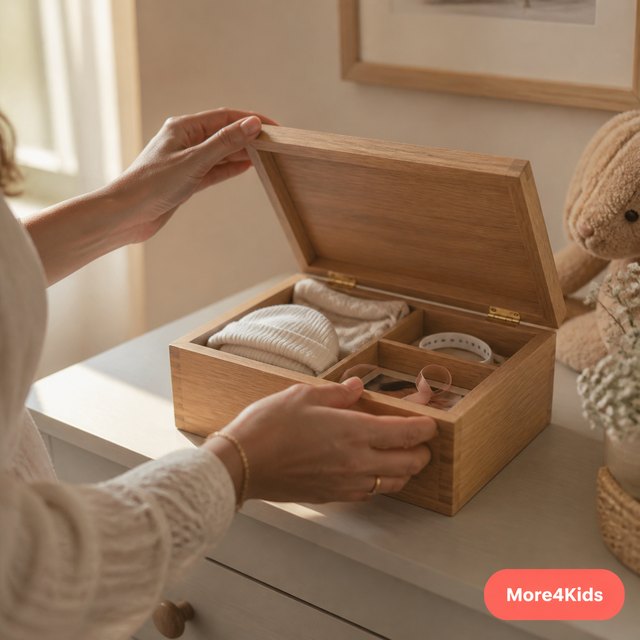
If you want something with a bit more polish because it’ll live somewhere visible — a shelf in the nursery, a spot in the living room built-in — a fabric-covered keepsake box or a wooden box with a hinged lid gives you that without requiring you to become a different kind of parent than you are. Just don’t let the container become the project. The container is not the point.
What’s Actually Worth Keeping (and What Genuinely Isn’t)
This is the part where I think most memory-box advice goes wrong. It hands you a checklist of forty items and calls it a starter kit, and then you either spend a year feeling guilty about the twenty-eight things you didn’t save, or you try to save all forty and end up with a bin so stuffed you can’t find the one thing that actually matters.
Here’s what tends to have real weight, from having done this three times over:
- The hospital ID bracelet — it’s small, it doesn’t degrade, and it’s oddly moving to hold years later
- The outfit they wore home from the hospital, if it survived the car seat buckle intact
- A lock of hair from the first haircut, in a small envelope or tucked into a card
- A handful of cards — not all of them, just the ones from people who mattered, or the ones with something written inside worth rereading
- One or two hospital printouts: the little hat tag, a footprint card, the bassinet name card if your hospital does those
- A baby book page or two if you filled any out, even partially
- A special toy or lovey, but only if you have a genuine duplicate or backup — don’t sacrifice the one they actually sleep with
What doesn’t need to go in the box: every onesie they ever wore, every single card, every art project (that’s a different bin, for a different age), every receipt from the registry, or anything you’re keeping purely out of guilt rather than genuine fondness. If you pick it up and think “eh, I don’t really need this,” you don’t. Let it go. The box that has twelve carefully chosen things in it means more, later, than the box that’s crammed so full you have to sit on the lid to close it.

Organizing by Age vs. Organizing by Category
Once you’ve accepted you’re not keeping everything, you’ve got two honest ways to organize what’s left: by age and stage, or by category. Neither is objectively better — it depends on how your brain works and how many kids you’re doing this for.
By age/stage means one box (or one clearly labeled section within a bigger bin) per period: newborn, first year, toddler, and so on. This is the version I’d recommend if you’re already a little overwhelmed, because it mirrors how you’ll actually want to revisit things later — “let’s look at the newborn box” is a much more natural instinct than “let’s look at the cards box.” It also scales cleanly if you have more than one kid, since each child just gets their own newborn box, their own first-year box, and you’re never mixing kids’ items together by accident.
By category means grouping across all ages by type — all the clothing together, all the cards together, all the art together. This works better for parents who are naturally more organized-brain, or for specific categories that genuinely deserve their own home regardless of age, like artwork and school projects, which pile up fast once your kid hits preschool and benefit from their own rotating system rather than living in the baby box at all.
Honestly, most of us end up with a hybrid without meaning to: one loosely-labeled “baby stuff” box for year one, and then category bins that kick in once the art projects and school papers start arriving. That’s not a failure of planning. That’s just what happens in a house with a real kid in it.

The Digital Question: What to Scan, What to Skip
Photos are where memory-box planning gets genuinely complicated, because physical photo prints have mostly disappeared from how we actually document our kids’ lives, and pretending otherwise doesn’t help anyone.
My honest take: don’t try to print and box everything. You’ll take thousands of photos on your phone in year one alone, and if your plan depends on printing all of them, the plan will fail — not because you’re disorganized, but because it’s not a realistic volume for anyone to manage. Instead:
- Pick a small number of true favorites per year — a dozen, maybe two dozen — and get those printed. A photo you can hold outlasts a folder you’ll forget the password to.
- Back up everything else somewhere that isn’t just your phone. A cloud photo service or an external drive, ideally both, since phones get lost, dropped, and replaced.
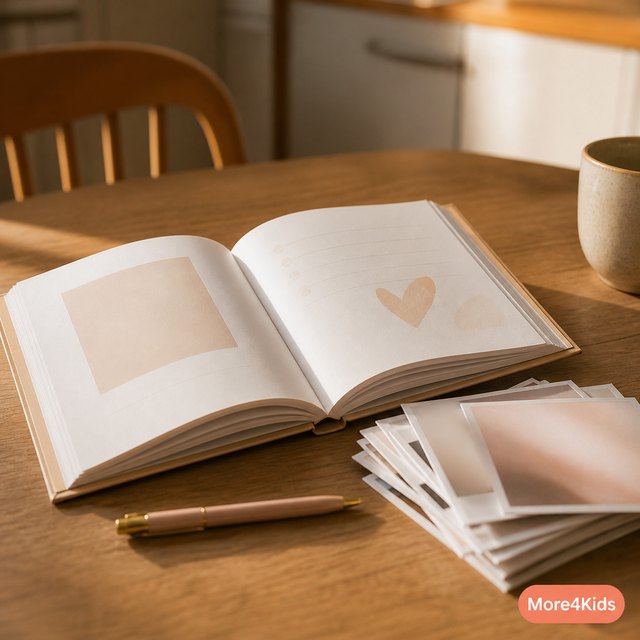
- If you want a physical object for the box beyond loose prints, a simple printed photo book covering the first year is a nice middle ground — it’s compact, it fits in the box, and it tells a story without demanding scrapbook-level effort.
- Cards and letters can be scanned or photographed before you decide whether to keep the originals, which takes the pressure off the “keep vs. toss” decision since you’ve got a backup either way.
There’s no perfect system here, and anyone who tells you they’ve solved digital-versus-physical for their kids’ entire childhood is probably exaggerating a little. Pick something reasonable, do it inconsistently, and that’s still infinitely better than a paralyzed non-system where nothing gets saved at all.
Permission to Do the Bare Minimum
If you take one thing from this article, let it be this: a shoebox with six things shoved in it, done, is worth more than a Pinterest-perfect memory chest that exists only as an idea in your head. I say this as someone who has genuinely tried both approaches across three kids and landed, every time, on the shoebox.
The goal isn’t a museum-quality archive. It’s a small collection of things that make you go “oh” when you find them again in fifteen years — not because they’re beautifully arranged, but because they’re real. A crumpled going-home outfit does that job just as well as a professionally preserved one. Don’t let the fantasy version of this project stop you from doing the five-minute version that actually happens.
If keepsakes are turning into a bigger project than you have bandwidth for right now, it’s worth pairing this with a look at baby scrapbooking ideas for a lower-pressure way to capture moments without committing to either extreme — sometimes a few pages beats a box, and sometimes it’s the other way around, and either is fine.
A Few More Baby Memory Box Ideas to Start With
If you’re setting this up before baby arrives, it’s worth folding the memory box into your broader baby registry planning rather than treating it as a separate errand — a basic keepsake box costs little and often ends up as a sweet, practical shower gift request. And if the bigger issue is that your whole nursery or closet system needs a rethink before you can even find shelf space for one more bin, our guide to keeping a home organized with young kids covers the storage side of this in more depth.
Start with a container you already own. Add the hospital bracelet today, before it gets buried in a drawer. Add the going-home outfit once it’s washed. Everything else can wait until it actually shows up — a card, a haircut, a first shoe. The box fills itself in slowly, over years, and that’s exactly how it’s supposed to work.
What to Do When the Memory Box Gets Full
Here’s a problem nobody warns you about: a memory box that’s actually being used will fill up, usually somewhere around the first birthday. The instinct is to buy a bigger box, but that’s how a keepsake box quietly turns into a storage bin you’re afraid to open. A full box is a good moment to do the one edit you’ve been avoiding.
Take everything out and sort it into three quick piles: keep, photograph-then-let-go, and honestly-why-did-I-save-this. The middle pile is the trick that makes the whole system sustainable. A snapshot of the hospital blanket or the first pair of shoes preserves the memory without the bulk, and it means the physical box only holds the handful of things you genuinely want to touch in twenty years. You’re not throwing away the memory — you’re keeping it in a form that fits.
For the things that graduate out of the box but you still can’t part with, a labeled larger bin in a closet works better than cramming them back in. One bin per kid, dated, is plenty. The memory box stays curated and openable; the overflow lives somewhere it isn’t creating daily friction. If you have more than one child, keeping each child’s baby keepsakes in a clearly separate box from the start saves you an untangling job later, when a hospital bracelet with no name on it could belong to either of them.
The best baby memory box ideas aren’t about saving everything — they’re about saving the few right things in a way you’ll actually revisit. A small box you open and smile at beats a giant one you never dare to sort. And if you do this edit once a year, around each birthday, it never becomes a big overwhelming project — just fifteen minutes of deciding what still matters, which is a much gentler task than facing a decade of unsorted boxes all at once.
It also helps to keep the box somewhere you’ll actually see it. A keepsake box shoved to the back of a high closet is one you forget for years; one on a shelf in the nursery or your own bedroom gets opened on the ordinary days, not just the milestone ones — and that’s really the whole point of keeping it. A few parents I know tuck a folded index card inside with a one-line note about what mattered that year, which turns a box of objects into something closer to a story. You don’t need to journal; a single sentence per birthday is plenty, and it’s the part your kid will actually want to read someday. However you set it up, the goal is the same: a small, cared-for box you’re glad to open, not a bin of guilt you keep meaning to deal with.
Frequently Asked Questions
What size box do I need for baby keepsakes?
A standard under-bed or closet storage bin — roughly shoebox to banker’s-box size — is enough for most families’ first year of keepsakes. You don’t need anything oversized; a box that’s too big just invites you to fill it with things you don’t actually need to keep.
Should I have one memory box per child or one big box for the family?
One per child is worth the small extra effort, especially once you have more than one kid. It avoids items getting mixed up or misattributed later, and it means each child eventually gets their own complete box rather than a shared, tangled one.
What if I didn't start a memory box right after birth — is it too late?
It’s not too late at all. Start with whatever you still have on hand — cards, a few photos, a special outfit — and don’t worry about the gap. A memory box built starting at six months, or even later, still tells a true story; it just starts a little further in.
Do I need acid-free tissue paper and archival supplies?
Not unless you want to. Basic archival paper can help protect delicate paper items like cards or hospital bracelets over many years — the National Archives has a solid, no-nonsense guide to preserving family keepsakes if you want the details — but plenty of memory boxes hold up fine in a regular closet with no special materials at all. Don’t let the lack of “proper” supplies stop you from starting.
How do I stop the box from turning into a junk drawer?
Set a loose rule before you start — something like “only things I’d genuinely want to hold again in twenty years” — and revisit the box once or twice a year to edit rather than just adding. A quick sort during a seasonal closet clean-out is usually enough to keep it from overflowing.
A Note on This Article
These ideas come from our own experience keeping (and occasionally losing track of) memory boxes for three kids — they’re meant as encouragement and a starting point, not a shopping guide, a professional archiving standard, or a promise that any particular system will work for your family. Keep what feels meaningful to you, skip what doesn’t, and don’t let anyone’s box look more impressive than yours.
Related Articles
- Organizing Your Childs Room
- Baby Scrapbooking Ideas
- Baby Registry Gift Ideas
- Tips For An Organized Home

Meet Sophia Richards Sophia Richards is an early childhood educator, passionate writer, and the proud mom of three energetic kids. With a degree in Education and over a decade of hands-on classroom experience, Sophia bridges the gap between professional teaching strategies and everyday family life. At More4Kids, she translates complex child development concepts into practical, actionable parenting tips that families can use at home.
Whether she is sharing positive reinforcement techniques, educational crafts, or honest reflections on the chaos of raising three children under one roof, Sophia’s goal is to empower parents to foster resilience and joy in their kids. When she isn't writing or lesson planning, you can find her organizing neighborhood scavenger hunts or trying out new kid-friendly recipes.
Areas of Expertise: Early Childhood Education, Positive Parenting, Sibling Dynamics, Educational Play, Family Wellness.

Add Comment