








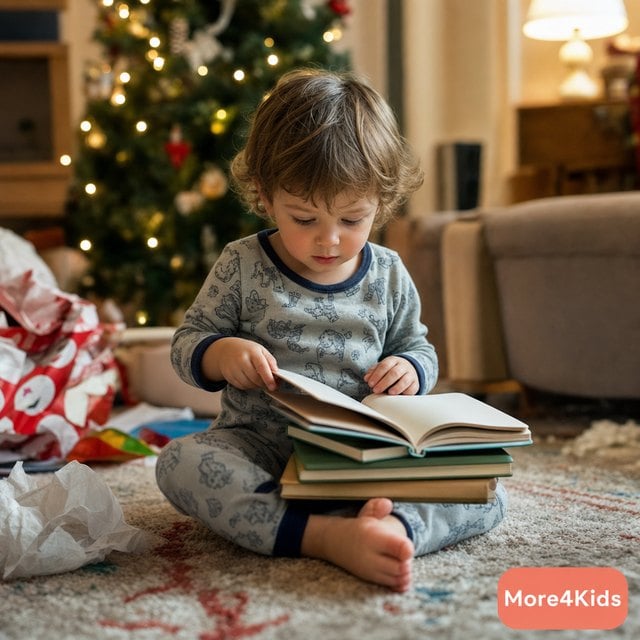
By 9:40 on Christmas morning last year, my youngest had abandoned every single wrapped gift under the tree and was fully absorbed in the box the play kitchen came in. Not the kitchen. The box. She’d turned it on its side, was posting the wrapping paper scraps through a hole she’d torn in the top, and genuinely could not have cared less about the toy that box used to hold. My older two were half-watching a movie by 10, surrounded by things they’d asked for by name three weeks earlier. It was, by most measures, a completely normal toddler Christmas.
I taught preschool for years before I had three kids of my own, and I promise you this scene repeats itself in every classroom’s holiday-break debrief. Parents come back in January describing the exact same thing: the big-ticket toy sat there, and the box, the bowl, the wooden spoon, or the dog’s water dish became the actual toy. It’s not that the gift was wrong, exactly. It’s that we’re often buying for the toy aisle instead of buying for the kid in front of us.
So this is not a “hottest toys of the year” list. Those lists chase novelty, and novelty is exactly what a one, two, or three-year-old brain is worst equipped to sustain interest in past the first afternoon. What I actually want to hand you is a short, honest list of Christmas gifts for toddlers that keep getting pulled off the shelf in February, March, and beyond — the categories that survive contact with an actual toddler, plus the safety checks I’d want any gift-giver in my life to run before they buy.

Why the “Wow” Toy Usually Loses by New Year’s
Table of Contents
Toddlers are not, developmentally, built for spectacle. Their nervous systems are still learning to regulate input, which means the toy that lights up, sings a song, and has forty combinations of buttons is often more overwhelming than delightful past the first five minutes. It gets a big reaction on Christmas morning because everything is new and exciting that day — the wrapping paper gets a big reaction too. That’s not the same as a toy earning a permanent spot in the rotation.
What actually holds a toddler’s attention long-term is a toy that can be used a hundred different ways, because a one-to-three-year-old’s whole job right now is figuring out cause and effect, testing what their hands can do, and practicing the same skill on a loop until it clicks. A toy with exactly one correct outcome — press this, hear that — gets mastered in an afternoon and shelved. A toy with no fixed outcome gets reinvented for years. Occupational therapists call this open-ended play, and it’s the single biggest lever for gift-giving I know.
That doesn’t mean skip anything with lights or sound. It means weight your list toward things a toddler directs, not things that direct the toddler.
The Four Categories That Actually Hold a Toddler’s Attention
After three kids and a lot of preschool circle times, I keep coming back to the same four buckets whenever I’m sorting through Christmas gifts for toddlers. Not every toddler needs one of each — read your own kid — but almost every toddler I’ve watched play for real, sustained stretches was playing with something from one of these four.
1. Big, chunky building pieces
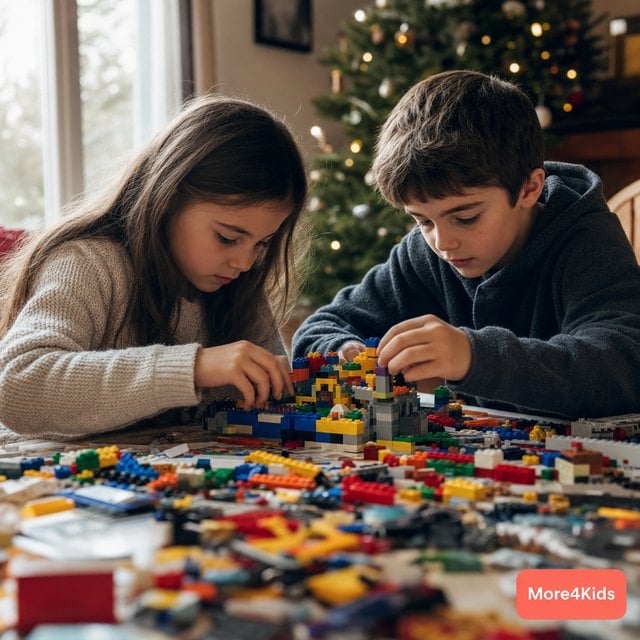
Not the fine-motor tile sets marketed to five-year-olds — the large, hand-sized wooden or thick plastic blocks a toddler can stack, knock down, sort by color, line up in a row, and stack again without frustration. This is the toy that ages up with them. At eighteen months it’s a stacking-and-knocking game. At three it’s a tower, a wall, a “house for the dog.” Same box of blocks, completely different play every few months.
As an Amazon Associate, More4Kids earns from qualifying purchases. We only recommend products we would use in our own homes, and we check every brand against current CPSC recall data before it appears here. Our recommendations are never paid placements.
→ Browse large wooden building blocks for toddlers on Amazon. Look for pieces you’d struggle to fit in your own fist — that’s your practical read on whether they’re too small for a one or two-year-old who still mouths things.
2. Pretend play that mirrors real life
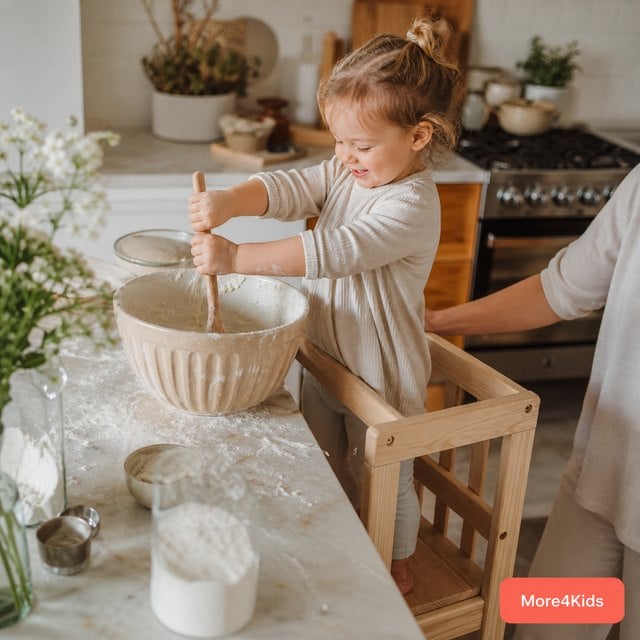
A play kitchen, a toolbench, a doctor kit, a set of pretend groceries — anything that lets a toddler act out what they watch you do all day. This is the category I underestimated most with my first kid and overbought for with my third. A toddler doesn’t need a kitchen with forty accessories. They need a stove-shaped thing to stir a pretend pot on while narrating “hot, hot, careful,” because that’s a direct rehearsal of language, sequencing, and empathy, dressed up as play.
→ Browse toddler play kitchens on Amazon. If your space is small, a smaller countertop version does the same job as the giant floor model — the play value comes from the pretending, not the footprint.
3. Books they can actually hold
I will die on this hill: board books are the most reliably re-played “toy” in my house, every single year, for every one of my three kids. A sturdy board book survives being chewed, thrown, sat on, and “read” upside down, and toddlers ask for the same one on repeat in a way that would drive an adult up the wall and is, developmentally, exactly the point — repetition is how language sticks.
→ Browse board books for toddlers on Amazon. A stack of five or six short ones beats one expensive picture book that’s too long to hold a toddler’s attention through the middle.
4. Music and movement they control
A small set of shakers, a drum, a xylophone with big enough keys not to disappear under a couch cushion — these give a toddler a cause-and-effect toy that’s fully theirs to direct, loud as they want, on their own schedule. It’s also one of the few gift categories that works just as well outside as it does indoors, which matters more than it sounds like once you’re three weeks into winter break.
→ Browse toddler musical instrument sets on Amazon. Skip anything with small maracas-style beads inside a piece that could crack — see the safety section below for exactly what to check.
A fifth honorable mention that doesn’t fit neatly in the four above: a genuinely large, chunky puzzle with four to eight pieces. It’s not glamorous, but it’s the toy I’ve watched hold a toddler’s focus at a kitchen table longer than almost anything else on this list, especially right after Christmas when the house is loud and everyone could use ten quiet minutes. → Browse large chunky toddler puzzles on Amazon.
The One-In-One-Out Rule Nobody Tells You Before Christmas
Here’s the part of Christmas gift-giving nobody warns new parents about: the problem is rarely finding good toys. It’s what happens to your living room on December 26th when a toddler suddenly owns twice as many toys as they did on December 24th, and none of them have an obvious home.
The fix that’s worked in my house isn’t fancy. Before the presents even get opened, I box up half of what’s already out and put it in the closet — not donated, just out of rotation. A few weeks after Christmas, I swap that box back in and something that’s been “boring” for a month suddenly looks brand new again. It costs nothing, and it does more for sustained toddler interest than buying a second wave of toys in January ever has for us. If your toddler is showing signs of being overwhelmed by too many choices at once — wandering from toy to toy without settling into anything — that’s usually the tell it’s time to rotate, not to buy more.
This pairs well with keeping your gift list itself smaller than it feels like it should be. Four gifts — something to build, something to read, something to wear, something they need — tends to actually get played with. Twelve gifts tends to mean eleven get glanced at once. The best Christmas gifts for toddlers are almost always the ones with room to grow into, not the ones with the most features out of the box. If you want the fuller version of what a toddler can actually do with their time and attention at this age, our guide to what 2- and 3-year-olds can really do is a useful gut-check before you fill a cart.
What to Check Before You Buy — the Six-Point Safety Pass
This is the part of the article that matters more than any product link. Whatever ends up on your Christmas gifts for toddlers list, every item should clear the same safety pass before it goes under the tree, whether it came from us, a store shelf, or a well-meaning relative.
Choking and small parts. The rule I use, and taught in my own classroom for years: if a piece fits through a toilet-paper tube, it’s a choking hazard for a child under three. This matters most for anything marketed as “for ages 3+” that ends up under a two-year-old’s tree because an older sibling asked for it — read the age label, and read it again for anything with detachable small pieces.
Button batteries. Any toy with a coin-shaped battery compartment needs a screwdriver-locked battery door, not a snap-open one. We’ve tracked more than twenty recalls in our own Recall Center tied to button-battery products marketed as casual kids’ items — mostly light-up wearables and novelty toys, not the categories on this list, but it’s worth checking every single light-up or musical toy before it’s wrapped.

Loose magnets. If a toy has small magnetic pieces that can be pulled apart, that’s a hard pass for a toddler in the house, full stop. Magnet ingestion is a surgical emergency, not a stomachache — our own recall data includes a magnetic-cube case where two children needed surgery after swallowing pieces. Save magnetic building sets for when a child is old enough to reliably understand they don’t go in the mouth, which is well past toddlerhood.
Cords, ribbons, and drawstrings. Anything with a long cord, a pull-string, or a ribbon loop long enough to reach around a toddler’s neck should stay out of the crib and off any toy meant for solo play. This applies to some musical instruments and pull toys, so check the string length before you buy, not after.
Tip-over risk. Play kitchens, toolbenches, and anything a toddler might climb should sit low and wide, or be secured to a wall if it’s tall. A toddler will absolutely try to stand on a play kitchen counter at some point; assume it and buy accordingly.
Sound level. Not a CPSC hazard, but a real one for your own household — test the volume before wrapping day. A toy that seemed fine in a noisy store can be genuinely too loud for a quiet living room, and there’s no returning the goodwill of a startled toddler mid-meltdown.
A clear recall check is a good sign, not a guarantee — recall databases, including our own, have real reporting gaps, so for anything safety-critical, a direct check of cpsc.gov is worth the extra two minutes. If a hazard like this ever does show up in something we’ve covered, our own recall coverage is where we log it, and our guide to keeping the holidays safe for younger kids covers more of the season-specific risks beyond toys.
What We’d Skip This Year
A deliberately link-free section, because not every popular category belongs on a toddler’s list, no matter how many “best toys of the year” roundups feature it.
Anything with a screen as the main feature. Interactive tablets marketed for one and two-year-olds test well in stores because they’re loud and colorful, and they hold attention for exactly the wrong reason — passive input, not active play. If you want the fuller reasoning here, not just the “no screens” version, it’s worth reading.
Anything marketed “educational” with a single correct answer. Toys that light up green for right and buzz for wrong are teaching a toddler to seek the light, not to think. Open-ended toys with no wrong answer teach more, more slowly, in a way that sticks.
Miniature versions of adult collectibles. Tiny figurine sets, blind-bag toys, and anything built around dozens of small pieces are a fast way to end up vacuuming pieces out of a rug for a year — and for a toddler specifically, they’re a small-parts risk before they’re a play value.
A second of anything they already have plenty of. If your toddler already owns six stuffed animals, a seventh isn’t a gift, it’s clutter with a bow on it. Ask what’s actually missing from the current rotation before adding volume.
A Simple Way to Handle the Grandparent Gift Flood
This is the part I get asked about most every December, and it has nothing to do with what to buy — it’s what to do when everyone in the family buys at once. Grandparents, aunts, uncles, family friends: everyone wants to get the toddler something, and nobody’s coordinating, and by December 26th you’re standing in a living room that looks like a toy store exploded.
The move that’s saved my sanity is sending a short list before the holidays, not after — three or four specific ideas from the categories above, sized to different budgets, so relatives get to pick something they’re excited to give without five people accidentally buying the same viral toy. It feels a little transactional the first time you do it. It is enormously less stressful than the alternative, and grandparents genuinely tend to appreciate the guidance rather than resent it — most people buying for a toddler they don’t see every day are relieved to be told what actually works.
And if the flood happens anyway, the one-in-one-out rotation above is your release valve. You don’t have to solve toy overwhelm by New Year’s Day. You just need somewhere to put the overflow until it’s not overflow anymore.
Frequently Asked Questions
How many Christmas gifts does a toddler actually need?
Far fewer than most gift guides imply. When you’re planning Christmas gifts for toddlers, a small list of four to six thoughtful items across different categories — something to build, something to read, something for pretend play, something they need — tends to get more actual play than a large pile. Volume competes with attention at this age; it doesn’t add to it.
What age-appropriate small-parts test should I use while shopping?
The toilet-paper-tube test: if a piece, or a piece that could break off, fits through a standard cardboard toilet-paper tube (about 1.25 inches across), treat it as a choking hazard for a child under three, regardless of what the box says.
Are open-ended toys really better than “educational” electronic toys?
For sustained attention and long-term play value, yes, in our experience and in most of the early-childhood development literature on the topic. Electronic toys with a single correct outcome get mastered quickly and shelved; open-ended toys like blocks, pretend-play sets, and books get reinvented as a toddler’s skills grow, which is why they tend to stay in rotation for years instead of weeks.
What should I tell grandparents who ask what to buy?
A short, specific list sent before the holidays works better than a vague request. Give three or four concrete ideas across a range of budgets so multiple relatives can each pick something different without duplicating the same viral toy.
However this Christmas goes at your house — a full morning of unwrapping or three gifts and a nap that saves everyone’s sanity — the toy that ends up mattering most is rarely the one that got the biggest reaction on camera. It’s usually the plain wooden block set, or the same board book for the fortieth time, or, honestly, the box. Buy for the kid you actually have, not the toy aisle, and you’ll do fine.

Meet Sophia Richards Sophia Richards is an early childhood educator, passionate writer, and the proud mom of three energetic kids. With a degree in Education and over a decade of hands-on classroom experience, Sophia bridges the gap between professional teaching strategies and everyday family life. At More4Kids, she translates complex child development concepts into practical, actionable parenting tips that families can use at home.
Whether she is sharing positive reinforcement techniques, educational crafts, or honest reflections on the chaos of raising three children under one roof, Sophia’s goal is to empower parents to foster resilience and joy in their kids. When she isn't writing or lesson planning, you can find her organizing neighborhood scavenger hunts or trying out new kid-friendly recipes.
Areas of Expertise: Early Childhood Education, Positive Parenting, Sibling Dynamics, Educational Play, Family Wellness.


Add Comment