















My middle son can spot a disguised homework assignment from across a room. Hand him a box that says “STEM” in friendly rainbow letters and he’ll turn it over once, decide it’s a worksheet in toy form, and ask if he can play with the box instead. It took me a few Christmases of watching genuinely clever kits get abandoned by December 27th to figure out what he already knew: kids don’t want to be taught. They want to build something, break it, and try again — and if that happens to be physics or circuitry, fine, but that can’t be the pitch.
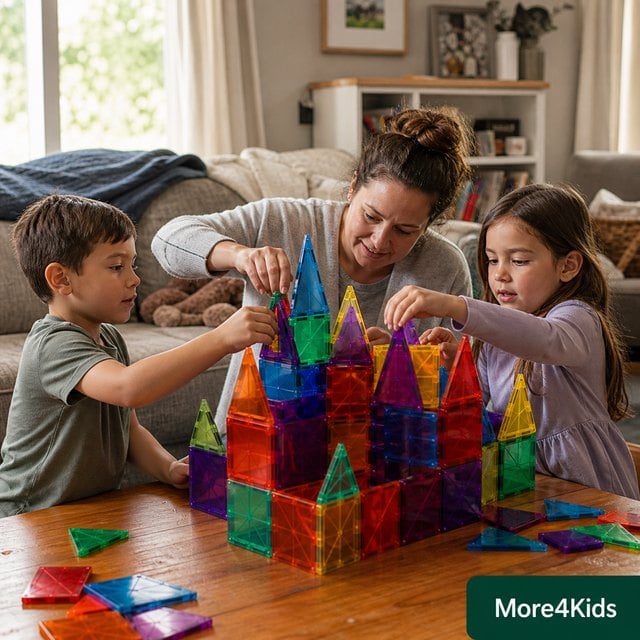
The good news is that the best STEM gifts for kids actually share a pattern, and it has nothing to do with the word “educational” on the box. It’s about whether the thing hands a kid a real problem and then gets out of the way. Below is what I’d actually put under the tree this year, organized by what a kid does with it rather than what a curriculum standard it hits, plus the safety checks that matter more in this category than almost any other — because STEM kits are, structurally, some of the highest-risk gifts in a December shopping cart.
Why “educational” is the kiss of death
Table of Contents
Here’s the thing nobody puts on the packaging: a toy that announces its own virtue is asking a kid to do the work of being impressed by it. Real engagement comes from the toy getting out of its own way — no character licensing, no app that nags for a screen, no manual that reads like a textbook. The best STEM gifts I’ve watched hold a kid’s attention for more than one afternoon all have the same quiet trick: they give an open-ended problem (“build something that lifts this cup”) instead of a closed one (“follow these steps to build the pictured model”). Kids finish the closed version once and shelve it. They come back to the open version for months.
That’s the filter I used to pick every STEM gift for kids in this list. If a kit only has one right answer, it’s a puzzle you solve once. If it hands a kid parts and a problem, it’s a toy.
As an Amazon Associate, More4Kids earns from qualifying purchases. We only recommend products we would use in our own homes, and we check every brand against current CPSC recall data before it appears here. Our recommendations are never paid placements.
Gear and pulley building sets — for the kid who takes things apart
This is the category I’d start with for a kid who’s never met a remote control they didn’t want to open. Gear and pulley kits are pure mechanism — cranks, axles, simple machines — with no electronics and no batteries to fail, which also means nothing to recall. A good set lets a kid build a working crane, break it, and rebuild it wrong on purpose just to see what happens. That failure loop is the entire point, the same rebuild-and-retry muscle we cover in teaching kids problem-solving skills — a kit that only assembles one correct way teaches a kid to follow directions, not to think like an engineer.
What I’d look for: real metal or sturdy plastic gears (not the flimsy kind that strip after a week), a project booklet that suggests builds without locking a kid into them, and pieces sized for the age on the box — some of the smaller gear-and-axle sets skew toward 6+ rather than 4+ for exactly the reason below.

→ Browse gear and pulley building kits on Amazon
Screen-free coding robots — for the kid who’s begging for a screen
If your household is fighting the screen-time battle already, this category is the compromise that actually works: robots that teach the logic of coding — sequences, loops, if/then thinking — through physical buttons or wooden blocks instead of an app. My youngest went through a phase of programming a little robot mouse through a cardboard maze she built herself, which is functionally the same skill as writing a short program, minus the tablet. It’s one of the few “screen alternative” claims I’ve watched actually hold up under a kid’s scrutiny.
What I’d look for: a robot that’s genuinely screen-free (some “screen-free” marketing still wants an app for setup — read the fine print), a coding method matched to the age band (button-sequence for the youngest kids, card- or block-based programming for elementary age), and a battery compartment secured with a screw, not a snap-open panel, since these run on small batteries a curious sibling could get into. It’s also one of the better tools we’ve found for the after-school stretch covered in helping kids focus — hands-on logic play instead of another screen.
→ Browse screen-free coding robots on Amazon
Circuit and electronics kits — for the kid who’s ready for “why,” not just “how”
This is the category to save for a kid who’s a little older — most reputable snap-together circuit kits are built and labeled for age 8 and up, and that age line is doing real work, not just marketing caution. Building an actual circuit that lights a bulb or spins a fan gives a kid a concrete answer to “how does electricity work,” and the snap-based ones let them do it without solder, wire strippers, or anything sharp. What makes this category worth the investment is that it scales: a starter kit teaches basic circuits, and the same kid can move to a bigger set with more parts and more complex builds a year or two later instead of aging out of the whole idea.
What I’d look for: the snap or clip connection style over anything requiring soldering at home, a project count that matches your kid’s patience (a kit with 100+ guided projects buys a lot more replay than one with 20), and — this is the one that actually matters for safety — parts sized well above choking-hazard range, since the snap pieces on a well-made kit are deliberately too large for the classic toilet-paper-tube test.
→ Browse circuit and electronics kits on Amazon
Engineering challenge kits — for the kid who likes a dare
These are the kits built around a specific, slightly cocky challenge: build a hydraulic arm, launch something across the room, make a robot walk. The framing matters — “engineering challenge” reads to a kid as a dare, not an assignment, and that reframing is most of why this category works when a plainer “building set” doesn’t. It’s also a genuinely good fit for a kid who’s outgrown basic building toys but isn’t ready for anything with real electricity.
What I’d look for: a stated challenge or goal on the box rather than a vague “STEM fun” label, an age range that actually matches your kid’s fine-motor patience (some of these have fiddly small connectors that frustrate a 6-year-old and delight a 10-year-old), and — same rule as everywhere in this article — every loose piece checked against the choking-hazard size threshold before it goes anywhere near a kid under 8.
→ Browse engineering challenge kits on Amazon
Kitchen science kits — for the kid who wants to eat the experiment
This is the category that gets the most genuine shrieking-with-delight reaction in my house, mostly because a lot of the best kits let a kid make something they can actually eat at the end — gummy candy, ice cream, rock candy — which turns “we’re learning about states of matter” into “we made candy.” That’s not a gimmick; cooking is chemistry, and a kid who’s stirred, measured, and watched something change texture has done a real experiment whether or not they’d call it one — the same small-win momentum we lean on in building a growth mindset.
What I’d look for: a kit that’s explicit about needing an adult for any stove or hot-water step (the good ones say so on the box), ingredients included rather than assumed you’ll have obscure items on hand, and — because “chemistry set” covers a wide range — one matched honestly to your kid’s age rather than the flashiest photo on the shelf; a 4-year-old and a 10-year-old need very different levels of independence here.

→ Browse kitchen science and chemistry kits on Amazon
Math and logic games — for the kid who thinks “math” is a bad word
I’ll be honest, this is the category I was most skeptical of, because “math game” has a well-earned reputation for being math homework with a cardboard box around it. The ones that actually work sidestep that entirely — they’re single-player logic puzzles or fast two-player games where the math is invisible, baked into the mechanic instead of announced on the label. A kid solving a spatial logic puzzle or racing to fill a grid isn’t thinking “I am doing math.” They’re thinking “I want to beat my last time,” which is a much better reason to pick something up on a snow day — and a genuinely good answer the next time someone asks what to do with a bored kid.
What I’d look for: a game that’s genuinely playable solo, since a lot of December STEM gifts get opened when siblings are busy with their own things, a difficulty range that grows with the kid (multiple challenge levels in one box beats a single fixed difficulty), and compact packaging if this is heading into a stocking or a car-trip bag rather than under the tree.
→ Browse math and logic games on Amazon
Matching the kit to the actual kid, not the age on the box
Age ranges on STEM gifts for kids are a floor for safety, not a ceiling for interest — the small-parts warning on an 8+ kit is a real hazard line, not a suggestion that a mature 6-year-old can ignore. But inside the “safe for this age” range, match the kit to temperament more than birthday. A kid who gets frustrated fast does better with gear-and-pulley sets that reward quick tinkering over engineering-challenge kits with a dozen fiddly steps before anything works. A kid who wants to be right does better with the guided circuit-kit projects; a kid who wants to break rules does better with an open-ended building set with no “correct” model at all. If you only remember one thing from this section: the box’s age range tells you what’s safe, not what your specific kid will actually enjoy, and those are two different questions.
The five-minute safety pass every STEM gift needs before it’s wrapped
STEM kits sit at an uncomfortable intersection: they’re marketed as the “smart” gift, but they’re also the category most likely to contain loose batteries, small connector pieces, or magnetic parts — exactly the recall patterns we track most often at More4Kids. None of that means skip the category. It means run this pass before anything goes under the tree, every single time, regardless of how reputable the brand:
- The toilet-paper-tube test. Any loose piece that fits through a 1.25-inch tube is a choking hazard for a child under 3 — and that includes any younger sibling who’ll be in the house on Christmas morning, not just the gift’s intended recipient.
- Check the battery compartment. If a kit uses coin or button batteries, the compartment should require a screwdriver, not a fingernail. Button-battery ingestion is one of the recurring hazard patterns in current recall data, and it’s an easy thing to check in ten seconds before wrapping.
- Look for loose magnets. Some circuit and robotics kits include small magnetic connectors. If any single magnet is small enough to swallow, that’s a hard no for a household with a child under 6 — magnet ingestion is a surgical emergency, not a stomachache.
- Read the age range out loud, not just the number. “Ages 8+” on a kit almost always means small-parts risk for anyone younger, spelled out in a small-parts warning somewhere on the box. Actually find and read that line.
- Check current recall data before buying, not after. Search the brand and product name against cpsc.gov/Recalls directly. Our own recall coverage here at More4Kids is growing but doesn’t go back far enough yet to be a substitute for checking the source.
- Do a five-minute test build yourself before your kid opens it on the day, if you can swing it. It catches missing pieces, a battery door that doesn’t latch, or a manual that assumes a reading level your kid doesn’t have yet — all things you’d rather discover in November than on the 25th.
What we’d skip
Not every “STEM” label deserves the shelf space. A few categories I’d pass on for most kids, regardless of the marketing:
- Anything with loose small magnets and a young sibling in the house. Even a kit rated for an older kid becomes a hazard the moment a toddler finds a stray piece under the couch.
- “STEM” kits that are really just stickers and a workbook. If the box’s main content is a printed activity book, it’s a workbook with better branding, not a hands-on toy.
- App-required “screen-free” claims. If the marketing says screen-free but the setup instructions send you to an app store, that’s not the category you’re shopping for.
- Kits with a single build and no replay value. If there’s exactly one way to assemble it and nothing to do once it’s built, it’s a one-afternoon toy no matter how impressive the finished model looks in the photo.
- Anything without a legible age range and small-parts warning on the box. If you can’t find that information without opening the package, that’s a sign to pick a different product, not just a different listing.
The budget reality of this category
Good STEM gifts for kids have a wide price spread, and the expensive end isn’t automatically the better end. A $15 gear-and-pulley starter set that gets rebuilt forty different ways beats a $70 kit with one impressive build and a shelf life of one afternoon. If you’re working with a set number of gifts this year — we’re fans of the four-gift rule in this house — a mid-range STEM kit slots naturally into the “something they need” or “something to learn” category rather than eating the whole budget on its own.

Frequently Asked Questions About STEM Gifts for Kids
What age should a kid be for their first STEM kit?
Simple building and gear sets exist for age 3 and up, but most electronics and circuit kits are built and labeled for 8+, and that line reflects a real small-parts safety threshold, not just marketing caution. Start younger kids with mechanism-based toys — gears, pulleys, simple building sets — that have no small electronic parts, and save circuit kits for when the age range actually matches.
Are STEM kits actually better than regular toys?
Not automatically. The “STEM” label doesn’t guarantee engagement — a kit with one fixed build and a workbook feel gets shelved just as fast as any other over-hyped toy. What predicts whether a kit gets used again is open-endedness: can a kid build something different the fifth time they open the box, or only the one thing pictured on the front?
How do I know if a STEM kit has a choking hazard?
Use the toilet-paper-tube test: if a loose piece fits through a standard 1.25-inch tube, it’s a choking risk for a child under 3, and that matters even if the kit is intended for an older sibling, since younger kids in the house will find their way to it. Check the box for an explicit small-parts warning, and don’t rely on the recommended age alone.
What’s the deal with STEM kits and batteries?
Battery-powered robots and light-up kits are one of the more common items in current recall data, usually tied to coin or button batteries with compartments that open too easily. Before buying, check that the battery door needs a screwdriver, not a fingernail, to open.
Do screen-free coding robots actually teach coding?
The good ones teach the underlying logic — sequencing, loops, if/then thinking — through physical buttons, cards, or blocks, which is the same reasoning skill as writing a short program. It’s a real head start on the concept, even without a keyboard involved. Just check that “screen-free” isn’t secretly requiring an app for setup.
What STEM gift categories should I skip for a child under 6?
Skip circuit kits, small magnetic building sets, and anything with a stated 8+ age range and small-parts warning. Stick to gear-and-pulley building sets, kitchen science kits designed for younger kids, and screen-free coding toys made specifically for the preschool-to-early-elementary range — the age line on the box exists for a reason at this category.
Whatever you land on, the test I’d apply at checkout is the same one my middle son already applies without meaning to: would a kid pick this up on a random Tuesday in March, or only under duress on December 25th? If it’s the second one, it’s not really a toy. Keep looking.

Meet Sophia Richards Sophia Richards is an early childhood educator, passionate writer, and the proud mom of three energetic kids. With a degree in Education and over a decade of hands-on classroom experience, Sophia bridges the gap between professional teaching strategies and everyday family life. At More4Kids, she translates complex child development concepts into practical, actionable parenting tips that families can use at home.
Whether she is sharing positive reinforcement techniques, educational crafts, or honest reflections on the chaos of raising three children under one roof, Sophia’s goal is to empower parents to foster resilience and joy in their kids. When she isn't writing or lesson planning, you can find her organizing neighborhood scavenger hunts or trying out new kid-friendly recipes.
Areas of Expertise: Early Childhood Education, Positive Parenting, Sibling Dynamics, Educational Play, Family Wellness.

Add Comment