















By Sophia Richards
Somewhere between the last bite of dinner and the moment a small head finally hits the pillow, a lot of families lose the plot. Teeth get half-brushed. A water cup appears, then a second one. Someone remembers a permission slip. Someone else discovers they are suddenly starving, wide awake, and full of urgent questions about sharks. If your school nights tend to slide from “almost done” to “how is it 9:40 already,” you are in very good company.
A school night bedtime routine is the thing that quietly rescues those evenings. Not a rigid, color-coded bedtime chart that assumes calm children and a silent house. A real one, built for the family you actually have, on the kind of tired Tuesday where everyone is running low. A book everyone actually wants helps too — these are our favorite bedtime stories, age by age. As a mom of three and an early-childhood educator, I’ve watched the same small truth prove itself over and over: kids sleep better, wake up easier, and fall apart less often when the last hour of the day has a predictable shape.
Here are eight steps to build a school night bedtime routine that protects sleep without turning bedtime into a nightly standoff.
Why a School Night Bedtime Routine Matters More Than One More Reminder
Table of Contents
Sleep is not a nice-to-have for school-age kids. Nemours KidsHealth notes that school-age children need 9 to 12 hours of sleep a night, and that homework, sports, screens, and hectic schedules can quietly steal the hours they need. When kids come up short, it shows: they can be cranky, moody, or hyper, and they can struggle to learn and pay attention the next day.
The routine is what makes good sleep repeatable instead of reinvented every night. The Sleep Foundation explains that a bedtime routine is simply a consistent, repetitive set of calming activities done before bed, and that children who follow one tend to fall asleep faster, sleep longer, and wake less during the night. The encouraging part for tired parents is that it can start working within a few nights.
More4Kids has long talked about how simple daily routines give children structure and security. A school night bedtime routine is that same idea aimed at the hardest transition of the day. And it helps you too: instead of making a dozen small decisions while everyone is exhausted, you make a few decisions once and let them carry the night.
Step 1: Work Backward From the Wake-Up Time
Most bedtime math happens in the wrong direction. We wait to see when a child seems sleepy, and by then it is already too late. Nemours KidsHealth suggests the opposite: decide when your child needs to wake up for school and count back 9 to 12 hours to find a realistic bedtime.
Do that math once for your family and write it down. If the bus comes at 7:15 and your child needs to be up by 6:30, a 9:30 bedtime is likely too late for a young grade-schooler. Working backward turns “go to bed” from a vague nightly argument into a fixed target the whole house can aim for. It also tells you when the wind-down has to start, which is usually earlier than any of us want to admit.
Step 2: Keep the Bedtime Consistent, Even on Weekends
A school night bedtime routine works best when the clock barely moves. The AAP encourages families to make sufficient sleep a family priority with regular routines, because predictability helps kids settle. Consistency is the ingredient that does the quiet heavy lifting.
Weekends are where good routines go to die. It is tempting to let everyone sleep in and stay up late, but both KidsHealth and the Sleep Foundation warn that drifting more than about an hour from the usual sleep and wake times can make Monday genuinely miserable. You do not have to run your Saturday like a school day. Just try to keep bedtime and wake-up within an hour of the weekday plan so the routine does not have to be rebuilt every single week.
Step 3: Start the Wind-Down Before the House Is Wired

Kids do not switch from full speed to sleepy on command, and neither do we. The wind-down is the on-ramp. The Sleep Foundation recommends winding the household down by dimming the lights and turning off screens in the lead-up to bed, and the AAP adds that dimming lights and keeping the home cool and calm helps set the stage for sleep.
In our house, the wind-down is less about a specific activity and more about lowering the volume of everything. Overhead lights go off, lamps come on. Loud play ends. Voices drop. This is also the moment to avoid overscheduling, which the AAP specifically flags: evening games, lessons, and late activities can crowd out the downtime kids need. A strong school night bedtime routine protects the last 45 minutes of the day like they matter, because they do.
Step 4: Put Screens to Bed First
Screens are not villains, but they are terrible at going to sleep quietly. Nemours KidsHealth advises turning off all screens at least 1 hour before bedtime and keeping TVs, computers, and game systems out of the bedroom, with phones charging overnight outside the room. The AAP echoes this and encourages a family media plan with clear screen-free times before bed.
Make the screen rule part of the routine, not a nightly negotiation. Decide on a “screens off” time, set an alarm for it, and let the alarm be the bad guy instead of you. Charging devices in the kitchen rather than the bedroom removes the midnight temptation entirely. If screens are a recurring battle in your home, our guide to how much screen time is healthy can help you think past minute-counting and focus on what screens are crowding out, which at night is sleep.
Step 5: Build a Short, Repeatable Sequence

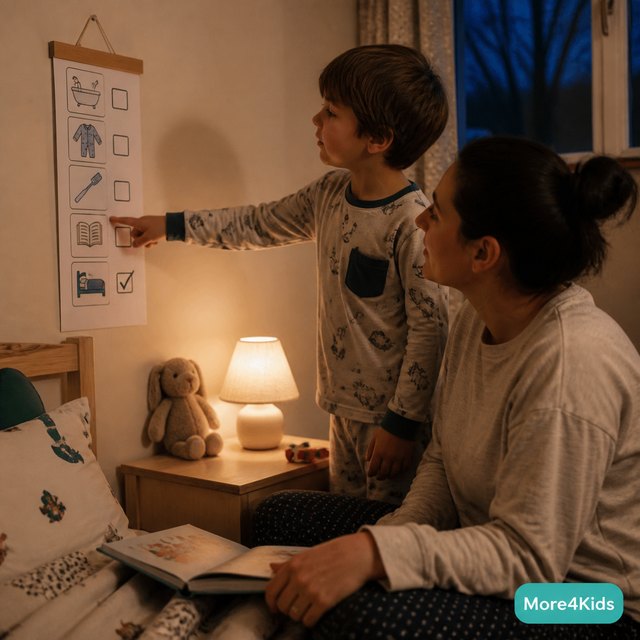
This is the heart of a school night bedtime routine. The Sleep Foundation notes that an effective routine is usually just three or four activities done in the same order every night, such as a light snack, brushing teeth, pajamas, and a book. Nemours KidsHealth similarly describes a calming routine of about 30 minutes that can include a bath or shower, brushing teeth, and quiet reading.
The magic is not in the specific steps. It is in the sameness. When the sequence is predictable, a child’s brain and body start reading each step as a signal that sleep is coming. Keep it short enough to survive a hard day and simple enough that a babysitter or grandparent could follow it. Pajamas, teeth, bathroom, books, lights, done. Little kids especially love knowing exactly what comes next, and that security is part of what helps them settle.
Step 6: Make the Bedroom Boring in the Best Way
A good sleep space is calm, not stimulating. KidsHealth recommends keeping the bedroom dark, cool, and quiet, and the AAP suggests keeping the bed a place for sleeping rather than playing. The Sleep Foundation adds that a dim nightlight is perfectly fine for a child who is afraid of the dark.
You do not need blackout curtains and a white-noise machine to make this work, though some families love them. Clear the bed of the toy avalanche, leave one comfort item if your child needs it, and lower the lights. If noise from the rest of the house tends to pull a child back out of bed, the Sleep Foundation suggests shifting the whole household to quieter activities once the kids are tucked in. The room should whisper “rest,” not “recess.”
Step 7: Watch the Snacks, Caffeine, and Rough Play
What happens in the hour before bed can quietly wreck the whole plan. Both KidsHealth and the Sleep Foundation caution against caffeine and sugary treats in the evening, and caffeine hides in more places than parents expect, including chocolate, some sodas, and even a few cereals. A light, simple snack is fine if your child is genuinely hungry; a sugar rush at 8 p.m. is not.
The same goes for wound-up play. The Sleep Foundation warns against letting kids work themselves into a frenzy at night, because an overtired, over-stimulated child is often a wired one. Save the wrestling and the scary stories for another time. Daytime is actually where the sleep groundwork gets laid: KidsHealth notes that plenty of exercise during the day helps kids sleep better at night, so let them run at the park after school and keep the evening calm.
Step 8: Protect the Routine, and Let It Do Its Work
The hardest part of any school night bedtime routine is not designing it. It is holding it on the nights you are tired, running late, or tempted to let it all slide. Consistency is exactly what makes it work, so protect it gently but seriously. Kids will test the edges; that is their job. Yours is to keep the shape steady.
Give it time, too. The Sleep Foundation points out that the benefits of a bedtime routine show up within a few nights and keep paying off for years, and the AAP links enough sleep to better school performance, behavior, memory, and mental health. That is a remarkable return for something as ordinary as pajamas, a book, and lights out at the same time each night. If your mornings are also rough, pairing this with a gentler morning routine for getting kids up lets the two ends of the day support each other.
A Sample School Night Bedtime Routine You Can Adapt
Here is a simple version to steal and make your own:
1. Set the target: bedtime counted back 9 to 12 hours from the school wake-up time. 2. Screens off: at least an hour before bed, devices charging outside the bedroom. 3. Wind-down: dim the lights, lower the noise, end loud play. 4. Snack and hygiene: light snack if needed, then bathroom and teeth. 5. Pajamas and prep: clothes for tomorrow set out, backpack by the door. 6. Books and connection: a story or a few quiet minutes to talk about the day. 7. Lights out: same time each night, comfort item allowed, dim nightlight if needed. 8. Weekend hold: keep sleep and wake times within about an hour of weekdays.
You will need to flip and trim this to fit real life. A child in evening sports needs a faster version on practice nights. A younger child may need a longer wind-down than an older one. Two kids on different bedtimes may need staggered routines. That is all fine. A working school night bedtime routine serves your family, not a printable chart’s idea of your family.
For more support on the ordinary evenings that make up family life, the parenting hub has plenty more, and if bedtime has become a genuine dread in your house, our older piece on why you might dread bedtime is a warm place to start. Pick one change this week, maybe a fixed screens-off time or a shorter, same-every-night sequence. One small routine that happens most nights will always beat a perfect plan that collapses by Wednesday.

Frequently Asked Questions
What is a good school night bedtime routine?
A good school night bedtime routine is a short, predictable sequence of calming steps done in the same order each night, ending with lights out at a consistent time. A common version is screens off, wind-down, light snack, bathroom and teeth, pajamas, a book, and lights out. The exact steps matter less than the consistency. Set the bedtime by counting back 9 to 12 hours from your child’s school wake-up time, and keep the routine short enough to survive a tired night.
What time should kids go to bed on school nights?
There is no single right bedtime for every child, because it depends on wake-up time and age. Nemours KidsHealth recommends deciding when your child needs to wake up for school and counting back 9 to 12 hours. So if your child must be up at 6:30, a bedtime somewhere around 7:30 to 9:30 usually fits, with younger children needing the earlier end. Consistency matters more than the exact clock time.
How can I get my child to fall asleep faster on school nights?
Start the wind-down earlier than feels necessary, turn off screens at least an hour before bed, and dim the lights to cue the body that sleep is coming. Keep the bedroom dark, cool, and quiet, and avoid caffeine, sugary snacks, scary stories, and rough play in the evening. A short, same-every-night routine helps a child relax and learn to fall asleep on their own. If falling asleep is a nightly struggle, plenty of daytime exercise can help too.
How do I keep a bedtime routine on the weekends?
You do not have to run weekends like school days, but try to keep bedtime and wake-up within about an hour of the weekday schedule. Both KidsHealth and the Sleep Foundation note that drifting further than that can make it harder to fall asleep and wake up on Monday. Keeping the core routine, even a shorter version, helps the whole week feel less like a restart.
When should I talk to a doctor about my child's sleep?
Occasional trouble sleeping is normal. But if your child regularly cannot fall asleep, wakes often at night, snores, resists bedtime intensely, or is very sleepy during the day even with a consistent routine, it is worth talking with your pediatrician. A steady school night bedtime routine helps most everyday sleep struggles, but persistent problems deserve a professional’s eyes rather than more troubleshooting at home.
Related Articles
- A Secret To Happy Kids Daily Routines
- How Much Screen Time For Kids
- Getting Kids Up
- Parenting
- Do You Dread Bedtime

Meet Sophia Richards Sophia Richards is an early childhood educator, passionate writer, and the proud mom of three energetic kids. With a degree in Education and over a decade of hands-on classroom experience, Sophia bridges the gap between professional teaching strategies and everyday family life. At More4Kids, she translates complex child development concepts into practical, actionable parenting tips that families can use at home.
Whether she is sharing positive reinforcement techniques, educational crafts, or honest reflections on the chaos of raising three children under one roof, Sophia’s goal is to empower parents to foster resilience and joy in their kids. When she isn't writing or lesson planning, you can find her organizing neighborhood scavenger hunts or trying out new kid-friendly recipes.
Areas of Expertise: Early Childhood Education, Positive Parenting, Sibling Dynamics, Educational Play, Family Wellness.



Add Comment