
















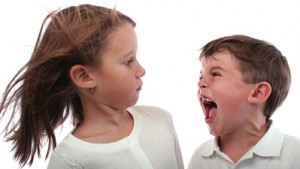
- Be sympathetic. Arguments amongst friends are tough for everyone – but especially so for kids. Chances are that either your child, the friend, or both are hurting. Keep in mind, your goal isn’t to solve the problem – that’s up to them–but you can acknowledge the hurt. “I can see why you’re upset.” “Arguments are never fun. They get everybody hurting.”
- Teach kids to call for time outs. Even a few seconds can be enough to stop a big quarrel so help your child come up with a few things to back off from an argument ready to blow. “When you feel like you and your friend are starting to argue, try to cool things off. You could say: ‘You know I’m too mad to talk right now.’ ‘Give me a minute to cool off.’ ‘I need to take a walk.’ ‘Let’s go shoot some hoops.’”
- Stress compromising. The best way for kids to learn how to get along is by watching others. So be the model! Anytime there is a conflict (which game to play, hich TV show to watch, whose house to go visit) between kids, the skill of compromising can be a goldmine. “You choose this time. I choose next time.” “Let’s find a TV show we can both agree on.” “Let’s play Monopoly for 30 minutes then Clue for 30 minutes.” Model it until your kids can pick up on it.
- Help them work it out themselves. Ask the kid involved what they plan to do to solve “their” problem. After all, real life practice is the best way for kids to learn skills. “I know you two can solve this. If you need me, I’m in the other room, but don’t leave the table until you can work this out fairly.” “Let’s see if you two can work this through calmly for three minutes. You’ve been friends far too long not to solve this.”
- Find the real cause. Usually there are deeper issues involved: what’s really triggering these arguments? Is the other child getting more attention, being manipulative or bullying? Does he have more of something? Does anyone feel they are not being listened to or being taken advantage of? Ask friends, teachers, coaches who know your child well. Compare notes and get to the root of the issue then commit yourself to doing one thing you can do to start turning things around.
- Teach conflict solving. Use the steps below to teach your kids how to Solving Conflicts So Everyone is Satisfied), but don’t expect overnight miracles. Learning any skill takes practice, so look for real life opportunities to practice the skill in then practice over and over. Here are the steps to resolving conflicts. They will take time to learn so just teach one step at a time until your kids have mastered the art of getting along.
- Stop and cool off. As you as feel an argument is getting nowhere, tune into everyone’s mood. Are your friends’ feelings getting hurt? If you or your friends look or sound tense, then call for a time out. You could take a deep breath, suggest everyone stop to stay calm, get a drink of water, leave a minute and then come back. Only when you and your friend are calm can you talk about what’s bugging you.
- Set some talking rules. Agree to switch off as talker and listener to hear each other’s side of the problem. No interrupting. No put downs. No name calling, insulting, or blaming. Stay calm. Tell the truth and remain respectful. Remember you both should take a bit of responsibility.
- Listen carefully. Hear your friend’s point of view.
- Use I Messages. When you talk say how you feel. Say why you feel that way. Say what you want or need to make things fair. Don’t say “You did this….” Or “you said that….” Your job is to attack the problem and not your friend.
- Agree on what the problem is. Both of you need to decide what you’re really arguing about.
- Brainstorm alternatives. Find a solution that’s fair to both of you. Agree to do it and move on. If they have been any hurt feelings, be

How do I teach my child to resolve conflicts with friends?
Table of Contents
Teach a step-by-step approach: first, cool off with a brief time-out or deep breath when emotions run high. Agree to take turns talking and listening — no interrupting, name-calling, or blaming. Use ‘I’ messages instead of accusations: say how you feel and what you need, not what the other person did wrong. Work together to name the real issue, then brainstorm solutions that feel fair to everyone involved.
What should I do when my kids are fighting?
Acknowledge the hurt first without diving in to solve it for them — ‘I can see you’re both upset’ goes further than jumping to referee. Encourage a brief cool-off, then redirect them: ‘I know you two can figure this out. I’ll be nearby if you need me.’ Real-life practice is how children actually learn conflict resolution, so stepping back while staying available is often the most effective approach.
How do I help my child identify the real cause of a conflict?
Many arguments have a deeper trigger than the surface dispute — a child may feel overlooked, taken advantage of, or unheard. Ask teachers, coaches, or other adults who know the children involved and compare what you hear. Once you identify the underlying issue, making one focused change to address it can start turning the relationship around more quickly than addressing the surface argument alone.
How do I model healthy conflict resolution for my children?
Children learn most powerfully by watching. Whenever a real disagreement arises in the family — which activity to choose, whose turn it is — use it as a live lesson in compromising: ‘You choose this time, I’ll choose next time.’ Speak calmly, use ‘I’ messages, and show that you can reach a solution where everyone feels heard. These patterns become the default your child reaches for when conflicts arise with peers.



Add Comment