














By Sophia Richards
My middle child sat at the kitchen table one morning, staring at the word “the” like it had personally wronged her. She could sound out “cat” and “dog” just fine — those play by the rules. But “the” doesn’t sound out, and she knew it, and she was done. She pushed the book away and said, “I’m bad at reading.” She was five. She was not bad at reading. She was stuck on one of the handful of words in English that don’t play fair, and nobody had told her that was normal.
That moment is the whole reason I wanted to write this. Homeschool reading instruction gets made to sound either effortless — some magic curriculum, some gifted kid who just picks it up — or completely overwhelming, with color-coded scope-and-sequence charts that make you feel like you need a teaching degree to help your own child sound out “mat.” It’s neither. Teaching a child to read at home is a series of small, ordered steps, done consistently, with a lot of patience for the days it doesn’t click. You don’t need a classroom. You need a plan and about fifteen minutes a day.
I’ve taught kindergarten and first grade, and I’ve now walked all three of my own kids through this same process at our kitchen table, at different ages and different speeds. What follows is the program I actually use — readiness signs, the phonics order that works, how to build a daily routine that survives real life, what to do when it stalls, and when a stall is actually worth a second opinion.
Is Your Child Ready to Start Homeschool Reading?
There’s no single “right age” to begin, and that’s actually one of the best things about doing homeschool reading instruction instead of waiting for a classroom calendar to decide for you. Readiness is a cluster of small signs, not a birthday. Most kids show a handful of these somewhere between three and six:
- They love being read to and ask for the same book again and again, sometimes to your quiet despair around book eleven of the same night.
- They recognize a few letters, usually the ones in their own name first. My youngest could pick his “W” out of a lineup months before he cared about any other letter — because it was his.
- They notice rhymes and beginning sounds. They’ll tell you “cat” and “hat” rhyme, or that “ball” starts the same as “baby.”
- They understand that print carries meaning. They point to words on a cereal box, “read” a memorized favorite, or ask what a sign says.
- They can sit with a book for a few minutes without it turning into a wrestling match.
- They ask what things say. “What does that say?” is one of the best green lights there is.
If most of these aren’t there yet for your child, that isn’t a delay — it’s information. Keep reading aloud every day, keep playing with sounds and rhymes and silly rhyming games in the car, and readiness tends to arrive on its own timeline. Pushing formal phonics before a child is ready almost always creates frustration instead of a head start, and frustration is exactly what makes a kid decide, at five years old, that she’s “bad at reading.”
The Homeschool Reading Program: A Step-by-Step Phonics Sequence
This is the part parents ask me about most, because it’s the part that feels the most like it requires special training. It doesn’t. Phonics works like a ladder — each rung has to hold before you add the next one — and once you know the order, you can teach it with index cards at your kitchen table. Move to the next step only when the current one feels easy, and don’t be afraid to drop back a step when something isn’t sticking. Going backward for a week is not falling behind; it’s how the ladder actually holds weight.
1. Letter sounds first, not just letter names. Start with short-vowel and common consonant sounds — a, m, s, t, p, n. “This letter says /m/” matters more right now than “this letter is called M.” Magnetic letters on a cookie sheet and a steady stream of “what sound does this make?” does most of the work. 2. Blending two and three sounds. Once a handful of sounds are solid, blend them: /m/ /a/ becomes “ma,” then /m/ /a/ /t/ becomes “mat.” This is the moment reading clicks for most kids — go slow here and make a genuine fuss when it lands. 3. Short-vowel CVC words. Consonant-vowel-consonant words — cat, dog, sun, bed, pig. Build them with letters, then read them off cards, then find them in a real (short, easy) book. 4. A small set of sight words. Words like “the,” “was,” “said,” and “you” don’t sound out cleanly — they’re the reason my daughter pushed her book away that morning. Teach a handful at a time by sight, explicitly telling your child these ones are exceptions. Naming the exception out loud takes the sting out of it. 5. Digraphs — two letters, one sound. Introduce sh, ch, th, wh, then ck and ng. Suddenly “ship,” “chin,” and “this” are readable. 6. Long vowels and silent-e. Show how a silent “e” flips the vowel sound: cap becomes cape, kit becomes kite, hop becomes hope. This single pattern unlocks a huge number of new words almost overnight. 7. Vowel teams and diphthongs. Move into ai, ee, ea, oa, oo, ou, ow, oi, oy. These take real repetition — a printed reference chart taped inside a folder helps more than you’d expect. 8. R-controlled vowels. Ar, er, ir, or, ur — the “bossy r” that changes a vowel’s sound entirely (car, her, bird, for, fur). 9. Multisyllable words and fluency. Now it’s about chunking longer words and reading easy books aloud daily until the words stop feeling like work and start sounding like talking.
Throughout every one of these steps, keep reading aloud to your child above their own reading level and talking about the story. Decoding and comprehension are two different muscles, and one without the other eventually stalls — a child who can sound out every word but has no idea what the paragraph meant hasn’t actually learned to read yet, not in any way that matters.

Building a Daily Homeschool Reading Routine That Survives Real Life

The families who make the fastest progress aren’t the ones with the fanciest curriculum. They’re the ones who show up for ten or fifteen minutes, most days, without turning it into a production. Here’s the rhythm that’s worked in my house across three very different kids:
- Read aloud to your child every single day, starting as early as eight months old — though it is genuinely never too late to start. This isn’t the “lesson.” It’s the soil everything else grows in.
- Do the short phonics practice separately, ideally at a consistent time — right after breakfast, or right before the read-aloud. Ten to fifteen minutes is plenty for a young child. Longer sessions don’t teach faster; they just teach a kid to dread the table.
- End on something that worked. If a session is going sideways, don’t grind it out to hit a time goal. Finish on an easy win — even if that means dropping back to yesterday’s words — so the last feeling of the day is “I can do this,” not “I’m bad at this.”
- Let your child show off. Make word cards. Let them read a sign, a menu, a text message out loud to a grandparent on the phone. A little audience does more for motivation than any workbook sticker.
- Watch for the plateau, and expect it. Kids often make fast progress, then seem to stall for a week or two while a skill consolidates. That’s not a red flag — it’s how learning works. Keep the routine steady through it.
A daily reading routine works the same way a predictable daily rhythm works for almost everything else with kids — the structure itself takes the pressure off, so nobody has to negotiate every single day about whether today is a reading day.
Homeschool Reading Activities That Make Practice Fun
Phonics practice doesn’t have to look like a worksheet, and for a lot of kids, it shouldn’t. A few homeschool reading activities that have earned their keep at my kitchen table:
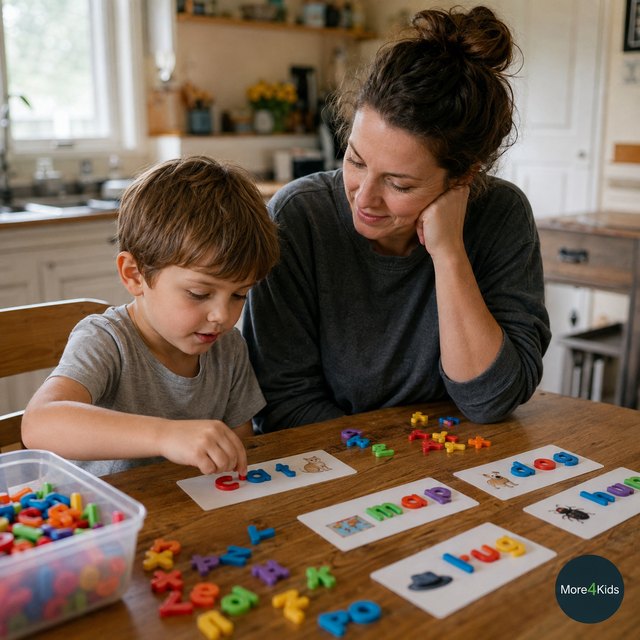
- Magnetic letters on a cookie sheet. Build a word, sound it out, change one letter, sound out the new word. Watching “cat” become “hat” become “hot” in seconds is more memorable than any flashcard drill.
- Word hunts around the house. Tape word cards to the objects they name — bed, lamp, door — at age three or four, before your child can read them independently. Familiarity with the shape of the word comes first.
- Letter and word card games. Concentration or a simple matching game, played with letter or sight-word cards instead of a regular deck, sneaks in repetition without anyone noticing it’s practice.
- Cut-and-build from magazines. Cut a picture out of an old magazine or catalog, then build the word for it with magnetic letters next to the picture. It turns vocabulary and phonics into the same game.
- Read to a stuffed animal or a younger sibling. Reading out loud to someone who won’t correct every mistake is lower-stakes than reading to you, and it builds fluency without pressure.
- Screen time that actually teaches. A little educational television or a well-chosen phonics app, used in moderation, reinforces letters and sounds without feeling like schoolwork — worth keeping in the mix of a reasonable screen time plan rather than either banning or over-relying on it.
None of this needs to be elaborate or expensive. The best reading activities I’ve used cost nothing but a cookie sheet and a set of letter magnets that have been in a kitchen drawer for a decade.

When Homeschool Reading Isn’t Clicking
Every child hits a wall somewhere in this sequence — mine all did, at different steps. Before you assume something is wrong, try these first:
- Drop back a step, not forward. If blending isn’t working, go back to isolated sounds for a few more days. Kids very rarely need harder material when they’re stuck; they usually need more repetition at the last easy step.
- Shrink the session. A ten-minute session that ends well beats a twenty-minute session that ends in tears, every time. If reading time has started to dread-inducing, cut it in half before you do anything else.
- Separate the skill from the emotion. A child who’s decided “I’m bad at reading” needs the emotional piece addressed before the phonics piece will land. Name it directly: “the still doesn’t sound out — that’s not you, that word is just weird,” and move on to a word that will sound out cleanly, so the session ends on success.
- Check for a genuine skills gap versus a fluency lag. A child who can sound out words slowly but accurately is progressing normally, even if it’s slower than a sibling. A child who consistently reverses letters (b/d), can’t hear that two words rhyme, or shows no progress at all across several weeks of consistent practice is a different situation.
- Rule out the obvious. A recent vision or hearing check is cheap reassurance and occasionally catches something simple that’s been quietly making reading harder than it should be.
If, after several weeks of consistent, patient practice, a child still isn’t blending sounds, still can’t hold basic letter-sound correspondence, or seems to be working much harder than the material should require, that’s the point to loop in your pediatrician or a reading specialist for an evaluation — not because something is necessarily wrong, but because an early evaluation is far easier to act on than a late one. Reading Rockets has solid, parent-friendly guidance on phonics instruction and what typical progress looks like at each stage, and it’s worth a look if you want a second reference point beyond one homeschool mom’s kitchen-table experience.
Reading stalls also tend to show up around the same table where homework stalls happen a few years later — if daily practice at home is starting to feel like a nightly battle no matter the subject, a calmer homework routine uses a lot of the same “shrink the session, end on a win” thinking that gets a reading slump moving again.
What Reading Skills Should My Child Have, and When?
Every child moves at their own pace, and these are guides, not deadlines — but they’re useful markers to watch for:
- By kindergarten age (5–6): most children know all the letter names and sounds, can blend sounds into simple words, and have a small reading vocabulary — words like the, boy, girl, see, a, to, ran, has, cat, dog, mom, dad, go, car, house, bed, school, and said are a reasonable early list.
- By early first grade: most children are working through short-vowel CVC words and digraphs, and starting to recognize a growing bank of sight words in context, not just on flashcards.
- By later first/second grade: long vowels, vowel teams, and r-controlled vowels are coming together, and independent reading of simple chapter books or early readers becomes realistic.
Zero to Three has good general guidance on early language development if you want to understand what’s happening well before formal phonics even starts — a lot of reading readiness is built during ordinary conversation and read-aloud time in the toddler years, long before a child ever sits down with a phonics workbook.
A Quick Reference: Sounds Every Homeschool Reading Program Should Cover
If you want a chart to keep near your teaching table, this is the reference I still use, organized in roughly the order a child needs them:
Vowels and vowel digraphs: short a (apple), long a (gave, say), short e (end), long e (seem, team, eagle), short i (in), long i (ice, tie), short o (octopus), long o (hope), short u (up), long u (tune, blue), y as a vowel (my, baby).
Consonants: all standard consonant sounds, including the two sounds of c (cat, circle) and g (girl, giraffe).
R-controlled vowels (“bossy r”): ar (card), er (dinner), or (for), ur (fur), ir (girl).
Consonant digraphs: th (them, the), sh (she, shoe), wh (white, when), ch (child, chin), qu (quart), ph (photo), kn (knife), ng (song).
Vowel teams and diphthongs: oo (wood, too), aw (saw), ew (new), ow (plow, cow), ou (ground), oi (coin), oy (boy), au (auto).
A printable version of this same progression is easy to find through any solid phonics resource, but this order — sounds, blending, CVC words, sight words, digraphs, silent-e, vowel teams, r-controlled vowels, fluency — is the backbone that matters more than any particular worksheet you use to teach it.
Frequently Asked Questions
What is the best way to start homeschool reading with a young child?
Start with daily read-aloud time long before formal phonics — reading to a child from infancy builds vocabulary and a love of books that makes phonics instruction land better later. When your child starts showing readiness signs (recognizing letters, noticing rhymes, asking what words say), begin with letter sounds, then move into blending two and three sounds together. Keep sessions short — ten to fifteen minutes — and end on an easy win.
How long does it take to teach a child to read at home?
It varies enormously by child, but most kids who get consistent daily practice move through the full phonics sequence — from letter sounds to reading simple chapter books — somewhere between kindergarten and second grade. Slow and steady with a consistent daily routine beats intensive, irregular pushes almost every time.
My child knows the letter sounds but can't blend them into words. What do I do?
This is one of the most common stalls in homeschool reading, and it’s usually a repetition issue, not an ability issue. Go back to blending just two sounds at a time (like /m/ /a/ = “ma”) until it’s automatic before adding a third sound. Say the sounds slowly, then a little faster, then have your child do the same — blending is a physical, auditory skill that needs practice, not just understanding.
Should I use sight words or phonics to teach my child to read?
Phonics should be the foundation — it gives a child a reliable system for sounding out new words independently, rather than memorizing word shapes one at a time. But a small set of irregular sight words (the, was, said, you) genuinely can’t be sounded out with early phonics rules and do need to be memorized directly. Use both: phonics for the vast majority of words, a short memorized sight-word list for the exceptions.
How do I know if my child needs extra help with reading, not just more time?
Most stalls resolve with a week or two of patient repetition at an easier step. It’s worth a conversation with your pediatrician or a reading specialist if, after several weeks of consistent daily practice, your child still can’t blend even simple sounds, consistently reverses letters, can’t hear that two words rhyme, or seems to be working far harder than the material should require. An early evaluation is easy to act on; catching a real gap late is much harder.
The One Thing Worth Remembering
If I had to boil this whole homeschool reading program down to one piece of advice, it’s this: read to your child every day, teach the phonics ladder in order, keep sessions short, and expect the plateaus. My daughter who pushed her book away over “the” is now a kid who reads under the covers with a flashlight, entirely because we kept the routine going through the weeks it wasn’t fun. That’s the whole secret. There isn’t a faster one hiding somewhere in a curriculum catalog.
You don’t need a teaching degree to do this well. You need patience, about fifteen minutes most days, and a willingness to go back a step when today isn’t the day. Your child will get there — probably on a completely different timeline than the kid down the street, and that’s fine. Reading isn’t a race. It’s a skill, built one sound at a time, at your own kitchen table.
Related Articles

Meet Sophia Richards Sophia Richards is an early childhood educator, passionate writer, and the proud mom of three energetic kids. With a degree in Education and over a decade of hands-on classroom experience, Sophia bridges the gap between professional teaching strategies and everyday family life. At More4Kids, she translates complex child development concepts into practical, actionable parenting tips that families can use at home.
Whether she is sharing positive reinforcement techniques, educational crafts, or honest reflections on the chaos of raising three children under one roof, Sophia’s goal is to empower parents to foster resilience and joy in their kids. When she isn't writing or lesson planning, you can find her organizing neighborhood scavenger hunts or trying out new kid-friendly recipes.
Areas of Expertise: Early Childhood Education, Positive Parenting, Sibling Dynamics, Educational Play, Family Wellness.
Latest posts by Sophia Richards (see all)
About the author

Sophia Richards
Meet Sophia Richards Sophia Richards is an early childhood educator, passionate writer, and the proud mom of three energetic kids. With a degree in Education and over a decade of hands-on classroom experience, Sophia bridges the gap between professional teaching strategies and everyday family life. At More4Kids, she translates complex child development concepts into practical, actionable parenting tips that families can use at home.
Whether she is sharing positive reinforcement techniques, educational crafts, or honest reflections on the chaos of raising three children under one roof, Sophia’s goal is to empower parents to foster resilience and joy in their kids. When she isn't writing or lesson planning, you can find her organizing neighborhood scavenger hunts or trying out new kid-friendly recipes.
Areas of Expertise: Early Childhood Education, Positive Parenting, Sibling Dynamics, Educational Play, Family Wellness.




Add Comment