















By Sophia Richards
Some of the best afternoons in our house have started with a question and a mess. “What happens if we mix these?” is how half our kitchen experiments begin, usually with one of my three kids holding something they probably shouldn’t be holding. As an early-childhood educator and a mom who’s mopped up more spills than I can count, I’ve come to love these moments — because easy science experiments for kids aren’t really about the science kits or the perfect results. They’re about wonder, and wonder is the engine of every kind of learning.
Here’s what I want you to know before we dive in: you do not need a lab, a degree, or anything fancier than what’s already in your pantry. The science activities I’ll share use baking soda, food coloring, dish soap, a few jars — ordinary stuff. These are real science experiments at home, no special science kit required. From a fizzing baking soda volcano to a bean sprouting in a jar, what makes these science activities powerful isn’t the materials. It’s the way they turn your child into a little scientist who predicts, tests, observes, and asks “but why?” Let me show you how simple this can be.
Why Easy Science Experiments for Kids Matter So Much
Before the fun, one quick reason to bother. When a child guesses what will happen, watches closely, and then puzzles over the result, they’re practicing the exact thinking that powers real science: observe, predict, test, wonder. It’s the scientific method in miniature, and they’re doing it without a worksheet in sight.
Young children are natural investigators. They’re already testing gravity by dropping spoons off the high chair and exploring cause and effect all day long. Hands-on science simply gives that curiosity somewhere to land. The folks at PBS Parents describe everyday exploration as the foundation of science learning — and a lot of that exploration starts as play. Protecting plenty of unstructured time for play gives these experiments room to breathe and grow into deeper questions.
So when you set out a bowl and a few household ingredients, you’re not just keeping little hands busy. You’re growing a thinker.
The Classic Baking Soda Volcano
If you do only one of these science activities, do the baking soda volcano. It’s the experiment that made my most science-skeptical kid lean in, eyes wide. It’s gloriously simple and endlessly repeatable.
You’ll need: baking soda, white vinegar, a squirt of dish soap, food coloring, and a small cup or bottle (a sandbox or a baking tray underneath saves your floor).
What to do: Put a few spoonfuls of baking soda in the cup. Add a drop of dish soap and a few drops of food coloring. Then — the big moment — pour in the vinegar and step back. The fizzing, foamy “eruption” is a chemical reaction producing carbon dioxide gas, and the dish soap traps the bubbles so the foam climbs dramatically.
The science talk: Before you pour, ask, “What do you think will happen?” That prediction step is the whole point of the baking soda volcano. Afterward, wonder together: “Why did it bubble? Where did the foam come from?” You don’t need a perfect answer. The wondering is the learning. This is one of those easy science experiments for kids you’ll be asked to repeat about forty times — and honestly, it never gets old.
Walking Water and Color Mixing
This one feels like quiet magic, and it’s wonderful for slightly calmer afternoons. It rewards patience, which is its own gentle lesson.
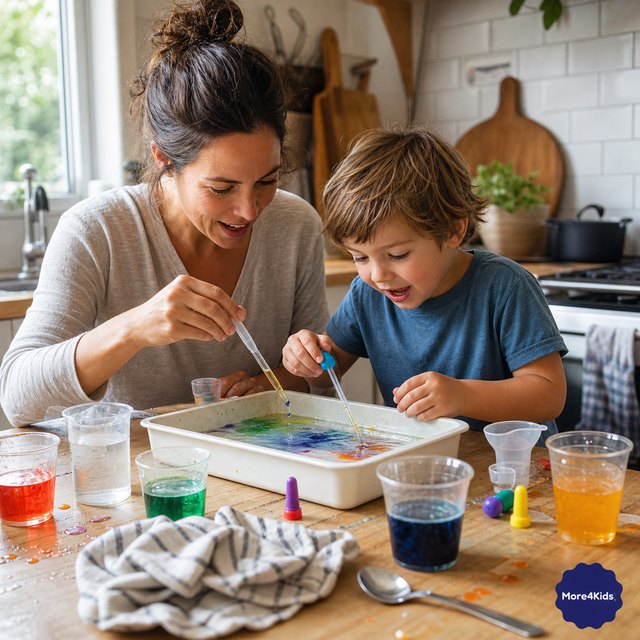
You’ll need: three or more clear cups, water, food coloring (red, yellow, blue), and paper towels folded into strips.
What to do: Fill every other cup with water and add a different color to each. Leave the cups between them empty. Drape a folded paper-towel strip from each full cup into the empty one beside it, like little bridges. Then wait. Over the next hour, the colored water “walks” up and over the paper towels and drips into the empty cups, where the colors blend — blue and yellow meeting to make green, right before your child’s eyes.
The science here is capillary action, the same way plants drink water up through their stems. It’s slow, which is part of the gift. Checking back every fifteen minutes teaches observation and patience, and the color-mixing reveal feels like a small miracle. These are the science activities that turn an ordinary, restless afternoon into something memorable — and they prove how doable easy science experiments for kids really are.
Sink or Float: Science Hiding in the Bathtub
You don’t even need a special setup for this one — bath time or a basin on the porch works beautifully. It’s perfect for toddlers and preschoolers because it’s so hands-on and forgiving.
You’ll need: a tub or bowl of water and a collection of small, safe household objects — a cork, a spoon, a crayon, a plastic toy, an apple, a coin.
What to do: Hold up each object and ask the magic question before you drop it in: “Do you think this will sink or float?” Let your child commit to a guess, then test it. Some answers will surprise you both — an apple floats, which feels wrong until you talk about it.
That prediction-then-test rhythm is the heart of scientific thinking, and it costs nothing. You can sort objects into “sinkers” and “floaters” afterward, which sneaks in a little math too. Folding short bursts of science into the parts of the day you’re already doing — like bath time — fits naturally into a simple daily routine without adding one more thing to your plate.
Grow a Bean in a Jar
For a child learning patience and the wonder of living things, nothing beats watching a seed wake up. This is real biology, stretched gently over days.
You’ll need: a clear jar or zip bag, a paper towel, water, and a few dried beans (the kind from the soup aisle work perfectly).
What to do: Dampen the paper towel and press it against the inside of the jar. Tuck a couple of beans between the towel and the glass so you can see them. Keep the towel moist, set the jar in a sunny window, and watch. Over several days, roots unfurl downward and a pale shoot reaches up — visible proof that something is alive and growing.
Caring for it teaches responsibility and observation, and the slow daily change rewards a child’s attention in a way screens never will. Talk about what plants need — water, light, time — and you’ve planted a little botany lesson along with the bean.
Making It Stick: Talking Like a Scientist
The real magic in any of these experiments isn’t the fizz or the sprout. It’s the conversation around it. A few small habits turn a fun activity into genuine learning:
- Predict first. Always ask “What do you think will happen?” before the action. That single question transforms your child from a spectator into an investigator.
- Observe out loud. Narrate what you both notice — “Look how fast it’s bubbling now,” “The green is getting darker.” You’re modeling careful observation and building vocabulary.
- Wonder, don’t lecture. When they ask why, it’s fine to say, “I’m not sure — what do you think?” You don’t need every answer. Curiosity is more contagious than facts.
- Let them lead the repeat. If they want to do it again with more vinegar or a different color, say yes. That’s them designing their own experiment.
Keep it light and pressure-free. Ten minutes of delighted fizzing beats an hour of forced “learning” every time, and play-based discovery like this is exactly what young children thrive on, as the American Academy of Pediatrics reminds us.
A Quick Word on Safety
Most of these use food-safe pantry items, but a little common sense keeps the fun fun. Stay close and supervise, especially with the smallest kids who put everything in their mouths. Skip anything involving heat, sharp tools, or harsh chemicals for young children — the science experiments at home worth doing at this age are the gentle, messy, edible-ingredient kind. And cover your surfaces; a towel or tray under the action saves a lot of cleanup grief.
Frequently Asked Questions
What age can kids start doing science experiments?
Toddlers can join in with simple, supervised activities like sink-or-float in the bathtub, while preschoolers and older kids can handle reactions like the baking soda volcano. Match the experiment to your child’s age and always stay close to supervise the younger ones.
Do I need to buy a science kit for these experiments?
Not at all. Every experiment here uses everyday household items like baking soda, vinegar, food coloring, paper towels, and dried beans. The learning comes from predicting, observing, and wondering together, not from anything you purchase.
How do I explain the science without overcomplicating it?
Keep it simple and lead with questions rather than lectures. Ask what your child thinks will happen, narrate what you both notice, and when they ask why, it’s perfectly fine to wonder aloud together instead of giving a textbook answer.
What if the experiment doesn't work the way it's supposed to?
A “failed” experiment is a wonderful teaching moment, not a problem. Talk about what happened and why it might have turned out differently, then try changing one thing and testing again — that troubleshooting is real scientific thinking in action.
How long should a science activity last with young kids?
Follow your child’s interest rather than the clock. Some experiments hold attention for twenty minutes, others for five, and either is fine. Stop while they’re still enjoying it, and you’ll have a child eager to do science again tomorrow.
A Gentle Place to Start
If a kitchen full of fizzing volcanoes sounds overwhelming, please don’t let it. You don’t have to do all of these, and you certainly don’t have to do them perfectly. Pick the one that sounds the most fun to you and try it this week — your enthusiasm is the secret ingredient.
Raising a curious kid isn’t about cramming facts. It’s about protecting that spark of wonder and feeding it now and then with a jar, a question, and a willingness to make a happy mess. Some days the experiment will flop and the cleanup will be real, and that’s all part of it. For more hands-on ideas to grow alongside your family, browse our math, science, and tech section and everything else we share at More4Kids. Now go find some baking soda — there’s a small explosion of joy waiting to happen.
Related Articles

Meet Sophia Richards Sophia Richards is an early childhood educator, passionate writer, and the proud mom of three energetic kids. With a degree in Education and over a decade of hands-on classroom experience, Sophia bridges the gap between professional teaching strategies and everyday family life. At More4Kids, she translates complex child development concepts into practical, actionable parenting tips that families can use at home.
Whether she is sharing positive reinforcement techniques, educational crafts, or honest reflections on the chaos of raising three children under one roof, Sophia’s goal is to empower parents to foster resilience and joy in their kids. When she isn't writing or lesson planning, you can find her organizing neighborhood scavenger hunts or trying out new kid-friendly recipes.
Areas of Expertise: Early Childhood Education, Positive Parenting, Sibling Dynamics, Educational Play, Family Wellness.
Latest posts by Sophia Richards (see all)
- Chores and Allowance: Should Kids Get Paid for Helping? - September 20
- Nightmares vs. Night Terrors in Kids: How to Help Them Feel Safe - September 19
- Experience Gifts for Kids: What Actually Works by Age This Christmas - September 18
About the author

Sophia Richards
Meet Sophia Richards Sophia Richards is an early childhood educator, passionate writer, and the proud mom of three energetic kids. With a degree in Education and over a decade of hands-on classroom experience, Sophia bridges the gap between professional teaching strategies and everyday family life. At More4Kids, she translates complex child development concepts into practical, actionable parenting tips that families can use at home.
Whether she is sharing positive reinforcement techniques, educational crafts, or honest reflections on the chaos of raising three children under one roof, Sophia’s goal is to empower parents to foster resilience and joy in their kids. When she isn't writing or lesson planning, you can find her organizing neighborhood scavenger hunts or trying out new kid-friendly recipes.
Areas of Expertise: Early Childhood Education, Positive Parenting, Sibling Dynamics, Educational Play, Family Wellness.




Add Comment