















By Sophia Richards
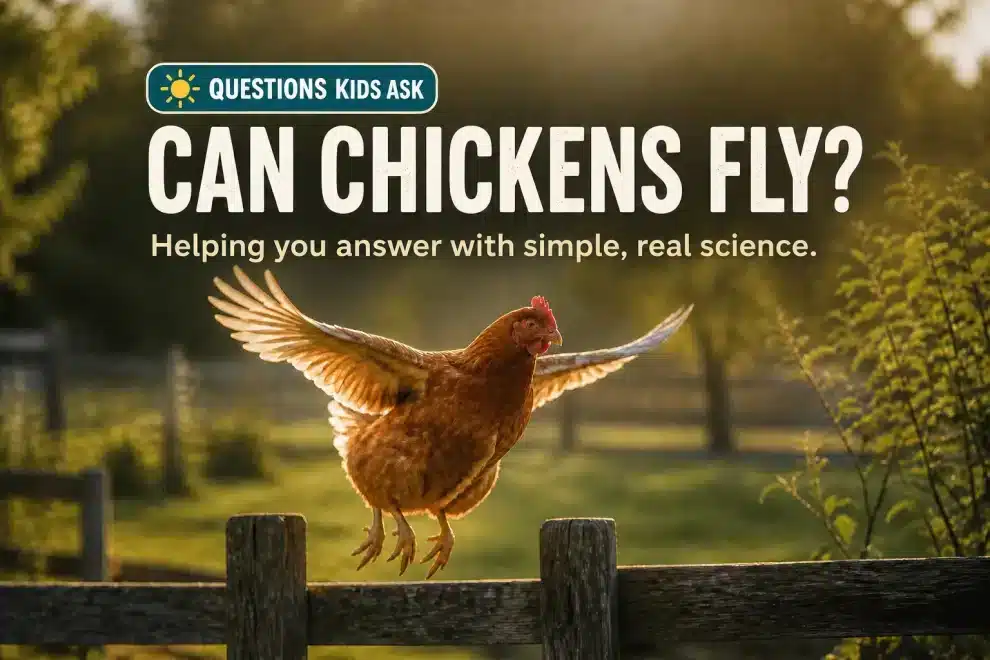
Yes, chickens can fly—but most can manage only short, low bursts. A chicken may flap onto a fence, reach a roost, cross a yard, or escape something that startled it. Its wings can create lift, but a modern chicken’s relatively heavy body and small wings make long, soaring flights impractical.

Fact verdict: Yes, for short flights. Chickens are not flightless birds like penguins or ostriches. They have working flight feathers, wing muscles, and the basic equipment for powered flight. What they usually lack is the body-and-wing combination needed to stay airborne for long.
How to explain it to a child: “A chicken can fly a little, like making a big jump with wing power. Its wings can lift it over a low obstacle or up to a perch, but they are too small for its body to keep it in the sky for very long.”
That quick answer usually settles the first question. Then comes the much more interesting one: if chickens have wings and feathers, why do their flights end so quickly?
Can Chickens Fly Like Other Birds?
Not quite. “Can fly” covers a huge range of abilities. An albatross can glide over the ocean, a hummingbird can hover, and a chicken is built for a sudden burst of movement close to the ground.
The Smithsonian’s National Air and Space Museum gives the clearest explanation: modern chickens have small wings compared with their bodies, so they cannot create enough lift to overcome their weight for very long. That does not make the first flap fake. It makes chicken flight brief.
Think of it as the difference between sprinting and running a marathon. A sprinter really is running, even if the effort lasts only seconds. A chicken really is flying when its wings lift and propel its body, even if the trip ends at a nearby fence post.
| Bird movement | What it looks like | What the body must do | |—|—|—| | Chicken’s burst flight | Quick takeoff, fast flapping, short landing | Produce a lot of lift quickly | | Soaring | Long stretches with little flapping | Use broad air currents efficiently | | Hovering | Stay nearly still in the air | Beat and rotate wings with remarkable speed and control | | Gliding | Move forward while slowly losing height | Use wing shape and speed to stretch a descent |
This is why a hen fluttering to a roost belongs in the “flight” column, even though nobody will mistake her for a migrating goose.
1. A Chicken’s Wings Work—But They Are Relatively Small
Chicken wings have feathers arranged to push against the air. When the wings sweep down, they help create both lift, which counters weight, and thrust, which moves the bird forward. The chicken’s chest muscles power those wingbeats.
The catch is proportion. The amount of wing area available to support a bird’s mass matters. Scientists call this relationship wing loading. You do not need the equation to understand the idea: supporting a heavier body with relatively small wings requires more effort and speed.
Modern chickens vary greatly in size because people have selected different breeds for eggs, meat, appearance, or other traits over many generations. The Cooperative Extension poultry program notes that today’s breeds range widely in shape and weight. A lightweight chicken and a heavy meat breed therefore should not be expected to have identical flight ability.
There is another helpful way to picture wing loading. Imagine holding two umbrellas of the same size on a windy day. If one umbrella had to support a much heavier load, the wind would need to push much harder for the same result. A wing is vastly more sophisticated than an umbrella—it moves, bends, twists, and changes angle—but the comparison makes the size-and-weight problem easier to see.
Wing loading does not act alone. A bird also needs enough muscle power, the right feather condition, and enough forward speed for the wing to work well. That is why the best answer to “Can chickens fly?” is about a whole system rather than one body part.
2. Short Wings Favor a Fast Getaway, Not a Long Trip
Wing shape matters as much as whether wings are present. Stanford’s bird-flight overview explains that many game birds have relatively short, low-aspect-ratio wings suited to rapid takeoff and agile movement rather than sustained high-speed flight.
That design fits the kind of trip a chicken is likely to attempt: launch quickly, clear an obstacle, and land. It is useful near the ground, where a bird might need to reach a perch or respond to a sudden threat. It is not the long, narrow-winged design associated with hours of efficient gliding.
In other words, chicken wings are not useless airplane wings. They are more like emergency boosters.
### Four forces in one tiny flight
Every chicken flight is a tug-of-war among four familiar flight forces:
- Weight pulls the chicken toward the ground.
- Lift is the upward force created as the moving wings interact with air.
- Thrust moves the bird forward.
- Drag resists that forward movement.
During takeoff, the chicken must produce enough upward and forward force to overcome weight and drag. The legs help with the launch, and the wings continue the job. During landing, the bird changes its wing angle, spreads its feathers, lowers its feet, and lets drag help reduce speed.
That is a lot of coordinated work for a trip that may last only a moment. It also shows why “flying” and “soaring” are not synonyms. The hen is controlling all four forces even though she will not remain aloft for long.

3. Powerful Flapping Uses Energy Quickly
A short chicken flight looks busy because it is. The bird must accelerate, beat its wings hard, manage its body angle, and prepare to land within a very short span. There is little of the calm, energy-saving glide we associate with hawks circling overhead.
Rapid effort works for a burst, but it becomes expensive to maintain. Once the chicken reaches the fence, branch, or roost it was aiming for, landing is the sensible next move.
Watch a slow-motion video of a chicken taking off and you can break the blur into stages. The bird crouches, pushes with its legs, opens its wings, and begins strong downstrokes. Its body rises and moves forward. Near the destination, the feet extend and the wings help control the approach. Even a clumsy-looking landing requires timing.
That leg push matters. A chicken is not asking its wings to lift a motionless body from the ground with no help. The jump gives the flight a useful start, much as a running leap changes what a person can clear. From an elevated perch, gravity can also help a chicken trade height for forward movement during a controlled descent.
This also explains why “How far can a chicken fly?” has no tidy answer. Chicken flight depends on the individual bird, breed, body condition, starting height, wind, motivation, and the place it is trying to reach. A single distance repeated online would sound wonderfully definite and still be a poor rule for every chicken.
4. Breed and Body Size Change the Answer
Some chickens are much more willing and able to leave the ground than others. Cooperative Extension describes lightweight commercial egg-laying breeds as tending to be “flighty,” while modern chicken breeds can differ dramatically in mature weight.
That gives us a useful, cautious pattern:
- A lighter, active chicken generally has less body mass for its wings to lift.
- A heavier chicken generally asks the same basic wing plan to support more weight.
- Age, feather condition, health, and individual behavior can change what a particular bird does.
These are tendencies, not promises. Two chickens of the same breed can still behave differently. The scientifically honest answer is not “this breed always flies” or “that breed never flies.” It is that proportions and condition help set the limits, while the individual bird decides whether to test them.
### How domestication changed the range of chicken bodies
All modern chicken breeds descend from red junglefowl, according to Cooperative Extension. Over many generations, people selected chickens for very different purposes. Some lines became efficient egg layers. Others became larger meat birds. Still others were selected for appearance or life in small flocks.
That history matters because selection can change body mass much faster than it changes the basic fact that the animal still has wings. Cooperative Extension gives a striking comparison: red junglefowl are much lighter than modern breeds developed for meat production. We do not need to claim that domestication “switched flight off.” The more accurate point is that it produced a wide range of bodies, and those bodies do not all carry the same wing-to-weight balance.
This is one more reason to be suspicious of a simple internet record offered as the answer for every chicken. “Can chickens fly?” is a species-level question. “How well can this chicken fly?” is an individual one.
5. Chickens Usually Fly for a Reason
Most chickens do not spend the afternoon taking recreational laps around the neighborhood. A brief flight usually solves an immediate problem. It may help a bird:
- reach a roost or raised platform;
- clear a low fence or gate;
- move away from something startling;
- get from a higher place to a lower one with a controlled descent;
- follow other birds toward a desirable spot.
This is one reason the question “Why don’t chickens fly away?” can be misleading. Many chickens can leave the ground. They simply have little reason—and limited physical ability—to turn that launch into a long journey.
### Feathers have to be in working order
Flight feathers are not decorative fringe. Their overlapping surfaces help the wing push air while still allowing the feathered tip to flex and separate. A bird also uses its tail as part of the steering-and-braking system.
Feather condition can therefore change chicken flight. A growing young bird, a bird replacing feathers during a molt, or a bird with damaged wing feathers will not interact with the air in exactly the same way as an adult with a complete, healthy set. That does not give us a perfect prediction, but it reminds us that flight ability changes over time.
This article does not recommend clipping wings. That is an animal-care decision with welfare and safety tradeoffs, and families who keep chickens should get guidance specific to their birds and enclosure from a qualified poultry professional or local Cooperative Extension office.
How Scientists Know Chickens Can Fly
The first evidence is direct observation: a chicken can beat its wings, leave the ground, travel through the air, and land elsewhere. That meets the ordinary meaning of powered flight.
The deeper explanation comes from anatomy and physics. Researchers can compare body mass with wing area, examine flight feathers and chest muscles, study wing shape, and observe how different birds take off and maneuver. The Smithsonian’s explanation connects a chicken’s small relative wing size with the challenge of producing enough lift. Stanford’s work on bird wing shapes explains why short, low-aspect-ratio wings favor quick takeoff over sustained flight.
Science also improves the answer by keeping observation separate from inference. We can observe a hen clearing a fence. We can measure her body and wing. We can use established flight physics to explain why the movement is possible and why it is hard to sustain. What we should not do is turn one impressive hen into a universal rule for millions of birds.
Put those pieces together and the apparent contradiction disappears: a chicken has functional flight equipment, but that equipment is optimized for a burst rather than endurance.
Myth Check: Chickens Are Not Completely Flightless
Calling chickens “flightless” is convenient, but it is not accurate for most healthy chickens. A truly flightless bird cannot perform powered flight. Chickens commonly can.
The opposite claim—“chickens can fly just like any other bird”—is also too broad. Birds are astonishingly diverse. Being capable of flight does not mean being equally capable of hovering, soaring, migrating, or staying aloft.
The better answer is delightfully specific: chickens are short-distance fliers. They can use their wings to get somewhere nearby, and then gravity wins the rematch.
Free Can Chickens Fly? Infographic
Want the answer in one page? This free family science printable brings together the short version, the four forces of flight, and a simple “tell a kid” explanation. Save it for your next chicken question, use it alongside the activity below, or print a copy for your science notebook.

Download the free full-resolution Can Chickens Fly? science infographic
Try This 5-Minute Wing-Loading Activity
No live chicken is required. You need two sheets of paper and two small coins.
1. Leave one sheet flat. Crumple the other into a compact ball. 2. Place one coin in the center of each sheet and gently lift the paper shapes through the air with your hands. 3. Ask your child which shape gives the air more surface to push against. 4. Remove the coins and compare again.
The model is not a chicken and does not reproduce real wing motion, so call it a thinking activity rather than an experiment that “proves” chicken flight. Its job is to make one relationship visible: area and weight both affect how an object interacts with air.
Ask two follow-up questions: “What changed when we added weight?” and “What changed when we altered the paper’s shape?” Those questions point toward wing loading and wing shape without pretending the paper has feathers, muscles, or a nervous system.
If your child wants to keep going, draw three imaginary birds with the same body but different wings: tiny rounded wings, broad rounded wings, and long narrow wings. Predict which bird might launch quickly and which might glide longer. Then compare the drawings with photographs of a chicken, hawk, hummingbird, and albatross. The goal is not to memorize categories. It is to notice that the word wing describes many different tools.
For more screen-free investigations, try one of these easy science experiments for kids or browse our Math, Science & Tech learning guides. Protecting room for curiosity and free play often leads to the best follow-up questions.
Frequently Asked Questions
How high can chickens fly?
There is no single reliable height for every chicken. A lightweight, active bird may clear obstacles that a heavier bird would not attempt. Breed, age, feather condition, motivation, and the starting point all matter, so an exact universal number would be misleading.
Can chickens fly over a fence?
Some can, especially when the fence is low or gives them an obvious landing place. A chicken may combine a jump with strong wingbeats to clear an obstacle. A fence that contains one breed or individual may not contain another.
Why can chickens fly only short distances?
Most modern chickens have relatively small wings for their body mass. Their wings can produce enough lift for a quick burst, but staying airborne requires more sustained lift and energy than their proportions support efficiently.
Can baby chickens fly?
Newly hatched chicks do not have the fully developed flight feathers or body control of an adult. As young chickens grow and feather out, they begin flapping, hopping, and making short wing-assisted movements before they can manage stronger flights.
Are chickens flightless birds?
No. Most healthy chickens can perform short powered flights, so they are not completely flightless. They are simply poor long-distance fliers compared with birds whose bodies and wings are adapted for sustained flight.
The Short Answer Worth Remembering
Can chickens fly? Yes—just not for very long. Their wings and muscles can lift them into the air, but their body size and wing shape make burst flight far more practical than soaring. The next time a child asks, “Why have wings if you can’t fly?” you have a better answer: those wings work beautifully for the small jobs a chicken actually needs them to do.
Related Articles

Meet Sophia Richards Sophia Richards is an early childhood educator, passionate writer, and the proud mom of three energetic kids. With a degree in Education and over a decade of hands-on classroom experience, Sophia bridges the gap between professional teaching strategies and everyday family life. At More4Kids, she translates complex child development concepts into practical, actionable parenting tips that families can use at home.
Whether she is sharing positive reinforcement techniques, educational crafts, or honest reflections on the chaos of raising three children under one roof, Sophia’s goal is to empower parents to foster resilience and joy in their kids. When she isn't writing or lesson planning, you can find her organizing neighborhood scavenger hunts or trying out new kid-friendly recipes.
Areas of Expertise: Early Childhood Education, Positive Parenting, Sibling Dynamics, Educational Play, Family Wellness.
Latest posts by Sophia Richards (see all)
About the author

Sophia Richards
Meet Sophia Richards Sophia Richards is an early childhood educator, passionate writer, and the proud mom of three energetic kids. With a degree in Education and over a decade of hands-on classroom experience, Sophia bridges the gap between professional teaching strategies and everyday family life. At More4Kids, she translates complex child development concepts into practical, actionable parenting tips that families can use at home.
Whether she is sharing positive reinforcement techniques, educational crafts, or honest reflections on the chaos of raising three children under one roof, Sophia’s goal is to empower parents to foster resilience and joy in their kids. When she isn't writing or lesson planning, you can find her organizing neighborhood scavenger hunts or trying out new kid-friendly recipes.
Areas of Expertise: Early Childhood Education, Positive Parenting, Sibling Dynamics, Educational Play, Family Wellness.




Add Comment