











By Sophia Richards
There is a very specific kind of quiet that fills a house right after you have yelled. Your child’s face crumples or goes blank, the room feels too big, and you are already replaying it, wishing you could pull the words back out of the air. If you know that feeling, I want you to hear this before anything else: you are not a bad parent. You are a tired human who lost your footing for a second, and that is a thing you can work on.

I am a mom of three and a former early-childhood educator, and I have done my share of yelling. In my house I have snapped over spilled cereal that was not really about the cereal. I have raised my voice to get shoes on faster and watched it slow everything down instead. Funny enough, I was calmer in the classroom with twenty other people’s children than I sometimes am at home with my own, which taught me something about how depletion and love-under-pressure collide. So when I talk about how to stop yelling at your kids, I am not preaching from some serene mountaintop. I am right here in the trenches with you, and I have found a handful of things that genuinely help.
Let me say one more thing up front, because guilt keeps a lot of us stuck. Yelling is a habit, not a character flaw. Habits can be understood, interrupted, and slowly rewired. That reframing is what finally moved me from beating myself up to actually changing.
Why Yelling Backfires, Even When It Seems to Work
Table of Contents
In the moment, yelling can look effective. The kids scatter, the noise stops, the shoes go on. But the win is short, and the cost is quiet and cumulative. The Child Mind Institute puts it plainly in its guide Calm Voices, Calmer Kids: when you yell often, it loses its impact, and the volume itself can overwhelm whatever you were actually trying to say, so kids miss the message entirely. Over time it wears on a child’s self-esteem and can leave them feeling like you do not much like them, which is the opposite of everything we mean.
There is a physical piece too. Cleveland Clinic pediatrician Dr. Kimberly Churbock describes kids as little sponges who absorb our body language and verbal cues, so when we are upset or anxious, they pick up on it and often get confused, scared, or dysregulated right along with us. Yelling does not calm a storm. It usually feeds it.
None of this is meant to pile on. It is meant to take the pressure off, because once I understood that yelling was working against me, I stopped white-knuckling my way through it and started changing the setup instead.
How to Stop Yelling at Your Kids Starts With Calming Yourself
Here is the part nobody loves hearing: the fastest route to a calmer child is a calmer you. Children borrow our steadiness to manage their own big feelings. When we are the calm one, we hand them something to co-regulate against; when we blow up, they have nothing solid to lean on.
So the first move is not a clever script for your kid. It is a pause for yourself. Take a breath and count to ten. Unclench your jaw. If it is safe to, step out of the room for sixty seconds and let your own nervous system come down a notch. That tiny gap between feeling the surge and opening your mouth is where the whole thing turns.
It also helps to take a step back and remember that your child’s meltdown is usually not about you. When I remind myself that my kid is melting down because he is exhausted or starving and not because he is out to ruin my evening, the anger loses most of its fuel. The behavior is information, not an attack.
Learn Your Own Triggers Before They Find You
Most yelling is not random. It clusters around the same few flashpoints: the morning rush, the dinner-to-bath handoff, the witching hour before bed. Once I mapped mine, I could see them coming instead of getting ambushed.
The Child Mind Institute’s advice here changed my mornings: pinpoint the problems you and your child fight about over and over, then solve them in advance instead of in the heat of the moment. We started laying clothes out the night before and packing bags at dinner, and suddenly the 7:45 scramble had far less to catch fire over. A predictable routine does a surprising amount of the emotional labor for you.
Watch your own gauge, too. I yell far more easily when I am hungry, over-caffeinated, or running on five hours of sleep. Naming my own low-battery moments out loud (“I’m getting snappy, I need a snack and a minute”) models something powerful for the kids and buys me a beat before I lose it.

What to Actually Do in the Hot Moment
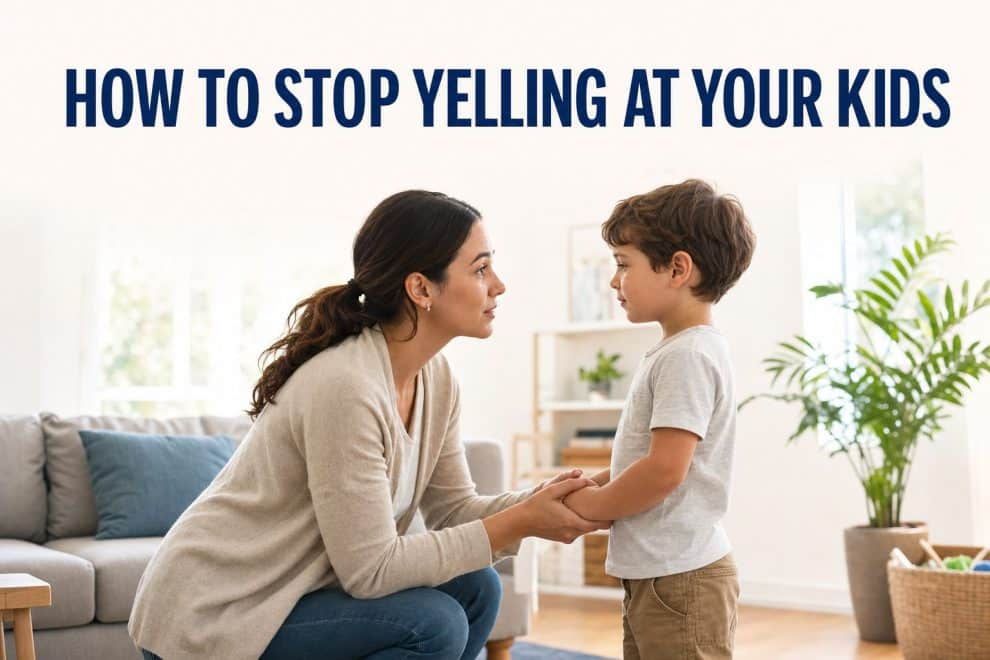
When the surge hits and you feel the yell rising, try trading volume for closeness. Instead of shouting across the house, walk over, get down to your child’s eye level, and lower your voice almost to a whisper. Kids lean in for a whisper the way they never lean in for a bellow. It feels counterintuitive and it works.
Keep your ask small and clear. Younger kids do best with simple, one-step directions and plenty of praise, not a paragraph of demands delivered at top volume. “Shoes on, please” lands. “Why is it that every single morning I have to ask you nine times to do the one thing” does not, and it winds us both up.
And if your default when you are angry has been a swat or a harsh punishment, know there are calmer, more effective tools. Our roundup of gentle alternatives to spanking walks through positive-discipline moves that teach the lesson without the fear. Cleveland Clinic’s Dr. Churbock makes the same point: positive reinforcement and praise of the behavior you want tends to work far better than negative, disciplinary communication.
Repair Quickly When You Slip, Because You Will
You are going to yell again. I still do. The goal is not a spotless record; it is a shorter distance between the mistake and the repair. What kids remember is not that you never lost it. It is that you came back.

As a parent, I have learned that repair sounds like getting down on their level and saying, “I was frustrated and I raised my voice, and that wasn’t okay. I’m sorry. Let’s try that again.” You are not undermining your authority by apologizing. You are teaching your child, in real time, that big feelings do not have to break a relationship, and that everyone owns their part. The words we choose with our kids carry enormous weight, and “I’m sorry, I love you, let’s start over” may be some of the most important ones they ever hear from us.

Repair also protects them from the story that they caused your anger. A calm, “That was my job to handle better,” keeps the blame off small shoulders where it never belonged.
Fill Your Own Cup So It Stops Overflowing at Them
Here is a truth I resisted for years: you cannot pour calm from an empty tank. So much of my yelling was really overflow from being depleted, touched out, and running on fumes. The kids were rarely the actual problem; they were just the nearest target for a stress that had built up all day.
Guarding a little time for yourself is not indulgent, it is maintenance. Even twenty quiet minutes can reset your fuse. I wrote a whole piece on why protecting a bit of mom time is one of the most practical anti-yelling tools there is, because a rested, refilled parent simply has more room before the boil. If your evenings feel like a powder keg, it is worth asking whether you are running too empty to stay steady.
Watch the overstimulation load, too, for the whole family. Noise, screens, and sensory overwhelm shorten everyone’s fuse. A calmer home rhythm, including a sane approach to screen time, leaves more margin for patience when the hard moments come.
Mind the Little Digs, Not Just the Big Blowups
Yelling is the loud version, but the quiet jabs count too. Sarcasm, name-calling under our breath, the muttered “what is wrong with you” all land harder than we think. If you want a gut-check on the phrases that slip out when we are frustrated, our list of things worth never saying in front of your child is a humbling, useful read.
The aim is not to become a robot who never shows a feeling. Kids need to see us have emotions and handle them honestly. The aim is to make our home a place where anger gets expressed without aiming to wound, and where “I’m mad right now” never turns into “you are the problem.”
Give It Time, and Give Yourself Grace
Changing a deeply grooved habit is slow, uneven work. You will have a gorgeous, gentle week and then a Tuesday where it all falls apart, and that does not erase the progress. Steadiness is built one recovered moment at a time. Healthy discipline, as the American Academy of Pediatrics reminds parents in its guidance on disciplining your child, is about patient teaching over the long haul, not winning any single standoff.
Figuring out how to stop yelling at your kids is really about learning to catch yourself a half-second sooner, again and again, until calmer becomes the groove instead of the exception. Be as gentle with yourself as you are trying to be with them. You are not failing. You are practicing, right alongside your kids, and that is exactly the model they need to see.
Frequently Asked Questions
Why do I keep yelling at my kids even though I hate it?
Yelling is usually a stress-overflow habit, not a sign you love your kids any less. It tends to fire when you are depleted, rushed, or caught at a predictable flashpoint like the morning scramble. Because it briefly “works,” the habit gets reinforced. Understanding your own triggers and lowering your daily stress load is what actually loosens its grip, not sheer willpower in the moment.
Does yelling at kids cause long-term harm?
Occasional raised voices in an otherwise warm, secure home are not the same as constant harsh yelling. That said, frequent yelling wears on a child’s self-esteem, loses its effectiveness over time, and can leave kids feeling anxious or disconnected. The reassuring part is that repair matters enormously, so a genuine apology and a warm reconnection go a long way toward protecting the relationship.
How do I stop yelling in the heat of the moment?
Put a tiny gap between the surge and your mouth. Take a breath and count to ten, unclench your jaw, and if it is safe, step out of the room for a minute. Then trade volume for closeness: walk over, get to eye level, and lower your voice to almost a whisper with one short, clear request. That physical reset does more than any perfect phrase.
Is it bad to apologize to my child after I yell?
Not at all, it is one of the best things you can do. Apologizing does not weaken your authority; it teaches your child that big feelings do not have to damage a relationship and that everyone owns their part. A simple “I raised my voice and I’m sorry, let’s try again” also keeps your child from believing they caused your anger.
What should I do instead of yelling to get my kids to listen?
Solve recurring battles before they start with routines and prep, keep directions short and specific, and lean on praise and positive reinforcement for the behavior you want. In the moment, get close and quiet rather than loud. Pediatricians note that positive, calm strategies get kids to cooperate far more reliably than yelling, bribing, or threats.
Related Articles
- Parenting And Spanking
- The Power Of Words
- Mommy Time Why It Is So Important
- How Much Screen Time For Kids
- 7 Parenting Phrases To Avoid

Meet Sophia Richards Sophia Richards is an early childhood educator, passionate writer, and the proud mom of three energetic kids. With a degree in Education and over a decade of hands-on classroom experience, Sophia bridges the gap between professional teaching strategies and everyday family life. At More4Kids, she translates complex child development concepts into practical, actionable parenting tips that families can use at home.
Whether she is sharing positive reinforcement techniques, educational crafts, or honest reflections on the chaos of raising three children under one roof, Sophia’s goal is to empower parents to foster resilience and joy in their kids. When she isn't writing or lesson planning, you can find her organizing neighborhood scavenger hunts or trying out new kid-friendly recipes.
Areas of Expertise: Early Childhood Education, Positive Parenting, Sibling Dynamics, Educational Play, Family Wellness.

Add Comment