














By Sophia Richards
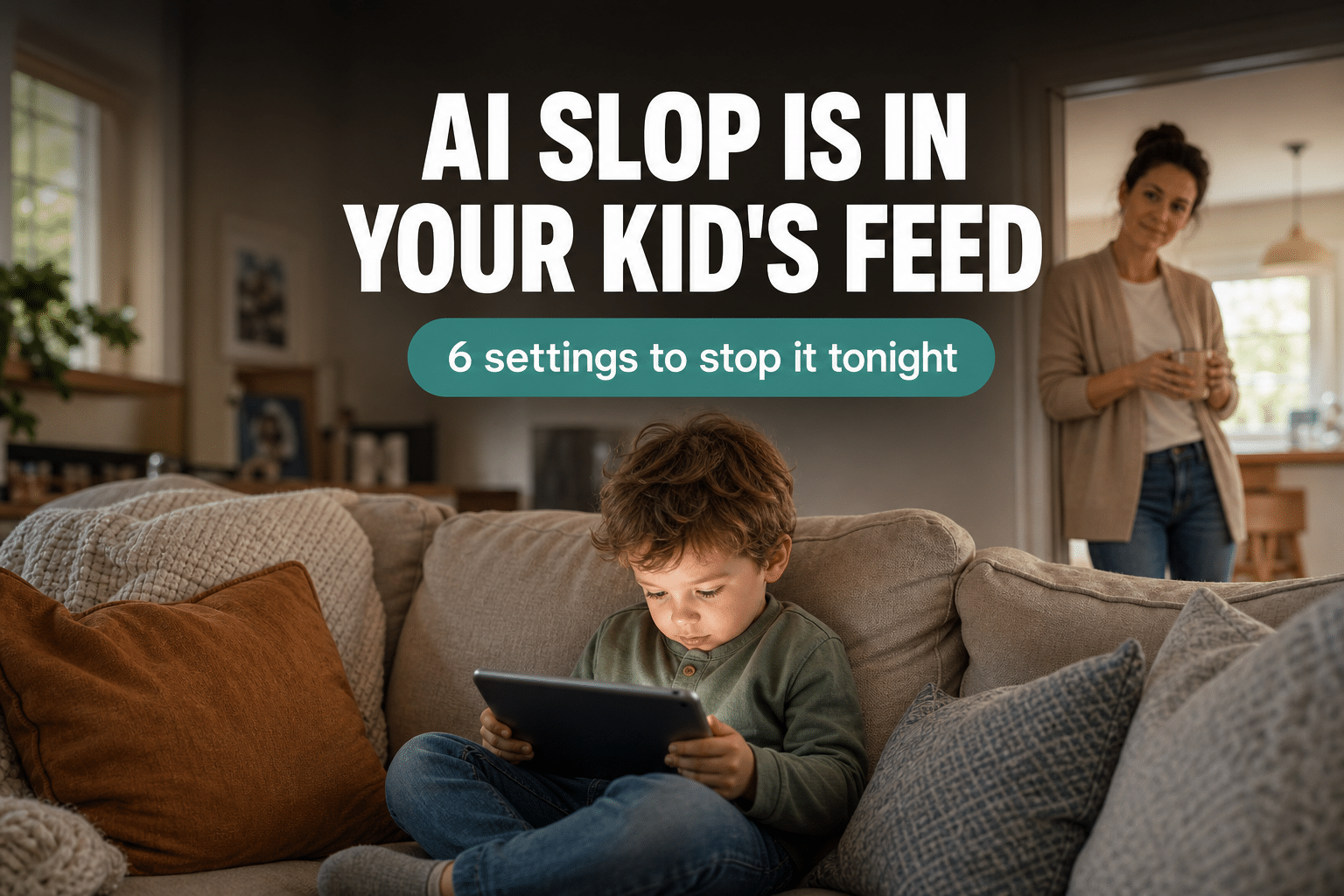
I handed over the tablet on a Tuesday because dinner wasn’t going to cook itself.
Twenty minutes later I looked over and something was off about what my youngest was watching. A rabbit was singing a counting song, which was fine. But the rabbit’s ears changed color halfway through. Then it had four fingers, then five. Then it sang “seven” twice and skipped nine entirely. The video had four million views.
I want to be honest about my first reaction, because I don’t think it was guilt. It was a very specific kind of unease — the sense that nobody had made this. Not badly, not cheaply. Nobody. No animator decided the rabbit was blue. No one checked the counting.
That’s the thing people are now calling AI slop, and if you’ve handed a toddler a screen in the last year, your child has almost certainly watched some.
What “AI slop” actually means
Table of Contents
AI slop is low-quality video generated in bulk by AI tools, published at a volume no human team could match, and aimed at whoever will watch it longest. On kids’ channels it usually looks like a nursery rhyme, a counting song, a color-learning video, or a knockoff of a show your child already loves.
The tell isn’t that it looks cheap. Plenty of these AI-generated cartoons look glossy. The tell is that they don’t hold together. Characters change shape between shots. A story starts and never finishes. The song counts wrong. Words appear on screen misspelled. In the good old days of bad kids’ TV, someone at least intended the thing you were watching. AI-generated videos often have no intention behind them at all beyond keeping a small person’s eyes on the screen.
As an early childhood educator I keep coming back to that word: intention. Everything we hand a young child in a classroom is chosen — this book, this song, this order, for this reason. AI slop is the exact inverse. It’s whatever the algorithm found sticky, generated ten thousand more times.
How much of it is in your child’s feed
More than I expected, and I’d already assumed the answer was “a lot.”
A New York Times investigation published in February 2026 followed what YouTube recommends after a child watches popular preschool programming. After videos from shows like Cocomelon, 40% of the recommended videos that followed contained AI-generated content. Not 40% of YouTube. Forty percent of what comes next, in the exact moment your child is most likely to keep watching.
The Guardian reported in December 2025 that more than 20% of the videos shown to brand-new YouTube users were AI slop — which tells you this isn’t only a kids’ problem, it’s the texture of the platform now.
And the scale underneath it is genuinely hard to hold in your head. The open letter that Fairplay sent to Google and YouTube in April 2026 notes that roughly 85% of children under 12 use YouTube daily, and about three-quarters of families with children under 6 use YouTube or YouTube Kids daily. Four of the five most-watched videos in YouTube’s history, each with billions of views, are aimed at kids and families.
So when AI content floods that particular corner of the internet, it isn’t a niche problem. It’s most of the small children in the country.
Why it’s suddenly everywhere
Follow the money and it stops being mysterious.
The Fairplay letter estimates that the top AI slop kids’ channels have earned over $4.25 million annually. Making a genuine preschool episode takes writers, animators, educational consultants, months. Generating a hundred AI videos takes an afternoon. When the payout is similar and the cost isn’t close, you get exactly what we’ve got.
There’s a wrinkle here I think parents deserve rather than a villain story. In March 2026, Bloomberg reported that Google’s AI Futures Fund invested $1 million in Animaj, an AI animation studio that makes kids’ videos and drew more than 22 billion views to its channels last year. Google also gave the studio early access to unreleased versions of its Veo, Gemini, and Imagen models. Animaj owns children’s brands you may know, like Pocoyo and Maya the Bee.
The obvious read is: the company hosting the slop is funding more of it.
But that’s not quite what the people involved say they’re doing. Animaj’s co-founder told Bloomberg, “Google knows the problem and the issue of AI slop that is happening right now on YouTube” — positioning his studio as the responsible alternative, not another firehose. Google’s fund director called it “a blueprint for the future” of kids’ entertainment. YouTube’s CEO said in January that managing AI slop is a top priority for the company this year.
Fairplay’s response is that it doesn’t matter how good the intentions are — one of its six formal asks is that Google halt investment in AI-generated video made for children, full stop.
I find the honest version more unsettling than the gotcha version, personally. Even the people trying to do this carefully are racing to make more of it. Nobody is slowing down to find out what it does first.
What we actually know about AI slop — and what we don’t
Here’s where I want to be straight with you, because most of what you’ll read about AI slop and kids isn’t.
There is no body of research showing what AI-generated video specifically does to a young child’s brain. It doesn’t exist yet. The content is roughly two years old at this scale, and studies take longer than that.
That’s not me being contrarian. It’s what the advocates themselves say. The Fairplay letter — signed by more than 200 organizations and experts including the American Federation of Teachers, the American Counseling Association, and MIT’s Sherry Turkle — puts it plainly: “there is much we don’t know about the consequences of AI content for children. Regardless, it has proliferated rapidly without any research or regulation.”
Read that twice, because it’s the actual argument. Not “this is proven to harm your child.” Rather: this is an enormous, unstudied experiment, and your preschooler is in the test group.
What we do have is decades of established child development research that doesn’t depend on AI at all. Young children learn through back-and-forth interaction with people who care about them. They need stories that hold together to build a sense of how narrative works. Their attention is a developing system, not a fixed trait, and content engineered to capture it competes with the play, sleep, and conversation that actually build it. Experts who reviewed AI kids’ videos for the New York Times described content that features conflicting information, lacks plot structure, and can be cognitively overwhelming. A Canadian pediatrician interviewed by CBC was blunter, calling AI videos aimed at babies “garbage.”
Pediatric bodies have started saying so formally. In April 2026, the Canadian Paediatric Society’s Centre for Healthy Screen Use published direct guidance: “Children under five years of age should not be exposed to AI toys or video content (often called ‘AI baby slop’). Young children need face-to-face interaction with humans who care about them. It’s how they learn and process the world around them.”
They go further than I expected, recommending that “parents and caregivers should avoid all forms of AI toys or digital content marketed for babies, toddlers and preschoolers,” on the grounds that such content “can only serve to create confusion and overwhelm children’s ability to learn and focus.”
I’ll flag something so you can weigh it yourself: that’s a recommendation, not a research finding. The Society is stating a professional position based on established developmental principles, and the page doesn’t cite AI-specific studies — because, again, they don’t exist yet. I think it’s a reasonable position. I also think you deserve to know which kind of claim it is before you act on it.
Why you can’t just look for a label
This is the part that made me genuinely annoyed, and it’s the most practical thing in this article.
You cannot rely on a label to identify AI content for your child.
YouTube does have an “altered or synthetic content” disclosure. But it’s largely voluntary, narrowly defined, inconsistently applied, and when it does appear it’s buried in the video description where no parent is looking mid-dinner. The Verge reported that YouTube doesn’t require animated AI kids’ videos to be labeled at all.
And on YouTube Kids — the product specifically built for this age group — no such label exists.
So if your plan was “I’ll just avoid the ones marked AI,” there’s nothing to avoid. That’s not a failure of attention on your part. There is no signal to catch.
It’s worth knowing that spotting AI content unaided is genuinely hard, too. Adults are roughly 50/50 at identifying AI-generated content — coin-flip odds. In one study, even linguistics experts got it wrong 62% of the time. If you’ve been squinting at a cartoon wondering whether you’re being paranoid, you’re not bad at this. It’s built to be hard.
6 settings and swaps to change tonight

None of this requires banning screens, and I’m not going to suggest it. Plenty of us hand over a tablet to get dinner made, and that’s a reasonable thing a loving parent does. The goal is narrowing what arrives when you do.
1. Turn off autoplay. This is the highest-value single change. Autoplay is the mechanism — one chosen video becomes a queue nobody chose. In YouTube Kids, open Settings, select your child’s profile, and switch autoplay off. It takes about fifteen seconds and it breaks the pipeline that delivers the slop.
2. Switch to “Approved content only.” Of all the YouTube Kids parental controls, this is the one that actually changes what arrives. It moves your child from algorithmic recommendations to a mode where they can only watch videos and channels you’ve specifically approved. It’s more setup, and it’s the difference between curating a shelf and leaving the door open. For under-fives especially, it’s worth the twenty minutes.
3. Build a short approved-channel list instead of a blocklist. Blocking is whack-a-mole; new channels appear faster than you can report them. Pick six to ten programs you actually trust and let that be the universe. Small and known beats infinite and filtered.
4. Watch the first two minutes with them. Not the whole thing — nobody has that time. The first two minutes is usually enough to catch the tells: characters shifting between shots, a song that counts wrong, text that’s subtly misspelled, a story that never resolves. If you spot one, remove it then, in front of them, and say why in one sentence.
5. Use the “why” out loud, even with little ones. “This one’s mixed up — it counted wrong. Let’s find a better one.” You’re not lecturing; you’re modeling that content is something we evaluate rather than absorb. Three-year-olds understand “mixed up” perfectly well.
6. Swap one screen block a week for something with a person in it. This is the one that matters developmentally, and it’s the least about technology. A picture book, a walk, cooking together, or the neighborhood scavenger hunts I fall back on when my three are climbing the walls. The research consensus isn’t really about screens being uniquely toxic — it’s about what screens displace. One swap a week is a realistic place to start, and it’s the change with the most established evidence behind it.
If you want the wider picture on where screens fit overall, our guide to how much screen time is healthy covers ages and stages in more depth, and screen time and kids gets into the daily negotiation of it. And if you’re building that approved list from scratch, the surprising impact of kids’ cartoons is a useful reminder that the qualities separating a good show from a bad one long predate AI.
You’re not failing at this

I want to end where I started, on that Tuesday with the singing rabbit.
I didn’t catch it because I’m vigilant. I caught it because I happened to look up. There is no version of parenting where you personally review every video before it plays, and any article implying otherwise is selling you something.
What you can do is narrow the funnel, break autoplay, and keep a few things in the rotation that a person actually made. That’s it. That’s the whole job.
The scale of this is not your fault, and it isn’t really fixable at the level of individual families — it needs platforms and regulators to move. But the settings above are genuinely useful in the meantime, and they take one evening. If you want more on raising kids alongside all of this, there’s a whole shelf of it in our parenting section.
Your child watching a badly-counted rabbit song is not a catastrophe. A childhood where most of what they see was made by nobody, for nobody, is a different question — and it’s worth an evening of settings to keep it from becoming the default.

Frequently Asked Questions
What is AI slop?
AI slop is low-quality video or images generated in bulk by artificial intelligence tools and published at high volume to attract views. On children’s channels it usually imitates nursery rhymes, counting songs, or popular shows, but lacks coherent story structure — characters change appearance mid-video, songs count incorrectly, and text is often misspelled.
How much AI slop is in my child's YouTube feed?
A New York Times investigation published in February 2026 found that after watching popular preschool shows like Cocomelon, 40% of the videos YouTube recommended next contained AI-generated content. The Guardian reported in December 2025 that more than 20% of videos shown to new YouTube users were AI slop.
Is AI slop harmful to toddlers?
There is no research yet showing what AI-generated video specifically does to young children — the content is too new, and the advocates raising concerns say so openly. However, the Canadian Paediatric Society recommends that children under five not be exposed to AI video content or AI toys, based on established principles about how young children learn through interaction with people.
Can I tell which videos are AI-generated?
Often not, and that isn’t your fault. Adults identify AI-generated content correctly only about half the time. YouTube’s synthetic-content label is voluntary, narrowly applied, and buried in video descriptions — and it doesn’t exist on YouTube Kids at all. Watching the first two minutes for continuity errors is more reliable than looking for a label.
What is the single most effective setting to change?
Turning off autoplay. Autoplay converts one chosen video into an endless algorithmic queue, and that queue is where most AI slop arrives. Switching YouTube Kids to “Approved content only” is the stronger option if you have time to set it up.
Related Articles

Meet Sophia Richards Sophia Richards is an early childhood educator, passionate writer, and the proud mom of three energetic kids. With a degree in Education and over a decade of hands-on classroom experience, Sophia bridges the gap between professional teaching strategies and everyday family life. At More4Kids, she translates complex child development concepts into practical, actionable parenting tips that families can use at home.
Whether she is sharing positive reinforcement techniques, educational crafts, or honest reflections on the chaos of raising three children under one roof, Sophia’s goal is to empower parents to foster resilience and joy in their kids. When she isn't writing or lesson planning, you can find her organizing neighborhood scavenger hunts or trying out new kid-friendly recipes.
Areas of Expertise: Early Childhood Education, Positive Parenting, Sibling Dynamics, Educational Play, Family Wellness.




Add Comment