








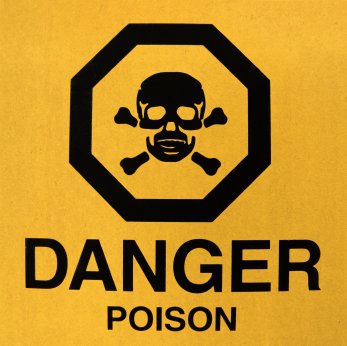
 Unlike in cartoons, children can’t identify poison by the skull and crossbones on the bottle. It would be nice if they could understand signs such as on the picture to the left, but even if there were such a label, a child wouldn’t recognize harmful substances. In truth, parents are often not aware of the prevalence of toxic substances. Preventing children access to every dangerous substance in the home is simple; however, as with defending against other dangers, a degree of diligence is required in the short run. Keeping complacency at bay is necessitated for the long run. Here are some suggestions to keep poisons away from your child, along with some common examples of dangerous household items.
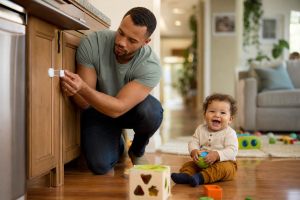
When some parents child-proof a home against falls, electrical shock, choking hazards, burns and other potential problems, they look at things from the child’s point of view. Literally, they get on their hands and knees and look at the world from that physical perspective. Such a great idea! When protecting against poisons, assume the same position. Go through the house, room-by-room, and take inventory of every substance that may be within reach of your crawler, toddler or small child. Search the closets, cabinets, dressers, behind the dressers, under the dressers, on the dressers, in drawers, everywhere you can imagine.
As the inventory is compiled, there will be several substances that may not trigger your “poison detector,” but that may actually be poisonous. It is a good idea to include every non-food substance in your inventory for just that reason. When you have completed a thorough inventory, clearly label each substance that you know to be harmful and put them in a locked, out-of-reach place(s). Locking storage containers can be found at any home goods or large department store, should there be a need for storage space.
For the questionable items, if they are hazardous it is generally clearly noted on the substance’s label. In the event that is not the case, contact the call center of the American Association of Poison Control Centers (AAPCC) at 800-222-1222, or your state’s poison control center. Operators will be able to tell you whether or not the substances are dangerous. These centers can also provide you with information relating to what should be done if a child comes into contact, either by ingesting, inhaling or touching, a hazardous substance.
To aid in identification, here is a listing of some harmful items commonly found in the home, by no means is this a comprehensive list:
Personal Hygiene: baby oil, mouthwash, nail polish, nail polish remover, skin cleansers
Over-the-Counter Medication: ibuprofen, acetaminophen, aspirin, cold medication
Prescription Medicine: antidepressants, heart/high blood pressure medication, cholesterol medication, pain medication
Cleaning Products: bleach, laundry detergent, dish detergent, drain cleaner, bathroom/toilet cleaners, furniture polish, floor wax

Other Chemicals: Alcohol (both antiseptic and liquor), pesticides, lawn fertilizer, antifreeze, paint thinner/remover (such as mineral spirits, for example), gasoline, kerosene, charcoal lighter fluid, windshield washer, car wax
This is certainly not an exhaustive list and it is meant only to provide guidance by way of example. There are many other things ranging from vitamins to certain household plants that can be dangerous to children and adults.
By their inquisitive nature, children learn and grow. That same curiosity can harm or even kill them if parents do not exercise diligence and persistence in providing a safe environment. Nearly a million young children per year are the victims of poisoning. It isn’t too much of a stretch to say that nearly every instance was the result of parental failure.
How should I childproof my home against poisons?
The best starting point is to see your home from your child’s eye level — literally get down on your hands and knees and look at every surface, cabinet, drawer, and floor space your crawler or toddler can reach. Go room by room and inventory every non-food substance you find. Label anything hazardous and store it in a locked, out-of-reach location. Locking storage containers are available at most home goods stores.
What common household items are poisonous to young children?
Many everyday products that seem harmless can be toxic to children. Personal hygiene items such as mouthwash, nail polish remover, and skin cleansers pose risks. Over-the-counter medications including ibuprofen, acetaminophen, and cold medicines are dangerous in small hands. Cleaning products like bleach, drain cleaner, and furniture polish are highly hazardous. Other chemicals to keep locked away include antifreeze, gasoline, pesticides, paint thinner, and charcoal lighter fluid — as well as alcohol, both antiseptic and liquor.
What should I do if my child gets into a poisonous substance?
Call the American Association of Poison Control Centers immediately at 800-222-1222. Trained operators are available around the clock to tell you whether a substance is dangerous and exactly what to do next — whether the child ingested, inhaled, or touched the substance. Do not wait for symptoms to appear before calling. If your child is unconscious or having trouble breathing, call 911 first.
How do I know if a substance I found at home is dangerous to my child?
If a product label says it is hazardous, treat it accordingly. For unlabeled or uncertain items, call the AAPCC at 800-222-1222 — operators can confirm whether a substance is toxic and advise on safe storage. When in doubt, include any non-food substance in your locked storage. It’s far safer to over-secure something harmless than to leave something toxic within a child’s reach.
Biography
Alan Hammond is a law enforcement official, writer and former educator. Shonna Hammond is a nationally certified teacher, writer and consultant. They can be reached in care of this publication or at [email protected].
No part of this article may be copied or reproduced in any form without the express permission of More4Kids Inc © 2007

Alan and Shonna Hammond