













By Sophia Richards
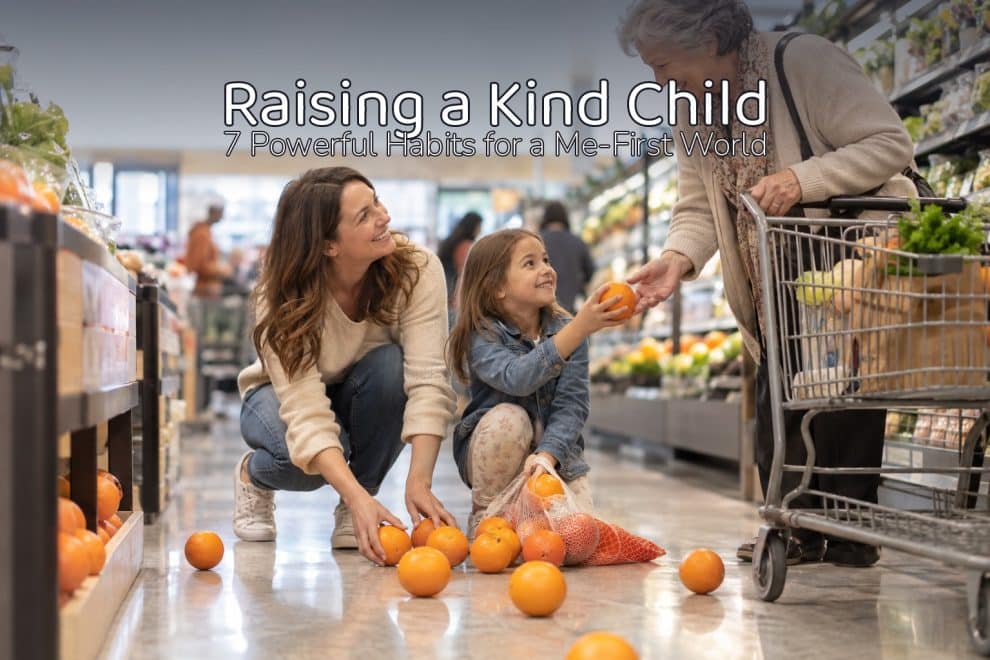
We were three carts deep in the grocery line when it happened. An older woman ahead of us dropped a whole sleeve of oranges — they went bouncing everywhere, under the candy rack, into the next lane — and before I could even react, my middle one, six at the time, was on the floor gathering them up like it was the most obvious thing in the world. “Here you go,” he said, stacking them back in her cart. She teared up. I teared up. And on the drive home, in that quiet glow you get when your kid does something genuinely good, I found myself thinking the thought every parent thinks eventually: how do I make sure that stays? How do I keep raising a kind child in a world that seems to reward the opposite?
Because let’s be honest with each other, parent to parent. It can feel like we’re swimming upstream. Our kids are growing up in a culture of selfies and scoreboards and “look at me,” where being first often looks like it matters more than being good. If you’ve ever watched your child snatch a toy, ignore a crying friend, or roll their eyes at “share with your brother” and quietly worried you were losing the battle — come sit with me. I want to walk you through what I’ve learned, over three kids and a lot of grocery-store moments both proud and mortifying, about raising a kind child on purpose. Not a doormat. Not a performer of niceness for the grownups. A genuinely kind human. Let me show you what kindness really is, why it’s more teachable than you think, and seven warm, doable habits that grow it — the everyday kind that sticks.
Why Kindness Can Feel Rare Right Now (It’s Not Just You)
Table of Contents
First, the reframe that took the pressure off my chest: if it feels like kindness is swimming against the current, that’s not your imagination and it’s not a failure of your parenting. We really are raising kids in what the researchers at UC Berkeley’s Greater Good Science Center bluntly call “the age of the selfie.” In their piece on fostering empathy in kids, they point to the psychologist Michele Borba’s warning that this constant focus on the self “is harmful to our children” — that low empathy is now common enough in the culture to worry about, and it’s tangled up with everything from bullying to anxiety.
Here’s the part that surprised me, though. The same researchers who sound that alarm are wildly hopeful about what parents can do about it, and there’s a good reason for the hope: kindness isn’t a personality you’re either born with or not. It’s a skill. And skills can be taught. Borba’s central point — the one I’ve come back to a hundred times — is that “if we are serious about raising a kindhearted, caring generation, then our expectations must be a lot clearer to our kids.” In other words, the me-first world isn’t destiny. It’s just the water we’re swimming in, and we get to teach our kids to swim. Raising a kind child is not about fighting your child’s nature; it’s about nurturing something that’s already in there.
What Kindness Really Is (and Why It’s a Practiced Skill)
Before we get to the how, let’s get clear on what we’re actually growing, because “be kind” is one of those phrases we say forty times a day and rarely define. Underneath kindness sits empathy — the engine that makes a child want to be kind. ZERO TO THREE, in its guidance on helping children develop empathy, defines it about as clearly as I’ve seen: empathy is “the ability to imagine how someone else is feeling in a particular situation and respond with care.”
Notice that it’s two parts — imagine how someone feels, and then respond with care. Kindness is empathy that gets up off the couch and does something. And both parts develop slowly, on a real biological timeline. ZERO TO THREE points out that it’s not until somewhere between 18 and 24 months that a toddler even develops a “theory of mind” — the dawning realization “that, just as he has his own thoughts, feelings and goals, others have their own thoughts and ideas, and these may be different from his.” So if your two-year-old grabs the truck without a flicker of concern for the wailing toddler beside them, they’re not cruel. Their brain is still installing the very hardware that kindness runs on.
That’s why raising a kind child is a marathon, not a lecture. Harvard’s Making Caring Common project — a research group I trust because they’ve studied this in real families — puts it perfectly in their tips for raising caring kids: “Learning to be grateful and caring is in certain respects like learning to play a sport or an instrument. Daily repetition… make[s] caring and gratitude second nature.” A kind child is grown the way a strong swimmer is grown — not with one big talk, but with ten thousand small reps, most of them ordinary, most of them at home. This is where kindness and a growth mindset meet: your child can get better at this, and telling them so matters.
Raising a Kind Child: 7 Powerful Everyday Habits
None of what follows is a curriculum. Please don’t turn kindness into a worksheet. Think of these seven habits as small shifts in the water your family swims in every day — the way you talk, what you praise, how you handle the not-nice moments. Do them imperfectly. Do them warmly. Do them over years. That’s how kindness sinks in.
1. Model it out loud — they are always studying you
This is the big one, the one everything else rests on, and it’s the most humbling: our kids learn kindness mostly by watching us. ZERO TO THREE says it flatly — “Be a role model. When you have strong, respectful relationships and interact with others in a kind and caring way, your child learns from your example.” Harvard’s team adds a detail that stopped me cold: “Children learn empathy both from watching us and from experiencing our empathy for them.” Meaning the way I treat my child when they’re melting down teaches them, in their bones, how caring people treat someone who’s struggling.
So I started narrating my own kindness on purpose — not to perform, but to make the invisible visible. “That driver let us merge, wasn’t that nice of him?” “Grandma sounded lonely on the phone, let’s call her back.” And the harder one: when I snapped at someone and got it wrong, I let my kids watch me repair it. “I was short with the cashier and that wasn’t kind — I’m going to apologize.” Harvard also names the quieter lesson kids absorb: they notice “if we treat a server in a restaurant or a mail carrier as if they’re invisible.” Your child is watching how you treat the people who can do nothing for you. That’s the real curriculum. Raising a kind child starts with the kindness you think no one sees.
2. Make “kind AND happy” the message they actually hear
Here’s a gut-punch from the Harvard research that changed how I talk: most parents say kindness is a top priority, but our kids are often hearing a different message underneath. When every “How was your day?” is really about grades and goals and did-you-win, children quietly learn what we truly rank first — and it isn’t caring for others.
Making Caring Common suggests a tiny, powerful edit to the thing so many of us say on autopilot. Instead of “The most important thing is that you’re happy,” try: “The most important thing is that you’re kind and that you’re happy.” I said it felt clunky the first few times. It also, over months, rewired the air in our house. Say it with your praise, too — make a genuine fuss when your child shares, includes, or comforts, the same way you’d fuss over a good report card. Greater Good is blunt about the cost of getting this wrong: “even if parents say they value kindness and compassion, if they only praise achievement, they give the wrong impression to their kids.” Our kids believe what we celebrate, not what we say we value. When gratitude is part of the daily message too, it reinforces the same root — here’s our take on teaching kids gratitude.
3. Grow a “moral identity” — help them see themselves as a kind person
This one is subtle and it’s my favorite, because the research on it is genuinely surprising. Greater Good describes a study of three- to six-year-olds where the kids “who were praised for helping others were less likely to act more generously in the future than kids who were praised for being a helpful person.” Read that twice. Praising the deed (“you helped!”) did less than praising the identity (“you’re such a helpful person”). As Borba puts it, “to respond empathically, kids must see themselves as people who care and value others’ thoughts and feelings.”
So I shifted one word. Not “that was a kind thing to do” (though I still say that) but “you’re the kind of kid who notices when someone needs help.” I want my children to carry a picture of themselves as a kind person — because a kid who believes “I’m a helper” behaves like one even when I’m not in the room. This is close cousins with building genuine confidence in a child: a child who knows who they are at their core acts from it. Careful, though — keep it honest and specific, not a hollow “you’re so nice” for everything. Name the real thing they did, then tie it to who they are.
4. Practice kindness like a sport — small daily reps beat big gestures
If kindness is a skill, it needs practice, and practice means routine, not occasional grand gestures. Harvard’s guidance is refreshingly unsentimental here: “Expect children to routinely help… and only praise uncommon acts of kindness. When these kinds of routine actions are simply expected and not rewarded, they’re more likely to become ingrained in every day actions.” In plain mom terms: helping shouldn’t earn a sticker every time, because we don’t want kindness to become a transaction. We want it to become a reflex.
So in our house, chores aren’t punishment and they aren’t for pay — they’re just what members of a family do for each other. Setting the table, carrying in a sibling’s backpack, checking on the little one. These tiny reps are the gym where kindness gets strong. And because a lot of the earliest reps happen between brothers and sisters, don’t waste those daily collisions — the way you coach kids through sibling rivalry is some of the most concentrated kindness training they’ll ever get. The everyday stuff is not too small to matter. The everyday stuff is the matter.
5. Expand the circle — teach them to zoom in AND zoom out
Almost every child is naturally kind to their own little circle — best friend, sibling, grandma. The real growth, Harvard says, is helping a child “learn to have empathy and care about someone outside that circle,” like “a new child in class, someone who doesn’t speak their language, the school custodian, or someone who lives in a distant country.” They describe it as teaching kids to “zoom in” — really see the person right in front of them — and to “zoom out,” taking in people they’d otherwise scroll right past.

I make this concrete with one question at dinner: “Who might’ve had a hard day today that we didn’t notice?” Sometimes it’s the new kid who ate alone. Sometimes it’s the bus driver. We talk about one small thing we could do tomorrow — sit with someone, say thank you by name, save a seat. Greater Good’s Borba is a big believer in stories for exactly this stretch, because “the right book can stir a child’s empathy better than any lesson or lecture ever could.” A character in a book about a refugee child, or a kid with a disability, quietly widens the circle in a way no lecture from me ever will. This is empathy growing its reach — from the people we love to the people we’ve only just noticed.

6. Use do-overs, not just discipline — repair is where kindness grows
Your kind child will still be unkind sometimes. Mine snatch, exclude, and say breathtakingly rude things to the people they love most. The habit that matters isn’t preventing every unkind moment (impossible) — it’s what you do after one. Greater Good offers a frame from Borba worth taping to the fridge: instead of only punishing, give kids “do-overs.” She calls it CARE: Call attention to the uncaring behavior, Assess how it affected the other person (“look at Maya’s face — how do you think she feels?”), Repair the hurt and make amends, and Express your disappointment while making crystal clear you expect kindness next time.
The genius of the do-over is that it teaches the skill instead of just shaming the child. “We don’t grab — let’s try that again. Can you ask Maya for a turn?” And then you actually let them redo it. Punishment ends a moment; repair builds one. This works far better once a child is calm, which is why it pairs so naturally with emotional regulation for kids — a flooded child can’t feel empathy for anyone. When the big feelings are especially stormy, our guide to helping kids manage big emotions gives you the calm-down step that has to come before the do-over. Handle the human first, then coach the kindness.
7. Name and validate feelings — including the ugly ones
Kindness toward others is built on the back of understanding feelings — your own and everybody else’s. And counterintuitively, that means we have to make room for our kids’ unkind, uncomfortable feelings, not shush them away. ZERO TO THREE gives a beautiful example of validating a hard emotion: “You are really mad that I turned off the TV. I understand. You love watching your animal show. It’s okay to feel mad.” They explain that “labeling and validating difficult feelings actually helps children learn to handle them” — and, crucially, “this type of approach also helps children learn to empathize with others who are experiencing difficult feelings.”
Read that last part again, because it’s the whole ballgame. A child whose own big, ugly feelings have been met with patience learns, from the inside, how to meet someone else’s big feelings with patience. So I try to name feelings all day long — theirs, mine, the character’s in the story, the friend’s at the park. “You’re disappointed.” “She looks nervous, doesn’t she?” “I’m feeling frustrated, I need a minute.” A kid with a rich vocabulary for feelings is a kid who can spot them in others — and a kid who can spot them is a kid who can care. This is the quiet foundation under every other habit on this list, and it’s the same skill at the root of long-term resilience.
When Kindness Is Hard: A Gentle Word for the Not-Nice Days
Let me say the thing no glossy parenting post says: some days your child will be a stinker, and it will feel like none of this is working. Mine have excluded, they’ve mocked, they’ve looked a struggling classmate in the eye and chosen themselves. On those days I have to remember my own reframe — the meltdown, the mean streak, the selfish phase is not the failure. It’s the raw material. It’s a rep. Every unkind moment you gently repair is a lesson banked, not a verdict delivered.
Kindness also doesn’t grow on a straight line, and it doesn’t grow through shame. A child who is made to feel like a bad person for an unkind act learns to hide, not to care. So aim your correction at the behavior and your faith at the child: “That wasn’t kind — and you’re a kid who can do better, so let’s fix it.” Hold both. And go easy on yourself, too. You are not raising a kind child by being a perfect parent; you’re doing it by being a real one who keeps coming back to warmth, keeps modeling repair, and keeps saying, in a thousand small ways, that in this family we notice each other. That’s enough. That’s actually everything.
If your child’s unkindness ever tips into a persistent, worrying pattern — real cruelty, a total absence of remorse over a long stretch, aggression that isn’t shifting with all your patient coaching — that’s worth a calm conversation with your pediatrician. Not as a panic button, just as one more caring adult in your corner. Most of the time, though, what our kids need isn’t a specialist. It’s us, swimming beside them, one small kind rep at a time.

Frequently Asked Questions
At what age can I really start teaching my child to be kind?
You can start from birth, but expect it to unfold slowly. ZERO TO THREE notes that true perspective-taking — understanding that others have thoughts and feelings different from your child’s — doesn’t begin until around 18 to 24 months, and it keeps maturing for years. With babies and toddlers you’re planting seeds through warmth, naming feelings, and modeling; by the preschool years you can start coaching real kindness like sharing, comforting, and taking turns. The earlier you begin the everyday habits, the more natural kindness feels later, so it’s never too early to start and never too late either.
Isn't some kids' kindness just their personality? Can it actually be taught?
Temperament is real — some children are naturally more tender and others more spirited — but kindness itself is overwhelmingly a learned skill, not a fixed trait. Researchers at Harvard’s Making Caring Common compare learning to care to learning a sport or an instrument: it grows through daily repetition and guidance, not luck of the draw. Even a strong-willed, me-first little one can absolutely be raised into a deeply kind person with modeling, practice, and clear expectations. Your child’s starting point doesn’t determine their finish line, so keep coaching regardless of the personality you’re working with.
Should I reward or praise my child every time they're kind?
Go easy on the rewards, and be thoughtful about the praise. Harvard’s research suggests expecting routine helpfulness without rewarding it, so kindness becomes an ordinary reflex rather than a transaction your child performs for a prize. When you do praise, praise the person more than the deed — “you’re such a caring kid” tends to build lasting kindness better than “good job sharing,” because it helps your child see themselves as a genuinely kind person. Save the big, enthusiastic praise for uncommon acts of kindness so it stays meaningful instead of automatic.
My child is kind at school but awful to their sibling at home — is that normal?
Completely normal, and honestly a good sign in disguise. Home is where your child feels safest to fall apart, so it’s often where their least kind self shows up — the flip side of feeling totally secure with you. Sibling conflict is also some of the richest kindness practice available, so use those daily collisions to coach repair, perspective-taking, and taking turns rather than just breaking up fights. Expect it to be a long project, stay calm and consistent, and trust that the kindness they can already show at school will slowly find its way home too.
How do I teach kindness without raising a pushover who can't say no?
Real kindness and healthy boundaries grow together, not in opposition. Teach your child that being kind never means letting others treat them badly, and that “no,” “stop,” and “that’s not okay” are themselves respectful, caring things to say. Model standing up for yourself and others gently but firmly, and praise your child when they’re both kind and assertive — like comforting a friend while also refusing to join in when that friend is being mean. A truly kind child cares about everyone’s feelings, including their own, so boundaries are part of the lesson, not a contradiction of it.
Related Articles
- Growth Mindset For Kids
- Teaching Gratitude
- How To Build Confidence In A Child
- Sibling Rivalry
- Teaching Kids Empathy
- Emotional Regulation For Kids

Meet Sophia Richards Sophia Richards is an early childhood educator, passionate writer, and the proud mom of three energetic kids. With a degree in Education and over a decade of hands-on classroom experience, Sophia bridges the gap between professional teaching strategies and everyday family life. At More4Kids, she translates complex child development concepts into practical, actionable parenting tips that families can use at home.
Whether she is sharing positive reinforcement techniques, educational crafts, or honest reflections on the chaos of raising three children under one roof, Sophia’s goal is to empower parents to foster resilience and joy in their kids. When she isn't writing or lesson planning, you can find her organizing neighborhood scavenger hunts or trying out new kid-friendly recipes.
Areas of Expertise: Early Childhood Education, Positive Parenting, Sibling Dynamics, Educational Play, Family Wellness.

Add Comment