
















By Sophia Richards
There is a particular moment at a family gathering when a child has had enough, even though the grown-ups are still having a lovely time. The lights are bright. Somebody wants one more photograph. Dinner is late, a relative is talking over the music, and your child is tugging at your sleeve without quite knowing what to ask for. If you’ve watched a little face go from excited to done in what feels like a minute, you know the moment I mean.
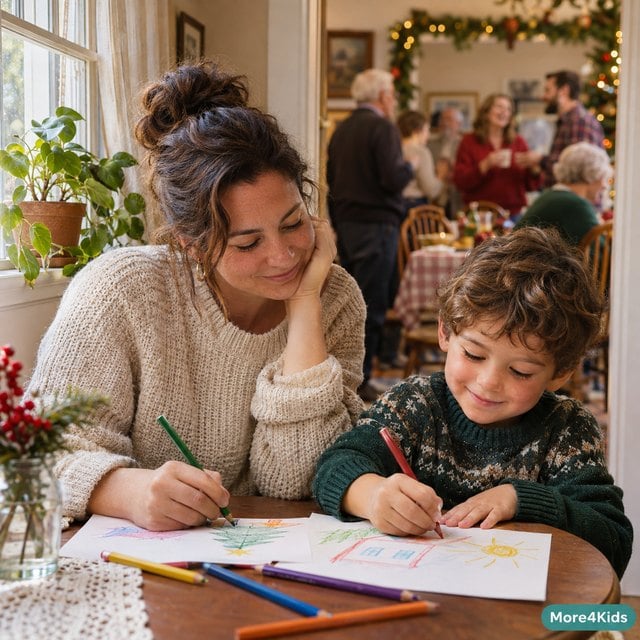
As a mom of three and an early childhood educator, I have learned to plan for that moment instead of treating it as a failure of the day. Child holiday overwhelm is not a verdict on your celebration, your relatives, or your parenting. A full room can be fun and still be too much for one child right now. The aim isn’t to make every child cheerful through every visit. It is to notice what the day is asking of them, make room for a pause, and help the family keep the parts that feel good.
The short version: choose fewer commitments, preserve a few familiar rhythms, agree on an exit or quiet spot, and let your child reconnect with you before asking them to rejoin the crowd. You do not need to do all seven ideas below at once. Pick the one that would have helped at your last gathering and start there.
What Child Holiday Overwhelm Can Look Like
Table of Contents
The child who was eager to see cousins at noon may be clinging to your leg by two. Another becomes louder and sillier, then cries when someone asks them to sit still. One of my three would have wanted to retreat from the noise while another would have wanted to stay right in the middle of everything; children don’t all announce a limit in the same way. Those are examples of ordinary differences in energy, not a checklist for labeling anyone.
Sometimes the signs are easy to mistake for poor manners: refusing a hug, asking the same question repeatedly, arguing about a coat, hiding behind the sofa, or suddenly not wanting the food they usually enjoy. A child can also say plainly, “I want to go home.” Before you decide what the behavior means, look at the whole afternoon. When did they last eat? Have there been several stops in a row? Is it far past the bedtime or nap you normally protect? Could you hear each other talk without raising your voices?
The American Academy of Pediatrics’ holiday guidance asks families to keep calendars manageable, protect routines and sleep, and notice when children need extra support. It notes that the holiday rush can intensify mood changes and that missed naps and busy days may contribute to toddler meltdowns. That is broad family guidance, not a promise that one schedule change will solve every difficult moment. But it gives us permission to plan around our children’s actual limits instead of an imagined perfect holiday.
In our parenting guides, I often come back to the same question: what is the next kind, workable move? For a child in a crowded room, that move is usually smaller than a lecture. A drink of water. A quieter hallway. A hand to hold. A parent saying, “It’s a lot in here. Let’s take a minute.”
Seven Gentle Ways to Help With Child Holiday Overwhelm
1. Edit the calendar before the day gets crowded
This is the hardest one for many adults, because someone else may be disappointed. Three invitations can each sound manageable in isolation. Put them all on one Saturday and the day becomes a relay race of coats, car seats, meals, and goodbyes. Before you say yes, ask what the whole week looks like for your family. You may be able to enjoy one gathering more if you skip two others.
The AAP explicitly recommends choosing events you can reasonably handle and declining the rest without guilt. That advice counts for children as well as parents. You do not have to explain your child’s temperament to every host. “We’d love to come for the first hour” or “We can’t make this one, but we’d enjoy seeing you another day” is enough. When three children have three different appetites for crowds, I would rather choose an outing we can all finish kindly than pack a day so full that no one remembers the pleasant parts.
Try leaving open space around the event, too. A morning without errands before an afternoon visit gives a child time to play, eat, and arrive without already feeling rushed. If travel makes that impossible, simplify the other parts of the day. A quieter calendar is not a smaller holiday; it is a holiday your actual family can inhabit.
2. Keep two or three familiar anchors
Holiday plans change meals, sleeping places, and the number of adults who ask your child questions. You cannot preserve every usual routine, and you needn’t try. Choose a few that help your family feel like itself: breakfast before you leave, the familiar bedtime story, a walk after lunch, or a quiet check-in at the end of a visit.
The AAP suggests protecting sleep, meals, and small anchors such as reading the same bedtime story. I think of these as handrails. The day may be new, but a child can recognize where to hold on. For a younger child, bring the usual book or comfort item if it fits the visit. For an older child, tell them when you’ll have a little time together without the crowd. The promise needs to be realistic. “We’ll read after we get home” is better than “Everything will be normal” when it plainly won’t be.
If a bedtime runs late, avoid turning that into a moral test for yourself. Notice what happened and leave a little recovery room the next day. A routine is useful because you can return to it, not because you never bend it. A familiar rhythm is especially valuable when holiday overwhelm shows up after a day that looked exciting on paper.

3. Tell your child the plan, including how to leave
A simple preview can make an unfamiliar house less mysterious. You don’t need a detailed itinerary. Try: “We’ll go to Auntie’s house, eat together, and stay until the afternoon. If you want a break, come find me. We can step outside or sit somewhere quiet.” Show a younger child where you will be. If the visit will involve photos, new people, or a meal later than usual, mention that honestly.
Give the child a small choice within the plan. Do they want to bring a book for the car, sit near you at dinner, or take the first five minutes to look around? A choice can give a child something steady to do without making them responsible for the whole family’s schedule. Don’t offer an exit you can’t honor. If you cannot leave early, identify a genuine break you can take inside the house. If you can leave early, tell the host that you may need to, and then follow through without a dramatic explanation.
With three kids moving at different speeds, I have found that a quiet agreement made before the doorbell rings is easier to remember than a new rule offered in the middle of tears. For some families a private signal helps: a squeeze of the hand or a phrase like “I need my book.” Practice it once at home. The signal doesn’t replace a child’s words; it gives them another way to reach you when the room is loud.
4. Make a low-key place to reset
Not every host has a spare room, and not every child wants to sit alone. A quiet corner can be a chair away from the speakers, a few minutes on the porch with you, or the car while you both breathe and decide what comes next. The important part is that it is a break, not a penalty. You can say, “Let’s find a quieter spot for a bit,” instead of announcing to the room that your child is misbehaving.
Ask the host privately where you could step away if needed. Bring something simple that feels familiar: a small book, drawing pad, or stuffed animal. I wouldn’t turn the break into a project to complete. Sometimes a child wants you beside them without conversation. Sometimes they want water and to tell you exactly which sound bothered them. Give that space before asking them to return and thank everyone for a wonderful time.
The AAP’s holiday advice makes room for slow moments and brief pauses. It offers small mindful breaks as one possible reset for adults and children. You can try noticing the cool air or taking a gentle walk, but do not insist on a breathing exercise that irritates a child in that moment. A low-stimulation place is helpful because the demands drop. It should not become one more demand.

5. Protect their right to say no to a hug, photo, or performance
Holiday gatherings are full of loving adults. They can also be full of requests: give a hug, smile for one more picture, say hello again, show us the song, try the special food. Each may seem tiny to a grown-up. Together they can feel like an audience has formed around one tired child.

Help your child greet people in a way they can manage. A wave, a spoken hello, or standing close to you can be enough. If someone asks for a hug, you can say warmly, “They’re saying hello with a wave today.” You do not have to make a scene or cast a relative as the problem. You are showing your child that affection does not have to be performed on cue. If a photo matters to the family, try it earlier in the visit or accept that this year the photo might be imperfect.
Food deserves the same gentleness. Serve something familiar when practical and allow a child to take a break from the table. Holiday overwhelm does not become easier because an adult argues about one more bite. If eating or sensory distress is a persistent concern outside celebrations, that is a separate conversation for your child’s clinician, not something to settle during dinner in front of guests.
6. Reconnect first when the feelings spill over
A meltdown in a bright, crowded place is an awful time to deliver a lesson on gratitude. If your child is safe, move somewhere less busy and get close enough to be a steady presence. Keep words brief: “That was a lot. I’m here.” Offer water or a pause if they want it. Let the child recover before you talk about what happened.
This does not mean every behavior gets a pass. You can hold a boundary without adding shame: “I won’t let you hit. We’re going to take a break together.” Once things are quieter, you can help the child repair a disrupted moment if needed. The order matters. A lecture offered while a child is struggling to hear themselves think is unlikely to help either of you.
I have used classroom strategies at home enough to know that a plan that sounds beautiful at breakfast may fall apart by dessert. That is not a reason to give up on the plan; it is a reason to make it shorter. Think one sentence, one move, one pause. Later, if your child wants to talk, ask what felt hard and what would make the next visit easier. If they don’t want to talk yet, you can wait. Our guide to emotional regulation for kids has more language for helping children name feelings when they are ready.
7. Leave space after the celebration
Parents often plan the trip there and forget the trip home. A child who held it together at the party may unravel in the car or at bedtime. Give yourself permission not to schedule a second event immediately. A simple meal, a familiar story, and a quiet morning can make the whole week easier to live through.
You might ask one small question after everyone has settled: “What was your favorite part? Was there a part that felt too loud or too long?” Listen without defending the gathering. Their answer can guide your next invitation. Perhaps your child loved decorating but not the crowded dinner; perhaps the photos were fine but the long car ride was not. You can keep the loved part and change the hard part. That is family tradition evolving, not failing.
An unstructured hour of play can be a kinder next-day plan than another holiday activity. Screens can also be one practical tool for a tired family, but they don’t need to carry the entire recovery day; if you’re weighing that choice, our screen-time guide offers a broader perspective. Notice what actually restores your child, not what looks most festive in someone else’s photographs.
When a Child Still Feels Overwhelmed
Some children find crowds hard even with a trimmed schedule. Others are grieving, missing a family member, worried about family conflict, or uneasy about money and gifts. You don’t have to put a name on all of that in the middle of a gathering. Make room for a private conversation when things are calm. The AAP encourages parents to notice when children need extra support and to remain available to talk, particularly when the season brings grief or social pressure.
If distress is persistent, seems unusually intense for your child, or regularly disrupts sleep, school, friendships, or everyday activities, talk with their pediatrician. That is not a label and not a sign you did the holidays wrong. It is a way to get help understanding what your child needs. For a child who already has an individualized support plan, the people who know them best should guide adjustments rather than a generic list on the internet.
Also check in with yourself. Holiday overwhelm belongs to adults, too. If you are trying to keep three children comfortable, manage relatives’ expectations, cook, travel, and look cheerful, the day can outrun you. The AAP explicitly includes parent self-care in its holiday advice. Step outside, trade off with another trusted adult, or decline an invitation. Your child benefits from a grown-up who has room to respond, not one who has perfected the decorations.
A Holiday Plan Small Enough to Use
Before your next gathering, write down four things: the time you will arrive, the time you hope to leave, where you can take a break, and one routine you’ll protect afterward. Tell your child the parts they need to know. That’s your whole plan. If the day goes differently, it is a plan you can adapt rather than a script you have broken.
In my family, I want the children to remember warm rooms and people who were glad to see them, not a parent pushing them through one more cheerful obligation. Some celebrations will still be noisy. Some endings will still be abrupt. A child holiday overwhelm moment does not erase the good that happened before it. It may simply be the moment that tells you it is time to go home, read the familiar story, and try again another day.

Frequently Asked Questions
How can I tell if my child is overwhelmed at a holiday gathering?
Look for a change from your child’s usual way of being: clinging, withdrawing, becoming louder or irritable, or asking to leave. Check practical needs such as food, rest, and a quieter place before deciding what the behavior means. Children show strain differently, so your knowledge of your child matters more than one universal sign.
What should I do when my child melts down at a family party?
First make sure everyone is safe, then move with your child to a less busy spot if you can. Use a few calm words, offer a pause, and save the longer discussion for after they have settled. You can hold a safety boundary without making the child explain themselves to the room.
Should I make my child hug relatives or pose for holiday photos?
You can help your child greet relatives politely without requiring a hug or an extra photograph when they are done. A wave or hello is a genuine greeting. Try a photo earlier if it matters, but protecting a child’s comfort is more important than obtaining a perfect image.
How do I keep holiday routines without missing every celebration?
Choose two or three anchors rather than trying to reproduce an ordinary day. A usual meal, a familiar story, and a realistic bedtime or recovery morning may help. The AAP recommends keeping family routines and the calendar manageable; flexibility is part of making that guidance livable.
When should I talk to a pediatrician about holiday stress?
If distress persists beyond busy events or repeatedly affects sleep, school, friendships, or daily life, a pediatrician can help you think through what is going on. You do not need to work out the cause on your own, and asking for guidance is not an admission that you failed at the holidays.
Related Articles

Meet Sophia Richards Sophia Richards is an early childhood educator, passionate writer, and the proud mom of three energetic kids. With a degree in Education and over a decade of hands-on classroom experience, Sophia bridges the gap between professional teaching strategies and everyday family life. At More4Kids, she translates complex child development concepts into practical, actionable parenting tips that families can use at home.
Whether she is sharing positive reinforcement techniques, educational crafts, or honest reflections on the chaos of raising three children under one roof, Sophia’s goal is to empower parents to foster resilience and joy in their kids. When she isn't writing or lesson planning, you can find her organizing neighborhood scavenger hunts or trying out new kid-friendly recipes.
Areas of Expertise: Early Childhood Education, Positive Parenting, Sibling Dynamics, Educational Play, Family Wellness.

Add Comment