
















By Sophia Richards
The pasta is fine. The sauce is fine. But the moment a single soft mushroom touches the plate, my youngest pushes the whole thing away like it might bite back. If you have watched a child gag at the sight of something slimy, lumpy, or unfamiliar, you already know this is not stubbornness for the sake of it. The reaction is real, and it is fast. You want your child to eat a reasonable variety. Your child wants the food in their mouth to feel safe and predictable. Child food texture aversion sits right in the middle of those two honest needs.
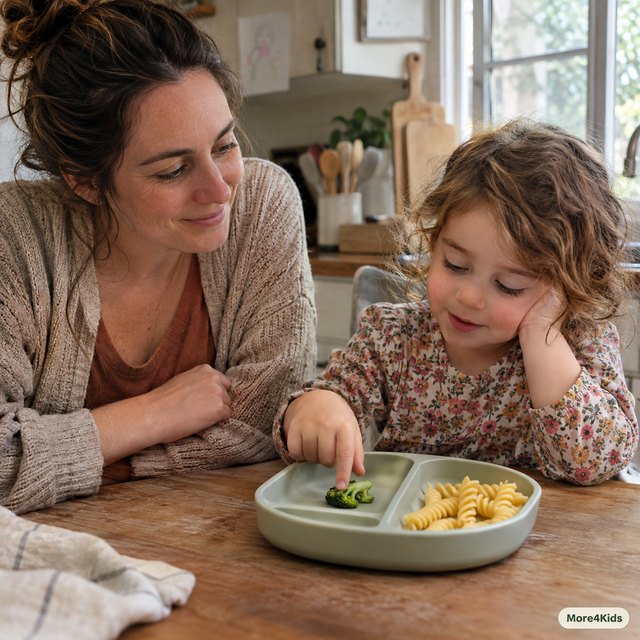
As a mom of three and an early childhood educator, I have served a lot of meals that came back barely touched, and I have learned that a texture battle rarely ends with a child suddenly loving broccoli. It ends with a calmer table, smaller steps, and a child who trusts that no one is going to force a bite past a gag. The American Academy of Pediatrics reminds parents that picky eating is often the norm for toddlers—after the fast growth of infancy, appetite and food preferences shift, and a favorite food one week can be refused the next. That does not make every refusal nothing, but it does mean a crowded plate of fears usually responds better to patience than pressure.
This is a parent-to-parent guide to gentle mealtime decisions, not a way to diagnose a feeding disorder or promise to cure a sensitivity. Start smaller than “just try it.” Let your child meet a new texture with their eyes, nose, and fingers before it ever reaches their tongue, keep the pressure low, and keep offering without a fight. If refusal is extreme, growth or weight is affected, gagging or choking happens often, or the distress is intense and lasting, talk with your pediatrician or a feeding specialist rather than pushing harder at home.
First, Understand What the Texture Means to Your Child
Table of Contents
When an adult says “it’s just a texture,” we have described our experience, not theirs. For some children, a wet or lumpy mouthfeel is genuinely alarming—the brain reads it as something to spit out, and the gag is automatic rather than theatrical. One of my children could eat a crunchy apple all day but gagged at applesauce; another was the opposite. If I had insisted they were being difficult, I would have missed that they were telling me real information about how food feels to them.
So I try to get curious before I get frustrated. You can ask, “Is it the way it feels, the way it looks, or the way it smells?” You may learn that it is not the taste at all—it is the slipperiness, the way pieces are hidden in a sauce, or the surprise of a soft center inside a crisp shell. You may also learn your child is fine with a food in one form and not another: plain pasta yes, cheesy pasta no. Those details are not excuses to work around. They are the map.
This matters even when dinner is rushed and you cannot cook three different meals. Understanding the texture does not oblige you to cater endlessly; it lets you set a kind, honest boundary. “You don’t have to eat the stew. There’s bread and the carrots you like right here.” The first part shows you heard the fear. The second keeps you from becoming a short-order cook. The AAP’s guidance leans the same way: provide a balanced family meal and resist making a separate dish on demand, while including at least one food your child reliably accepts.
Seven Gentle Ways to Respond to Child Food Texture Aversion Without a Mealtime Battle
1. Lower the pressure before you add anything new
The single most helpful change at my table was taking the pressure out of the room. In my house I sometimes still feel the pull to hover and coax, and I have learned it rarely helps. Pressuring kids to eat—or punishing them when they don’t—can actually make them dislike foods they might otherwise come to accept. So the new food goes on the plate with no speech attached. No “three bites and you can leave.” No hovering. The job, as the pediatricians put it, is this: the parent decides what food is offered and when; the child decides whether and how much to eat.
That division of responsibility sounds almost too simple, and it is hard to hold when you are worried. But a child who knows no one will force the mushroom is far more likely to lean in and look at it. Pressure teaches a child to brace; safety teaches them to be curious. I remind myself that one tense dinner is not the emergency it feels like in the moment. The pattern over weeks matters more than any single plate.
If mealtimes have become a nightly standoff, the first repair is almost always to do less, not more. Serve the food, sit down, eat your own meal, and talk about something else. You are not giving up on variety. You are removing the fight that was teaching your child to associate new textures with stress.
2. Let the new texture be explored before it’s eaten
Children meet the world with their hands, and food is no exception. Long before a new texture is something to swallow, it can be something to look at, poke, smell, and put on the plate without any expectation of a bite. In my kitchen a brand-new food often earns a spot on the plate for several meals purely as a visitor. No one has to eat it. It just gets to be there until it stops being a stranger.
You can make this explicit and playful: “You don’t have to eat it. Can you tell me if it’s bumpy or smooth?” Touching a cooked pea, squishing a piece of avocado, or smelling a slice of melon are real steps toward acceptance, even when nothing is tasted. For a child who gags easily, moving from “across the table” to “on my fork” to “touching my lips” to “a tiny taste” can take many meals. Each of those is progress, not stalling.
This is also where a gag is useful information rather than a verdict. If simply having the food near their face triggers distress, you have started too close. Back up a step—put it on the far side of the plate, or on a separate small dish—and let the nervous system settle. Forcing past a gag does not build tolerance; it teaches the body that mealtime is a place to be on guard.

3. Pair the unfamiliar with something safe
A plate that is all unknowns is a plate most cautious eaters will refuse outright. So I anchor every meal with at least one food my child trusts. The AAP suggests the same—include a reliably accepted food at each meal alongside whatever else you are serving. The safe food is not a reward or a bribe; it is the secure base that makes exploring the rest feel possible.
Placement helps, too. A tiny portion of the new texture beside a generous helping of the familiar reads very differently than a plate dominated by the scary thing. Think one slice, one spoonful, one piece—small enough that it is clearly not a demand to finish. You can even serve components separately so a child can see exactly what is in the sauce, since hidden lumps are often the real problem for a texture-sensitive eater.
Over time, you can let the familiar and the new touch, then mix, at your child’s pace. But early on, keeping things visibly separate respects the fear instead of ambushing it. A child who finds a surprise mushroom inside their trusted pasta learns to distrust the pasta, and now you have lost ground on both.
4. Offer a tiny “learning bite” with a built-in exit
When your child does feel ready to taste, make the smallest possible ask and give them a dignified way out. A “learning bite” is exactly what it sounds like: a crumb-sized taste whose only job is to gather information. Pair it with a no-thank-you plate or napkin where a food can be put back without drama. “You can taste the edge. If you don’t like it, you can put it right here.” Knowing there is an exit is often what makes the entrance possible.
The exit has to be honest, or the whole thing collapses. If a child spits out a learning bite and you react with disappointment or a lecture, you have taught them that the exit is a trap. I try to keep my face neutral and my voice ordinary: “Okay, now you know.” That is genuinely the goal—now they know something about that texture, and knowing is how a food slowly becomes familiar. Many unpressured exposures, not one heroic bite, is what tends to move the needle.
Keep the stakes tiny and the wins quiet. A child who touches it today, licks it next week, and takes a real bite a month from now is doing beautifully. Celebrating too loudly can backfire, turning a calm experiment back into a performance with an audience. A simple “thanks for trying that” respects the effort without raising the pressure again.
5. Keep bribes and dessert deals off the table
It is so tempting to say, “Two bites of the stew and you can have a cookie.” I understand the appeal; I have said it. But treating one food as the price of a treat usually makes the treat more exciting and the target food less appealing. The pediatric guidance is blunt about this: bribing with sweets can raise the status of the “prize” food and lower the status of whatever you were trying to encourage.
Dessert, when you serve it, works better as a neutral part of the meal than as a weapon. Some families put a small sweet on the table with everything else, so it stops being a bargaining chip. You do not have to do that. But do notice if the nightly negotiation has become its own stressful ritual—if so, retiring the deal often lowers the temperature more than any new recipe.
The same goes for rewards charts and elaborate incentives for eating. They can work for a little while and then stall, because they keep the focus on performance rather than on the child’s real, slow relationship with the food. For a texture-sensitive child especially, the quieter the mealtime, the more room there is to get genuinely curious.
6. Protect safety, calm, and a sensible clock
Gentleness does not mean anything goes. A gag is usually just a gag, but real choking is a safety issue: supervise meals, serve textures that are appropriate for your child’s age and chewing ability, and never push a bite past a child who is distressed or reflexively gagging. If you are introducing a firmer or chunkier texture, do it when you are sitting right there and the room is calm, not during a rushed, chaotic meal.
Calm is a kind of safety, too. Short, predictable mealtimes tend to go better than long ones where a child is expected to sit until the plate is clean—that expectation, paired with a texture they fear, is a recipe for tears. The AAP encourages letting children listen to their own hunger; a child who ate a big lunch may simply not be hungry at dinner, and that is allowed. Twenty reasonably pleasant minutes at the table beats forty-five tense ones.
I also keep screens off at meals, which matters more than it sounds. Family-style meals without the TV or a phone give a texture-sensitive child something steadier to anchor to: the ordinary rhythm of a family eating together, with you quietly modeling that the stew is fine. If you are rethinking screens at the table, our calm guide to screen time may help you set shared expectations that stick.

7. Play with texture away from the pressure of a meal
Some of the best progress happens when no one is expected to eat anything at all. As an early childhood educator, I watched this in the classroom long before I saw it at home: children who would not taste a food at lunch would happily explore it during a sensory activity an hour earlier. Cooking together, washing vegetables, squishing dough, or sorting foods by “crunchy, soft, and in-between” lets a child meet textures as a game rather than a demand. A child who helped stir the batter or tore the lettuce has already built a little familiarity before the food ever appears on a dinner plate.
Sensory play with food—within reason and without wasting a meal’s worth—can take the charge out of a frightening texture. Finger-painting with a dab of yogurt, stacking cooked pasta, or pressing shapes into a soft fruit gives the nervous system a low-stakes way to learn that “soft and wet” is survivable. For some children these playful exposures matter as much as anything that happens at the table. If big feelings come up even during play, that is worth noticing gently rather than pushing through.
The aim across all of this is not to raise an adventurous eater by Friday. It is to keep mealtimes warm, keep offering without force, and let your child’s comfort stretch at its own pace. When feelings run high around food or anything else, our guide to emotional regulation for kids offers language that travels well beyond the dinner table. And a broader parenting hub can help you build the steady routines that make all of this easier.
When Is a Texture Aversion More Than Ordinary Picky Eating?
Most texture refusal in young children is a normal, if exhausting, phase that eases with time and unpressured exposure. But there is no useful diagnosis hiding in a single refused mushroom, and some patterns do deserve a professional’s eyes. Look at what is happening around the food rather than at any one meal. Is the list of accepted foods shrinking rather than slowly growing? Is your child’s growth, weight, or energy affected? Is refusal paired with frequent gagging, choking, or vomiting? Is every meal marked by intense, lasting distress for your child or the whole family?
Those observations are worth bringing to a pediatrician, who can look at the whole picture—age, growth charts, medical history, and other needs—alongside you. In some cases a clinician may raise the possibility of a more significant feeding difficulty, sometimes discussed under the term avoidant/restrictive food intake disorder, and may suggest an evaluation with a feeding therapist, occupational therapist, or dietitian. That is a conversation for a qualified professional, not a label to assign from an article. Bring concrete notes: which textures are refused, how your child reacts, which foods are reliably eaten, and what you have already tried.
Be wary of any approach, at home or elsewhere, that insists the fix is simply forcing more bites. For a child who is genuinely frightened of a texture, repeated force tends to deepen the fear, not resolve it. If a professional recommends a specific plan, follow their individualized advice. The seven ideas here are gentle family communication and mealtime strategies, not a substitute for assessment or treatment of a child whose eating is seriously limited.
A Small Plan for This Week
Pick one meal this week to make deliberately low-pressure. Serve one family meal, include at least one food your child reliably eats, and add a tiny portion of one new or disliked texture off to the side—with no requirement to touch it. Sit down, eat your own plate, and talk about anything other than the food. If your child ignores the new texture entirely, that counts as a successful first exposure. It was simply there, and nothing bad happened.
Over the following meals, let the new food stay a visitor. Invite a touch, then a smell, then maybe a learning bite with a clear, honest exit—always at your child’s pace, never past a gag. Write down the foods your child reliably accepts so you can keep anchoring meals to them, and note any small movement so you can see the slow progress that is hard to feel in the moment. If the refusal is severe, growth is affected, or the distress keeps escalating, make the call to your pediatrician the next step rather than another round of pressure.
I want my children to trust that the table is a safe place—that no one is going to force food past a gag, and that their “no, not yet” will be heard. From that safety, curiosity grows on its own schedule. The mushroom may stay on the far side of the plate for a long time. And one ordinary evening, when nobody is watching too closely, it quietly won’t be scary anymore.
Frequently Asked Questions
Is it normal for a child to gag at certain food textures?
Often, yes. Picky eating and texture sensitivity are common in toddlers and young children, and appetite naturally slows after infancy. A gag at a slimy or lumpy food is usually a real sensory reaction, not misbehavior. Keep offering without pressure and watch the overall pattern. If refusal is severe, growth or weight is affected, or gagging and choking are frequent, talk with your pediatrician.
Should I make my child a separate meal if they refuse the texture?
Generally, no—serving a separate dish on demand tends to reinforce refusal. Instead, serve one family meal that includes at least one food your child reliably accepts, so there is always something safe to eat. That respects the fear without turning you into a short-order cook. You are providing balanced options; your child decides how much to eat.
How do I introduce a new texture without a fight?
Let the food be explored before it is eaten. Put a tiny portion on the plate with no demand, and invite your child to look at, touch, and smell it over several meals. When they are ready, offer a crumb-sized “learning bite” with an honest no-thank-you exit. Many calm, unpressured exposures move a food from strange to familiar far better than one forced bite.
Should I use dessert or treats to get my child to try new foods?
It usually backfires. Bribing with sweets raises the status of the treat and lowers the appeal of the food you want your child to try. Keep rewards and dessert deals off the table and focus on low-pressure, repeated exposure instead. If dessert is served, offering it as a neutral part of the meal keeps it from becoming a bargaining chip.
When should I worry that this is more than picky eating?
An article cannot diagnose a child. Consider a professional conversation if the list of accepted foods is shrinking, growth or weight is affected, gagging or choking is frequent, or distress around food is intense and lasting. A pediatrician can assess the whole picture and, if needed, refer you to a feeding therapist, occupational therapist, or dietitian for individualized support.
Related Articles

Meet Sophia Richards Sophia Richards is an early childhood educator, passionate writer, and the proud mom of three energetic kids. With a degree in Education and over a decade of hands-on classroom experience, Sophia bridges the gap between professional teaching strategies and everyday family life. At More4Kids, she translates complex child development concepts into practical, actionable parenting tips that families can use at home.
Whether she is sharing positive reinforcement techniques, educational crafts, or honest reflections on the chaos of raising three children under one roof, Sophia’s goal is to empower parents to foster resilience and joy in their kids. When she isn't writing or lesson planning, you can find her organizing neighborhood scavenger hunts or trying out new kid-friendly recipes.
Areas of Expertise: Early Childhood Education, Positive Parenting, Sibling Dynamics, Educational Play, Family Wellness.

Add Comment