Parent and Teacher conferences. Communication is an essential component to your child's academic success. By increasing your level of communication, you are optimizing your child's ability to perform well in the educational environment.
by Angie Shiflett
There are numerous documents that stress the importance of parent and teacher communication. Parents and the relationships that they share with their child’s teacher have been researched for many years now. These studies have concluded that when a parent is actively involved with their child’s education, it benefits all involved in one way or another. Communication is one of the top strategies for fostering the relationships that grow between a parent and the educators that work with their child. The educational system is faced with many challenges and obstacles, and when parents and teachers communicate effectively these may be successfully overcome. In this article, we will share some tips and many important facts pertaining to parent and teacher communication.
The first step to effective communication is to ensure that you understand that it is more than just gathering reports from your child’s teacher on their overall performance in the classroom. It is also more than acquiring information about the child’s behavior while in the educational environment. It is about achieving a fluid exchange of information between both the teacher and the parent about the achievements within the classroom as well as the child’s general persona. It is about sharing the child’s weaknesses and strengths both at home and at school. It also aids in the collaboration between the teacher’s agenda and lesson plans with the parent so that the skills being introduced in the classroom are being reinforced in the home environment.
Many parents make the mistake of allowing the teachers to “do their job”. What many parents fail to understand is that the first and perhaps the most impressionable classroom is the home. Parents have the greatest understanding of their child. They know their personalities, they know how they learn, they know the types of interests that they have, and they know where their child’s weaknesses are. Teachers, on the other hand, rarely get the opportunity to focus on a child as an individual in the classroom and rarely get to a point where they are just as familiar with a child as a parent is. While there is not a lot of room in the classroom for individualized instructions, it is important for a parent to express the characteristics and qualities of their child to the teacher so that the teacher may have a better understanding of the child as a unique student. Should a situation arise, this information could prove to be exceptional in overcoming that situation.
It is important to understand that when parents and teachers communicate, it provides an opportunity for the child to reach their maximum potential both in the classroom and outside of the classroom. This is because of the fact that when regular communication is engaged in, a relationship will form. This relationship will assist the child in realizing that they have a solid support system that is working together for their benefit. Children who know that their parent and their teacher communicate often have been found to perform better academically. They have also been found to exhibit more appropriate behavior in the classroom setting. It has also been established that children who have a parent that communicates with their teacher regularly have a better understanding of consequence as it relates to their academic performance and their behavior.
Parents have an important role when it comes to their child’s academic success. It has been established that the parent is the top educator in their child’s life. It has also been established that the parent is the prime role model for their child. While teachers are important as well, the child will benefit more if there is a collaboration that involves regular communication. Teachers have the capability to express the skills and the concepts that are being introduced in the classroom so that parents may reinforce them at home through an assortment of learning activities. The teacher has the ability to offer productive suggestions on learning tools and even exercises that may be performed at home in order to optimize the child’s learning experience.
There are many ways that parent and teacher communication may be enhanced. If you are interested in developing a relationship with your child’s teacher, the following suggestions may assist you in achieving success:
1. First, it is important to understand that parent and teacher communication is intended to benefit the child’s overall success academically. It is important to know that academic success is more than just a grade or a score. It is about ensuring that the child has a complete understanding of the skills and concepts that are being taught in the educational environment. A complete understanding of a concept is more important than a numeric score.
2. While the numeric scores will outline a child’s level of achievement on tests and other assignments, it is important to realize that a numeric score is also beneficial in identifying a child’s weaknesses. When it comes to the academic success of the child, it is important to identify weaknesses instead of focusing solely on successes. By doing so, you will be able to increase their knowledge and future success.
3. Many parents make the mistake of sitting back and allowing a teacher to come to them with issues. It is absolutely essential that you avoid doing this. In many cases, when an issue is discovered in the classroom, the child is falling behind at a high rate. It is important to make it a point to communicate regularly with a child’s teacher. If there are issues that are starting to develop, you will be able to identify them quickly and resolve them.
4. It is important to sign up as a volunteer in your child’s classroom and ensure that you visit their class often.
This will allow you to see how your child listens, how they work, and how the teacher handles themselves. If you are a strong presence in the child’s education, they will start to develop an understanding of its overall importance.
5. It is important to understand that parent/teacher conferences may not always be appropriate as far as time is concerned.
Encourage your child’s teacher to provide you with an alternative means of communication such as a telephone number or an email address. This will allow you and the teacher to communicate during periods that you are unavailable in person.
Hopefully with this tips, you will find that you will be able to communicate in an effective manner with your child’s teacher. Remember, communication is an essential component to your child’s academic success. By increasing your level of communication, you are optimizing your child’s ability to perform well in the educational environment.
Biography:
Angie Shiflett is a writert that focuses on writing on an assortment of topics. Currently, her passion is education. Both Angie and her husband place a high emphasis on family, and dedication to the importance of a proper education.
This article is the copyright of More4kids Inc. No part may be copied or reproduced in any form without the express permission of More4Kids © and All Rights Reserved
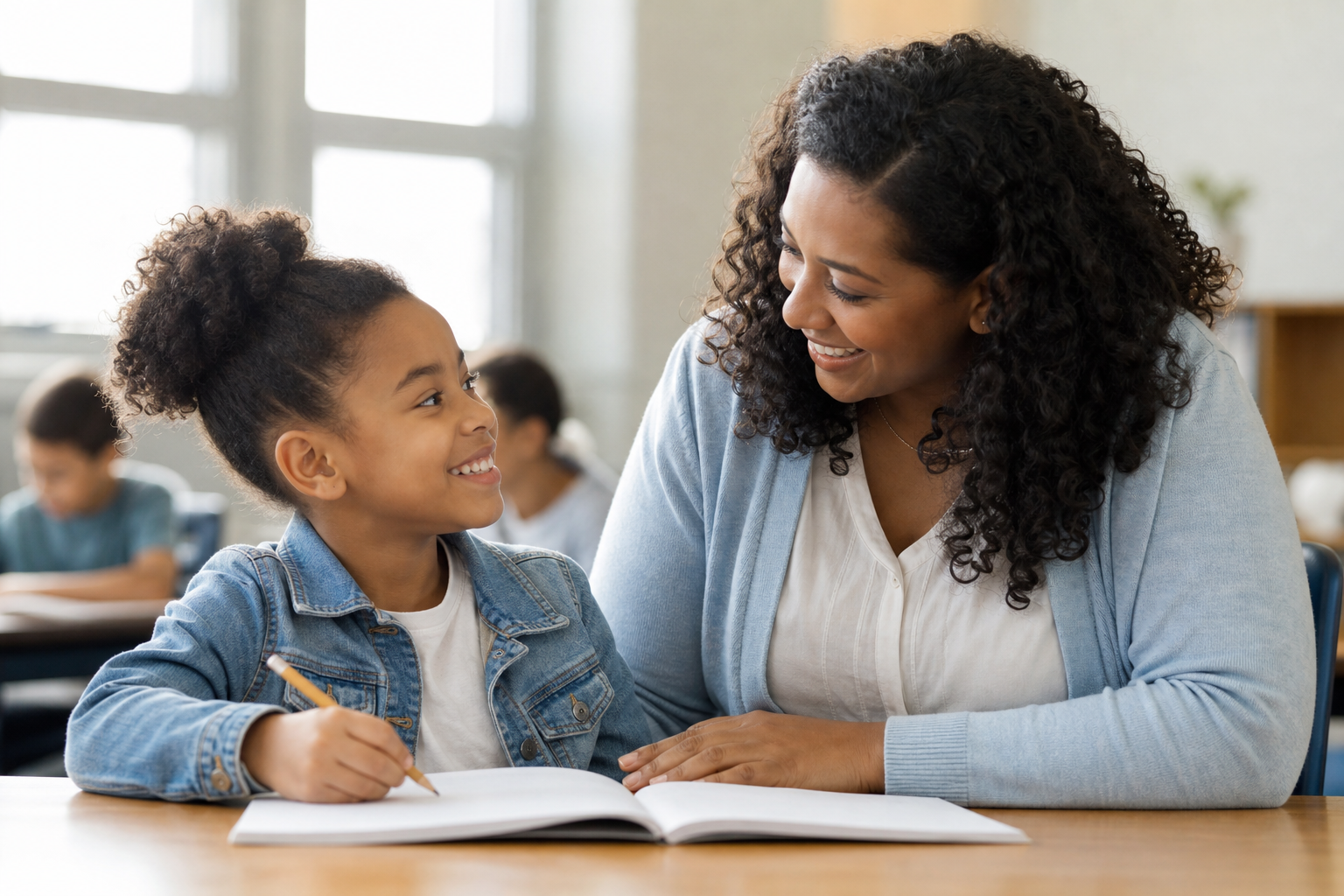
When parents and teachers stay connected, kids get the best support from both sides of their world.
Why is parent-teacher communication so important for my child’s success?
Research consistently shows that children whose parents communicate regularly with their teachers perform better academically and behave more appropriately in the classroom. When kids know that the two most important adults in their educational life are in contact, they develop a clearer understanding of the importance of their own performance — they see a unified support system working specifically for them.
What is parent-teacher communication really about beyond grades and report cards?
It is a two-way exchange about the whole child. As a parent, you know your child’s personality, learning style, strengths, and struggles in ways a teacher rarely gets to see in a full classroom. Sharing that knowledge gives the teacher the context to support your child as an individual. In return, teachers can tell you exactly which skills are being introduced in class so you can reinforce them at home — the collaboration goes far deeper than a numeric score.
How can I improve communication with my child’s teacher?
Do not wait for the teacher to come to you with a problem. Make regular contact a habit from the beginning of the school year, not just at report card time. Ask the teacher for their preferred way to connect — email, a phone call, or a classroom app — and use it. Volunteering in the classroom occasionally is another powerful way to stay present and involved in your child’s daily educational experience.
What should I do if my child seems to be struggling at school?
Reach out to the teacher directly and proactively, before the situation shows up on a progress report. By the time a low grade appears, a child may already be significantly behind. Share what you observe at home — fatigue, avoidance, frustration with a specific subject — and ask what you can reinforce there. Turning the conversation into a shared problem-solving session rather than an assignment of blame is what actually moves the needle for your child.

















Add Comment