














by Ann Bowers
The first thing you must obtain is a copy of your state or country’s academic standards for each educational level. These give you a specific set of goals that define the content taught at each level, in each grade, and when the content may be considered to have been mastered. This document used to be called “Scope and Sequence.” While you aren’t required to follow the standards exactly, at some point, your child should have mastered them. The academic standards allow you to evaluate whether or not your children are keeping pace with students in traditional schools. This is important in case you ever want your children to return to the local school system, take a standardized achievement test, or attend university. Knowing the standards will also reassure you that you are teaching everything that children need to learn.
There are many approaches to home schooling. Here are some of them:
- Structured schooling means teaching the state standards in an organized, goal-oriented manner.
- Interest based, sometimes called “unschooling,” is learning through real life experiences. Children pursue their own interests and the parents provide encouragement, resources and activities that teach necessary skills and knowledge through the child’s interests.
- A learning style approach is used with children who have a dominant learning style, such as kinesthetic (tactile) or auditory.
- A philosophical style of education is structured according to the tenets of an educational philosophy espoused by educational experts, such as “Back To Basics.” The accelerated approach is used with children who are extremely intelligent, have a special talent, or want to reach a specific occupational goal.
- The accommodating approach is used when a child has a special need.
- In a unit based approach, the teaching and learning is focused on a particular topic for a period of time and each child learns about the topic at his/her own level of understanding.
- A community approach involves the family in community activities, including religious groups, youth organizations, and volunteer activities outside the home.
- The eclectic approach includes any combination of the above!
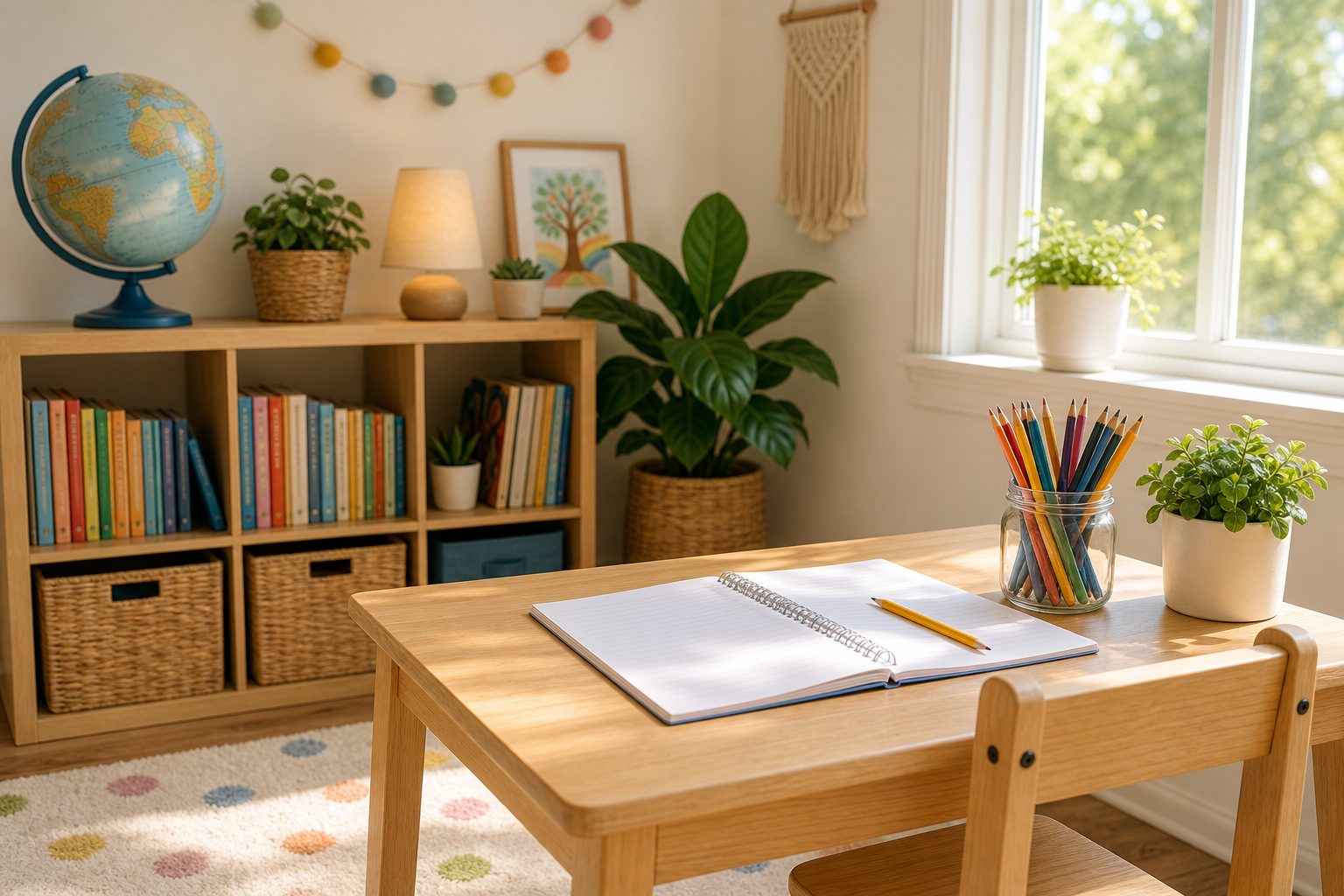
You probably will purchase some items, but before you do, search through what you already have. Determine where in the home you will teach the children. Prepare the area with desks or a large table, chairs, bookcases, pencils, pens, crayons, markers, paper, a computer. Organize your books by fiction and non-fiction, including reference books, such as encyclopedias, dictionaries, and thesauruses. Learning games and toys, such as Monopoly, puzzles, blocks, cards, Scrabble, Life, and so forth are very useful.
What are the different approaches to homeschooling?
There are many ways to homeschool, and families often mix and match. Structured schooling follows state academic standards in an organized, goal-oriented way. Interest-based learning (sometimes called ‘unschooling’) lets children pursue their own curiosity with parental guidance. A learning-style approach matches teaching methods to how your child naturally learns best — kinesthetically, auditorily, or visually. Other approaches include unit-based study (focusing on one topic at a time), a community approach (integrating religious groups and volunteer activities), and eclectic homeschooling — any combination of the above that works for your family.
Do homeschooling parents need to follow state academic standards?
You aren’t required to follow your state’s standards to the letter, but knowing them is important. Academic standards (sometimes called ‘Scope and Sequence’) define what children should know at each grade level. They serve as a valuable benchmark — especially if your child ever returns to traditional school, takes a standardized test, or applies to college. Getting a copy of your state’s standards early helps you plan confidently and ensures your child isn’t missing anything critical.
What supplies do I need to start homeschooling?
Before buying anything, look at what you already have. Set up a dedicated learning space with a desk or large table, chairs, pencils, paper, and a computer if possible. Organize your books — fiction, non-fiction, reference books, dictionaries, and encyclopedias. Educational games like Scrabble, Monopoly, and puzzles are genuinely useful teaching tools. Yard sales, thrift shops, eBay, and fellow homeschooling families are great sources for affordable materials. Don’t overlook your public library — books, magazines, videos, and computer access are all free.
Where can I find free homeschooling resources and lesson plans?
The Internet is your most valuable starting point. You’ll find free lesson plans for specific topics, printable workbook pages, project templates, and research sites on virtually any subject. Educational supply stores carry hands-on learning aids, and educational conferences are excellent for discovering curriculum catalogs. If you decide to use the same textbooks your local school system uses, request the Teacher’s Guide — it explains how to present difficult concepts in ways that actually work.
|
Ann Bowers has been an elementary school teacher, in kindergarten through 8th grade, for 20 years. She was a Bilingual Education Grant Project Coordinator for seven years and a school principal for seven. She has a B.A. in English, an M.A. in Education, and holds California Life Teaching Credentials and specialist credentials in Remedial Reading and Teaching English as a Second Language. She is retired and has started a second career as a freelance writer. |
No part of this article may be copied or reproduced in any form without the express permission of More4Kids Inc © 2006
Posting Search Tags: Homeschooling Education

Ann Bowers


Add Comment