It’s September (or any month you decide to begin homeschooling) and you’ve researched curriculum, decided on your educational philosophy, started collecting ideas, prepared a place in your home that will serve as a schoolroom, and convinced your children that home schooling will be FUN! But, where do you start, on the first day and in the first week?
Don’t Bite Off More Than You Can Chew!
Probably, it’s best to start with the 3Rs – reading, riting, and ritmatic, as we used to say in the U.S. That is, start with reading, writing, and mathematics. You can add all the rest: social science, science, the arts, physical education, music, etc. as you go along.
Beginning Homeschooling with Reading
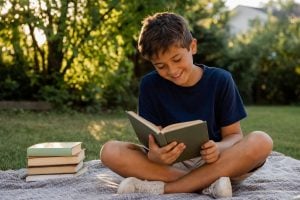
To begin with reading, you need to find out at which level your child is reading. To do this, get a grade level reader or ask the local librarian to provide a book written at your child’s grade level (or age level). Sit down with your child, alone. Ask him/her to read the book to you. When he gets stuck on a word, wait for a few seconds, if he doesn’t come up with it, tell him what it is and let him go on reading. If he/she can read 95% of the words (not counting the ones you told him/her) on five pages, this book is at his/her “independent reading level.” That means that the book is fairly easy and the child can read it by himself. If he/she can read 90% of the words on five pages, the book is perfect for his/her first reader. This is the “instructional level.” This is the book you will use to start teaching the child reading. If the child reads 85% or fewer words on five pages, the book is too hard to use for instruction at this time; you should try a book that is geared for one grade lower. If the child reads 90% of the words, try having him/her read a book for one grade higher. Keep trying until you find a book at which the child can read 90% of the words without help. If your child cannot read yet, we’ll cover that in the next article.
Once you have the correct book, have your child read a few pages at a time to you. Note the words missed. Teach these words to the child (more on that in the next paragraph). Ask the child questions about what has been read. Be prepared that kindergarten, first, and second graders (ages 5-8) may have nary a clue about what they read. They concentrate so hard on how to read the words that often the meaning escapes them. You must help them build “comprehension.” (More on that in the coming articles.) Older children need to improve comprehension and learn higher level thinking skills, such as sequencing, inference, and so forth.
Teaching Reading Words
Most teachers believe that children must know the relationship between letters and sounds in order to read. The debate over this versus “sight” reading (i.e.; memorizing words by shape or beginning sound) has gone on for almost 150 years. It began with Horace Mann, an educator in the 19th century who questioned the need for phonics instruction. The debate continued with publication of the book Why Johnny Can’t Read
by Rudolph Flesch (1957) and has continued since that time. This book claimed that the reason children in the late 50s and early 60s couldn’t read well was because they had been taught only to memorize words, not “sound them out.” In the 1980s, the popularity of “whole language” instruction, which stresses the use of quality literature and minimal focus on phonics, got the debate started again. The latest attempt to determine which approach makes the most sense was researched by the National Reading Panel (National Institute of Child Health and Human Development, 2001), which examined quantitative research studies on phonics. Their analysis of hundreds of studies confirmed the findings of the National Research Council: phonics is a way more effective to teach children to read than is no phonics instruction. They found that phonics had particularly strong benefits for students of low socio-economic status. In Britain, recent analysis of how children learn to read has caused the Ministry of Education to proclaim that phonics is an important part of primary reading instruction.
Many educators continue to debate this; I am not one of them. It is my belief, based on 10 years of teaching 1st grade, that children do not learn to read without phonics (i.e.; learning the sounds that letters make and how to blend them into words). Of course, some words are irregular (such as “they” and have to be memorized; these are called sight words).
So, when your child can’t read a word, make a note of it. After each few pages (or each story or chapter), teach the words the child does not know. Be sure to reread the story after teaching the words. To teach a word, go through it, sound by sound, with your child, helping him/her to get the sounds correct. Then, help the child blend the sounds together to make the word. For example:
Hat You review with the child the sounds of h
, a (as in apple) and t.
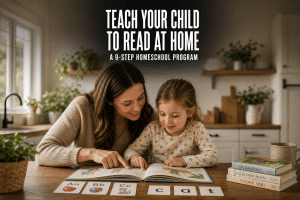
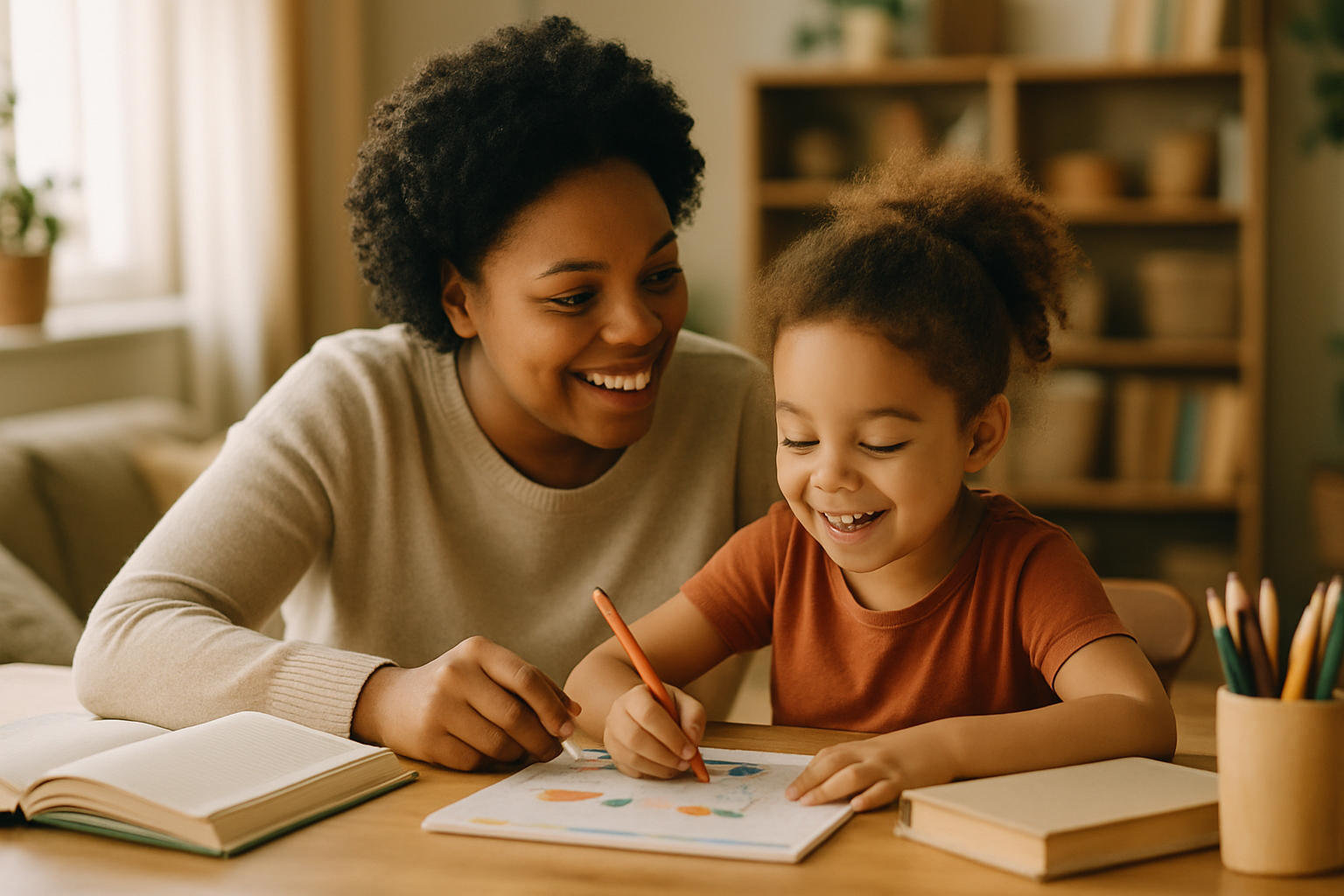
A simple weekly plan helps homeschooling beginners build confidence and routine from day one.
(That’s the sounds, not the letter names.)
Then you help the child blend them into the word: huh, ah, tuh. Repeat them, faster and faster until they become hat.
You can also focus on particular sounds in stand-alone lessons, for example, teaching the kn
sound and the words in which it is most often found. Worksheets are often are part of these lessons.
If a word is irregular (i.e.; the sounds are different from the spellings), the child must learn it by memorization. Keep 3” by 5” cards on hand (lots of them) to print the words on, in large letters. You can play games with these to help the child learn the words. (We’ll cover those later.)
In the next few articles, we’ll discuss reading comprehension, teaching the very first steps in reading, and how to begin teaching writing and mathematics.
Where should I start when beginning to homeschool?
Start with the basics — reading, writing, and math. Resist the urge to cover every subject on day one; it’s more effective to build a strong foundation in the three R’s first and add science, social studies, the arts, and physical education as you go. Ann Bowers, a veteran teacher and principal with 20 years of classroom experience, recommends starting simple and adding complexity once your child and your routine have settled in.
How do I find out what reading level my child is at when starting homeschooling?
Sit with your child and have them read five pages from a grade-level book. If they can read 95% of words independently, that book is at their comfortable reading level. If they read 90% correctly, that’s the right level for teaching — it’s challenging but manageable. If they struggle and read fewer than 85% of words correctly, drop down one grade level. Keep adjusting until you find a book where they get 90% right on their own. This simple test tells you exactly where to start.
Should I teach reading through phonics or ‘whole language’ when homeschooling?
Phonics is the evidence-backed choice. The National Reading Panel — which analyzed hundreds of research studies — confirmed that phonics instruction is significantly more effective than teaching children to read by memorizing word shapes alone. Ann Bowers, who taught first grade for 10 years, agrees: most children need to learn that letters represent sounds and practice blending those sounds into words. Irregular words (like ‘they’ or ‘have’) are memorized as exceptions, not the rule.
How do I teach my child to read words they don’t know?
When your child gets stuck on a word, make a note of it. After a few pages, go back and teach those words directly: walk through the word sound by sound, help your child get each sound correct, then blend them together faster and faster until the word clicks. For example, ‘hat’ becomes ‘huh-ah-tuh’ repeated until it flows naturally. Irregular words need to be memorized — write them on index cards, play games with them, and review them regularly so they become automatic.
Bio for Ann Bowers
Ann Bowers has been an elementary school teacher, in kindergarten through 8th grade, for 20 years. She was a Bilingual Education Grant Project Coordinator for seven years and a school principal for seven. She has a B.A. in English, an M.A. in Education, and holds California Life Teaching Credentials and specialist credentials in Remedial Reading and Teaching English as a Second Language. She is retired and has started a second career as a freelance writer.











Add Comment