It’s never too early to teach your little one to enjoy music. Kids love to sing and dance to their heart’s content. Most children have a heap of natural musical ability. How you nurture it is the key to whether your child’s musical ability will continue to grow.
by Patricia Guth
It’s never too early to teach your little one to enjoy music. Kids love to sing and dance to their heart’s content. Most children have a heap of natural musical ability. How you nurture it is the key to whether your child’s musical ability will continue to grow.
These days, parents are so anxious to give their children the “upper hand”, enrolling them in dance at age 2, soccer by age 4, and music lessons shortly thereafter. While this may appear to make your child well-rounded, in some cases you are doing more harm than good.
Preschool children should certainly be exposed to good music but in a less formal setting than private lessons. You can find a wealth of different activities more appropriate to the mind-set and attention span of a 3 or 4 year old.
Begin at Home
What your little one hears at home on your stereo or radio will largely shape his/her musical choices and also influence his/her singing abilities.
Little children should listen to kid’s music. Simple tunes with easy-to-memorize words are the best songs for children. You know them. You grew up singing them. Twinkle, Twinkle. Mary Had a Little Lamb. Comin’ Round the Mountain.
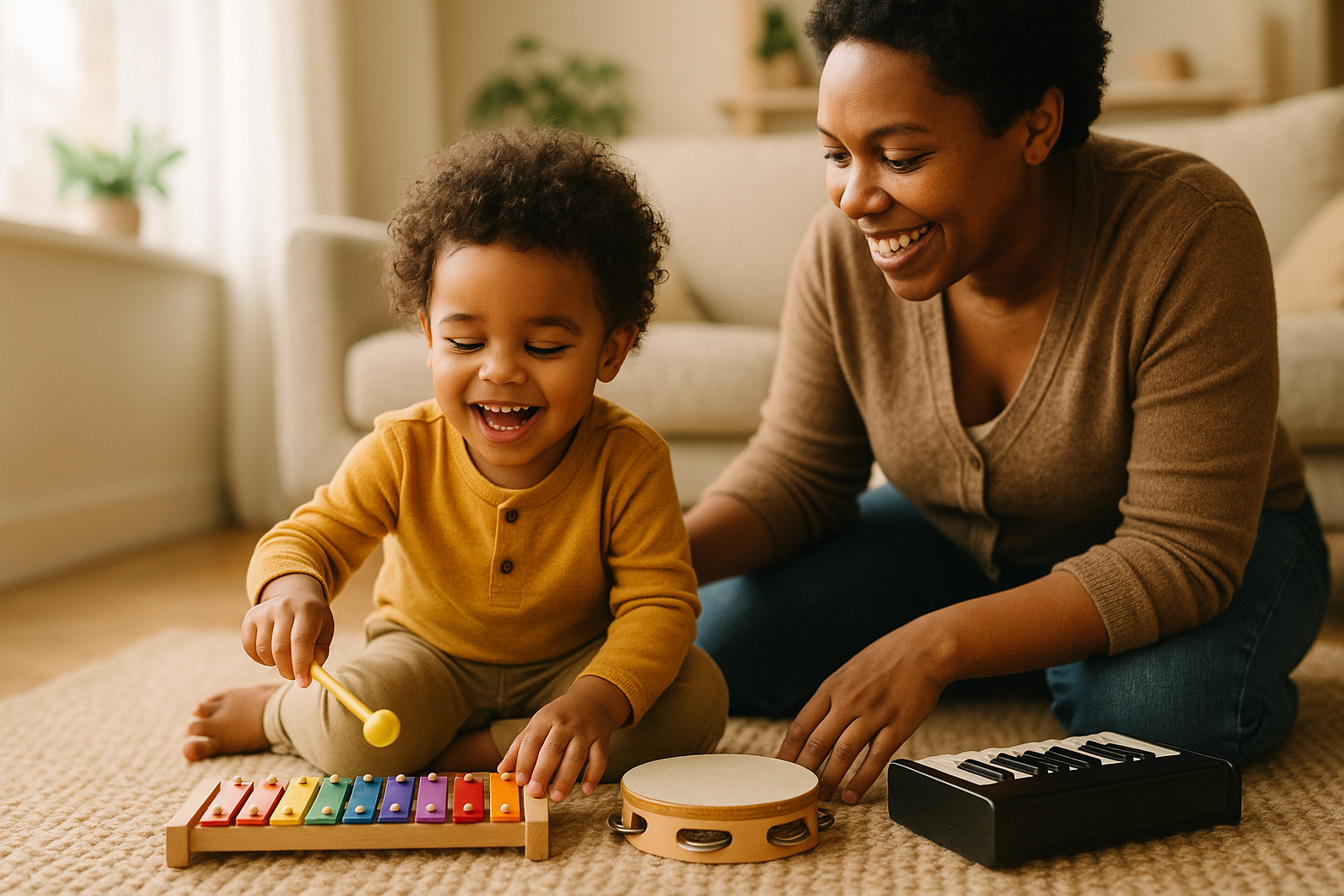
Buy CDs that contain songs designed especially for preschool age children. Encourage your child to sing along. Sing with them. Buy small rhythm instruments and play marching band. Bring the CDs along on car rides to keep your child entertained. You’ll find that exposing them to age-appropriate songs will help them develop not only a love for singing but also a good singing voice.
Try not to let your preschooler sing along to the latest Christina Aguilera or U2 songs. Imitating rock singers encourages improper singing technique and could put your child at risk for vocal chord damage later in life. Avoid the Broadway Belter style as well. Most Broadway song lyrics are inappropriate for little ones and boast extensive ranges that result in poor and out-of-tune singing. They’ll reap many more benefits from singing time-honored children’s favorites.
Classes Outside the Home
If you’re looking for some musical activity in which to enroll your child outside the home, check out the many programs that involve both parent and child. One of the best and most well-known is Kindermusik. Developed in Germany in the 1960s and adapted to serve American families in the 1970s, Kindermusik is now offered in more than 35 countries. Their philosophy is founded upon the beliefs that “music nurtures a child’s cognitive, emotional, social, language, and physical development” and “every child should experience the joy, fun, and learning which music brings to life.” The Kindermusik program accommodates learners from newborn to 7 years old and provides activities that can be enjoyed and reinforced at home.
If you don’t have a Kindermusik program in your area, seek out other “Mommy and Me”-type programs that encourage parent involvement in your child’s music education. They usually involve learning simple songs, coordinating creative movement with these songs, and playing rhythm instruments.
Stay away from programs that promise the impossible. For example, one popular east coast kid’s “gym” offers a music program that includes ½ hour group keyboard lessons for 3-year olds. Don’t waste your money. Unless your child is the next Mozart, he/she will have neither the attention span nor the motor skills to reap any benefits from such lessons.
When is the right age to start music lessons for my preschooler?
Most music educators recommend against formal private lessons before age 6 or 7. Preschoolers typically don’t yet have the attention span or fine motor skills needed to benefit from structured instrument lessons — a group keyboard class for 3-year-olds, for example, is unlikely to produce results worth the investment. Instead, focus on informal musical exposure at home and group music programs designed for young children. Formal private lessons become much more productive once children are a bit older and can follow instruction and practice independently.
What kind of music should young children listen to at home?
Children’s songs with simple melodies and easy-to-memorize words are ideal for preschoolers. Classic nursery rhymes and children’s folk songs — ‘Twinkle Twinkle,’ ‘Mary Had a Little Lamb,’ ‘She’ll Be Comin’ Round the Mountain’ — help develop singing ability and a genuine love of music. Encourage your child to sing along, and sing with them. What your child hears regularly at home shapes their musical taste and their singing voice, so avoiding music designed for older audiences (especially songs with complex ranges or inappropriate lyrics) is worth the effort.
What is Kindermusik and is it good for young children?
Kindermusik is a music education program developed in Germany in the 1960s and now available in over 35 countries. It’s designed for children from newborn through age 7 and involves both parent and child in the learning process. The program is built on the belief that music supports cognitive, emotional, social, language, and physical development — and that children learn best when parents are actively involved. Classes typically include songs, creative movement, and simple rhythm instruments, with activities that can be reinforced at home.
Should I let my preschooler imitate pop or Broadway singers?
It’s best to steer clear. Pop and rock vocals often use techniques that can strain a young child’s developing vocal cords, and Broadway-style belting encourages ranges that are too wide for small voices. Many Broadway song lyrics are also inappropriate for young children. Children’s songs are designed with age-appropriate ranges and techniques that allow kids to sing with good habits from the start. Patricia Guth, a music educator with 25 years of classroom experience and a Kindermusik-trained director, recommends sticking with children’s repertoire through the preschool years.
Biography for Patricia Guth
Patricia Guth, a resident of the Philadelphia area, holds a degree in music education from Westminster Choir College, Princeton, NJ. For the past 25 years, Mrs. Guth has taught in both public and private elementary schools and has directed both community choirs and church choral and instrumental ensembles. She has been trained in a number of different musical methods, including Kindermusik and Kodaly.
As artistic director of the Young Singers of Pennsylvania since 1998, Mrs. Guth has traveled extensively with this award-winning choir, performing in such venues as Walt Disney World, Quebec City’s Canada Day celebration, Boston’s Faneuil Hall, Central Park in New York City, and many other locations throughout the eastern U.S. and Canada.
Mrs. Guth is also currently the Director of Music at the Ivyland (PA) Presbyterian Church, where she oversees a graded choir program.
Patricia has been married for 25 years to Gary, also a music teacher, and has two children. Son Ryan is a music teacher and daughter Emily is a dancer.
No part of this article may be copied or reproduced in any form without the express permission of More4Kids Inc © 2006
Posting Search Tags: Education Children Music













Add Comment