















By Sophia Richards
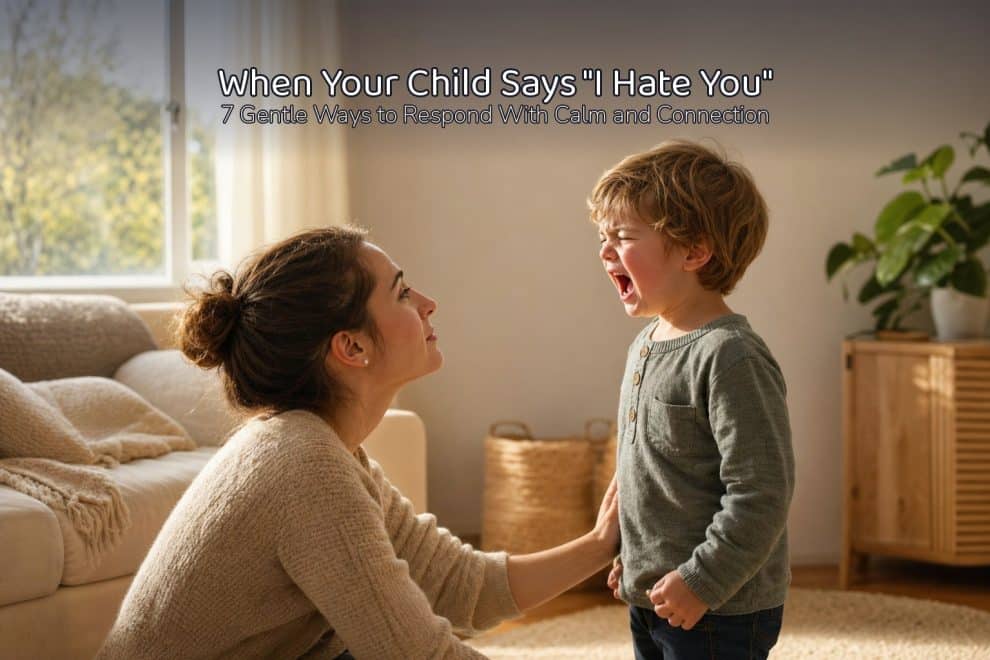
The first time one of my kids said it, I was holding a wet dish towel and completely unprepared. I’d told my oldest — she was five — that no, we were not having ice cream before dinner, and her whole little face crumpled and then hardened, and out it came like a slammed door: “I HATE you!” I remember the towel going still in my hand. I remember the hot, stupid sting of tears behind my own eyes, and the very grown-up thought that arrived a half-second later: she doesn’t mean it… does she? If your child says I hate you and it knocked the wind out of you too, come sit down here with me for a minute, because I have been on that kitchen floor, and I want to tell you what I wish someone had told me.

Here’s the short version, and then we’ll take it apart together gently: those three words are almost never the truth, and they are almost always a signal. A child who says “I hate you” is a child who is drowning in a feeling too big for their small body and reaching for the loudest, sharpest word they know to make you feel how bad it is inside them. It is not a verdict on your parenting. It is not the beginning of a lifelong rift. It is, more often than not, a clumsy, red-faced cry for help. Let me show you what’s really going on underneath, and seven warm, doable ways to respond that hold your limit and your child’s heart at the same time.
What “I Hate You” Really Means (It’s a Big Feeling, Not a Verdict)
Table of Contents
Let’s start with the reframe that saved my sanity, because everything else grows out of it. Young children do not have the emotional vocabulary we do. When a feeling swamps them — fury, powerlessness, disappointment, the sheer indignity of being told no — they don’t have the words to say, “Mom, I feel completely out of control right now and I don’t know what to do with all of this.” So they grab the biggest, most powerful words within reach.
The child-development experts at ZERO TO THREE explain this beautifully in their guidance on aggressive behavior in toddlers: young children “use actions like hitting or biting when they don’t have the words to express big feelings.” “I hate you” is simply the verbal cousin of that hit — the same overflow of a feeling that’s too big to hold, coming out of the mouth instead of the hands. It looks like an attack. It’s actually a signal flare.
And their brains genuinely are not built yet for anything more graceful. ZERO TO THREE puts it in a line I keep taped to the inside of a cabinet: at this age, “emotions still trump thinking skills almost every time.” Your child’s feeling brain, in a big moment, simply outruns their thinking brain. They cannot, in that flooded instant, pause, locate the precise word, and deliver you a calm, accurate report of their inner state. What comes out is loud and blunt and aimed at you — because you are their safe person, the one they trust enough to fall apart in front of. That last part is the twist of the knife and also the comfort: they say it to you precisely because they feel safest with you.
So when your child says I hate you, try to hear the sentence underneath the sentence. It’s usually some version of: I’m so mad. I feel powerless. I wanted that so badly and you said no and I don’t know what to do with how big this is. Once you can hear that, you stop reacting to the words and start responding to the child. That shift is the whole game.
When You Might Hear It — and Why It’s Normal
You’ll hear “I hate you” most often right on the heels of a limit: bedtime, screen time ending, a “no” to the toy, a turn that went to a sibling instead. That’s not a coincidence. ZERO TO THREE notes that toddlers and young children are busy discovering “that they are their own person, separate from parents,” hungry to “assert independence and make their own choices” — while their brains “are still building the skills needed for self-regulation.” A limit collides head-on with that fierce new drive for autonomy, and the collision comes out sideways.
It also shows up a lot between brothers and sisters, which is why the way you coach sibling rivalry matters here too. And it can arrive during ordinary transitions — the American Academy of Pediatrics reminds us in its tips on tantrums that big meltdowns “are a normal part of development,” peaking “between ages 1 and 3 years.” The reassuring news tucked into that same guidance: tantrums “do tend to get better after the age of 3,” as language and self-control slowly catch up. “I hate you” tends to follow the same arc — loudest in the little years, softening as your child grows the words to say what they actually mean.
None of that makes it pleasant. But it does mean that if your child says I hate you, you are not raising a cruel kid and you are not failing. You are raising a normal one whose feelings are, for now, bigger than their toolbox.
When Your Child Says I Hate You: 7 Gentle Ways to Respond
None of these are scripts to perform perfectly. Think of them as a path you walk with your child, over and over, until the walking teaches them something. Do them warmly. Do them imperfectly. Do them a thousand times.
1. Breathe first — your calm is the most powerful thing in the room
Before you say a single word, take the breath. I know how hard this is — those three words are engineered to hit a parent right in the tender spot. But ZERO TO THREE is unambiguous about what helps: “Staying calm yourself is the best response as it helps your child calm down more quickly… She needs you to be her rock when she is ‘losing it.'” When you get agitated and escalate, you pour gasoline on the fire; when you stay steady, you become the shore your child can swim back to.
This is also, quietly, the most important teaching you’ll do. The AAP’s number-one healthy-discipline strategy is simply to “model behaviors you would like to see in your children” — to “teach children right from wrong with calm words and actions.” Your child is learning how big feelings get handled by watching you handle theirs. So the first move, always, is to stay calm: unclench your jaw, drop your shoulders, and remind yourself of the truth — this is a scared, overwhelmed kid, not an enemy. You can even name your own reset out loud: “That was a big thing to say. I’m going to take a breath.” You just modeled the entire skill.
2. Don’t take the bait — respond to the feeling, not the word
Here’s the trap I fell into for a while: I’d argue with the content. “You don’t hate me. That’s a terrible thing to say. After everything I do for you?” All that does is start a courtroom battle your child cannot win and does not understand, and it teaches them that “I hate you” is a big red button that gets an enormous reaction every time they press it. The AAP notes that the most powerful tool you have is your attention — so be careful what you lavish it on. A giant wounded reaction can accidentally reward the very words you don’t want.
Instead, let the word slide right past and reach for the feeling behind it. You might say, calmly, “Wow. You are so angry with me right now.” No lecture. No wounded speech. You’re showing your child that their feeling is what you heard — not the ammunition they threw. This takes practice and it takes not letting your own hurt drive the bus for thirty seconds. It gets easier every time you do it.
3. Name and validate the feeling underneath
This is the heart of it. Once you’re calm and you’ve let the word go, put language to what’s actually happening inside your child — the language they couldn’t find. ZERO TO THREE calls this putting “words to their feelings,” and it’s exactly what the teacher Talisa does in their lovely example of a child melting down at drop-off: she stays calm, holds the child close, and tells her “she knows [she] is sad… and that it’s okay to be sad.” Notice the move — she validates the feeling fully and warmly, and (as we’ll see next) still holds the behavior line.
In my house it sounds like this: “You’re allowed to be mad at me. You really wanted that ice cream and I said no, and that feels so unfair. I get it. Sometimes we’re so angry at someone we love that it feels almost like hate for a minute — and that’s okay.” That “it feels almost like hate” line does something magic: it hands my child accurate words for the enormous thing they’re feeling, and it quietly corrects the story without shaming them. The Greater Good Science Center at UC Berkeley, in its guide to helping kids with anger, reminds us that anger “is neither good nor bad, but rather evidence of being human.” We’re not trying to make the anger go away. We’re trying to help our child feel it, name it, and survive it — which is the root of real emotional regulation for kids.
4. Hold the limit and your love at the same time
Validating the feeling does not mean caving on the limit — and this is where so many of us wobble, because it feels contradictory. It isn’t. The gentle magic is doing both at once: “It’s okay to be mad at me. It is not okay to scream mean things — and we’re still not having ice cream before dinner.” Feeling: fully welcome. Behavior and boundary: firmly held.
The AAP’s advice to “set limits” with “clear and consistent rules” lives right alongside its advice to hear your child out — they’re partners, not opposites. And consistency is the kindness here: the AAP points out that “your consistency from day to day is key.” A child who learns that “I hate you” reliably melts the limit will reach for those words again and again; a child who learns the limit holds and the love holds learns something far more reassuring — that your care for them is not up for negotiation and neither, calmly, is bedtime. If the big feeling tips into hitting or throwing, that’s the one place to be crystal clear: the AAP says plainly, do “not ignore behaviors like hitting, kicking, biting, or throwing.” Feelings are always allowed; hurting people or things is where the gentle, firm line lives. Holding that line without withdrawing your warmth is also how you build the kind of security that lets a child tolerate a “no” — the quiet foundation under genuine confidence in a child.

5. Wait for calm before you teach — connect first, correct later
We parents love to teach in the heat of the moment — to deliver the lesson right when the feeling is loudest. It never works, and now I understand why. ZERO TO THREE spells it out: a flooded child needs “help to calm down before any teaching or learning can take place.” The thinking brain is offline. Any lecture you give a screaming child is a voicemail left at a number that’s temporarily disconnected.
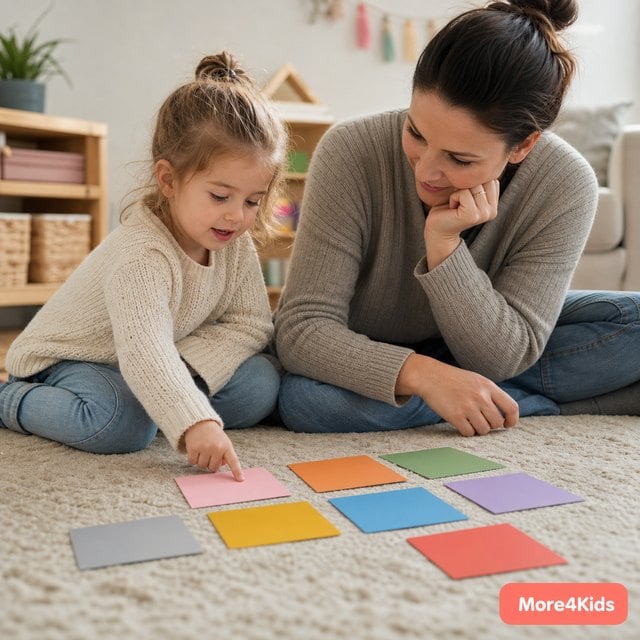
So connect first. Get down to their level. Offer the calm-down before the conversation — the AAP suggests giving a child “control over little things” with small, directed choices, which hands a powerless-feeling kid a scrap of agency: “Do you want to squeeze my hand or squeeze the pillow?” ZERO TO THREE loves a “cozy corner” — a soft, safe spot with pillows and books where a child can regain control (and they’re clear “this is not punishment,” it’s a life skill). Only after the storm passes, when your child’s eyes are clear again, do you gently circle back to what happened. Connection is not you losing the discipline battle. Connection is what makes the discipline land. When the feelings run especially huge, our full guide to helping kids manage big emotions walks you through that calm-down step in more detail.
6. Give the big feeling a better exit
Once your child is calm and you’re teaching, the most useful thing you can offer isn’t “don’t say that” — it’s “here’s what you can do instead.” Big feelings need somewhere to go. ZERO TO THREE suggests coaching kids toward healthy outlets: “jump up and down, hit the sofa cushions, rip paper, cuddle up in a cozy area,” anything that lets the storm move through the body without hurting anyone. The goal, in their words, is to “teach your child that there are many ways to express his feelings in healthy, non-hurtful ways.”
I keep this concrete in our house. “When you’re that mad, you can stomp your feet, you can tell me ‘I’m SO angry,’ you can go squeeze your pillow-monster as hard as you want. Those are strong-and-safe. Screaming that you hate me — that hurts, and it doesn’t help you feel better anyway.” Greater Good adds a lovely deeper move for slightly older kids: teach them to “look beneath anger,” because it’s “often pointing to what they value most: friendship, fairness, belonging, or care.” When my middle one raged “I hate you” at bedtime for weeks, looking underneath revealed the real thing — he was scared of the dark and furious about being left alone with it. The words were “I hate you.” The need was “please don’t leave me.” Coaching kids to find that underneath is the same muscle as teaching empathy — first they learn to read their own hearts, then everyone else’s.
7. Repair together afterward — and repair yourself, too
Here’s the step glossy advice skips: the repair. When your child is calm, come back together — not to re-litigate, but to reconnect and gently close the loop. ZERO TO THREE models naming the impact simply and without shame: “After you hit Carrie, she started to cry. It hurt.” For words, it’s the same: “When you yelled that you hate me, it hurt my feelings a little — and I still love you completely, no matter what. Nothing you could ever say would change that.” Then catch the good: the AAP is big on praising real effort, and ZERO TO THREE says to “give your child lots of positive feedback when she shows self-control.” When your child manages a big feeling a little better next time, notice it out loud.
And Greater Good offers the piece that made me exhale: model repair for your own slip-ups. If you lost your cool and snapped back, own it — “I yelled too, and I’m sorry. I was frustrated, and I’m working on staying calm just like you are.” Taking responsibility, they note, “doesn’t mean the anger was wrong; it means [we’re] learning to use it wisely.” You are not required to be a parent who never gets stung. You’re allowed to be a real one who keeps coming back to warmth. That repeated coming-back, over years, is what grows a genuinely resilient child — and self-control itself is a skill that strengthens with practice, the same way a growth mindset takes root.
When It’s More Than a Moment: A Gentle Word on Getting Help
Let me say the honest thing. For the vast majority of kids, “I hate you” is a passing storm that softens as they grow — one more normal, maddening, tender part of the parenting years. Stay calm, connect, hold your limits with love, and it fades.

But you know your child. If the words come wrapped in aggression that isn’t easing with all your patient coaching, if there’s real cruelty or a persistent, worrying pattern, or if — as ZERO TO THREE gently frames it — it “starts to interfere with learning or relationships,” that’s worth a calm conversation with your pediatrician. The AAP says the same about intense behavior: “Talk with your pediatrician if you’re concerned.” This isn’t a panic button. It’s just adding one more caring, knowledgeable adult to your child’s corner. Most of the time, though, what our kids need in these moments isn’t a specialist. It’s us — steady, unshaken, still loving them fiercely on the days they can’t find a kind word to save their lives.

Frequently Asked Questions
Does my child really mean it when they say "I hate you"?
Almost never, and especially not in the way the words sound to your adult ears. For a young child, “I hate you” is rarely a considered statement about their true feelings toward you — it’s the biggest, loudest word they can find to show you how overwhelmed, angry, or powerless they feel in that moment. Their feeling brain has outrun their thinking brain, and this is simply what overflowed. In fact, children tend to say it to the person they feel safest with, which is a strange kind of compliment buried in a painful sentence. Respond to the big feeling underneath rather than the words themselves, and the sting fades faster for both of you.
How should I respond in the actual heat of the moment?
Lead with your own calm, because your steadiness settles your child faster than anything you can say. Take a breath, drop the urge to argue with the word, and reflect the feeling back: “You are so angry with me right now.” Validate the emotion fully while still holding your limit — “It’s okay to be mad; it’s not okay to scream mean things, and the answer is still no.” Save any teaching or talking-it-through for after the storm passes, because a flooded child genuinely can’t take in a lesson mid-meltdown. Connect first, correct later, and you’ll get much further than any in-the-moment lecture ever will.
Should I punish my child for saying "I hate you"?
Punishing the feeling usually backfires, because it teaches your child to hide big emotions rather than learn to handle them. Aim your response at the behavior, not the emotion: the feeling of anger is always allowed, but hurtful words and actions are where you hold a gentle, firm line. Instead of a punishment, coach a better exit — name the feeling, offer healthy ways to release it, and revisit it calmly once your child settles. If the words tip into hitting, throwing, or real aggression, address that clearly and consistently. The goal is to build self-control over time, and that grows from connection and practice far more than from consequences alone.
At what age do kids say "I hate you," and will they grow out of it?
You’ll most often hear it from toddlers through the early school years, frequently right after you set a limit, because that’s when a child’s fierce drive for independence collides with their still-developing self-control. It tends to peak in the little years, when feelings are enormous and vocabulary is small, and it genuinely softens as your child grows the language to say what they actually mean. That doesn’t mean you ignore it in the meantime — the calm, connected responses you practice now are exactly what teach the better words. With steady coaching, most children move from “I hate you!” toward “I’m really mad at you!” and that’s real progress worth celebrating.
It hurts my feelings so much — how do I not take it personally?
First, give yourself grace: it’s supposed to sting, because you love this child with everything you have, so of course the words land hard. It helps enormously to hold onto the reframe — your child isn’t reporting a true feeling about you, they’re showing you an overwhelmed one about the moment. Take your own breath, and if you need a second to steady yourself before responding, that’s not weakness, it’s wise modeling. It’s also okay to name it gently later: “That hurt my feelings, and I still love you no matter what.” Repairing your own hard moments teaches your child that big feelings and lasting love can live in the same house — which is one of the most reassuring things they’ll ever learn.
Related Articles
- Sibling Rivalry
- Emotional Regulation For Kids
- How To Build Confidence In A Child
- How To Help Kids Manage Big Emotions
- Teaching Kids Empathy
- Raising Resilient Children

Meet Sophia Richards Sophia Richards is an early childhood educator, passionate writer, and the proud mom of three energetic kids. With a degree in Education and over a decade of hands-on classroom experience, Sophia bridges the gap between professional teaching strategies and everyday family life. At More4Kids, she translates complex child development concepts into practical, actionable parenting tips that families can use at home.
Whether she is sharing positive reinforcement techniques, educational crafts, or honest reflections on the chaos of raising three children under one roof, Sophia’s goal is to empower parents to foster resilience and joy in their kids. When she isn't writing or lesson planning, you can find her organizing neighborhood scavenger hunts or trying out new kid-friendly recipes.
Areas of Expertise: Early Childhood Education, Positive Parenting, Sibling Dynamics, Educational Play, Family Wellness.

Add Comment