















By Sophia Richards
There’s a shoebox in my closet right now with about ninety loose photos in it, three concert ticket stubs that don’t belong to any of my kids, and a hospital bracelet I meant to do something with two years ago. I know exactly what it is. It’s the ghost of a baby book I bought with the best intentions and abandoned somewhere around month four, when “creative project” stopped sounding like a language I still spoke.
If you’re picturing baby scrapbooking as coordinated cardstock, die-cut letters, and a Pinterest-worthy two-page spread for every milestone, I want to talk you out of that image completely. A lot of scrapbooking for new moms advice out there is written by people with a genuine hobby and a full evening to spend on it, which is just not where most of us are in the newborn or toddler years. That version is lovely if it’s genuinely your thing — but most of us are not sitting down with washi tape and a Cricut at 9 p.m. The scrapbook that actually gets made is the one that asks almost nothing of you.
I’ve raised three kids through the newborn fog, and here’s what I’ve learned about baby scrapbooking that nobody puts on the craft-store endcap: the goal isn’t beautiful. The goal is exists. A messy scrapbook your kid can flip through at sixteen beats a gorgeous one that’s still sitting in a bag of supplies you never opened.
That’s really the whole premise behind every one of the baby scrapbooking ideas below — low effort, genuinely doable, and built around the life you actually have instead of the craft-fair version of parenthood.
Baby Scrapbooking Ideas That Take 10 Minutes, Not 2 Hours
Table of Contents
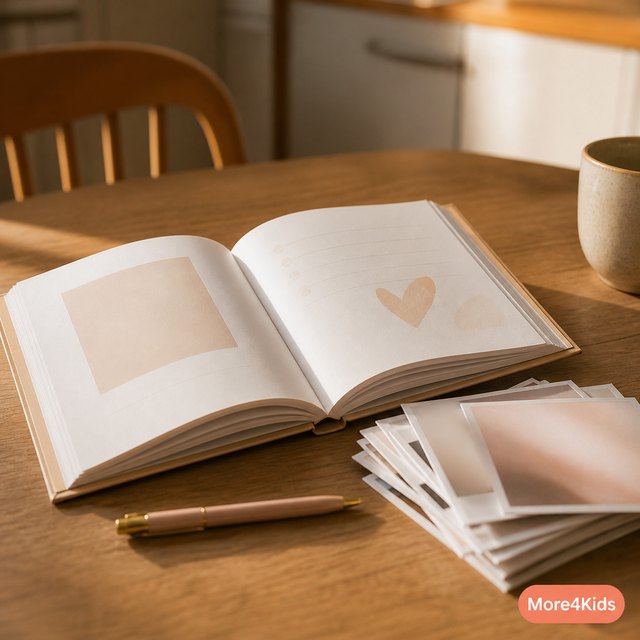
Here’s the layout that actually happens in real life: one photo, taped or glued onto a page, with a sentence or two written underneath in your regular handwriting. That’s it. That’s the whole system.
I used to think a “real” scrapbook page needed a background paper, a border, some kind of embellishment, and a caption in careful lettering. What actually works is closer to a photo diary than a craft project. Pick one photo. Stick it down. Write one true thing about that day — what he was wearing, what was going on in the background, what you were thinking. Move on.
The trick is capping your ambition on purpose. Tell yourself “I’ll do a full spread with three photos and decorations,” and you’ll do it twice, then stop — that’s genuinely too time-consuming for the stretch of uninterrupted time you actually have. Tell yourself “one photo, one page, five sentences max,” and you can do that during a nap, during a show your toddler is half-watching, or in a parked car waiting for a sibling’s practice to end.
A few real formats that take ten minutes or less:
- One photo + a caption. No theme, no color-coordination. Whatever photo is on top of the stack.
- A “this week” page. Not a milestone, just what an ordinary Tuesday looked like — what he ate, what made him laugh, what you were tired of by 6 p.m.
- A list page. No photo at all — just a running list, like “sounds she makes now” or “things that currently make him cry,” added to over a few sittings.
None of these require supplies you don’t already own. That’s the point — and honestly, most easy baby scrapbook ideas fall apart not because parents lack creativity, but because the “real” version was never realistic in the first place.
What’s Actually Worth Documenting (Hint: Not Just the “Firsts”)
Baby books love to chase firsts — first smile, first steps, first word, first tooth. Those matter, and I’m not telling you to skip them. But if firsts are the only thing you record, you end up with a book that’s mostly blank, because most of babyhood isn’t a first anything. It’s Tuesday. It’s the fortieth time he’s done the same funny face.
The ordinary stuff is what you’ll actually miss later, and it’s also the stuff you’re most likely to forget, because there’s no clear marker for “the day he stopped needing the pacifier to nap” the way there is for “first steps.” Milestones announce themselves. Everyday texture doesn’t — it just quietly disappears unless someone writes it down.
So when you’re deciding what goes in the scrapbook, let it be a mix on purpose:
- The milestones, sure — but you don’t need a whole page each. A sentence and a photo is plenty.
- A “right now” entry every so often — favorite food this month, favorite toy, a phrase she says constantly, what makes him laugh hardest.
- The mundane photo that’s secretly the good one — not the posed smile, but the mid-meltdown face, the bedhead, the one where he’s mid-sneeze. Those are the ones that make you laugh out loud in five years.
- Small context that won’t survive in your memory — what the apartment looked like, what was on the radio, what you were worried about that week.
If you only have energy for one rule, make it this one: document more everyday moments than firsts, on purpose, because the firsts will mostly take care of themselves anyway.
Supplies You Already Own (No Craft-Store Trip Required)
You do not need a hobby-store haul to start a baby scrapbook. This is where most baby scrapbook ideas online go wrong — they assume you’re starting from zero and need to buy a kit. You don’t. Here’s what actually works, and what I’ve genuinely used:
- A plain notebook or blank sketchbook. Doesn’t have to say “baby book” on the cover. A sturdy spiral notebook or a hardback sketchbook from any drugstore or big-box store holds a photo and a bit of writing just fine.
- Printed phone photos. This is the one everyone skips and the one that matters most. Photos that live only on your phone aren’t in the scrapbook — they’re future clutter in your camera roll. You don’t need photo-lab quality; a basic home printer or a drugstore photo kiosk print is enough.
- Tape. Plain tape, double-sided tape, or a glue stick — whatever’s already in your junk drawer. You do not need archival photo corners or acid-free paper unless you want them.
- A pen you like writing with. That’s genuinely it. The handwriting is part of the charm — it doesn’t need to be neat.
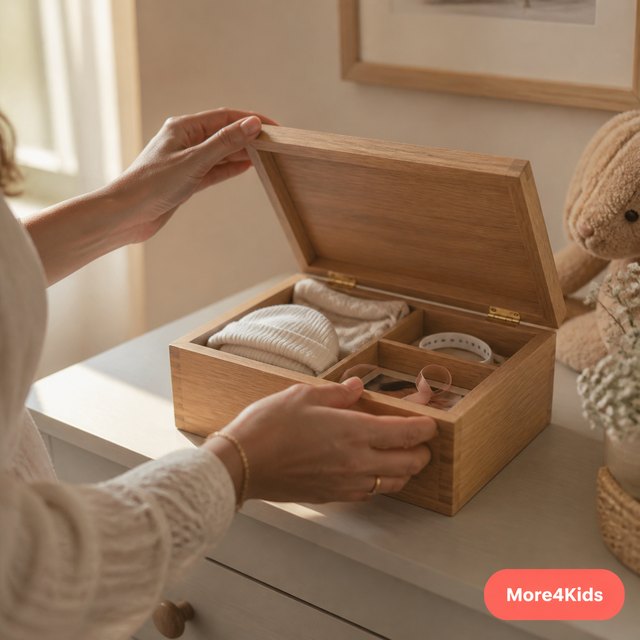
- Optional extras, if you have them: a hole punch and ribbon to bind loose pages later, a few stickers if a kid wants to decorate, an envelope taped into a page for flat keepsakes like a hospital bracelet or a lock of hair.
What I’d actively skip: patterned scrapbook paper, a die-cutting machine, stamp sets, anything that requires planning a project before you can start it. If those things genuinely bring you joy, wonderful — but treating them as required is exactly what turns a ten-minute task into a project that never starts.

Batch Your Printing Instead of Scrapbooking in Real Time
This is the single biggest thing that changed how I actually finished pages instead of just planning to. Don’t try to print and scrapbook a photo the same week it was taken. Batch it.
Pick a photo-printing cadence you can actually sustain — monthly is realistic for most people, quarterly is fine too. Once a month (or once a season), go through your camera roll, pick a manageable number of photos — I aim for somewhere around ten to twenty — and send them to print all at once, either through a drugstore kiosk or an online photo-printing service. Then the scrapbooking itself becomes a separate, smaller task: you already have a stack of printed photos sitting there, so all you have to do is tape a few in and write a caption whenever you have a spare ten minutes.
Trying to do both steps — pick the photo, print it, journal about it — in one sitting is what kills most scrapbook attempts. Splitting “get the photos printed” from “put them in the book” means neither task requires much time or decision-making on its own. Printing is a task you can do half-asleep while a toddler eats crackers next to you. Taping and writing a sentence is a task you can do in a waiting room.
If even that feels like too much, set a recurring reminder on your phone for “print photos” and treat it like any other recurring household task — similar to the kind of small maintenance habits that keep a home running smoothly without becoming its own project.

If You’re Never Going to Do Physical Pages, Go Digital
Some parents read all of the above and still know, honestly, that physical pages are not going to happen. That’s a completely legitimate thing to know about yourself, and there’s no shame in it — digital scrapbooking is just as real a record as a taped-up notebook, and for some households it’s the only version that will actually get maintained. A digital version can absolutely give your kid the same thing — a record they can look back through — without asking you to own scrapbook supplies at all.
A few realistic digital paths:
- Photo book apps. Most major photo-printing services let you build a simple photo book right from your phone’s camera roll, add short captions, and order a printed, bound copy when you’re ready. You can build it in small sessions over months rather than all at once, and it still ends up as a physical object your kid can hold — just without any cutting, taping, or page design on your part.
- A shared photo album or folder. Even without ever ordering a printed book, keeping a running, organized digital album — with occasional captions in the photo’s description field — is a real form of scrapbooking. It’s not tactile, but it’s searchable, backed up, and easy to share with grandparents.
- A voice memo or notes app entry. If writing captions feels like the bottleneck, talk instead. A quick voice memo describing a photo, saved alongside it, captures tone and detail that you might not bother typing out.
- A private social media album or blog. Some parents keep a private, unlisted account or blog just for family photos and updates. It’s not archival in the traditional sense, but it is a running record, and it’s genuinely better than nothing sitting on a phone that could be lost or replaced.
None of these are lesser than a physical scrapbook. They’re just a different tool for the same underlying goal — actually keeping the memory somewhere instead of only in your head, where, if you’re anything like me on four hours of broken sleep, it will not reliably stay. I know plenty of parents, myself included on my third kid, who mix both — a loose physical notebook for the everyday stuff and a digital photo book ordered once a year for the polished version. There’s no rule that says you have to pick only one.
Permission to Do the Messy Version (or the Incomplete One)
I want to say this plainly, because I think a lot of parents need to hear it: an unfinished scrapbook with gaps in it is still a real scrapbook. A page with a crooked photo and a two-word caption still counts. A book that has entries for months two, five, and eleven, with nothing in between, is still worth having.
The whole idea that a baby book has to be complete — every month accounted for, every milestone in its designated box — is what stops most of these projects before they start. Nobody’s future teenager is going to flip through their baby book counting the missing months. They’re going to look at the photos that are there, read the handwriting, and feel something. That’s the entire job of the thing.
So: use whatever notebook you have, even if the cover doesn’t match. Skip months if you skip them, and pick back up later without going back to fill in the gaps. Let a page be one blurry photo and no caption at all if that’s what you’ve got the energy for that day. If a kid “helps” and a sticker ends up crooked or upside down, leave it — that’s not a flaw, that’s evidence a real toddler was in the room. The point was never a museum piece. The point is having something real, in your handwriting, that says this happened and this is how I remember it.
If you’re also working on other places to keep the physical bits of babyhood — the hospital bracelet, the going-home outfit, that lock of hair you’ve been carrying around in a sandwich bag — our baby memory box ideas piece is basically the sister project to this one, built with the same “low effort, still meaningful” philosophy. Between a loose scrapbook and a simple memory box, you end up with a pretty complete picture of the first year without either project turning into a second job. And if you’re setting up a nursery or nursery storage from scratch, some of the same low-pressure thinking applies to organizing a baby registry — pick a few things that make life easier, skip the rest, and don’t let “complete” become the enemy of “started.”
Give yourself permission to close the notebook after five minutes. Give yourself permission to let this month be blank. The version of this project that exists, imperfect and half-finished, will always beat the perfect one that’s still just an idea in your head — and that’s true whether you end up with a full baby memory book or three loose pages taped into a notebook you grabbed off a shelf.
Frequently Asked Questions
How often should I actually sit down and scrapbook?
There’s no correct frequency — the honest answer is “whenever you have ten free minutes and a stack of printed photos handy.” Some parents do a quick session weekly, others do a longer catch-up session monthly when they batch-print photos. Either works. What matters more than frequency is keeping each session short enough that you’ll actually want to do the next one.
What if I already have months of photos I never printed or organized?
Start now, not from the beginning. Pick a recent chunk of photos, print and add those, and let the earlier gap just be a gap — or do a single “catch-up” page later that summarizes an earlier stretch in a few sentences with one or two representative photos, instead of trying to recreate every week you missed.
Do I need to buy an actual baby scrapbook album?
No. A plain notebook, sketchbook, or even a three-ring binder with plain paper works fine. A dedicated album with pre-printed prompts (“baby’s first laugh,” “baby’s first bath”) can be nice if that structure motivates you, but it’s not required, and some parents find the blank prompts more pressure than help when life doesn’t follow the book’s order.
How do I get my other kids or my partner involved without it turning into a mess?
Let a sibling pick a photo or add a sticker to a page — a slightly crooked sticker is a feature, not a flaw. For a partner, splitting the two tasks helps: one of you handles printing photos periodically, the other adds captions when there’s a spare moment. It doesn’t need to be a shared ritual to still be a shared project.
Is it bad to just keep everything digital and skip a physical book entirely?
Not at all. A well-organized digital photo album, or a photo book ordered once or twice a year from a printing app, accomplishes the same goal — a record your child can look back on. The format matters far less than whether it actually exists and is easy enough for you to add to over time.
A Note on This Article
These ideas come from my own experience trying (and repeatedly failing, then trying again) to keep some kind of record of my kids’ early years — they’re not a professional craft tutorial or a claim that any one method is the “right” one. Every family’s version of this will look different, and that’s fine. This article is for general inspiration only; it isn’t organizing, archival, or medical advice, and you should adapt any of it to what actually fits your household and your energy level.
Related Articles

Meet Sophia Richards Sophia Richards is an early childhood educator, passionate writer, and the proud mom of three energetic kids. With a degree in Education and over a decade of hands-on classroom experience, Sophia bridges the gap between professional teaching strategies and everyday family life. At More4Kids, she translates complex child development concepts into practical, actionable parenting tips that families can use at home.
Whether she is sharing positive reinforcement techniques, educational crafts, or honest reflections on the chaos of raising three children under one roof, Sophia’s goal is to empower parents to foster resilience and joy in their kids. When she isn't writing or lesson planning, you can find her organizing neighborhood scavenger hunts or trying out new kid-friendly recipes.
Areas of Expertise: Early Childhood Education, Positive Parenting, Sibling Dynamics, Educational Play, Family Wellness.

Add Comment