
















By Sophia Richards
Homework has a way of finding the worst moment. It surfaces at 7:45 on a Tuesday, right when dinner is half-cleared, someone needs a bath, and the folder that was definitely in the backpack is now definitely not. Then comes the part every parent knows: the worksheet you could finish in four minutes, the child who would rather do almost anything else, and the slow slide from “let’s just get this done” into a standoff nobody wanted.
I’ve sat on both sides of that table. As a mom of three and an early-childhood educator, I’ve learned that the goal of homework isn’t a perfect worksheet tonight. It’s a kid who slowly learns how to sit down, focus, and finish something on their own. That shift changes everything, because it means your job is not to be the answer key. It’s to build the conditions that make the work possible, then get out of the way. These homework tips for parents are built around exactly that idea.
Why the Best Homework Tips for Parents Start Before the Homework Does
Table of Contents
Here’s the reassuring part, straight from the pediatricians: helping with homework does not mean hours hunched over a desk beside your child. Nemours KidsHealth notes that kids are more successful when parents take an active interest in their homework because it shows kids the work matters, and that being supportive can look like modeling good study habits, explaining one tricky problem, or simply encouraging a break.
The American Academy of Pediatrics puts it even more plainly: your role is to provide a quiet place, supplies, encouragement, and occasional help, but homework is your child’s responsibility, not yours. That one sentence takes a lot of pressure off. You are the setup crew, not the star of the show.
And most of the setup happens before a pencil ever touches paper. Just like a good daily routine gives kids structure and security, a predictable homework rhythm removes the nightly negotiation. Get the where, the when, and the how steady, and the actual work gets dramatically easier for everyone.
Step 1: Set Up a Homework-Friendly Spot
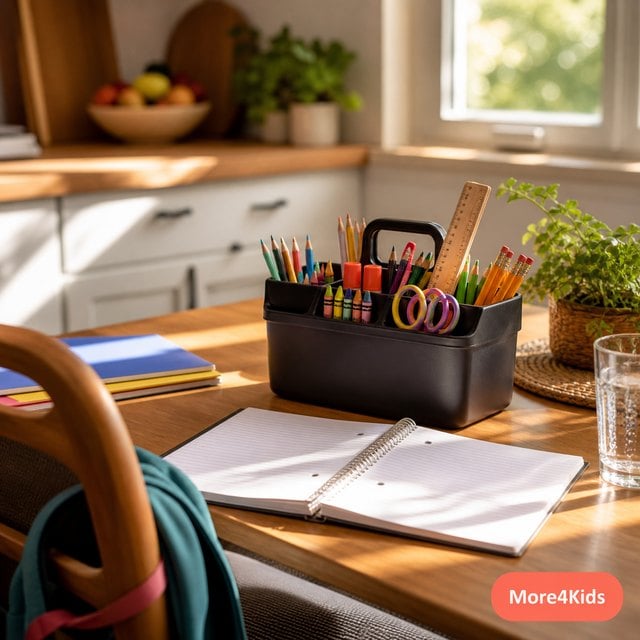
Kids can’t focus in chaos, and honestly, neither can we. KidsHealth recommends giving kids a well-lit place with supplies within reach so they can start without hunting for a pencil. The AAP agrees and adds a comforting detail for anyone without a dedicated study nook: a desk in the bedroom is not required, and the kitchen table works just as well, as long as it is quiet and free of the TV, other kids playing, and phone distractions.
The trick is to make starting frictionless. Keep paper, pencils, a dictionary, and whatever else your child reaches for in one bin or drawer near the workspace. When the supplies are already there, you skip the ten-minute warm-up of “I can’t find anything” that so often becomes an excuse to stall.
Step 2: Pick a Regular Time That Fits Your Kid

There is no universally right time for homework, and pretending there is causes half the battles. The AAP points out that some kids do best right after school, while others need to unwind and play first and tackle it after dinner with fresh energy. KidsHealth similarly suggests scheduling a regular study time around what actually works for your child.
Two things make this stick. First, let your child have a say in the plan; the AAP notes that agreeing together on a time and place removes two of the most common sources of homework conflict. Second, if a dictated hour (“4 o’clock, every day”) gets resistance, try a guideline instead, like “no screens until homework is done.” For families still finding their footing after summer, our guide to getting back into a back-to-school routine can help you anchor homework to the rest of the day. Once you find what works, protect it.
Step 3: Clear the Distractions Before You Start
A phone buzzing on the table will win against long division every single time. KidsHealth advises keeping distractions to a minimum: no TV, no loud music, no phone calls during homework, with the reasonable exception of an occasional call to a classmate about the actual assignment. The AAP echoes this, describing the ideal spot as quiet and free of screens and background noise.
In our house, phones and tablets go in a basket on the counter during homework time, mine included. Kids are far more likely to follow the example they see than the rule they hear, so if I’m scrolling three feet away, the no-screens rule loses all its power. Model the focus you’re asking for.
Step 4: Help Them Make a Plan, Then Step Back
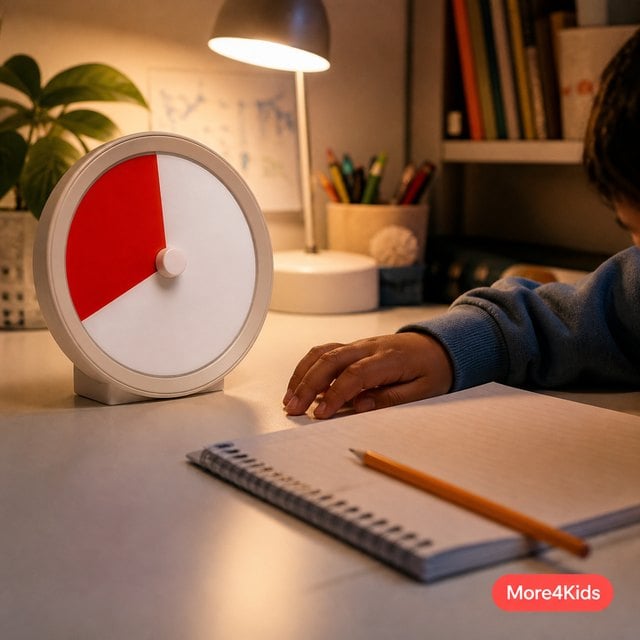
Big assignments overwhelm kids because they see one giant, shapeless task instead of a series of small ones. This is where you’re genuinely useful. KidsHealth suggests helping your child break the work into manageable chunks and, on heavy nights, sketching a quick schedule with a short break, ideally around 15 minutes, every hour or so.
The AAP flags one area where parent help is especially valuable: organizing how much work needs to happen each day to finish a long assignment like a term paper or science project. A wall calendar or a sticky note that breaks “book report due Friday” into “read two chapters tonight, notes tomorrow” teaches planning your child will use for the rest of their life. Make the plan together, then hand the pencil back.
Step 5: Help Without Doing It for Them

This is the hardest one, and the most important. It is so tempting to just tell them the answer at 8 p.m. when everyone is tired. But all three of my go-to sources land in the same place: KidsHealth says kids won’t learn if they don’t think for themselves and make their own mistakes, Reading Rockets reminds parents that doing your child’s homework does not help in the long run, and the AAP advises letting your child try a couple of problems first before you step in to explain.
A good rhythm is to sit nearby with your own book or paperwork, available but not hovering. Answer real questions, explain a concept once, then let them work. If your child routinely can’t finish everyday homework without you actively participating, the AAP suggests that’s worth a conversation with the teacher, because your child may need stronger direction in the classroom, not more help at the kitchen table.
Step 6: Space Out Studying Instead of Cramming
The night-before cram is a family tradition in a lot of homes, and it barely works. Reading Rockets recommends the opposite: when a big test is coming, help your child study a little bit each day rather than cramming, noting that about an hour every other day, spaced out, helps material actually stick.
Two more small tricks from the same source pay off. Mixing up the order, a little math, a little reading, a little word study, can leave a stronger impression than grinding one subject to the end. And revisiting new vocabulary a few times across the week, in different settings, deepens understanding. If reading itself is the sticking point, our parent’s guide to phonics has practical ways to build the underlying skills that make every other subject easier.
Step 7: Be a Motivator and a Monitor
Kids do more, and mind it less, when they know someone is paying attention. KidsHealth describes the parent’s job as motivator and monitor: ask about assignments, quizzes, and tests, check that homework is finished, give encouragement, and stay available for questions. Reading Rockets adds a simple version of this, which is to ask about homework each day and tell your child you’re proud of the work they’re doing.
Praise the effort, not just the grade. The AAP specifically encourages praising your child’s effort and success at doing homework well, because that’s what builds the habit. Post the hard-won spelling test on the fridge. Mention the finished project to Grandma while your child can hear it. Kids will pour more into work they feel genuinely seen doing.
Step 8: Protect Play and Reading, and Loop In the Teacher
Homework is not the whole evening, and it shouldn’t be. The AAP is clear that play matters for healthy social, emotional, and physical growth, and that your child has already had a long, tiring day of learning and needs some free time too. It also recommends reading aloud together even on nights with no assigned homework, which keeps the work-time habit alive and grows a love of reading at the same time.
Finally, stay in touch with the teacher. The AAP suggests flagging it if your child either struggles with assignments or breezes through them, so the work can be adjusted to fit. And if homework problems keep repeating, KidsHealth advises getting help, because sometimes what looks like a motivation issue is really something else, like a child who needs glasses or an evaluation for a learning or attention difference. If reading or spelling struggles feel bigger than an off week, our overview of the early signs of dyslexia is a calm place to start before you talk with the school.
A Simple Homework Routine You Can Adapt
Here’s a plain version to steal and reshape for your own family:
1. Same spot: a well-lit, quiet place with supplies already there. 2. Same time-ish: a regular slot your child helped choose, or a clear guideline like “homework before screens.” 3. Distractions parked: phones in a basket, TV off, and yours off too. 4. Quick plan: glance at everything, break the big stuff into chunks, note a short break each hour if it’s heavy. 5. You nearby, not on top: available for real questions, but they do the work. 6. Spread it out: for tests, a little each day beats a panic the night before. 7. Notice and praise: ask about it, check it, and name the effort you see. 8. Then stop: protect play, read together, and tell the teacher if something’s consistently off.
You’ll flex this constantly, and that’s the point. A first grader with ten minutes of homework needs almost none of it; a fifth grader with a project needs the planning parts most. A working homework routine serves your real family on a real Tuesday, not some tidy after-school fantasy.
For more of the ordinary, that’s-actually-hard parts of raising school-age kids, the parenting hub has plenty more. Pick just one change this week, maybe a fixed homework spot or a phones-in-the-basket rule. One small thing you actually keep will always beat a perfect system that collapses by Thursday.

Frequently Asked Questions
What are the best homework tips for parents?
The most effective homework tips for parents are less about the worksheet and more about the setup: give your child a quiet, well-lit spot with supplies within reach, pick a regular time that fits your child, and clear away screens and noise before starting. From there, help your child break big assignments into chunks, stay nearby to answer real questions without doing the work for them, and praise effort rather than just the grade. Consistency matters more than any single trick.
How can I help with homework without just giving the answers?
Sit nearby and be available, but let your child try first. Both Nemours KidsHealth and the American Academy of Pediatrics recommend explaining a concept or a single problem after your child has attempted a couple on their own, rather than solving it for them. Ask guiding questions like “what’s the first step?” instead of supplying the answer. Reading Rockets notes that doing your child’s homework doesn’t help in the long run, because the point of homework is the learning, not the finished page.
What time of day is best for homework?
There is no universal right time. The AAP notes that some kids do best right after school, while others need to unwind and play first and work better after dinner. Let your child have a say in the plan, since agreeing together on a time and place removes a major source of homework conflict. If a strict hour causes pushback, try a guideline such as “no screens until homework is done” instead.
How do I get my child to stop procrastinating on homework?
Reduce the friction and the drama. Keep supplies ready so there’s no stalling, give a ten-minute warning to help your child shift from play to work mode, and cut distractions like TV and phones, including your own. Break large tasks into small, clear steps so the work feels doable, and for tests, spread studying across several days rather than cramming. Steady encouragement and a predictable routine usually beat nagging.
When should I talk to my child's teacher about homework?
Reach out if your child regularly can’t finish everyday homework without you actively doing it with them, if assignments are consistently confusing, or if your child breezes through everything as though it’s no challenge at all. The AAP recommends staying in touch so the teacher can adjust the work to fit. If homework struggles keep repeating despite a good routine, KidsHealth advises getting help, since the cause is sometimes a vision issue or a learning or attention difference worth evaluating.
Related Articles
- A Secret To Happy Kids Daily Routines
- Back To School Schedules
- Parents Guide To Phonics
- Signs Of Dyslexia In Kids
- Parenting

Meet Sophia Richards Sophia Richards is an early childhood educator, passionate writer, and the proud mom of three energetic kids. With a degree in Education and over a decade of hands-on classroom experience, Sophia bridges the gap between professional teaching strategies and everyday family life. At More4Kids, she translates complex child development concepts into practical, actionable parenting tips that families can use at home.
Whether she is sharing positive reinforcement techniques, educational crafts, or honest reflections on the chaos of raising three children under one roof, Sophia’s goal is to empower parents to foster resilience and joy in their kids. When she isn't writing or lesson planning, you can find her organizing neighborhood scavenger hunts or trying out new kid-friendly recipes.
Areas of Expertise: Early Childhood Education, Positive Parenting, Sibling Dynamics, Educational Play, Family Wellness.

Add Comment