














By Elena Marsh
The first Celtic name that stopped me in my tracks was Sabrina. I was reading an old story about the River Severn to my daughter, and there it was — a girl’s name hiding inside the name of a river, carried down from a people who lived in Britain long before most of the names we know today. That is the pull of Celtic baby names for me, as a parent and a lifelong name-meaning nerd: so many of them began as rivers, hills, bears, and old words for noble and strong, then traveled through legend and poetry until they landed on a modern birth certificate. They feel ancient and alive at the same time.
Celtic baby names come from the Celtic peoples — the Irish, Scots, Welsh, Bretons, and the older Britons and Gauls — whose languages gave us some of the oldest name-roots still in use. I am a fellow parent and not a linguist, so I treat these meanings carefully. Celtic etymology is genuinely hard, and honest sources often disagree, so where a meaning is debated I say so instead of picking a tidy invention. The notes below come from our own published baby-name directory, with every name linked to its page, and you can browse the whole set at our Celtic origin hub or start wider at the main baby names directory. If you love hunting for the perfect fit, our Baby Name Finder is a lovely place to wander.
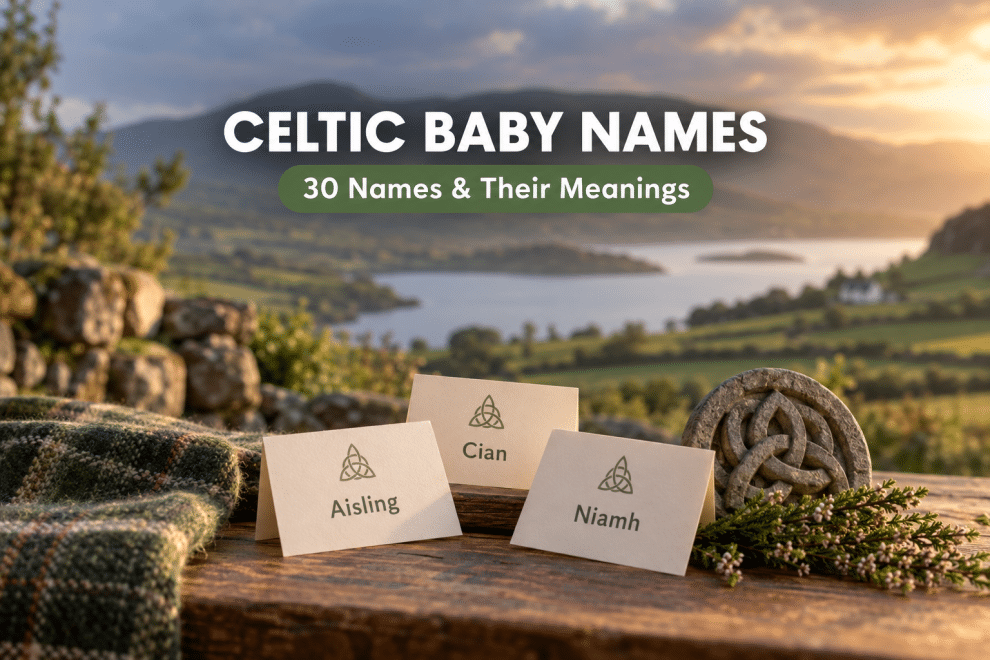
I gathered 30 Celtic baby names from our live directory and verified every name page before including it, because a name guide should never send you to a dead end. These are real published pages, not a list copied from a random corner of the internet. A few carry the roll of legend — Arthur, Tristan, Sabrina — while others began as plain, grounded words for the land itself: a river, a hill, a rock. One gentle note before the list: Celtic names have crossed through Irish, Welsh, Breton, and English hands for well over a thousand years, so many have more than one thread. I point those out rather than flattening them, and I keep the sourced meaning separate from my own fondness for a name.
Celtic Baby Girl Names
Celtic baby girl names often carry a quiet poetry — rivers, the sea, light, and old words for noble and bright. Many reach back to Irish, Scottish Gaelic, and Welsh roots, softened over centuries into names that feel both grounded and dreamy. Others arrive through legend and literature, worn by queens, saints, and Shakespeare’s heroines. Together they make a list of Celtic baby girl names that feel gentle and strong at once.

Sabrina (sah-BREE-nah) — The Latinized form of the old Celtic name of the River Severn in Britain; the precise meaning is uncertain, and legend ties it to a drowned princess. Sabrina is published in our directory with its own pronunciation and meaning page. Sabrina is one of the loveliest Celtic baby girl names for exactly this reason — it names a real river and carries a whisper of myth, romantic without being fussy.
Alana (ah-LAH-nuh) — Often read as harmony or precious; the feminine form of Alan, from Breton and Celtic elements, with threads reaching toward other languages too. Alana is published in our directory with its own pronunciation and meaning page. Alana is sunny and easy to love, a three-beat name that feels warm in any accent, and I like that its oldest roots lean toward harmony.
Muriel (MYOOR-ee-ul) — From the Old Irish and Scottish Gaelic Muirgeal, from muir (sea) and geal (bright, shining), meaning sea-bright or shining sea. Muriel is published in our directory with its own pronunciation and meaning page. Muriel is a vintage gem among Celtic baby names, and that meaning — shining sea — is pure Celtic poetry hiding inside an old family favorite.
Meryl (MER-əl) — A form of Muriel and Meriel, from the same Gaelic Muirgheal, carrying the bright-sea meaning in a trimmer shape. Meryl is published in our directory with its own pronunciation and meaning page. Meryl is crisp and modern-sounding while quietly holding the same shining-sea root as Muriel, which makes it feel like a secret for families who love a name with layers.
Imogen (IM-oh-jen) — Possibly from a Celtic word for maiden or girl, or from Latin imago (image); the name may also have begun as a printer’s misreading of Innogen in Shakespeare. Imogen is published in our directory with its own pronunciation and meaning page. Imogen is bright and literary, and I love telling its tangled origin story honestly — a name that may owe its very spelling to a happy accident in print.
Imogene (IM-uh-jeen) — A spelling variant of Imogen, usually read as maiden or innocent. Imogene is published in our directory with its own pronunciation and meaning page. Imogene gives the same Celtic-rooted name a softer, more vintage American sound, and families often choose between Imogen and Imogene purely on the music they prefer.
Cordelia (kor-DEEL-ee-uh) — Possibly from Celtic or Latin roots tied to the heart, and often linked to the Welsh Creiddylad, read as jewel of the sea. Cordelia is published in our directory with its own pronunciation and meaning page. Cordelia is elegant and old-soul, carried by Shakespeare’s most loyal daughter, and its possible meaning — jewel of the sea — fits right in with the water-and-light pattern of Celtic baby girl names.
Arden (AR-den) — From a Celtic place name meaning high or great, tied to the Forest of Arden in Warwickshire; Shakespeare used it for his enchanted forest and it was his mother’s surname. Arden is published in our directory with its own pronunciation and meaning page. Arden is a fresh, nature-touched choice that works beautifully for a girl, carrying the hush of an old English forest and a meaning that simply means high and great.
Joyce (JOYSS) — From the Breton and Celtic personal name Iodoc, meaning lord, carried into English through Norman French and later folk-linked to the word joy. Joyce is published in our directory with its own pronunciation and meaning page. Joyce is a true vintage classic whose Celtic root most people never suspect, and I find it sweet that a name meaning lord came to feel like a name full of joy.
Maelynn (MAY-lin) — A modern compound joining Mae or Maël, a Breton and Welsh element meaning prince or chief, with the soft -lynn ending (Welsh for lake). Maelynn is published in our directory with its own pronunciation and meaning page. Maelynn is a gentle, contemporary name that still reaches back to a real Breton root, perfect for a family who wants something current with an old Celtic thread inside it.
Avalynn (AV-uh-lin) — A modern blend of Ava with the -lynn suffix (Welsh for lake), sometimes linked to Avalon, the Celtic isle of apples. Avalynn is published in our directory with its own pronunciation and meaning page. Avalynn is airy and lyrical, and I love that its possible tie to Avalon gives this very modern name a shimmer of old Celtic legend.
Brylee (BRY-lee) — A modern American name joining Brynn, from the Welsh bryn (hill), with the -lee ending, from Old English leah (meadow). Brylee is published in our directory with its own pronunciation and meaning page. Brylee is bright and playful, and I like pointing out the real Welsh hill tucked inside it — proof that even very new names can carry an ancient Celtic root.
Celtic Baby Boy Names
Celtic baby boy names often ring with strength and story — bears, noble and high, rivers, and the heroes of legend. Many come from Irish, Breton, and Welsh roots honored for centuries, while others reach us through the great Arthurian tales. Together they feel sturdy without being harsh, dignified Celtic baby boy names a boy can carry from the playground into adulthood.

Brian (BRY-un) — From the Old Celtic bri or brigh, meaning high, noble, or strong; made legendary by the Irish High King Brian Boru, who united Ireland against the Vikings. Brian is published in our directory with its own pronunciation and meaning page. Brian is a cornerstone of Celtic baby names — strong, familiar, and carrying a real High King behind it — the kind of name that sounds confident without ever trying too hard.
Bryan (BRY-un) — A variant spelling of Brian, from the same Old Celtic root meaning high, noble, or strong, also tied to Brian Boru. Bryan is published in our directory with its own pronunciation and meaning page. Bryan gives the classic exactly the same noble meaning with a slightly sleeker look, and families usually pick between Brian and Bryan on spelling alone.
Bryant (BRY-unt) — A surname form of Brian, from the Celtic root tied to Brigantia, meaning high, noble, or exalted. Bryant is published in our directory with its own pronunciation and meaning page. Bryant turns that noble Celtic root into a crisp, surname-style first name, dignified and a little distinctive while keeping Brian’s strong heart.
Arthur (AR-ther) — Possibly from the Celtic root artos (bear), suggesting bear-man or strong as a bear. Arthur is published in our directory with its own pronunciation and meaning page. Arthur is the great legend of Celtic baby boy names, worn by the once and future king, and I love that its oldest likely meaning is simply, wonderfully, bear.
Arturo (ar-TOO-roh) — The Spanish and Italian form of Arthur, carrying the same Celtic bear root, associated with the legendary King Arthur. Arturo is published in our directory with its own pronunciation and meaning page. Arturo keeps Arthur’s bear and his legend while rolling off the tongue with Mediterranean warmth, a beautiful bridge for families with blended heritage.
Art (ART) — A short form of Arthur with its Celtic bear readings, and also the Irish name Art, meaning bear, borne by high kings. Art is published in our directory with its own pronunciation and meaning page. Art is plainspoken and sturdy, and I find it charming that this little one-syllable name is both a clip of Arthur and a genuine old Irish name for a bear.
Artie (AR-tee) — A pet form of Arthur, tied to the Celtic art (bear) and the bear-man readings. Artie is published in our directory with its own pronunciation and meaning page. Artie is warm and friendly, the kind of nickname-turned-name that feels like a hug, while still carrying Arthur’s ancient bear root underneath.
Alan (AL-un) — A Breton and Celtic name of debated meaning; proposed roots include little rock and harmony. Alan is published in our directory with its own pronunciation and meaning page. Alan is a quiet classic among Celtic baby names, and I like being honest that even its meaning is debated — little rock or harmony, both of them lovely ideas to hand a son.
Allan (AL-un) — A spelling of Alan, from the Breton and Celtic root, read as little rock or harmony. Allan is published in our directory with its own pronunciation and meaning page. Allan is the same steady name with a doubled-l look that many families prefer, carrying the same debated-but-beautiful Celtic roots as Alan.
Allyn (AL-in) — A spelling of Allen and Alan, from the Celtic, variously read as handsome, little rock, or harmony. Allyn is published in our directory with its own pronunciation and meaning page. Allyn is the most distinctive spelling of this old Breton name, soft and a touch unexpected, and it layers its possible meanings rather than forcing just one.
Tristan (TRIS-tun) — From Celtic roots meaning tumult or noise, carried through the medieval romance of Tristan and Iseult, sometimes reshaped toward the Latin for sad. Tristan is published in our directory with its own pronunciation and meaning page. Tristan is romantic and knightly, one of the most story-rich Celtic baby names, and I note its bittersweet thread honestly — a hero’s name with a wistful echo inside it.
Devon (DEV-un) — From the Celtic tribe the Dumnonii, often read as deep valley dwellers, and the English county Devon. Devon is published in our directory with its own pronunciation and meaning page. Devon is easygoing and nature-touched, naming a real green corner of Celtic Britain, and it wears equally well on a boy today as a first name or a family surname.
Trent (TRENT) — Often tied to the River Trent in England, with readings such as the trespasser or the flooding river. Trent is published in our directory with its own pronunciation and meaning page. Trent is short, strong, and modern, and I like that it continues the river thread running through so many Celtic baby names — a single syllable with a whole waterway behind it.
Cedric (SED-rik) — Likely coined by Sir Walter Scott for Ivanhoe, inspired by the older Celtic name Cerdic. Cedric is published in our directory with its own pronunciation and meaning page. Cedric has a gallant, old-world ring, and I find its history fascinating — a name a novelist shaped from a genuine early Celtic root and then handed to the world.
Melvin (MEL-vin) — Likely from an old Celtic or Gaelic personal name, with proposed elements for council and friend; other threads reach toward Malvin and Melville. Melvin is published in our directory with its own pronunciation and meaning page. Melvin is a warm vintage name quietly due for a comeback, and I keep its tangled origin honest rather than tidy — most likely a gentle old Celtic blend of council and friend.
Avon (AY-vən) — From the Celtic and Welsh afon, meaning a river; the root behind several English rivers, including Shakespeare’s Avon. Avon is published in our directory with its own pronunciation and meaning page. Avon is simple and flowing in the best sense, naming a river in the plainest Celtic way, and it carries a gentle literary shimmer from Stratford-upon-Avon.
Aven (AY-ven) — From the Celtic abona (river, water), the same root that names the River Avon; also sometimes a short form of Avon. Aven is published in our directory with its own pronunciation and meaning page. Aven is a fresher, trimmer take on that river root, soft and modern, perfect for a family who loves a nature name that most people have not heard yet.
London (LUN-dun) — Possibly from the Celtic Londinium, the Roman name for London, of uncertain meaning — perhaps wild place or forest river. London is published in our directory with its own pronunciation and meaning page. London is a bold, contemporary place-name whose roots may be genuinely Celtic, and I like noting that even this very modern choice may trace back to an old British word for a wild or wooded place.
How to Choose Celtic Baby Names with Care
The first question I would ask about any of these Celtic baby names is not whether the name is trending. It is whether you understand the story you are carrying, and whether you are comfortable that the story is sometimes uncertain. Celtic names and meanings are often genuinely debated — the languages are ancient, the records are thin, and honest scholars disagree. I think that is part of their beauty. A name like Alan may mean little rock or harmony. A name like Sabrina names a river and a legend at once. You are not choosing a tidy label; you are choosing a thread that runs back further than almost any name on a modern list.
Say the name out loud with the pronunciation from its More4Kids page. Then say it with your last name. Then imagine explaining it to a curious child someday. That explanation does not have to be academic; it just needs to be honest. “Your name means strong as a bear.” “Your name means the shining sea.” “Your name comes from a river.” Those small stories tend to stick, and children carry them proudly. It is also worth remembering that Celtic names traveled through Irish, Welsh, Breton, and English mouths, so a name like Tristan or Imogen can carry slightly different tellings depending on which branch of the story you follow.
For background on the Celtic peoples themselves, I like starting with careful, educational sources such as Encyclopaedia Britannica’s overview of the Celts and Britannica’s introduction to the Celtic languages. They are not baby-name lists, but they help place these names inside a real history and culture rather than treating them as a passing style.
Celtic Baby Names and Meanings: A Few Patterns to Notice
A few patterns show up again and again in Celtic names and meanings, and noticing them makes the whole list easier to love. These Celtic baby names are not a random grab-bag; they share real roots. First, water runs through everything. Sabrina, Avon, Aven, and Trent all began as rivers, and Muriel and Meryl mean the shining sea. Once you hear that thread, you start to notice how often these names point toward moving water — which makes sense for peoples who lived among Britain and Ireland’s rivers and coasts.
Second, strength and nobility sit at the heart of many Celtic baby boy names. Brian, Bryan, and Bryant all mean high, noble, or strong, while Arthur, Arturo, Art, and Artie carry the old root for bear — a bear-man, strong and brave. There is something grounding about handing a son a name that simply means strong, or noble, or bear.
Third, legend and literature keep these names alive. Tristan rides straight out of medieval romance, Arthur is the once and future king, Cordelia and Arden come from Shakespeare, and Cedric was shaped by a novelist from a genuine Celtic root. That is part of why so many Celtic baby names feel both ancient and familiar — we have been telling their stories for a very long time.
Frequently Asked Questions
What are popular Celtic baby names?
Popular Celtic baby names in our directory include Brian, Arthur, Tristan, Devon, and Alan for boys, and Sabrina, Alana, Muriel, Imogen, and Cordelia for girls. Some, like Brian and Arthur, are beloved classics with real kings and legends behind them, while others, like Maelynn and Avalynn, feel especially fresh and modern while still carrying an old Celtic root.
What do Celtic baby names usually mean?
Celtic names and meanings often center on the natural world, strength, and legend. Many of these Celtic baby names began as plain, grounded words — rivers like Avon and Trent, the shining sea in Muriel, a bear in Arthur, a hill in Brylee. Others mean high, noble, or strong, like Brian and Bryant. Because the Celtic languages are so old, a good number of these meanings are genuinely debated, and a careful guide should say so rather than pretend every name is tidy.
Are Celtic and Irish baby names the same thing?
Not exactly. Irish names are Celtic, but Celtic is the larger family that also includes Welsh, Scottish Gaelic, Breton, and the older Britons and Gauls. So a name like Brian is Irish-Celtic, while Avon and Imogen lean Welsh or British, and Alan and Joyce come through Breton roots. Think of Celtic as the big family tree and Irish as one strong branch of it.
Where can I find more Celtic baby names?
You can browse the full More4Kids Celtic baby names origin page for the larger list, then open each name page for meaning, pronunciation, and popularity details. This article highlights 30 verified names, but the directory includes many more.
A Warm Send-Off
Celtic baby names reward careful listening. Some arrive wrapped in legend — Arthur, Tristan, Sabrina. Some are sturdy and plain in the best way — Brian for strong, Art for a bear, Avon for a river. Some sound like something whispered across old green hills — Muriel for the shining sea, Arden for high and great, Imogen for a maiden. The best of these Celtic baby names for your family may not be the rarest or the trendiest. It may be the name whose story you can imagine telling your child with a full heart, even when that story ends with an honest “and some say it means something a little different.”
If you are choosing from heritage, I hope these Celtic baby names help you feel the thread between generations, legend, and the sound of old Irish, Welsh, and Breton tongues. If you are simply drawn to their music, I hope they invite respect for the peoples who carried them across more than a thousand years of rivers, hills, and stories. Whether you lean toward the classic Celtic baby names like Brian and Arthur or the fresh, modern Celtic baby names like Maelynn and Aven, take your time. A meaningful name should feel less like a label and more like a small inheritance.
Related Articles

Elena Marsh
Elena Marsh is a writer, historian, and lover of names and where they come from. A mom of two, she went down the rabbit hole of name meanings and the cultures and stories behind them, and now writes warm, parent-to-parent guides to baby names from around the world. She researches and sources every meaning, and writes as a curious fellow parent rather than a credentialed linguist.

Add Comment