














By Elena Marsh
The first time I understood how far a Latin name can travel, I was helping my daughter with a homework page on ancient Rome. She stopped, tapped a name in the margin — Victoria — and said, “That’s my friend’s name.” She had no idea her friend was carrying a two-thousand-year-old word for victory to third-grade recess. That is the quiet magic of Latin baby names. They started as the language of an empire, and they never really stopped moving — they slipped into churches and courtrooms, into English and Spanish and Italian, into the name tag on a lunchbox down the street.

Latin baby names are the deep roots under so much of what we name our children. When a name means “light,” “grace,” “victory,” or “beloved,” there is a very good chance the meaning was first written down in Latin. As a mom who loves the story tucked inside a name, I find Latin especially rewarding, because the meanings are usually clear — the Romans were wonderfully direct. Amanda literally means “she who must be loved.” Gloria is simply “glory.” Every meaning below comes from our own name records rather than from guesswork, and where a name traveled through Greek or Hebrew before Latin carried it to us, I have said so, because that journey is part of the beauty.
I’ve gathered 34 Latin baby names below — girls first, then boys — using published names from our own directory, so every link opens to a real name page with more detail. The meanings here come from those name records, and the pronunciations are written the simple, say-it-out-loud way. You can also browse the full Latin origin page or start wider with our main baby names directory if you are still gathering possibilities.
Latin Baby Girl Names
Latin baby girl names have a way of sounding both graceful and grounded. So many of them carry gentle, hopeful meanings — grace, victory, glory, the olive branch of peace — worn in soft, flowing sounds. Some of these Latin baby names are among the most-loved choices in the country right now; others have a timeless, classic warmth that has never faded. What strikes me every time I read through them is how effortlessly they cross borders: a Latin baby girl name feels equally at home in Rome, in Mexico City, and in a kindergarten class down the road. Nearly all of them are easy to say and lovely to grow into.
Isabella (iz-uh-BEL-uh) — A Latin form of Elisabeth, carrying the meaning “devoted to God” or “my God is an oath.” Isabella is romantic, regal, and endlessly popular. It sounds like a name made for a storybook and a real little girl at once.
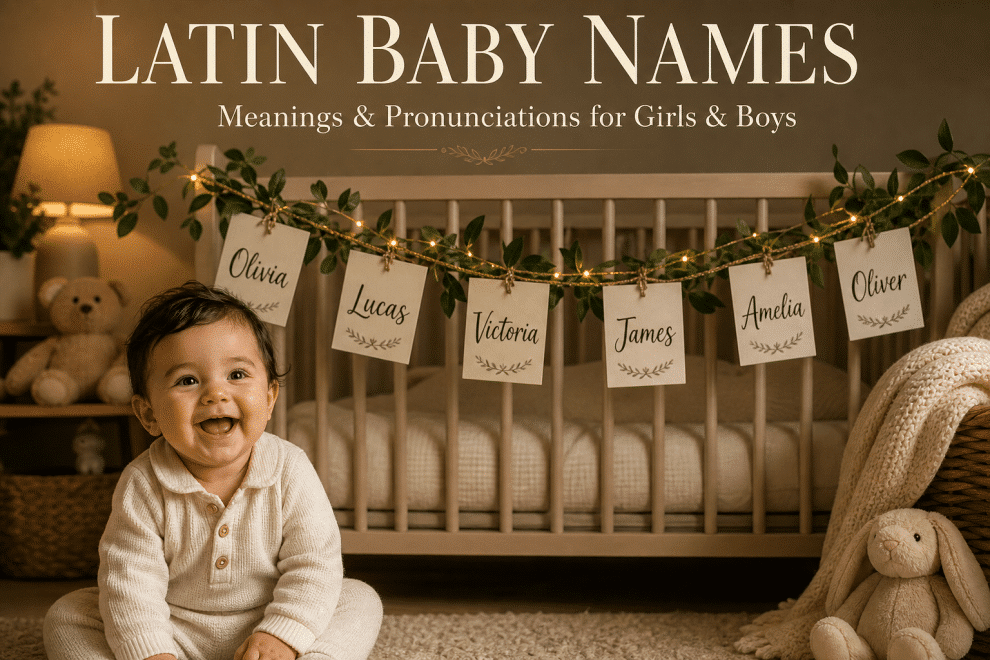
Olivia (oh-LIV-ee-uh) — From the Latin for the olive tree, a lasting symbol of peace. Olivia is soft, elegant, and beloved by parents all over the world. It carries a green, gentle meaning right in its sound.
Ava (A-vuh) — A short, luminous name possibly from the Latin avis, “bird,” and long read as “life” or “living one.” Ava is airy and modern while feeling classic. It is simple, pretty, and full of life.
Amelia (uh-MEE-lee-uh) — A name meaning “work,” “industrious,” or “striving,” carried through Latin roots into English. Amelia pairs a hardworking meaning with a delicate, melodic sound. It feels both spirited and sweet.
Victoria (vik-TOR-ee-uh) — Directly from the Latin victoria, “victory.” Victoria is triumphant and stately, with a warmth that keeps it from feeling too grand. It is a name that quietly stands tall.
Grace (GRAYS) — From the Latin thread of grace, elegance, and divine favor. Grace is short, serene, and timeless. It says something lovely about a child in a single soft syllable.
Emily (EM-ih-lee) — From the Roman family name Aemilius, read as “rival” or “one who strives.” Emily is gentle and familiar, a longtime favorite for good reason. It sounds tender and quietly determined.
Anna (AN-uh) — The Latin form of the Hebrew Hannah, meaning “grace” or “favor.” Anna is clean, classic, and warm in nearly every language. It is the kind of name that never goes out of style.
Catherine (KATH-er-in) — From the Greek Aikaterine, later read as “pure”; the Latin form Catharina spread it through medieval Christendom. Catherine is dignified and enduring, with a soft heart under its poise. It feels both royal and reachable.
Amanda (uh-MAN-duh) — One of the most tender meanings on this list: from the Latin gerundive of amare, “she who must be loved,” “worthy of love.” Amanda says out loud exactly how a parent feels. It is warm, graceful, and full of affection.
Amy (AY-mee) — From the Old French Amée and ultimately the Latin amare, “to love,” read simply as “beloved.” Amy is sweet, bright, and easy to love right back. It is short and sunny with a big-hearted meaning.
Angela (AN-jeh-luh) — The feminine of Angelus, from the Latin angelus and Greek angelos, “messenger.” Angela is soft and celestial, with a gentle spiritual thread. It feels kind and quietly radiant.
Laura (LAW-ruh) — From the Latin laurus, the laurel tree, an ancient symbol of victory and honor. Laura is smooth, classic, and softly triumphant. It carries a wreath of laurel in a single lovely word.
Gloria (GLOR-ee-uh) — Straight from the Latin gloria, “glory,” “fame,” or “renown.” Gloria is vintage, warm, and a little bit joyful, echoing the Gloria sung in Christian tradition. It sounds like a name meant to be celebrated.
Patricia (pah-TRISH-ah) — From the Latin for “noble,” “patrician,” “of noble birth.” Patricia is stately and classic, with friendly nicknames tucked inside. It carries an air of quiet dignity.
Margaret (MAR-guh-ret) — Meaning “pearl,” carried through Greek and Latin (Margarita) into English. Margaret is timeless and gently regal, a treasure of a name. It has stood beautifully for centuries.
April (AY-pril) — From the Latin Aprilis, the fourth month, possibly from aperire, “to open,” for the opening buds of spring. April is fresh, bright, and full of new beginnings. It sounds like the season it is named for.
Virginia (ver-JIN-ee-uh) — From the Roman family name Verginius, likely tied to the Latin virgo, “maiden.” Virginia is graceful and old-fashioned in the loveliest way. It feels gentle, classic, and warm.
Christina (kris-TEE-nuh) — The Latin feminine of Christianus, “follower of Christ.” Christina is elegant and enduring, with a soft spiritual meaning. It reads as poised and kind.
Julie (JOO-lee) — A French feminine form of Julius, from the Roman family name Iulius. Julie is cheerful, breezy, and easy to love. It has a friendly, timeless charm.
If one of these catches your eye, it may help to browse more baby girl names beside it and see which sounds keep pulling you back.

Latin Baby Boy Names
Latin baby boy names lean into strength, virtue, and history. Many carry meanings you would be proud to hand a son — righteous, priceless, light, noble — and they have been worn by saints, scholars, and emperors for two thousand years. A few of these Latin baby names reached us through Greek or Hebrew before Latin carried them forward, and I have named that path where it runs. What I love about a good Latin baby boy name is how much weight it carries so lightly: the meaning is often grand, but the sound stays warm and completely wearable for a real little boy. Together they range from classic and grand to warm and everyday.
James (JAYMZ) — From the Latin Iacomus, a form of Jacob, read as “supplanter,” “one who takes the place of another.” James is a rock-solid classic that has never once fallen out of favor. It is strong, handsome, and endlessly wearable.
Lucas (LOO-kus) — From the Latin lux, “light,” read as “bringer of light.” Lucas is warm, current, and easy on the ear. It carries a bright, hopeful meaning that suits any child.
Oliver (OL-ih-ver) — Tied to the olive tree, and so to peace and fruitfulness. Oliver is friendly, spirited, and hugely loved right now. It sounds both classic and playful.
Anthony (AN-thuh-nee) — From the Roman family name Antonius, long read as “priceless” or “of inestimable worth.” Anthony is strong, familiar, and quietly noble. It has a timeless, dependable warmth.
Peter (PEE-ter) — From the Greek Petros and Latin Petrus, “rock” or “stone.” Peter is steady, honest, and classic to the core. It sounds like a name you can lean on.
Patrick (PAT-rik) — From the Latin Patricius, “nobleman,” “patrician.” Patrick is warm and dignified, with an easygoing charm. It carries a noble meaning without any fuss.
Christian (KRIS-chun) — From the Latin Christianus, “follower of Christ.” Christian is strong and gentle at once, with a clear, heartfelt meaning. It feels sincere and enduring.
Angel (AYN-jul) — From the Greek angelos, “messenger,” carried through the Latin angelus. Angel is tender and luminous, beloved across many cultures. It wears its meaning openly and beautifully.
Mark (MARK) — From the Latin Marcus, likely “of Mars,” dedicated to the god Mars. Mark is clean, strong, and refreshingly simple. It has a grounded, dependable sound.
Paul (PAWL) — From the Latin Paulus, “small” or “humble.” Paul is a quiet classic with a gentle, grounded meaning. It is short, sturdy, and timeless.
Austin (AW-stin) — A contracted form of Augustine, from the Latin augustus, “great,” “venerable,” “dignified.” Austin is warm and modern while carrying an old, stately meaning. It sounds friendly and confident.
Justin (JUS-tin) — From the Latin Justinus, from iustus, “just,” “righteous,” “fair.” Justin is smooth, familiar, and quietly principled. It has a bright, easy sound and a good-hearted meaning.
Stephen (STEE-ven) — From the Greek Stephanos and Latin Stephanus, “crown” or “garland,” the ancient symbol of victory. Stephen is classic and gentle, with a small note of honor in its roots. It feels dignified and kind.
Dennis (DEN-is) — From the Medieval Latin Dionysius, read as “follower of Dionysus.” Dennis is friendly and familiar, a warm mid-century classic. It has an approachable, everyday charm.
If a name here feels close but not quite right, browsing more baby boy names nearby can help you find the sound you’re really after.

Where Latin Baby Names Come From
Latin baby names come from the language of ancient Rome — and from everywhere Rome’s language traveled after the empire itself was gone. Latin lived on in the church, in law, in science, and in the Romance languages it grew into: Italian, Spanish, French, Portuguese, Romanian. That is why a Latin name can feel at home in so many countries at once. Olivia is as natural in Rome as in Ohio; Lucas means “light” whether it is spoken in São Paulo or Seattle.
What I love most is how clear the meanings are. Roman naming often said plainly what a family hoped for a child — Victoria, victory; Amanda, one who must be loved; Justin, the just and fair. That directness is a big part of why Latin baby names still feel so reassuring to give: you rarely have to wonder what you are wishing on a child. Where a name reached Latin by way of Greek (Peter, Catherine, Stephen) or Hebrew (Anna), I have traced that path, because a name’s journey is part of its meaning. And because Latin seeded so many living languages, plenty of the Latin baby names here double as Spanish, Italian, or French favorites too — a lovely thing if your family carries more than one heritage. If you enjoy the history behind the names, Behind the Name is a helpful cross-check for Latin and Late Roman roots, and the U.S. Social Security Administration’s popular names data is the definitive record of how many of these names — Olivia, Isabella, Lucas, James — still top the charts today.
Frequently Asked Questions
What are popular Latin baby names?
Popular Latin baby names include Olivia, Isabella, Ava, and Amelia for girls, and Lucas, Oliver, James, and Anthony for boys. Many sit at the very top of today’s charts, which shows just how naturally Latin roots still fit modern children.
What do Latin baby names mean?
Latin baby names tend to have clear, hopeful meanings drawn straight from the Latin language — Victoria means “victory,” Lucas means “light,” Amanda means “she who must be loved,” and Gloria means “glory.” The Romans were wonderfully direct, so the meanings are usually easy to love.
Are Latin baby names good for girls and boys?
Yes. Latin gives us some of the most beloved girl names (Olivia, Isabella, Grace, Amelia) and boy names (James, Lucas, Oliver, Anthony) in use today. Their soft sounds and strong, virtuous meanings work beautifully for either.
What are classic Latin baby boy names?
Classic Latin baby boy names include James, Anthony, Paul, Mark, and Peter, along with warm modern favorites like Lucas and Oliver. Many carry noble or virtuous meanings — “righteous,” “priceless,” “light” — that have kept them in use for centuries.
Where do Latin baby name meanings come from?
The meanings here come from our own directory’s name records, which trace each name to its Latin root — and, where a name passed through Greek or Hebrew first, to that earlier source as well. Where a meaning is debated, it is more honest to note the uncertainty than to invent a tidy answer.
A Warm Send-Off
Latin baby names reward saying out loud. Try one on a toddler, a teenager, and a grown person signing an email someday — most of these have already proven they can carry a whole life, because they have been doing it for two thousand years. Read the meaning twice, too. There is something steadying about handing a child a name that means “light,” “grace,” or “victory.” And if you are choosing across a blended heritage, remember that many of these Latin baby names live comfortably in Spanish, Italian, and French too, so a single choice can honor more than one side of a family at once. That kind of quiet flexibility is a gift you may not appreciate until years down the road, when the name has to work in a dozen different rooms.
Whether you are drawn to the sweetness of Amanda, the peace inside Olivia, the quiet strength of James, or the bright hope of Lucas, Latin baby names offer something rare: meanings that are clear, sounds that are soft, and a history deep enough to hold anything your child grows into. Take your time with them. A good name can wait for you to hear it properly.
Related Articles

Elena Marsh
Elena Marsh is a writer, historian, and lover of names and where they come from. A mom of two, she went down the rabbit hole of name meanings and the cultures and stories behind them, and now writes warm, parent-to-parent guides to baby names from around the world. She researches and sources every meaning, and writes as a curious fellow parent rather than a credentialed linguist.




Add Comment